IM15-1
LABORATORY MANUAL AND WORKBOOK FOR BIOLOGICAL
ANTHROPOLOGY INSTRUCTOR’S MANUAL
Lab 15: The Australopiths and Early Members of the Genus Homo
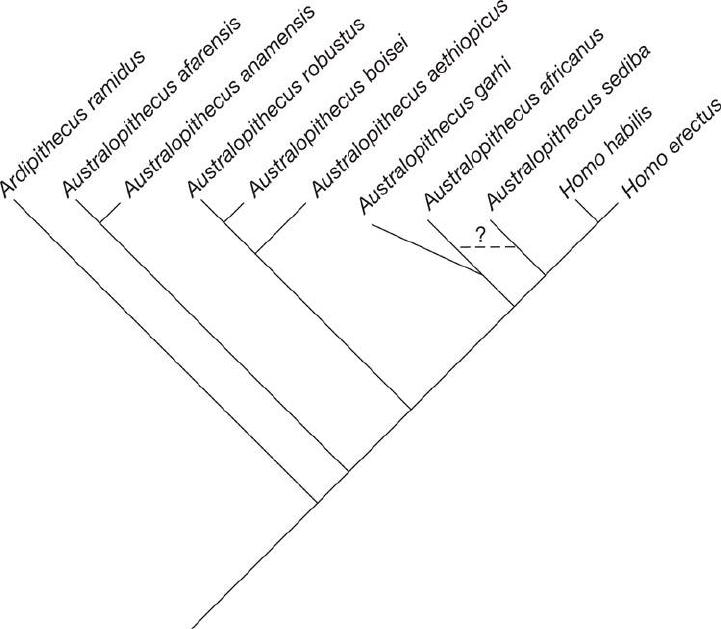
Cladogram of Australopiths and the Homo Genus. This cladogram shows the possible
relationships among the species discussed in Lab 15. It is provided as a synthesis of the material
presented in this lab. You may share it with your students, or you may use an alternate
interpretation of your choosing.
ANSWERS TO LAB 15 CONCEPT REVIEW QUESTIONS
australopith, unusually tall, or alive around 2 mya).
6. Descriptions of the two tool forms associated with the Oldowan tool industry:
7. C. Australopithecus garhi may be among the first stone tool users, based on recent

IM15-3
10. Features that decrease in size between the australopiths and early members of the Homo
GUIDE & ANSWERS TO LAB 15 EXERCISES
Exercise 1: Australopith Dentition (15 to 20 minutes)
For this exercise, you could use your own materials to supplement or replace the images
provided in the Image Library of: (A) Au. boisei mandibular dentition (KNM-ER-729), (B)
Homo sapiens mandibular dentition, and (C) Au. africanus (STS-52) mandibular dentition.
Additional supplies needed: students will need access to sliding calipers (or rulers with notations
in millimeters) as well as calculators.
[Note: Methods and calculations in this exercise are modeled after McHenry (1984).
Following this model, P3 is excluded from measurement because it does not function as part of
the chewing apparatus in same way as P4, and M3 is excluded from measurement because the
size is highly variable in humans, making it hard to draw comparisons.]
[Note: Exact numbers in the chart will vary depending on the specimens used and the
accuracy of the measuring tools. If using casts and calipers, the general pattern is as follows for
total surface area, after McHenry (1984): Au. boisei (756 mm²), human (334 mm²), Au. africanus
(516 mm²)].
Use the casts provided by your instructor (or the photos in the Lab 15 Exercise Image Library on
p. 448) to calculate information for the mystery fossil specimens.
STEP 1: Measure the length and width of each tooth in millimeters.
STEP 2: Calculate the surface area for each tooth.
STEP 3: Calculate the surface area for all three teeth.
STEP 4: Interpret the data. Use your completed chart to answer the following questions.
1. Which of the mystery specimens is a human? What evidence indicates this?
2. Which of the mystery specimens is a gracile australopith? What evidence indicates
this?
3. Which of the mystery specimens is a robust australopith? What evidence indicates
this?
Exercise 2: Australopith Variation (5 to 10 minutes)
For this exercise, you could use your own materials to supplement or replace the images
provided in the Image Library of (A) Au. afarensis and (B) Au. boisei crania.
Refer to the casts provided by your instructor (or the photos in the Lab 15 Exercise Image
Library on p. 449) to answer the following questions.
1. Which of these mystery australopiths is a later, more robust form?
IM15-5
2. Describe at least two facial or cranial traits you used to make this determination. Be
sure to describe how each trait appears in the two fossils.
Exercise 3: Australopith Bipedalism (5 to 10 minutes)
For this exercise, you could use your own materials to supplement or replace the images
provided in the Image Library of (A) the Australopithecus afarensis partial skeleton known as
Lucy, (B) a reconstruction of the articulated Lucy remains, and (C) the complete articulated
human skeleton.
Review the casts provided by your instructor (or the photos in the Lab 15 Exercise Image Library
on p. 450) and answer the following questions.
1. Examine the Lucy (Australopithecus afarensis) skeleton. Describe at least two
postcranial (below the head) traits that indicate that Au. afarensis was adapted for
bipedalism.
2. Compare the Lucy (Au. afarensis) skeleton with the human (Homo sapiens) skeleton.
Describe at least two postcranial traits that differ between these species.
IM15-6
3. What do your answers suggest about the kind of bipedalism practiced by Au.
afarensis?
Exercise 4: Australopithecus sediba (10 minutes)
For this exercise, you could use your own materials to supplement or replace the images
provided in the Image Library of Australopithecus sediba.
Review the casts provided by your instructor (or the photos in the Lab 15 Exercise Image Library
on p. 451) and answer the following questions.
1. Examine the Australopithecus sediba skeleton. Describe at least two traits that Au.
sediba shares with other australopiths (such as Au. africanus or Au. afarensis).
2. Describe at least two traits that Au. sediba shares with members of the Homo genus.
3. What do your answers suggest about the evolutionary relationship between these
species?
4. Au. sediba lived in southern Africa around 2 mya. When did the first members of the
Homo genus appear? And where?
5. Does your answer change your interpretation of the relationship between Au. sediba
and the members of the Homo genus? Why or why not?
Students should now recognize that Au. sediba may not be the direct ancestor for
Exercise 5: Australopiths versus the Genus Homo (5 to 10 minutes)
For this exercise, you could use your own materials to supplement or replace the images
provided in the Image Library of (A) Homo habilis and (B) an australopith (such as the Au.
boisei depicted).

IM15-8
Use the casts provided by your instructor (or the photos in the Lab 15 Exercise Image Library on
p. 452) to answer the following questions.
1. Describe at least two traits that differ between these fossils. (Be sure to describe how
each trait appears in the two fossils.)
2. Based on this information, which of these fossils is an australopith?
3. Based on this information, which of these fossils is a member of the Homo genus?
Exercise 6: The Early Members of the Genus Homo (5 to 10 minutes)
For this exercise, you could use your own materials to supplement or replace the images
provided in the Image Library of (A) KNM-ER 1470 (Homo rudolfensis) and (B) KNM-ER 1813
(Homo habilis).
Refer to the casts provided by your instructor (or the photos in the Lab 15 Exercise Image
Library on p. 453) to answer the following questions.
1. Describe at least two traits that differ between these fossils. (Be sure to describe how
each trait appears in the two fossils.)
IM15-9
2. Do you believe these differences are the result of sexual dimorphism or of different
adaptations? Why?
Exercise 7: Stone Tool Technology (5 minutes)
For this exercise, you could use your own materials to supplement or replace the image provided
in the Image Library of an Oldowan chopper.
Review the casts provided by your instructor (or the photos in the Lab 15 Exercise Image Library
on p. 454) and answer the following questions.
1. What type of tool is this?
2. Describe the features of this tool that led you to identify it as this tool type.
3. What tool technology does this tool belong to?
4. Name one fossil species that may have made this stone tool.
IM15–10
ANSWERS TO LAB 15 CRITICAL THINKING QUESTIONS
1. Biological anthropologists disagree about the best way to classify the robust species of
australopiths. One approach classifies the robust australopith forms in the Australopithecus
2. Interpretation of the Australopithecus sediba finds would likely differ depending on the study
material, and it shows the difficulties that paleoanthropologists face in interpreting
fragmentary fossils. Examining just the arm bones of Australopithecus sediba, one would
IM15–11
3. Regarding stone tools and early tool use, no, the earliest stone tools were probably not the first
use of tools by our extinct relatives. As discussed in Lab 11, many nonhuman primates make
and use tools. This is probably a behavioral potential found in most primates, including our
4. The fact that multiple species shared a habitat for over 1 million years without one species
outcompeting the other could be for several reasons. It seems increasingly likely from the
5. The femur angling inward (medially) puts additional strain on the joint and puts us at greater
risk of injury. This trait can be clearly traced back to the australopiths (if not earlier).
IM15–12
Although it carries risks, the benefits for improving bipedal movement outweigh the potential
6. A completed Australopith and Early Homo Chart is provided on the following pages. [Note:
7. Some elements of the answers may vary, but sample answers are provided here:
A. Eastern Africa has had the most early hominin discoveries so far, but southern Africa has
B. Many australopiths and the early Homo species engaged in stone tool production and use,
whereas the pre-australopiths are not yet known to have done so. This difference may be
C. Australopithecus africanus compared to Australopithecus robustus: both are found in
southern Africa, have small cranial capacities, did not make stone tools (that we know
IM15–13
of), and were habitual bipeds with associated mosaic postcrania. Distinguishing traits: Au.
africanus occurred earlier in time and had less-robust features (smaller back teeth,
D. Australopithecus africanus compared to Homo habilis: both were found in southern
Africa, had smaller cranial capacities than humans today, and had traits for bipedalism
(both were at least habitual bipeds, with Homo habilis perhaps more obligate).
Distinguishing traits: Au. africanus occurred earlier in time and had more-robust features
IM15–14
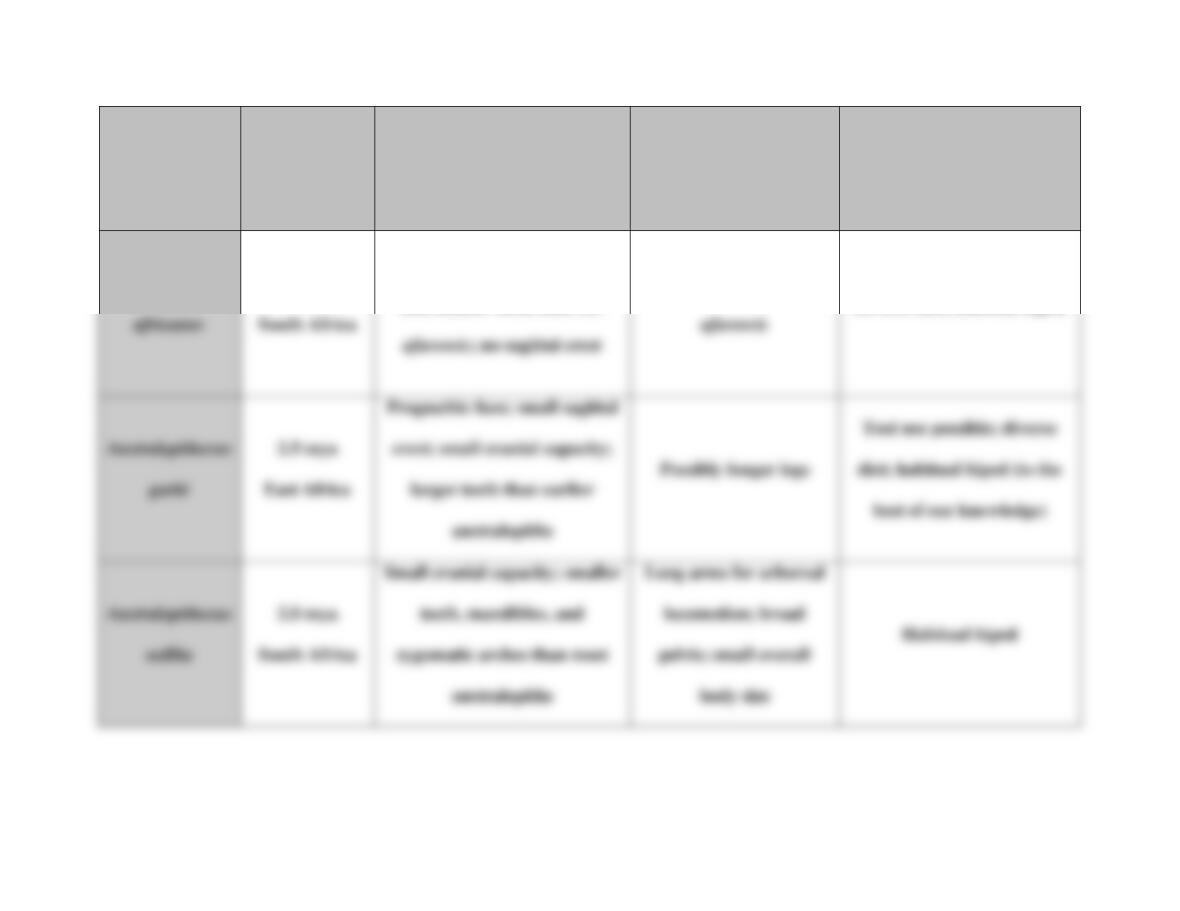
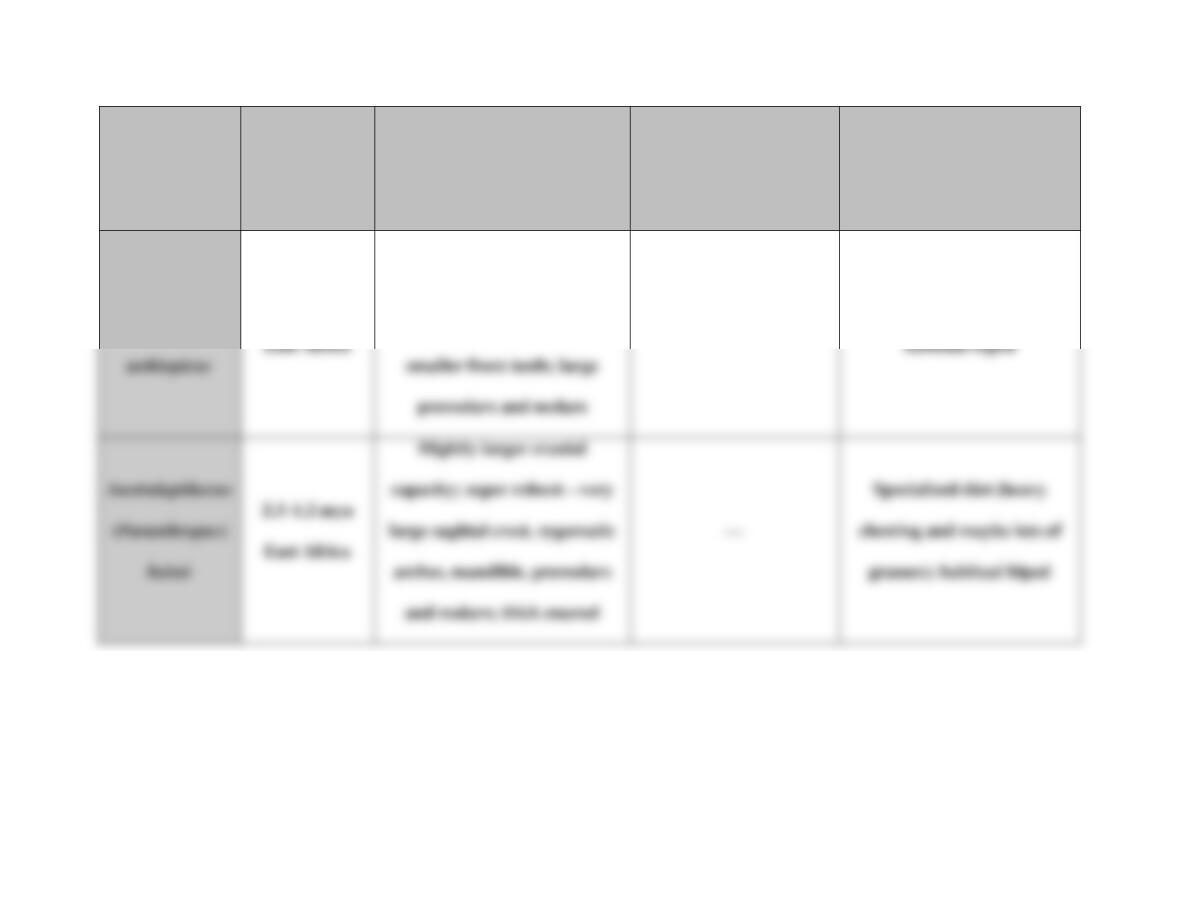
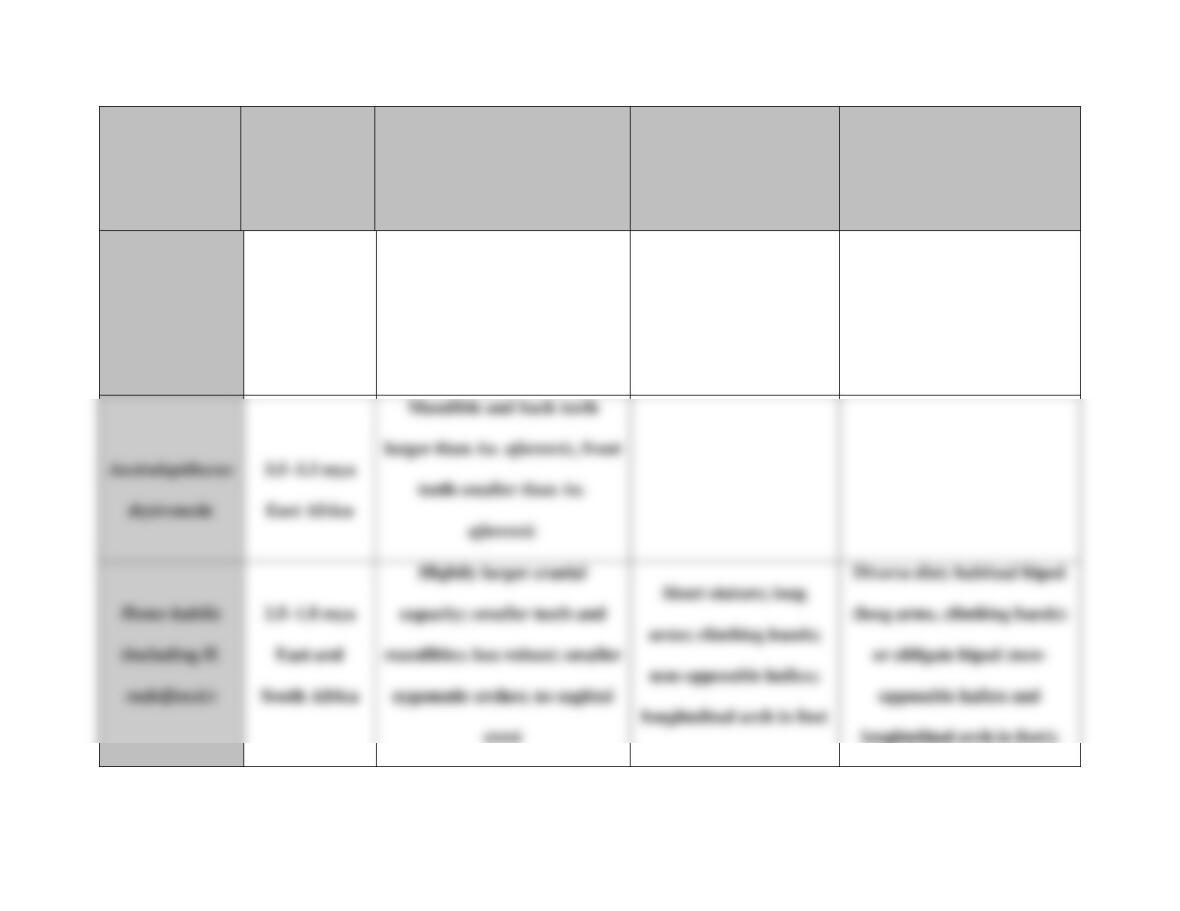
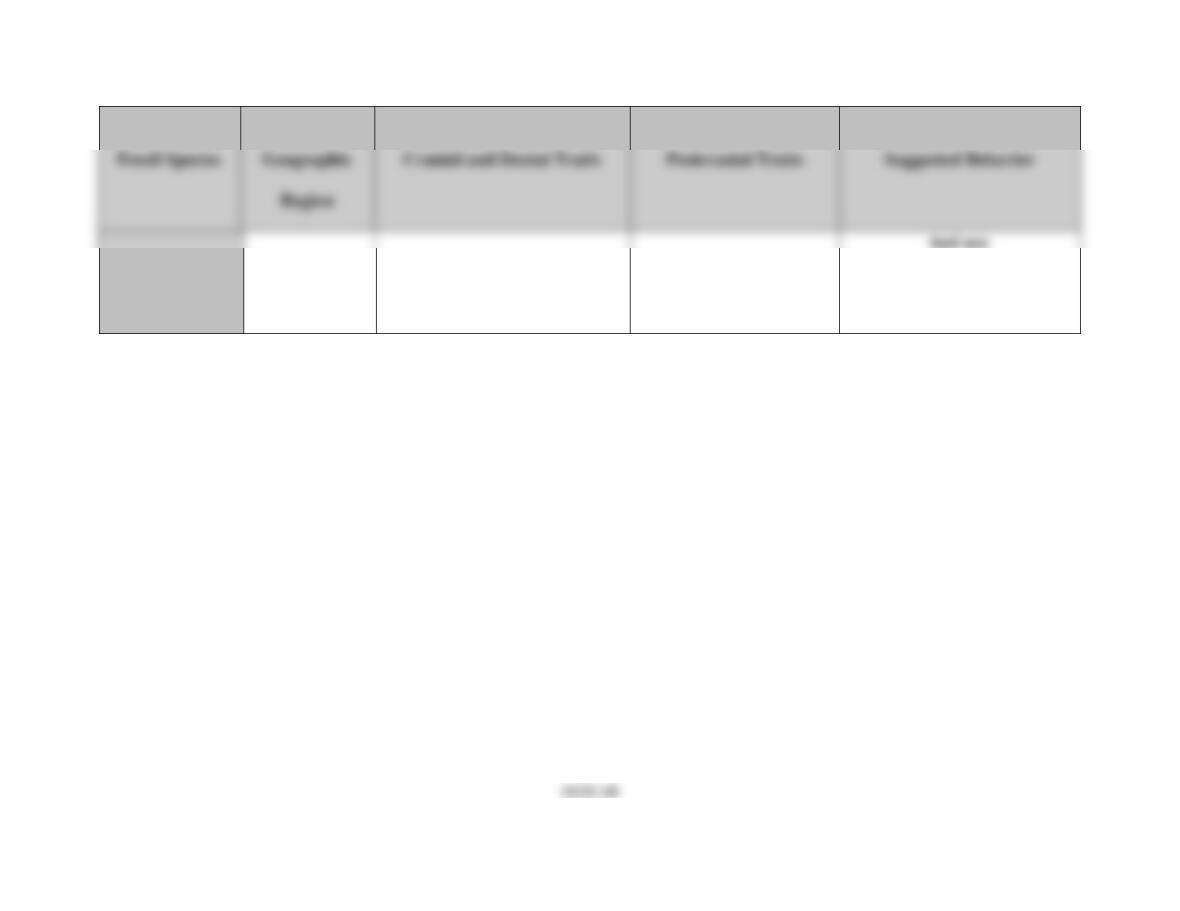
AUSTRALOPITH AND EARLY HOMO CHART
Fossil Species
Dates and
Geographic
Region
Cranial and Dental Traits
Postcranial Traits
Suggested Behavior
Large canines; parallel upper
Bipedal adaptations
long arms; curved
IM15–15
Fossil Species
Dates and
Geographic
Region
Cranial and Dental Traits
Postcranial Traits
Suggested Behavior
Australopithecus
3.0–2.0 mya
Slightly larger cranial capacity
and smaller teeth than Au.
Postcrania similar to Au.
Diverse diet; habitual biped
South Africa
larger teeth than earlier
IM15–16
Fossil Species
Dates and
Geographic
Region
Cranial and Dental Traits
Postcranial Traits
Suggested Behavior
Australopithecus
(Paranthropus)
2.5 mya
Small cranial capacity; large
sagittal crest; large zygomatic
arches; large mandible;
—
Heavy chewing adaptations;
Australopithecus
(Paranthropus)
arches, mandible, premolars
—
grasses); habitual biped
IM15–17
Fossil Species
Dates and
Geographic
Region
Cranial and Dental Traits
Postcranial Traits
Suggested Behavior
Australopithecus
(Paranthropus)
robustus
2.0–1.5 mya
South Africa
Slightly larger cranial
capacity; large sagittal crest,
zygomatic arches, mandible,
premolars, and molars
—
Heavy chewing adaptations;
habitual biped
Dates and