
IM16-1
LABORATORY MANUAL AND WORKBOOK FOR BIOLOGICAL
ANTHROPOLOGY INSTRUCTOR’S MANUAL
Lab 16: Later Members of the Genus Homo
ANSWERS TO LAB 16 CONCEPT REVIEW QUESTIONS

erectus, which they consider to be a separate species.
6. We have been able to recover ancient DNA from a few species, such as Neanderthals and
Denisovans, but not from all of the members of the Homo genus because some
7. D. Homo floresiensis is the fossil species that lived on a small Indonesian island around

GUIDE & ANSWERS TO LAB 16 EXERCISES
Exercise 1: Early versus Later Members of the Genus Homo (5 to 10 minutes)
For this exercise, you could use your own materials to supplement or replace the lab exercise
images provided of crania from (A) Homo erectus and (B) Homo habilis.
Review the mystery fossils provided by your instructor (or depicted in the Lab 16 Exercise
Image Library on p. 482) and answer the following questions.
1. Which of these mystery fossils is Homo habilis?
2. Which of these mystery fossils is Homo erectus?
3. Describe at least two traits you used to make these identifications. Be sure to describe
how each trait appears in the two fossils.

IM16-4
Exercise 2: The Evolution of Bipedalism (5 to 10 minutes)
For this exercise, you could use your own materials to supplement or replace the images
provided of fossil skeletons of Lucy (Australopithecus afarensis) and Nariokotome boy (Homo
erectus).
Use the Australopithecus afarensis and Homo erectus postcrania provided by your instructor (or
depicted in the Lab 16 Exercise Image Library on p. 483) to answer the following questions.
1. Describe at least two postcranial traits that differ between these two species. Be sure
to describe how each trait appears in the two fossils.
2. What do these differences suggest about the two species’ degrees of bipedalism?
Exercise 3: Homo erectus Variation (5 to 10 minutes)
For this exercise, you could use your own materials to supplement or replace the images
provided of fossil crania of (A) more recent, Asian Homo erectus and (B) earlier, African Homo
erectus.
Refer to the casts provided by your instructor (or the pictures in the Lab 16 Exercise Image
Library on p. 484) to answer the following questions.

1. Describe at least two traits that differ between these fossils. Be sure to describe how
each trait appears in each of the fossils.
Fossil A is generally more robust (larger brows, thicker bones, larger mandible)
2. Why might these differences exist? (Hint: Consider factors such as date,
environment, adaptation, and sexual dimorphism.)
3. Do you think these differences warrant the classification of these fossils as two
distinct species (Homo ergaster and Homo erectus)? Why or why not?

IM16-6
Exercise 4: Homo heidelbergensis (5 minutes)
For this exercise, you could use your own materials to supplement or replace the images
provided of fossil crania of Homo heidelbergensis and Homo erectus.
Refer to the Homo heidelbergensis and Homo erectus crania provided by your instructor (or
depicted in the Lab 16 Exercise Image Library on p. 485) to answer the following questions.
1. Describe at least one trait that these two species share in common.
2. Describe at least one trait that differs between the two species. Be sure to describe
how each trait appears in the two fossils.
Homo heidelbergensis has a larger cranial capacity, a less pronounced occipital
Exercise 5: Stone Tool Technology (5 to 10 minutes)
For this exercise, you could use your own materials to supplement or replace the images
provided of (A) an Acheulean handaxe and (B) an Upper Paleolithic blade.
Examine the mystery stone tools provided by your instructor (or depicted in the Lab 16 Exercise
Image Library on p. 486).
1. Which mystery tool is a handaxe?

2. Describe the features of this tool that led you to identify it as this tool type.
3. What tool technology does it belong to?
4. Name one fossil species that may have made this tool.
5. Which mystery tool is made from a Levallois flake?
6. Describe the features of this tool that led you to identify it as this tool type.
7. What tool technology does it belong to?
8. Name one fossil species that may have made this tool.
9. Which mystery tool is a blade?
10. Describe the features of this tool that led you to identify it as this tool type.
11. What tool technology does it belong to?
12. Name one fossil species that may have made this tool.

IM16-8
Exercise 6: Homo neanderthalensis (5 to 10 minutes)
For this exercise, you could use your own materials to supplement or replace the images
provided of fossil crania from (A) Homo sapiens and (B) Homo neanderthalensis.
Review the mystery fossils provided by your instructor (or depicted in the Lab 16 Exercise
Image Library on p. 486) and answer the following questions.
1. Which of these mystery fossils is Homo neanderthalensis?
2. Which of these mystery fossils is Homo sapiens?
3. Describe at least two traits you used to make these identifications. Be sure to describe
how each trait appears in the two fossils.
Exercise 7: Homo floresiensis (10 minutes)
For this exercise, you could use your own materials to supplement or replace the images
provided of fossil crania from (A) Homo sapiens, (B) Homo floresiensis, and (C) an
australopithecine, such as the Australopithecus africanus depicted.

IM16-9
Compare the mystery fossil crania provided by your instructor (or depicted in the Lab 16
Exercise Image Library on p. 487) and complete the chart below. Place an “X” in the appropriate
column to indicate which mystery fossils have the traits listed. [Note: A trait may be found in
more than one mystery fossil.]
Mystery Fossil A
Mystery Fossil B
Mystery Fossil C
Large Cranial
Capacity
X
Low Cranium
X
X
Presence of Chin
X
Large Mandible
X
1. Based on this information, which mystery fossil is Homo floresiensis?
2. Based on this information, which mystery fossil is Homo sapiens?
3. Based on this information, which mystery fossil is an australopith?

IM16–10
ANSWERS TO LAB 16 CRITICAL THINKING QUESTIONS
1. Neanderthals had physical and cultural traits adapted for their life in Ice Age Europe;
these traits might have led to their extinction. Physical adaptations included large nasal
openings to warm inhaled air and a stocky body type to conserve heat. Cultural
2. In general, tool form became more standardized over time while tool specialization
increased and tool production techniques became more sophisticated. Early Oldowan
tools were somewhat haphazard, while Acheulean handaxes were more uniform and

3. Of the explanations for the origin and spread of humans, the assimilation model is
probably the most accurate model because it is supported by the most lines of evidence.
The fossil record shows that human fossils first appeared in Africa, and they then
4. Homo neanderthalensis and Homo sapiens buried their dead. Although the details behind
this practice are elusive, it suggests complex thought and symbolic behavior. For

IM16–12
5. Most researchers believe that Homo floresiensis had a small cranial capacity and a small
body because of island (or endemic) dwarfism. On islands, where resources are limited,
6. Answers considering future research possibilities will vary. An example is given here.
Question: When did our ancestors first make clothing, and how was it made? Possible
7. Students are to list evolutionary trends in order from oldest to most recent by placing a
“1” next to the trend that occurred first (is the oldest) and numbering the remaining trends
in order to the most recent (“5”). For each trend, students should also note which fossil
species is first associated with the change.

IM16–13
8. A completed Later Homo Chart listing fossil species and their defining characteristics is
provided on the following pages.
9. Some elements of the answers may vary, but sample answers are provided here:
A. Later members of the Homo genus are often found in Africa, Asia, and Europe. This
B. Later Homo species expanded on the tool production and use found in earlier species.
They made tools that were more complicated, and they pursued more active hunting
(instead of scavenging). This changed their diets to include more meat—helping to

IM16–14
C. Homo erectus compared to Homo sapiens distinguishing traits: H. erectus occurred
earlier in time and had more robust features (larger brows, occipital torus, larger teeth
and facial features) and less symbolic behavior; H. sapiens occurred later (more
D. Homo neanderthalensis compared to Homo sapiens distinguishing traits: H.
neanderthalensis had more robust features (larger brow ridges, thick cranial bones,

IM16–15

IP 16-16
LATER Homo CHART
Fossil
Dates and
Geographic
Region
Cranial and Dental Traits
Postcranial Traits
Suggested Behavior
1.8 mya–400
kya (Europe)
Large brows, long and low
cranium, occipital torus,
600–130 kya
200–130 kya
Large brows, long and low
heavy incisor wear (in some),
Diverse diet (with hunted
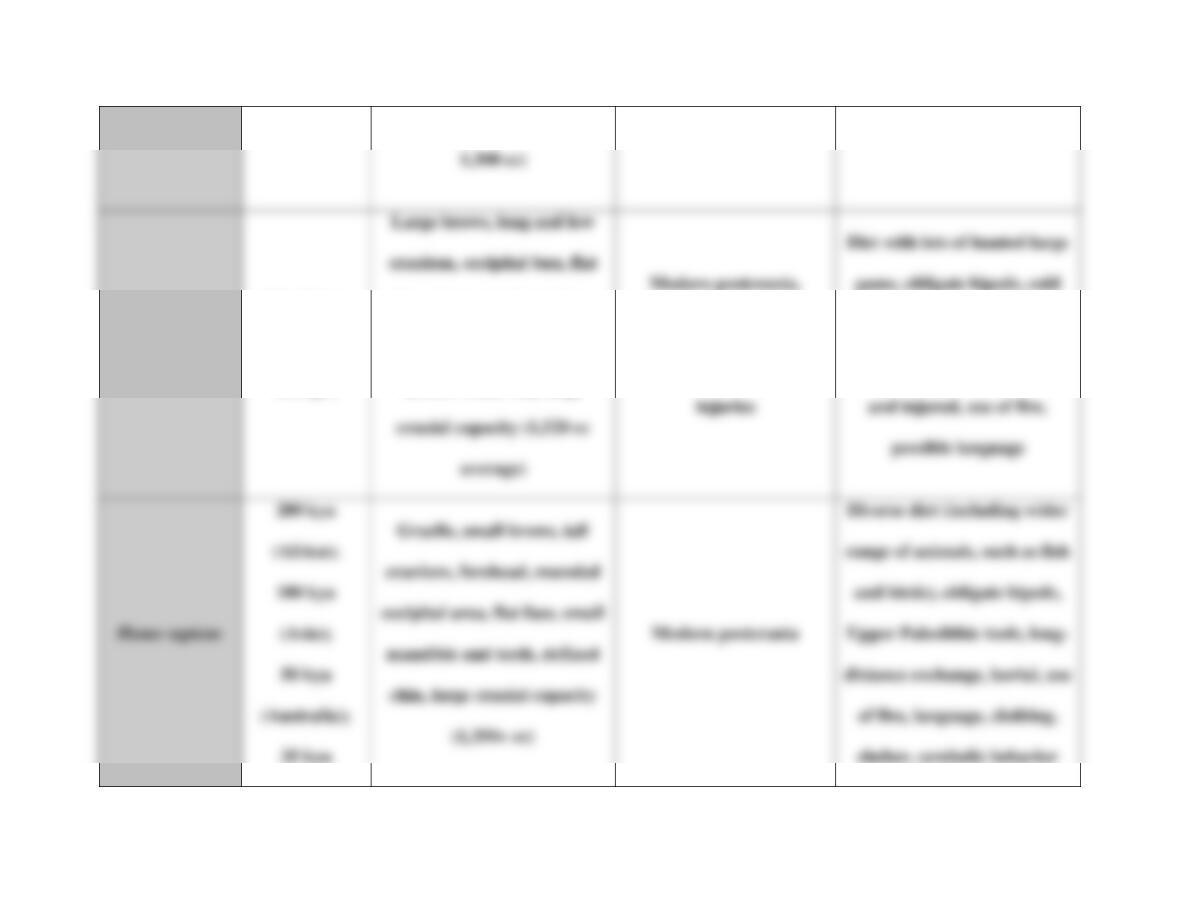
IP 16-17
(Asia)
large cranial capacity (1,200–
Homo
neanderthalensis
130–30 kya
(western Asia,
Europe)
face, large nasal opening,
small back teeth, heavy
incisor wear, very large
robust and stocky bodies,
many fossils show signs of
adapted, Mousterian tools,
burial, possible care for sick

(Europe);
(including “art”)
Homo naledi
335–236 kya
(Southern
ridge, small teeth and
Climbing shoulders,
Possible disposal of dead (see