LABORATORY MANUAL AND WORKBOOK FOR BIOLOGICAL
ANTHROPOLOGY INSTRUCTOR’S MANUAL
Lab 9: Classification
ANSWERS TO LAB 9 CONCEPT REVIEW QUESTIONS
1. The major levels of classification in order from most general to most specific are as
paleospecies.
presence of wings in beetles and hummingbirds (not an ancestral trait, a unique derived
trait, or a shared derived trait).
such as downward facing nostril orientation in humans and baboons (not a unique derived
trait, an analogy, or an ancestral trait).
homoplasy, analogies to group similar primates, or ancestral traits).
IM9-2
GUIDE & ANSWERS TO LAB 9 EXERCISES
Exercise 1: Scientific Names (10 to 15 minutes)
In this exercise, students practice identifying and correcting issues with the formatting of
scientific names. You may want to highlight the reminder at the start of this exercise for students:
Remember to underline when writing scientific names by hand. (This should encourage students
to underline scientific names they write throughout the exercise.)
Scientific Name
What Is Wrong?
Correct Format
IM9-3
1. If you were writing about Homo habilis and Homo neanderthalensis at the same time,
would you need to change your abbreviations? Why or why not? If you needed to
change them, what would the new abbreviations be?
2. If you were writing about Hylobates agilis and Homo neanderthalensis at the same
time, would you need to change your abbreviations? Why or why not? If you needed
to change them, what would the new abbreviations be?
Exercise 2: Homologous Structures (15 to 20 minutes)
IM9-4
1. Examine the limb specimens provided by your instructor (or the images in the Lab 9
Exercise Image Library on p. 276) and complete the chart below.
For bone length, indicate whether you think the animal’s limb bones are relatively long,
short, or intermediate for its overall body size. Use the drawings of the complete animals
and shading of the bone elements as a guide. (For example, a kangaroo would be
described as having long legs for its body.)
For bone robusticity, indicate whether you think the animal’s bones are robust (heavy and
dense), gracile (lightweight and slender), or intermediate.
Animal
Bone Length
Bone Robusticity
Intermediate
Intermediate
[Note: Answers may vary slightly. It is primarily important that students identify trends
2. What do you notice is generally similar across all the specimens?
3. What do you notice is generally different across the specimens?
IM9-5
4. How do these similarities and differences relate to the evolutionary relationships between
these species?
5. What similarities and differences in adaptation (for example, different locomotor needs or
different weight-bearing needs) may also relate to the similarities and differences you see
across these specimens?
Exercise 3: Types of Homologies (10 to 15 minutes)
For this exercise, you could use your own materials to supplement or replace the image provided
in the Lab 9 Image Library of five objects to be classified. We recommend small items that come
IM9-6
Question 6 in the Critical Thinking section at the end of Lab 9 gives students another opportunity
to classify “organisms” (blocks) following the instructions for this exercise. As suggested below,
1. Describe one trait that all the objects have in common (an ancestral trait).
Answers will vary depending on which objects. If using the button images, one could
2. Describe two traits that some of the objects share but other buttons do not (shared
derived traits).
3. Describe one trait that is particularly unusual, perhaps found in only one object
(a unique derived trait):
IM9-7
Trait 1:
Round
Trait 2:
Four Holes
Trait 3:
Big
Trait 4:
Light Blue
Color
Exercise 4: Inferring Relationships from Traits (10 to 15 minutes)
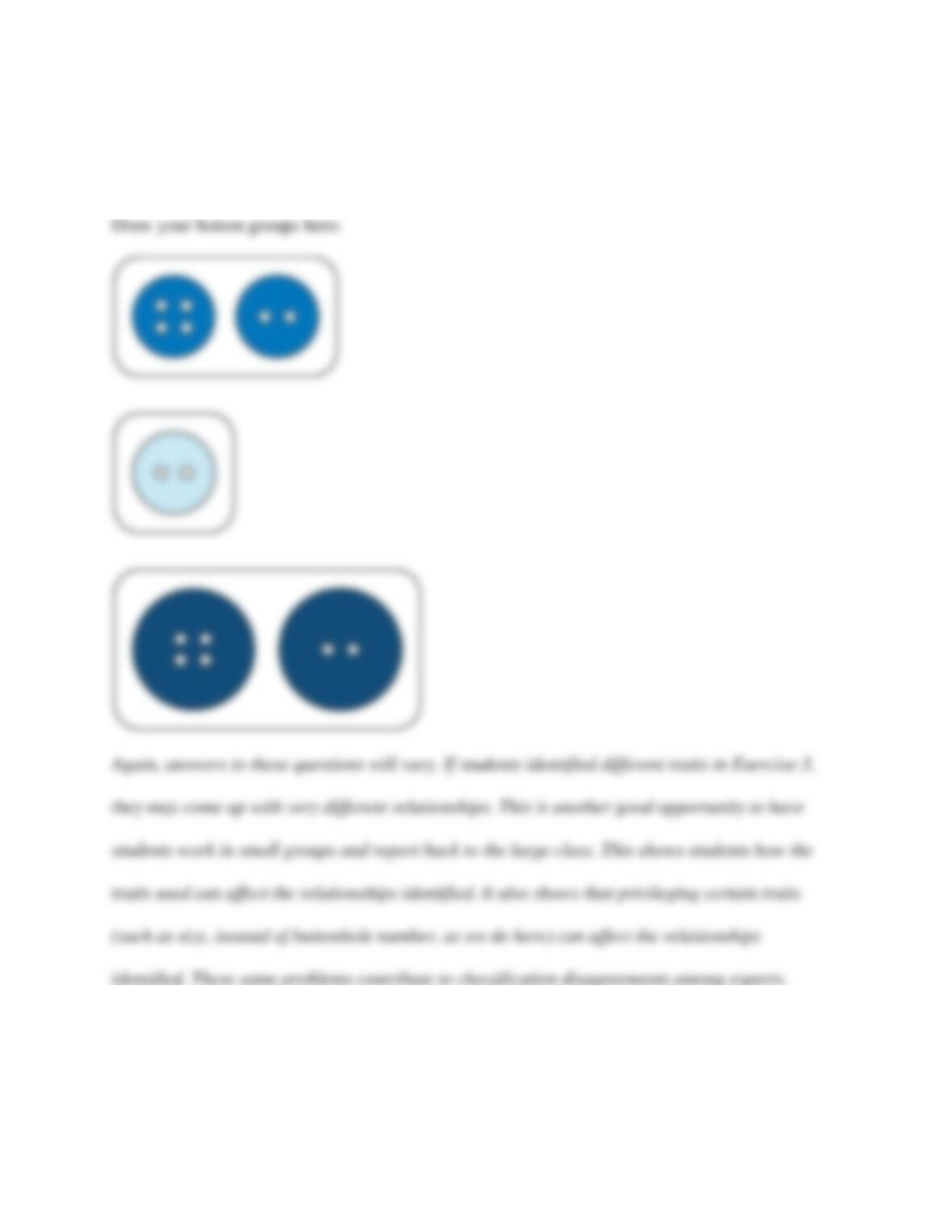
Again, for this exercise, you could use your own materials to supplement or replace the
collection of buttons provided in the lab Image Library. You should use the same materials here
as in Exercise 3 because this builds on that exercise.
Question 6 in the Critical Thinking section at the end of Lab 9 gives students another opportunity
to classify “organisms” (blocks) following the instructions for this exercise. As suggested, you
IM9-8
and they should be grouped together. Objects that share multiple shared derived traits are closely
related, and they should be subgroups within larger related groups.
Exercise 5: Making a Cladogram (10 to 15 minutes)
IM9-9
Again, for this exercise, you could use your own materials to supplement or replace the
collection of buttons depicted in the lab Image Library. You should use the same materials here
as in Exercises 3 and 4 because this builds on those exercises.
Question 6 in the Critical Thinking section at the end of Lab 9 gives students another opportunity
to classify “organisms” (blocks) following the instructions for this exercise. As suggested, you
could complete the block classification for practice as a whole class before students work on the
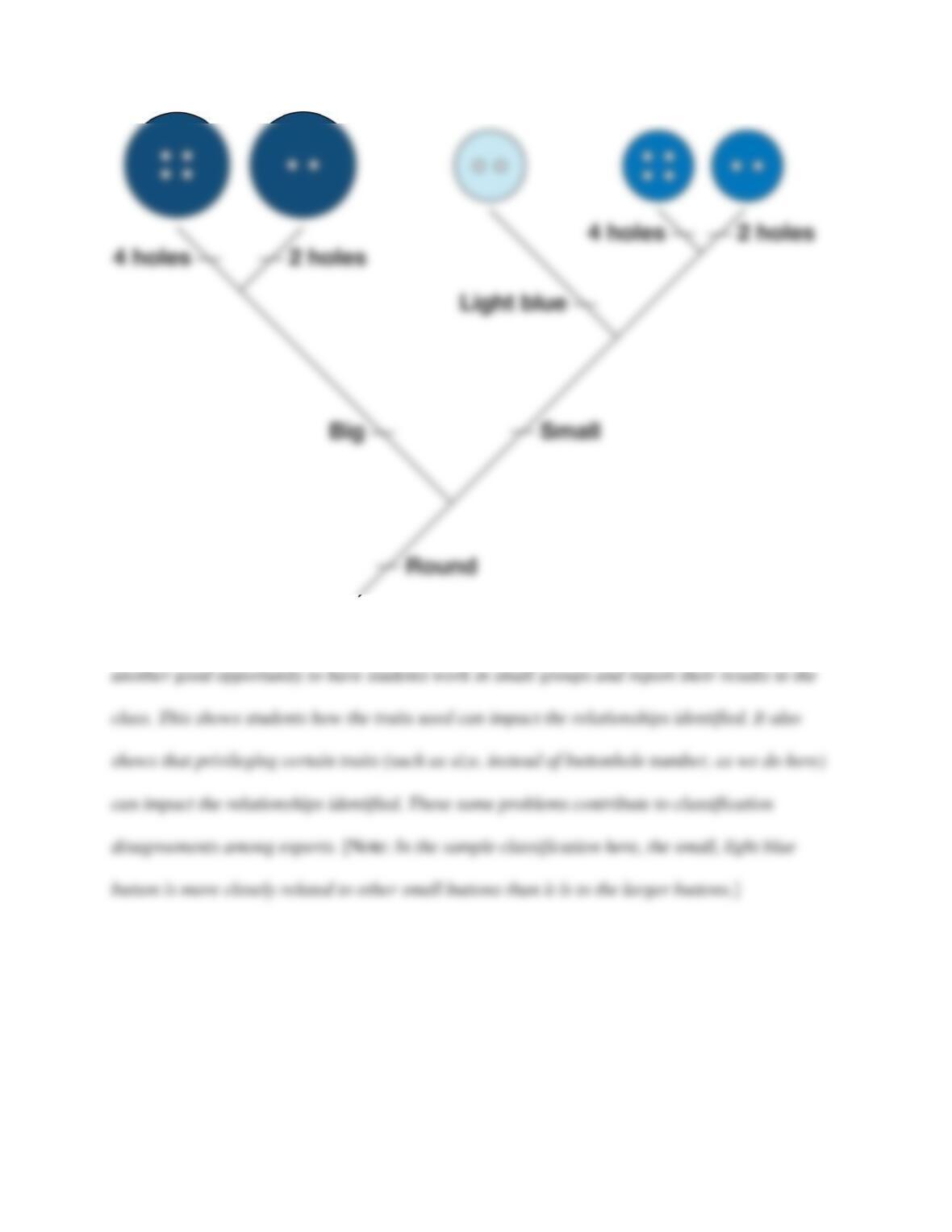
IM9-10
Again, answers will vary, depending on the traits used and relationships identified. This is
ANSWERS TO LAB 9 CRITICAL THINKING QUESTIONS
IM9-11
1. In classifying humans, there is generally consensus on kingdom (Animalia), phylum
2. The “humanzee” is likely to be similar to the offspring of the female horse × male donkey
3. Many similarities exist due to common ancestry among the animals in Exercise 2 (frog,
4. A. Dolphins and sharks both have fins: Analogy, because both animals have fins as an
IM9-12
D. Some snakes and spiders have venom: Analogy, because both animals have venom as
IM9-13
5. In some cases, genetic analysis supports morphological classifications. This is expected,
since morphological similarities used in classification are supposed to be due to ancestral
(and therefore genetic) relationships. In other cases, genetic analysis may not support
morphological classifications. This may happen if researchers have incorrectly identified
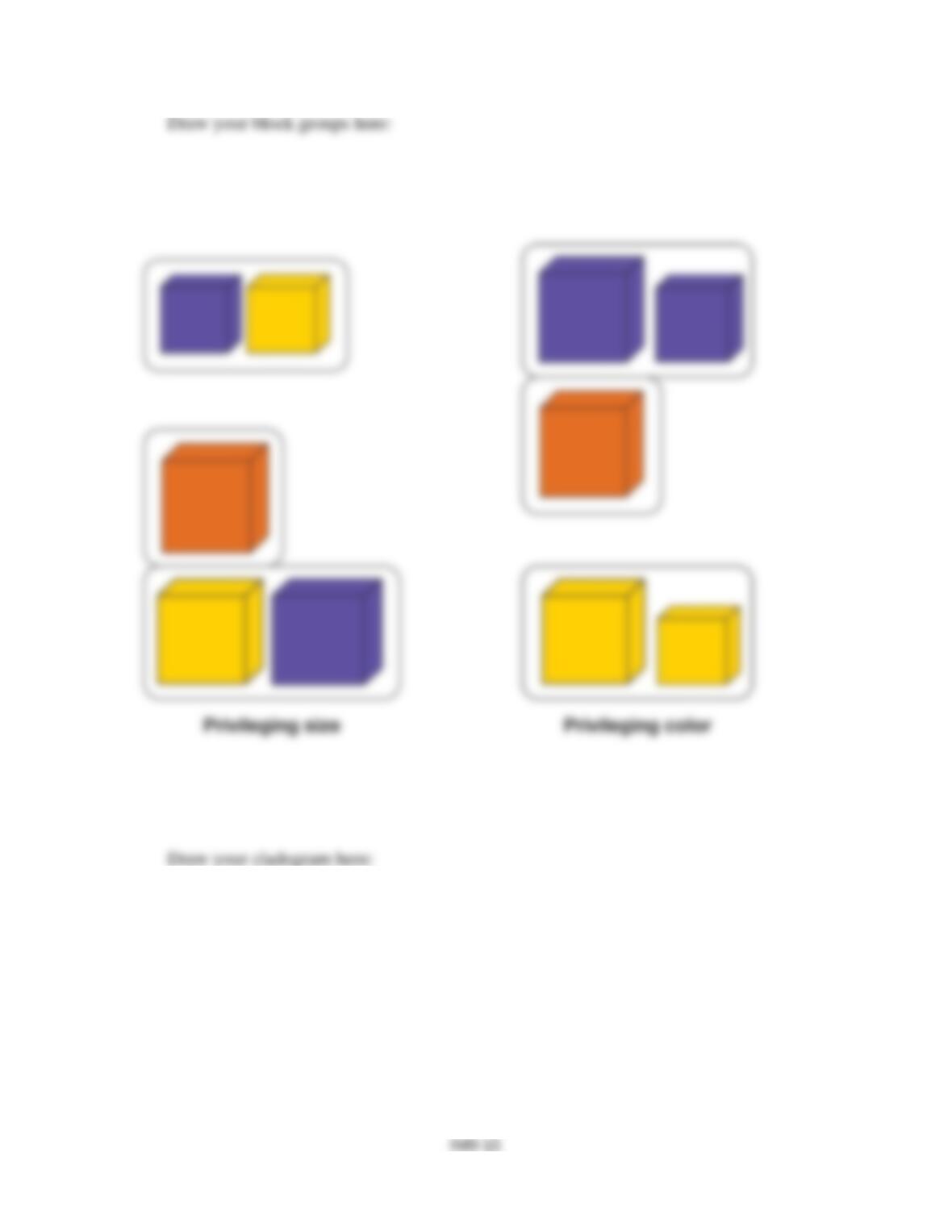
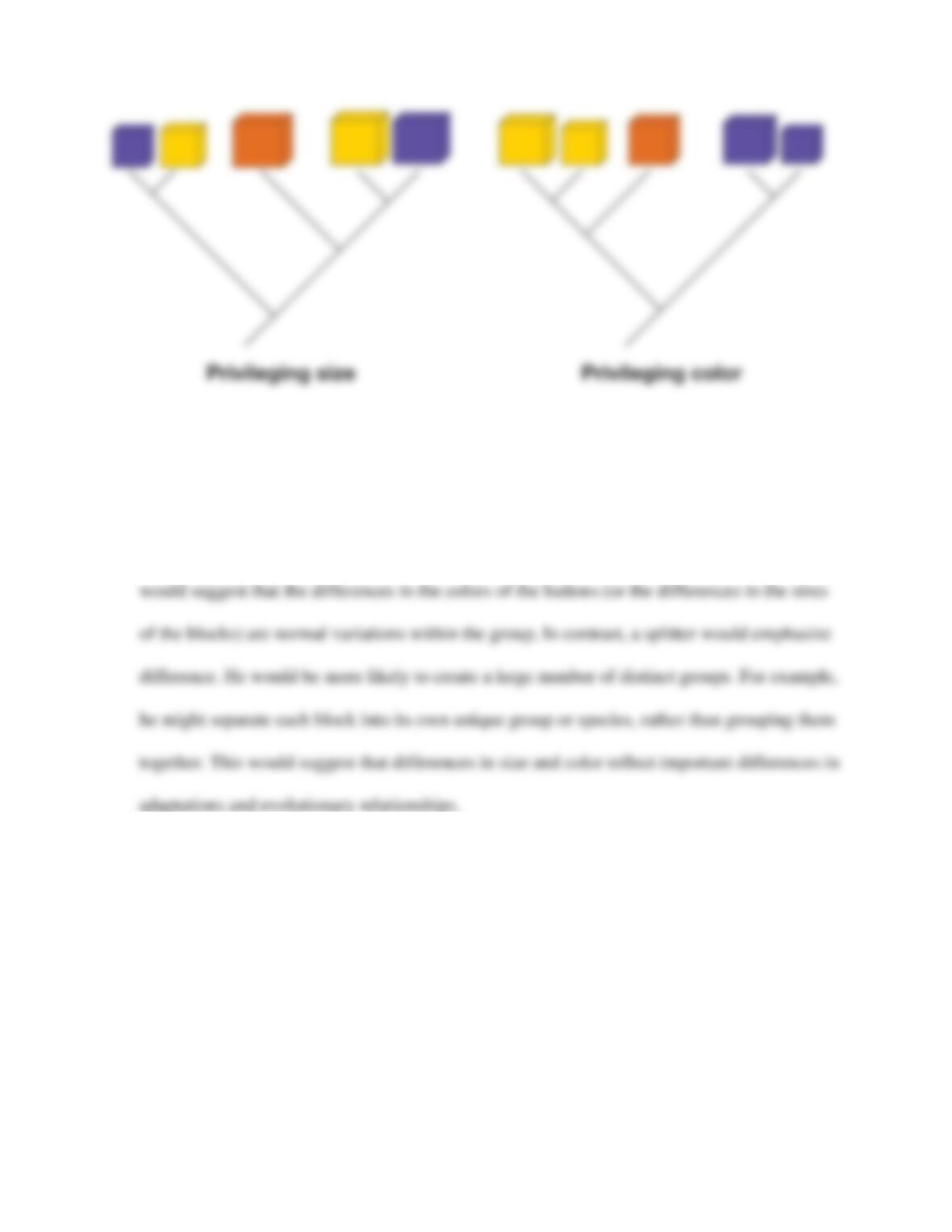
6. This critical thinking question is designed as an additional opportunity to practice
classification. However, it may also be adapted as a demonstration activity. You could
IM9-14
[Note: Answers will vary, depending on the traits used and emphasized. We include two
different approaches here as samples.]
IM9-16
7. A lumper would emphasize similarity. She would be more likely to create a limited number of
distinct groups. For example, she might combine a big and small two-holed button (or a big
and small red block) into one group or species, rather than treating them as separate. This