IM12-1
LABORATORY MANUAL AND WORKBOOK FOR BIOLOGICAL
ANTHROPOLOGY INSTRUCTOR’S MANUAL
Lab 12: Comparative Primate Anatomy
ANSWERS TO LAB 12 CONCEPT REVIEW QUESTIONS
2. D. Small body size is the trait a gummivorous primate is likely to have (not large
4. Brachiation is defined as a form of suspensory locomotion where movement occurs
IM12-2
7. A. Terrestrial quadrupedalism is the type of locomotion practiced by a primate that has
8. D. Knuckle-walking is the type of locomotion practiced by a primate that has long arms,
9. The sexually dimorphic traits should one of these (including male–female differences in
appearance):
GUIDE & ANSWERS TO LAB 12 EXERCISES
Exercise 1: Tooth Types (15 minutes)
For this exercise, you will need to provide students with small servings of different foods. We
suggest that you have students working in groups, with only one student eating the food and the
other students helping to track the data (teeth and chewing patterns). This helps students collect
more accurate data, and it limits the amount of preparation needed in advance. Each group will
need a small serving of food from each of these categories: 1. Leafy food (we suggest one piece
IM12-3
of lettuce, but raw spinach or other leafy greens could be used instead). 2. Soft fruit (we suggest
a soft fruit like ½ of a banana or one large strawberry, but the fruit should be large enough that
students will bite it into smaller pieces). 3. Crunchy food (this food should mimic insects, so we
recommend small, soft seeds (like sunflower seeds) or slightly crunchy candy (like M&Ms). 4.
Gooey food (this should mimic tree gums, so we recommend viscous food (like maple syrup or
honey) of which students would eat a spoonful).
STEP 1: Generate hypotheses. Student answers will vary, but should follow the samples
given here.
1. Which food type(s) do you hypothesize will require biting?
2. Which food type(s) do you hypothesize can be eaten without biting?
3. Which food type do you hypothesize will require the most chewing?”
4. Which food type do you hypothesize will require the least chewing?
STEP 2: Collect the data. Take each food one at a time. Eat the food as you normally would,
taking bites if appropriate and chewing it until you are comfortable swallowing.

FOOD TYPES AND TEETH CHART
Number of Bites
Taken (0 or More)
Teeth Used to Bite
(if Relevant)
Number of Chews
per Bite (Up and
Down Jaw
Movement = 1
Chew)
Teeth Used to
Chew
(if Relevant)
Many
Maybe incisors or
canines (but
Many
Molars and
premolars
STEP 3: Evaluate the data. Review your results and use the data to evaluate your hypotheses.
Student answers may vary slightly, but should follow this general pattern:
5. Which food type(s) required biting? How do these data compare to your earlier
hypotheses?
IM12-5
6. Which food required the most chewing? Which food required the least chewing?
How do these data compare to your earlier hypotheses?
7. Which types of teeth were primarily used for biting? Which teeth were primarily
used for chewing?
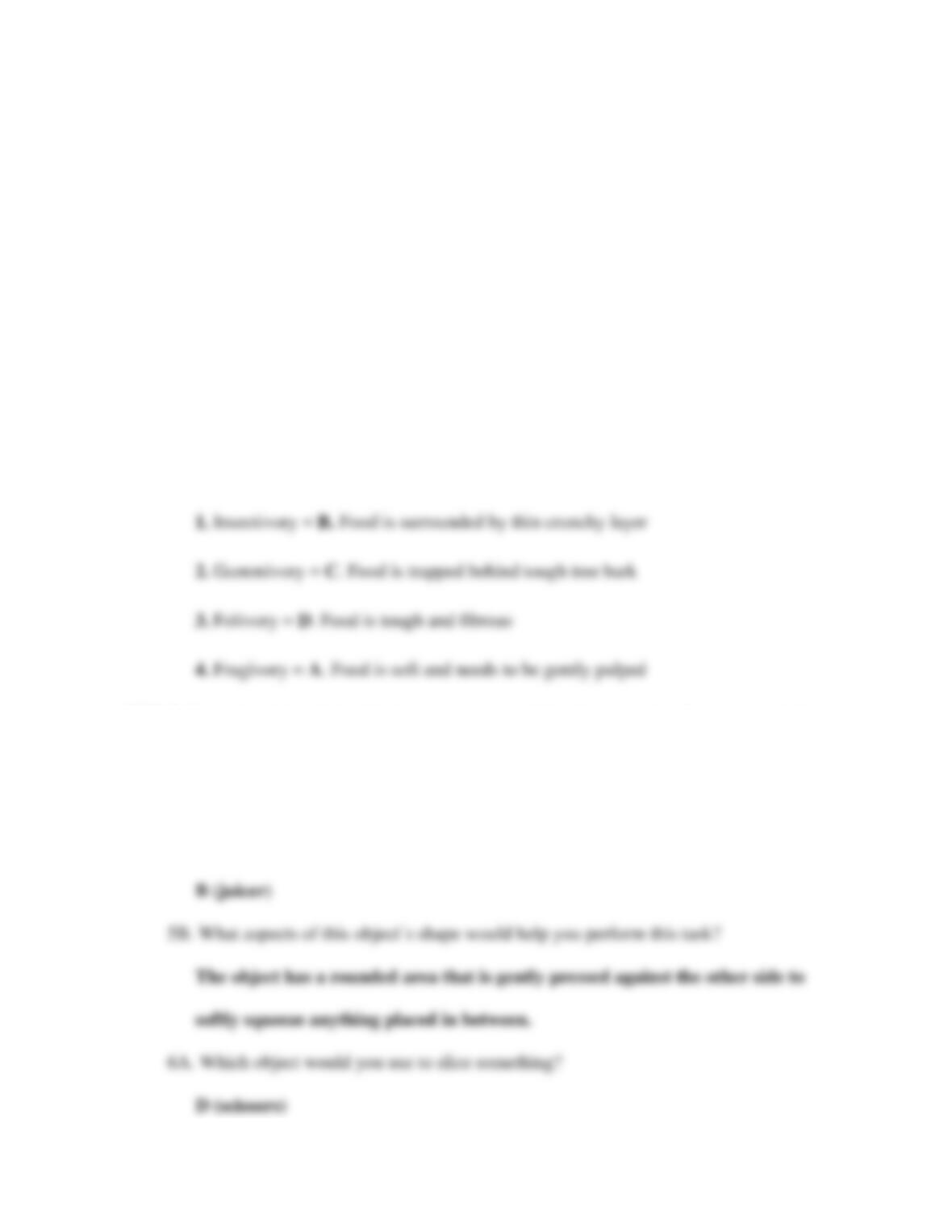
8. If you were to further test how different types of teeth correspond to different
diets, what types of teeth would you hypothesize to be enlarged in primates whose
diets emphasize each of these food types? Why?
Leafy food would be associated with big premolars and molars, because this
IM12-6
Exercise 2: Tooth Shape as Adaptation (10 minutes)
For this exercise, you could use your own materials to supplement or replace the images of
everyday objects provided in the lab Image Library. A = a nail (or large metal stake), B = a
handheld fruit juicer, C = a metal comb (combs of other materials would work too), and D =
scissors (or something similar with overlapping blades, such as a paper shredder or paper
cutter).
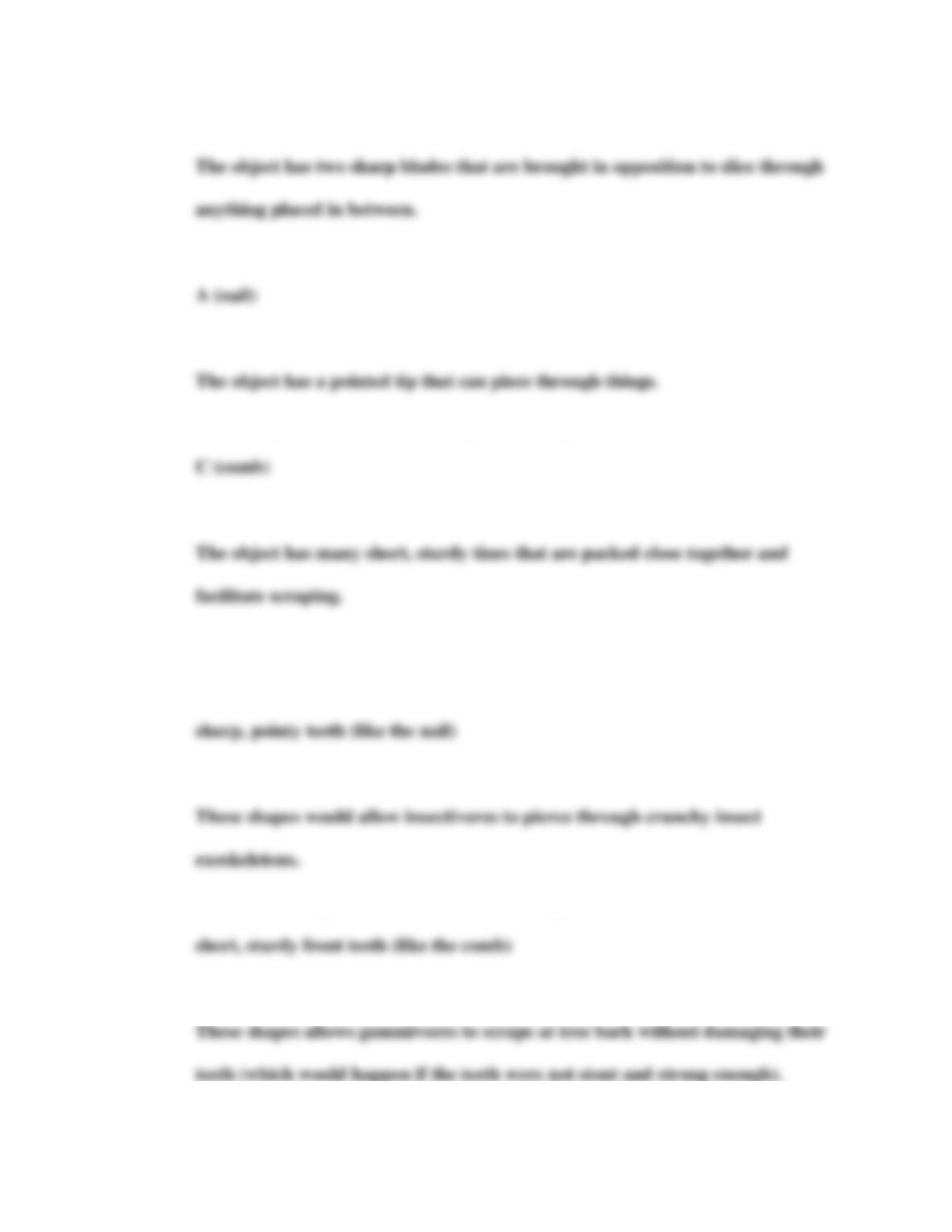
STEP 1: Review the primate diets discussed in this lab. Match each of the diets below to its
primary obstacle.
STEP 2: To explore the relationship between shape and function, examine the everyday objects
provided by your instructor (or those depicted in the Image Library), and answer these
questions.
5A. Which object would you use to gently squash or squeeze something?
IM12-7
6B. What aspects of this object’s shape would help you perform this task?
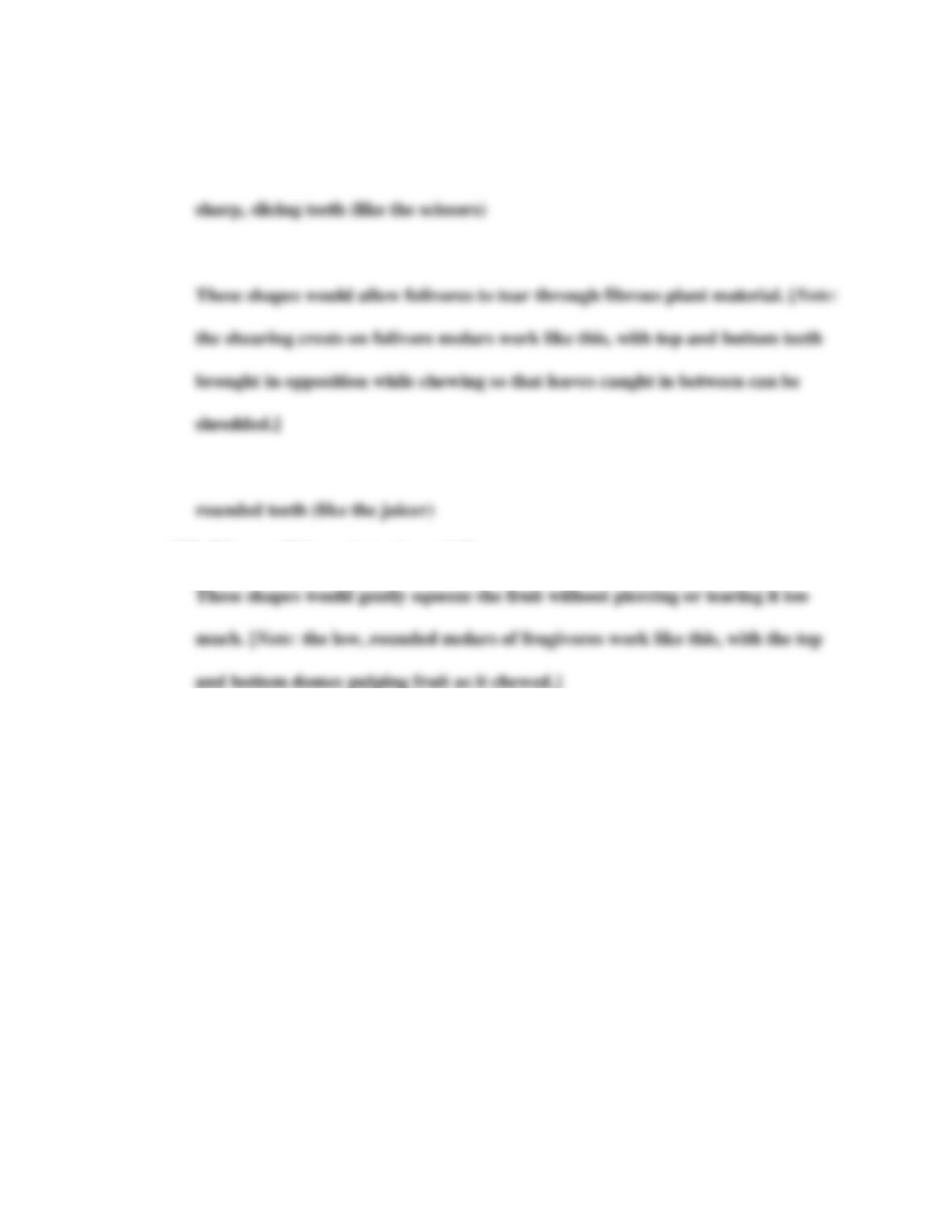
7A. Which object would you use to pierce or puncture something?
7B. What aspects of this object’s shape would help you perform this task?
8A. Which object would you use to scrape something?
8B. What aspects of this object’s shape would help you perform this task?
STEP 3: Use your answers to reflect on the relationship between tooth shape and primate diet.
9A. What tooth shapes would be most useful for an insectivore?
9B. Why would these shapes be useful?
10A. What tooth shapes would be most useful for a gummivore?
10B. Why would these shapes be useful?
IM12-8
11A. What tooth shapes would be most useful for a folivore?
11B. Why would these shapes be useful?
12A. What tooth shapes would be most useful for a frugivore?
12B. Why would these shapes be useful?
Exercise 3: Diet and Dietary Adaptations 1 (10 minutes)
For this exercise, you could use your own materials to supplement or replace the images of
primate crania and mandibles provided in the Image Library at the end of Lab 12: A = a folivore
(such as a gorilla or colobine), B = an insectivore (such as a tarsier or galago), C = a
gummivore with a dental comb (such as a lemur or loris), and D = a frugivore (such as a gibbon
or the macaque depicted in the lab Image Library).
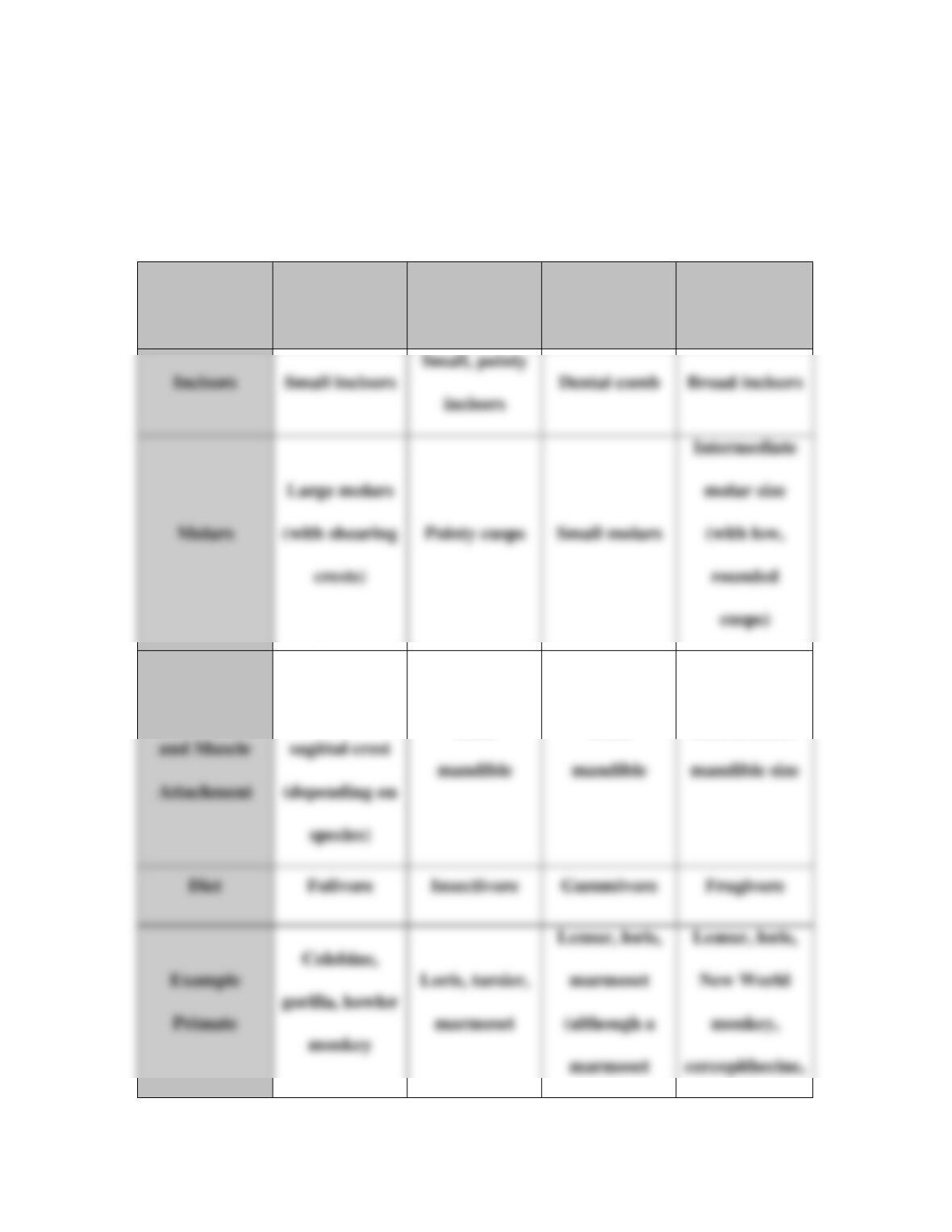
Refer to the mystery primate dentitions provided by your instructor (or the photos in the Lab 12
Exercise Image Library on p. 360) to complete the chart. Describe the incisors, molars, and
IM12-9
muscle attachment on the mandible of each mystery primate. Then, using this trait information,
determine the likely diet of each mystery primate, and give an example of one primate that has
this diet.
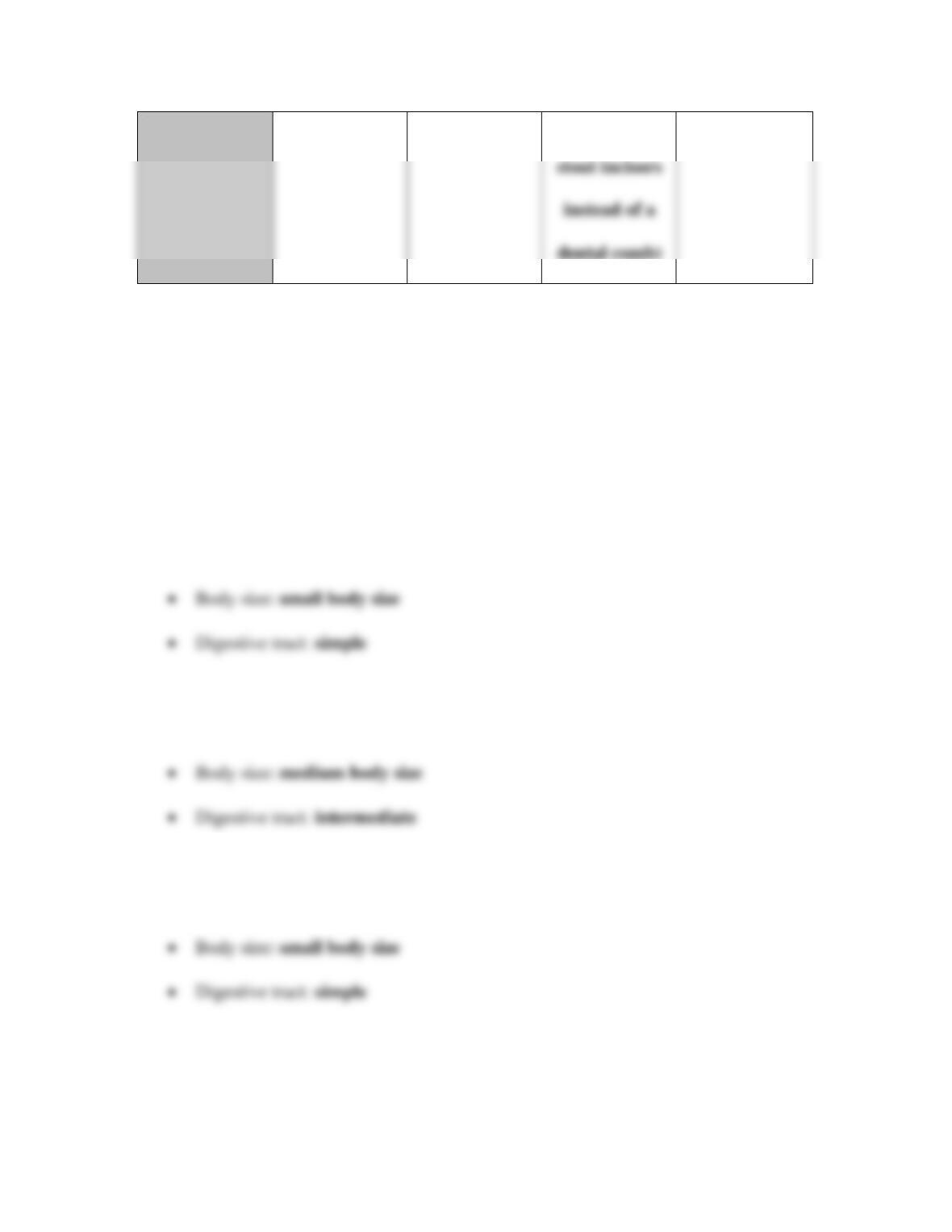
Mystery
Primate A
Mystery
Primate B
Mystery
Primate C
Mystery
Primate D
Mandible Size
Large
mandible,
Small
Small
Intermediate
IM12-10
would have
gibbon
Exercise 4: Diet and Dietary Adaptations 2 (5 to 10 minutes)
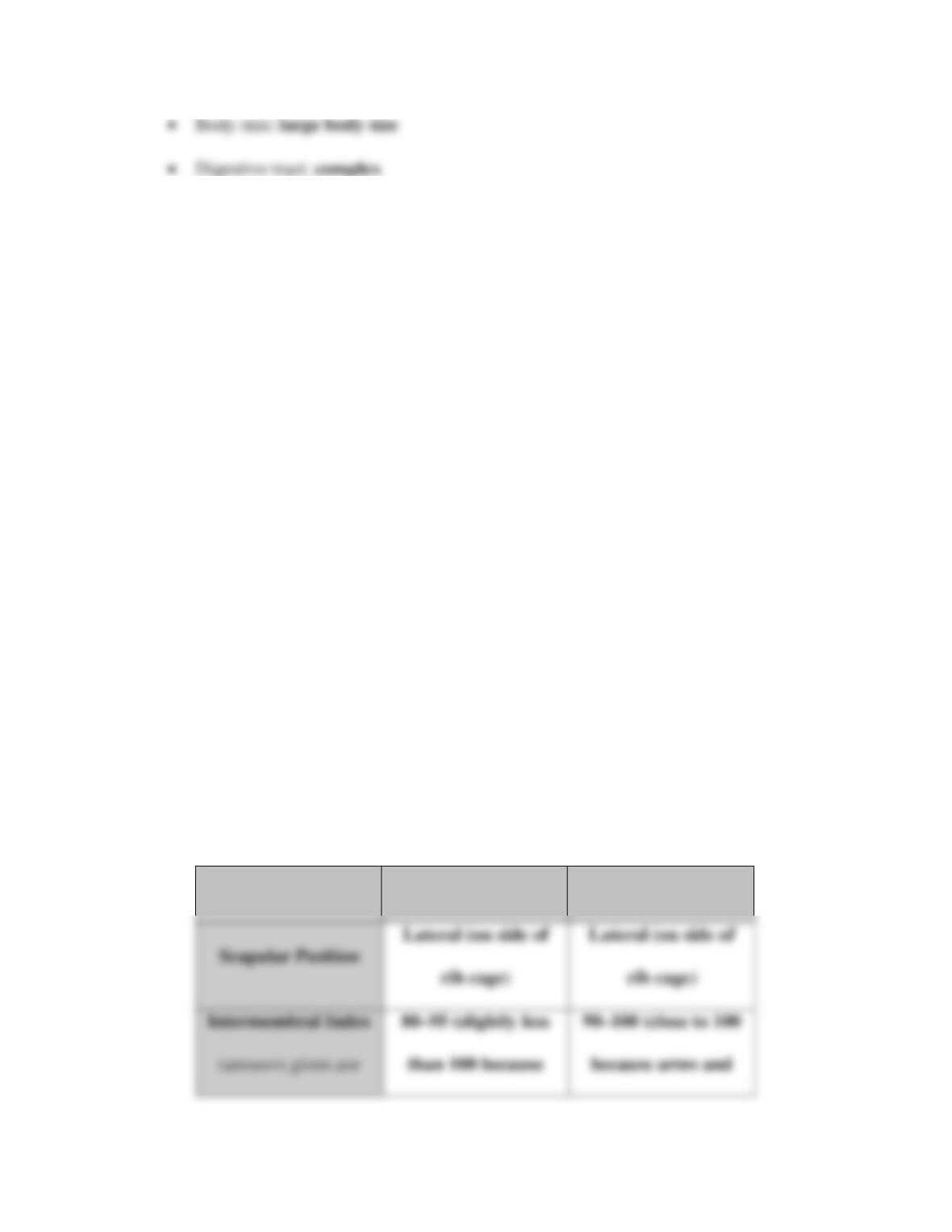
Review the primate descriptions below. For each primate, describe the primate’s likely body size
and digestive tract.
1. Primate A is an insectivore that eats a lot of moths, stick insects, and grasshoppers. These
foods provide small packets of energy that are easy to digest.
2. Primate B is a frugivore that eats a lot of berries, figs, and other tree fruits. These foods
provide moderate packets of energy that are relatively easy to digest.
3. Primate C is a gummivore that eats a lot of tree sap. This food provides small packets of
energy that are easily digested.
4. Primate D is a folivore that eats a wide variety of leaves, stems, and young plant shoots.
This food provides limited, slow-burning energy and is difficult to digest.
IM12-11
Exercise 5: Locomotion and Locomotor Adaptations 1 (5 to 10 minutes)
For this exercise, you could use your own materials to supplement or replace the images of
articulated primate skeletons provided in the lab Image Library: A = an arboreal quadruped
primate (such as a squirrel monkey) and B = a terrestrial quadruped primate (such as a
baboon).
To help students calculate intermembral index, provide them with rulers (if using the
photographs in the Image Library) or tape measures, calipers, or an osteometric board (if using
skeletal material you provide). [Note: Intermembral Index = (length of humerus + length of
radius) / (length of femur + length of tibia) × 100.]
Use the mystery primate skeletons provided by your instructor (or the photos in the Lab 12
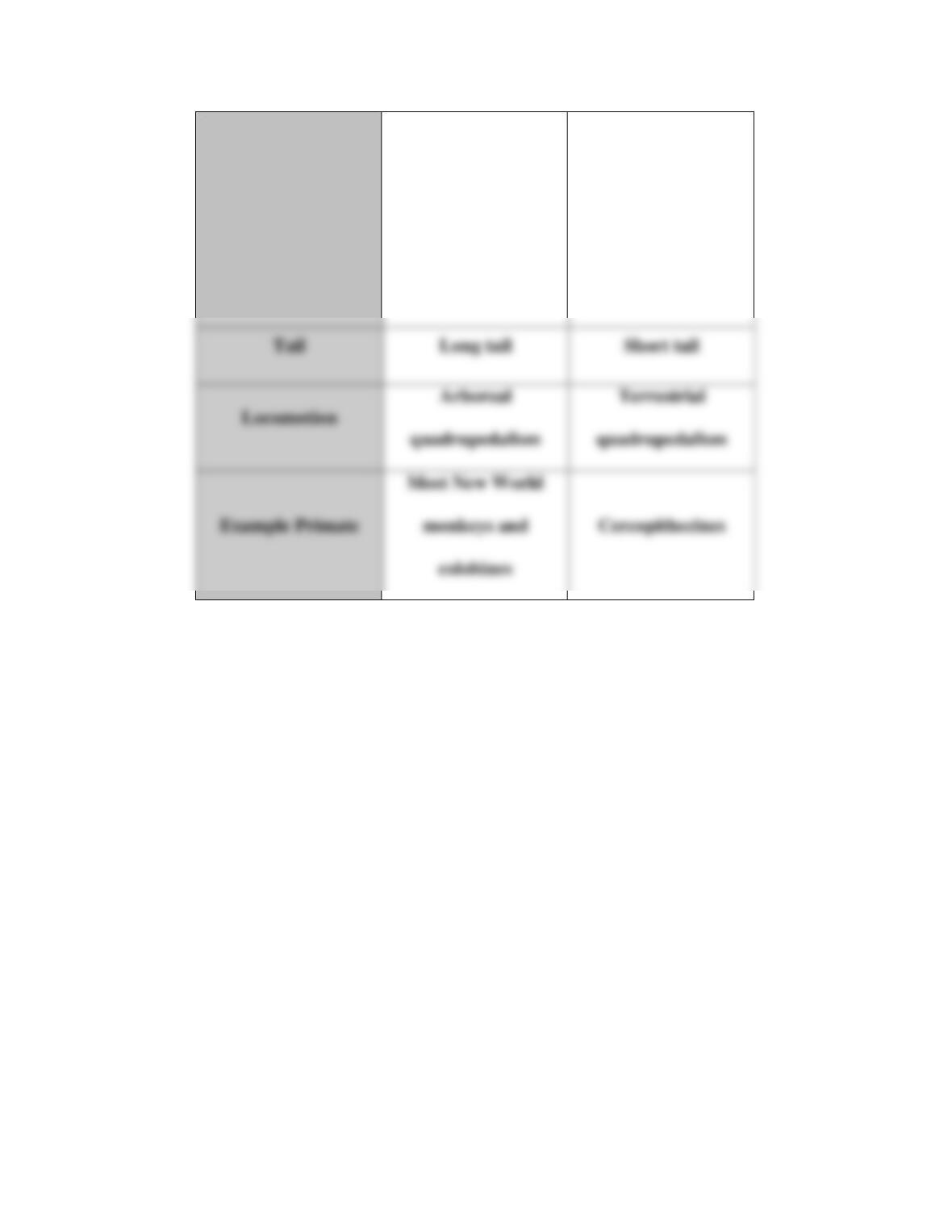
Exercise Image Library on p. 361) to complete the chart. Identify the scapular position, calculate
the intermembral index, and describe the tail of each mystery primate. Then, using this trait
information, determine the likely form of locomotion of each mystery primate, and give an
example of one primate that has this form of locomotion.
Mystery Primate A
Mystery Primate B
IM12-12
estimates based on the
images provided and
may vary slightly if
skeletal material is
used)
legs are slightly
longer than arms)
legs are relatively
equal)
Exercise 6: Locomotion and Locomotor Adaptations 2 (10 minutes)
For this exercise, you could use your own materials to supplement or replace the images of
articulated primate skeletons provided in the lab Image Library: A = a semibrachiator (such as
a howler monkey), B = a brachiator (such as a gibbon), and C = a vertical clinger and leaper
(such as a galago).
To help students calculate intermembral index, provide them with rulers (if using the
photographs in the Image Library) or tape measures, calipers, or an osteometric board (if using
skeletal material you provide). [Note: Intermembral Index = (length of humerus + length of
radius) / (length of femur + length of tibia) × 100.]
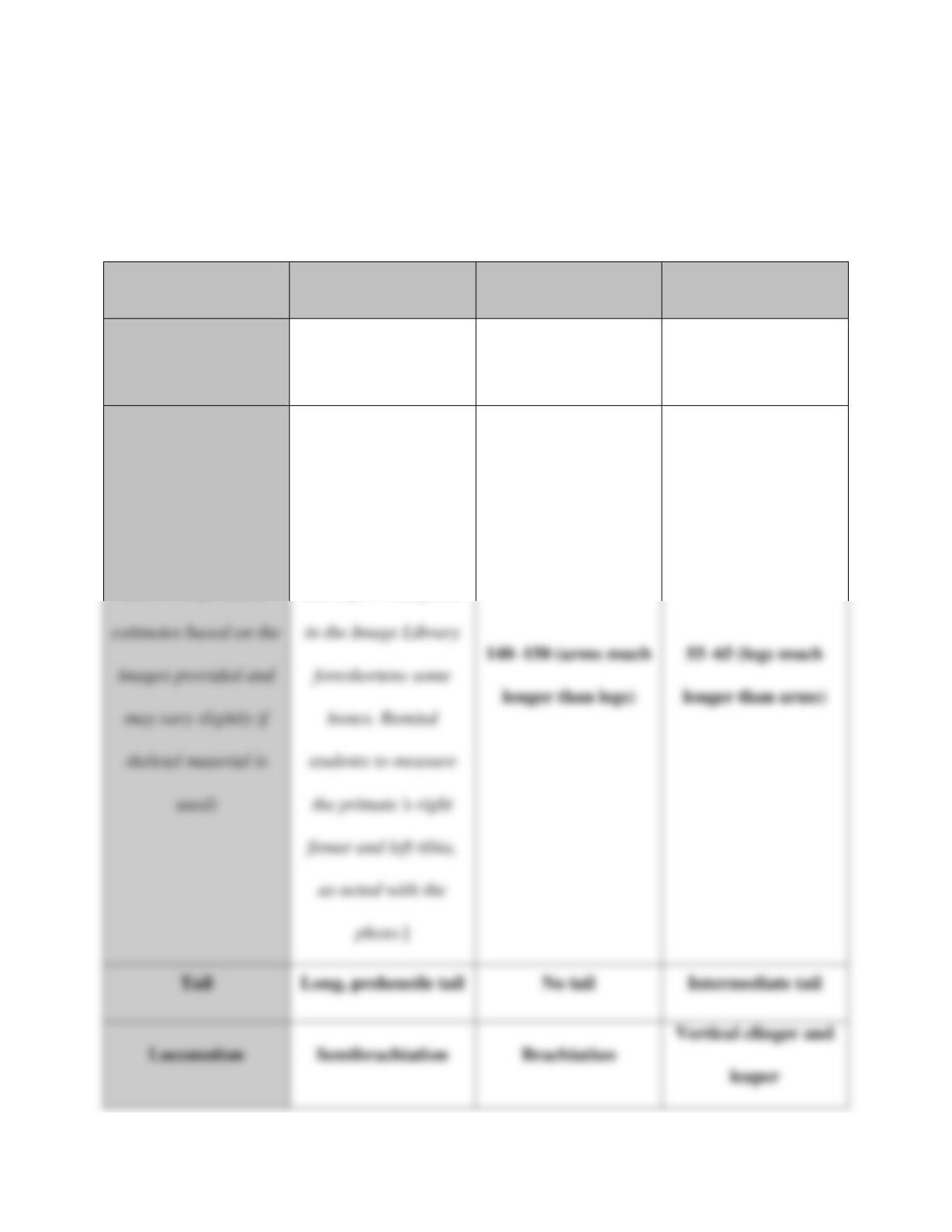
Use the mystery primate skeletons provided by your instructor (or the photos in the Lab 12
Exercise Image Library on pp. 362–363) to complete the chart below. Identify the scapular
IM12-13
position, calculate the intermembral index, and describe the tail of each mystery primate. Then,
using this trait information, determine the likely form of locomotion of each mystery primate,
and give an example of one primate that has this form of locomotion.
Mystery Primate A
Mystery Primate B
Mystery Primate C
Scapular Position
Lateral (on side of
rib cage)
Posterior (on back of
rib cage)
Lateral (on side of
rib cage)
Intermembral Index
(answers given are
95–105 (arms and
legs similar in
length) [Note: The
angles of the arms
and legs in this photo
IM12-14
Exercise 7: Sexual Dimorphism (5 to 10 minutes)
For this exercise, you could use your own materials to supplement or replace the images
provided of the male and female baboon crania.
Examine the mystery primate crania provided by your instructor (or the photos in the Lab 12
Exercise Image Library on p. 364) and answer the following questions. These crania represent
adult individuals from the same species.
1. Which mystery primate is female?
2. Which mystery primate is male?
3. Describe two traits you used to make this distinction.
Exercise 8: Social Organization and Sexual Dimorphism (5 to 10 minutes)
For this exercise, you could use your own materials to supplement or substitute for the images of
paired female and male skulls for two primate species provided in the lab Image Library: A = a
IM12-15
multimale polygynous species (such as chimpanzees) and B = a single-male polygynous species
(such as gorillas).
Examine the mystery primate crania provided by your instructor (or the photos in the Lab 12
Exercise Image Library on p. 365) and answer the following questions. These crania represent an
adult male and an adult female from two mystery primate species, A and B.
1. Which mystery primate species has a single-male polygynous social structure?
2. Which mystery primate species has a multimale polygynous social structure?
3. Describe one trait you used to make this distinction.
Species B has more pronounced sexual dimorphism in both canine size and
ANSWERS TO LAB 12 CRITICAL THINKING QUESTIONS
1. The traits of broad incisors and molars with rounded cusps suggest a frugivorous diet.
While humans today do eat a fair amount of fruit, we do not actually emphasize this food
as a true frugivore would. We have a generalized diet and eat a wide variety of things
relatively equally. Frugivore dental traits are more generalized than the traits associated
with other diets. Because we evolved from a generalist lineage and maintain a generalist
diet today, these are the traits found in humans.
2. Humans have many adaptations for brachiation. We have broad chests with scapulas on
the posterior surfaces of our rib cages. We have highly mobile shoulders and long, curved
3. Our low degree of sexual dimorphism suggests that modern humans tend to be
IM12-17
4. Regarding the primate with arms and legs that are relatively equal in length, a short tail,
small incisors and large, bilophodont molars (a female, but males of her species have
much larger bodies and canine teeth than females, as well as extra fur around their chests
5. Measurements of the maximum bone lengths:
Humerus: 4 cm Radius: 2.9 cm
Femur: 5.5 cm Tibia: 5 cm
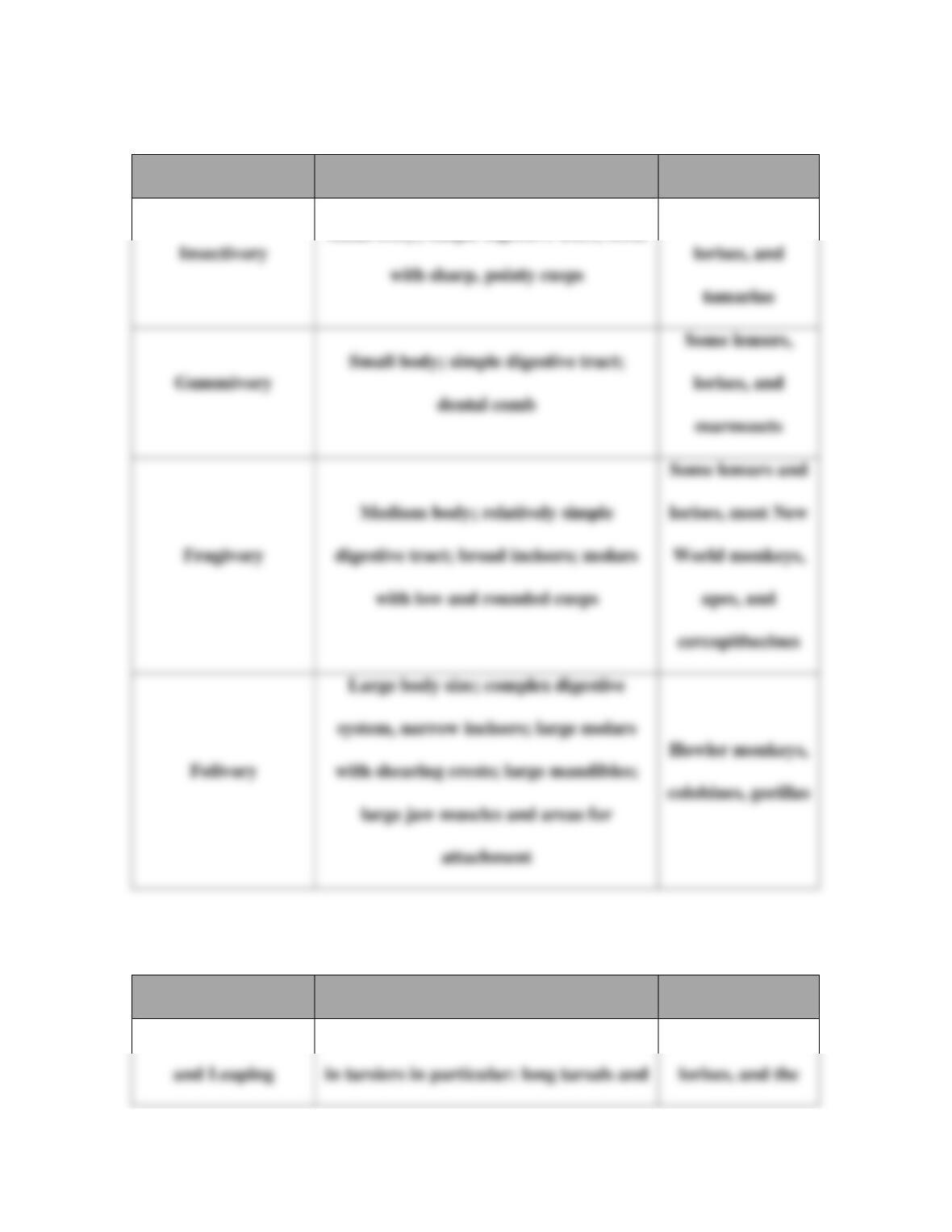
6. The following completed Primate Diet Chart describes the adaptations associated with
each diet and includes a sample primate that has this diet. Similarly, in the Primate
IM12-18
Locomotion Chart, adaptations associated with each form of locomotion are described
IM12-19
PRIMATE DIET CHART
Adaptations
Primate(s)
Small body; simple digestive tract; teeth
Tarsiers, some
PRIMATE LOCOMOTION CHART
Adaptations
Primate(s)
Vertical Clinging
Very long legs and feet;
Some lemurs and
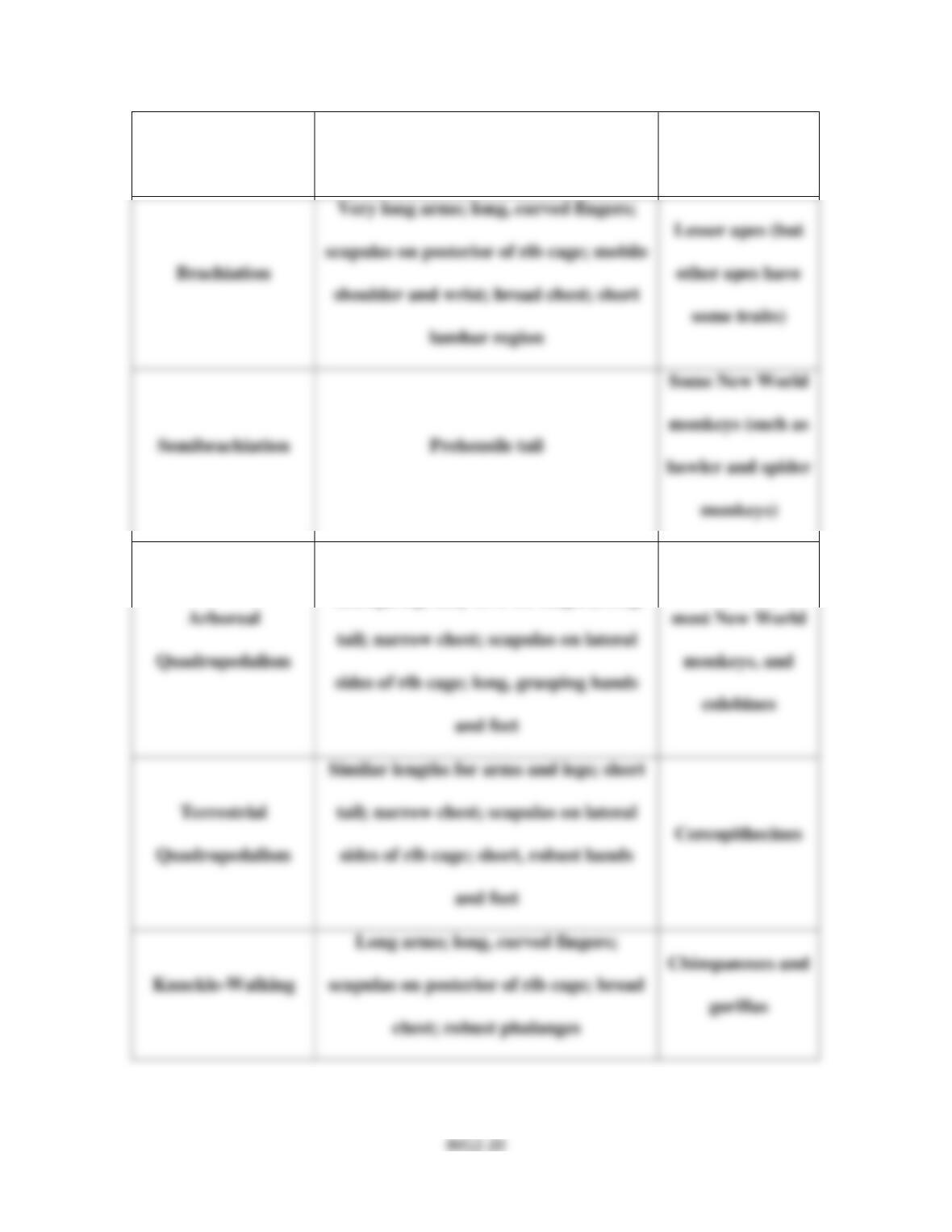
fused tibia and fibula
tarsiers
Relatively similar length arms and legs
(though legs may be a bit longer); long
Some lemurs,