IM4-1
LABORATORY MANUAL AND WORKBOOK FOR BIOLOGICAL
ANTHROPOLOGY INSTRUCTOR’S MANUAL
Lab 4: Forces of Evolution
ANSWERS TO LAB 4 CONCEPT REVIEW QUESTIONS
recombination, or genetic drift).
6. C. Genetic bottleneck is the term used to describe a substantial loss of genetic variation
(not genetic die-off, gene flow, or gene dam).
No natural selection is occurring.
GUIDE & ANSWERS TO LAB 4 EXERCISES
Exercise 1: Mutation (15 to 20 minutes)
1. What mutation has occurred?
2. Will this mutation have a real effect? Why or why not? [Hint: You may want to try the
Exercise 10 from Lab 2 again, using the mutated DNA strand to make the mutated
protein.]
IM4-3
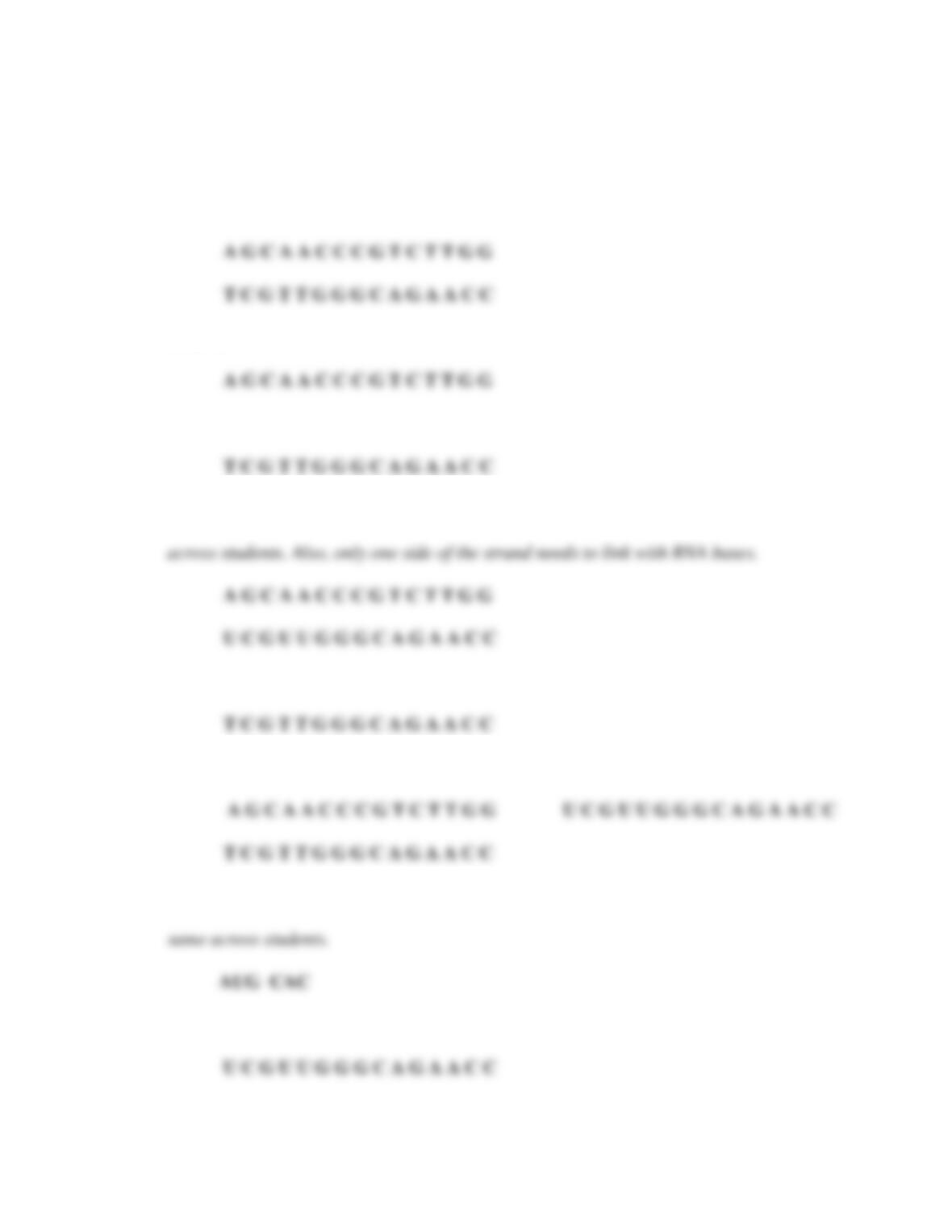
Steps of the protein synthesis part, if students followed the lab manual’s suggestion, are as
follows:
STEP 1
STEP 2
STEP 3: The free-floating bases will vary, but the linking bases should be the same
STEP 4
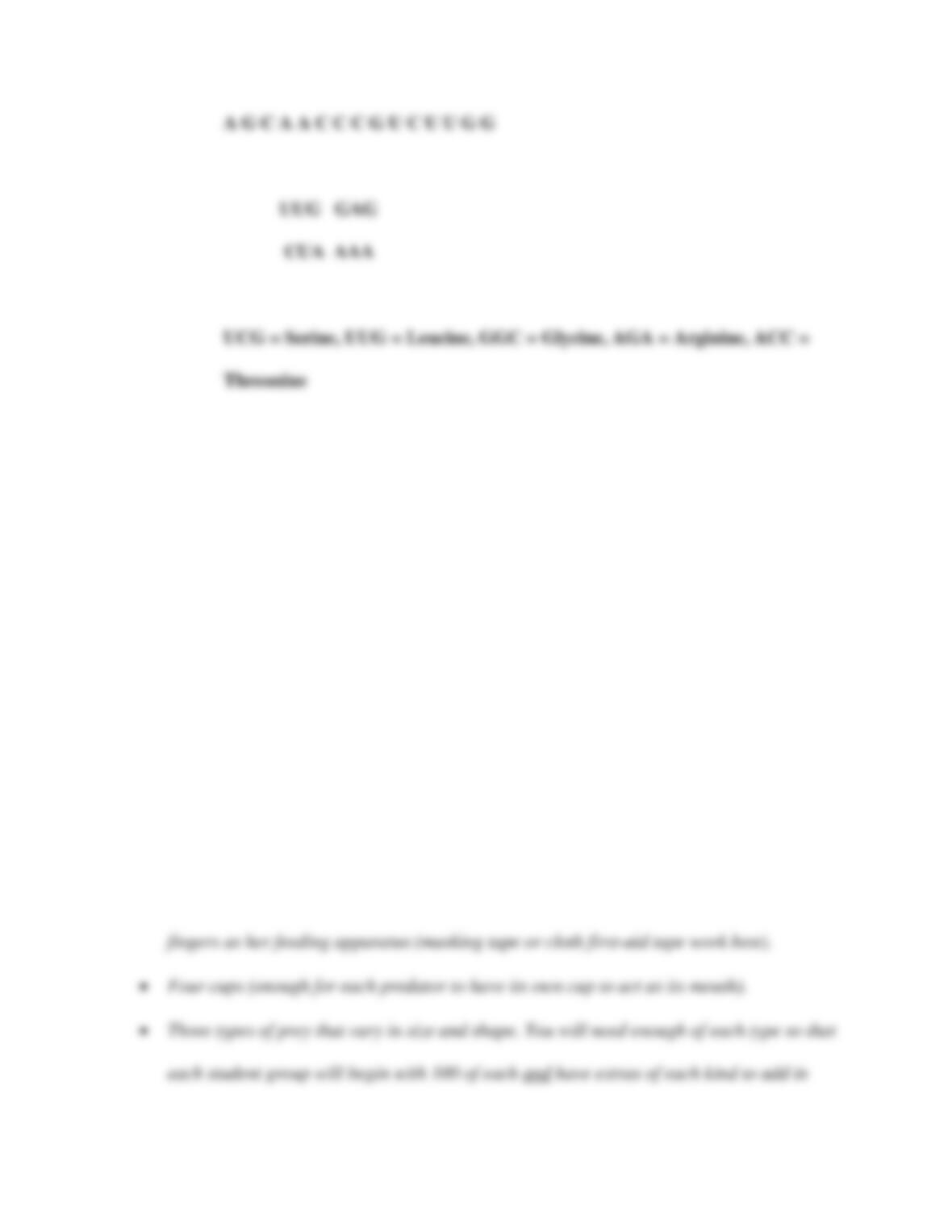
STEP 5: The free-floating anticodons will vary, but the linking anticodons should be the
IM4-4
STEP 6
Exercise 2: Natural Selection Activity (30 to 35 minutes)
For this exercise, have students work in groups of four or five. If they work in groups of four,
each student will be a predator, and you may want to help them keep track of their 60-second
hunting sessions. You can do this by having all the student groups synchronize their hunting
sessions to run simultaneously while you provide them with their start and stop times. If you have
the students working in groups of five, one student can be responsible for monitoring the timing
of the hunting sessions in the group while the other four students act as predators.
You will need to provide each student group with the following materials:
• A fork, a knife, and a spoon. (These utensils can be plastic, and breaking the utensil can
be another way that natural selection acts on the feeding apparatus trait.)
• Tape, so that one of the predators can tape down her thumb and use the other four
IM4-5
• A habitat for the hunting sessions. Your choice of habitat will depend on the space
available. You may have students run their sessions in a delineated space outdoors or on
the floor or tables in the classroom. If doing this, you will want to create separate areas
for each group using string, tape, garden hoses, or something similar. Note that if you
provide a thicker boundary (such as a garden hose), students may use this to help them
• A method for timing the 60-second hunting sessions, such as a timer, a clock with a
second hand, or a cell phone with stopwatch capabilities. If the groups run their sessions
simultaneously, you will only need one timing device to mark the start and end of the
hunts.
[Note: If you have a larger class and want to use larger groups of students, you could add
additional predator apparatuses such as tweezers, kitchen tongs, chopsticks, or large serving
IM4-6
spoons. In this case, be sure to have students add the appropriate additional columns to their
charts. Alternatively, you could double up on apparatuses. You could give each group two forks,
two knives, two spoons, and two sets of tape. The predators will now pool their results. For
example, the two fork predators will collect their prey individually and then add their totals
together.]
STEP 2: Set up the predators.
STEP 3: Set up the prey in the environment.
STEP 4: Establish your hypotheses.
1. Which prey type do you think will be the most fit and avoid capture more
often than other prey types?
2. Which predator do you think will be the most fit and succeed in capturing the
most prey?
STEP 5: Simulate hunting session 1.
STEP 6: Record your results. After the end of your 60 seconds of hunting, record the
number of prey collected by each predator in the appropriate chart.
IM4-7
Note that students are to collect data for the first hunting session and two subsequent sessions in
which underfed predators are omitted and prey populations reflect those left after the previous
hunt.
STEP 10: Use your results to answer the following questions:
3. Which prey type was the best suited to the environmental context? What data
do you have to support this conclusion?
4. Which predator was the best suited to the environmental context? What data
do you have to support this conclusion?
5. Answers will depend on the prey (and any additional predator types)
IM4-8
6. In what ways does this activity demonstrate the process of natural selection
and its consequences?
The activity demonstrates these basic processes and consequences of
Exercise 3: The Founder Effect (10 to 15 minutes)
In this exercise, you are to provide students with a cup of beans (20 red and 20 white). [Note:
Dried kidney beans work well for red beans, and dried navy beans, great northern beans, or
cannellini beans work well for white beans.] We suggest having students work in groups and
share the tasks of pulling out beans, etc. The groups can work simultaneously, so everyone in the
IM4-9
class works at the same pace and they share their results as they go. We also suggest that you
might want to have your own cup of beans to follow along with the class. This is particularly
helpful because it allows you to demonstrate the dramatic impact of the founder effect by
intentionally skewing your founders’ allele frequencies (purposefully selecting genotype pairs
that are skewed heavily toward one allele type or the other).
STEP 2: Assess the gene pool.
1. How many alleles of each type are present in your overall population?
STEP 3: Select the subpopulation that will survive an ecological catastrophe.
2. How many alleles of each type are represented in this surviving population (the
founders)?
3. As this surviving population mates, and the population increases again, will it differ
from the original, larger population? Why or why not?
STEP 4: Select a second subpopulation that will survive another catastrophe.
4. How many alleles of each type are represented in this surviving population?
IM4-10
5. Does this group of founders differ from the first group of founders, above? Why or
why not?
6. Does this group of founders differ from the original, larger population? Why or why
not?
7. How might the size of the founding group affect genetic drift?
Exercise 4: Gene Flow (15 to 20 minutes)
In this exercise, you are to provide students with a cup of beans (24 black and 20 white). [Note:
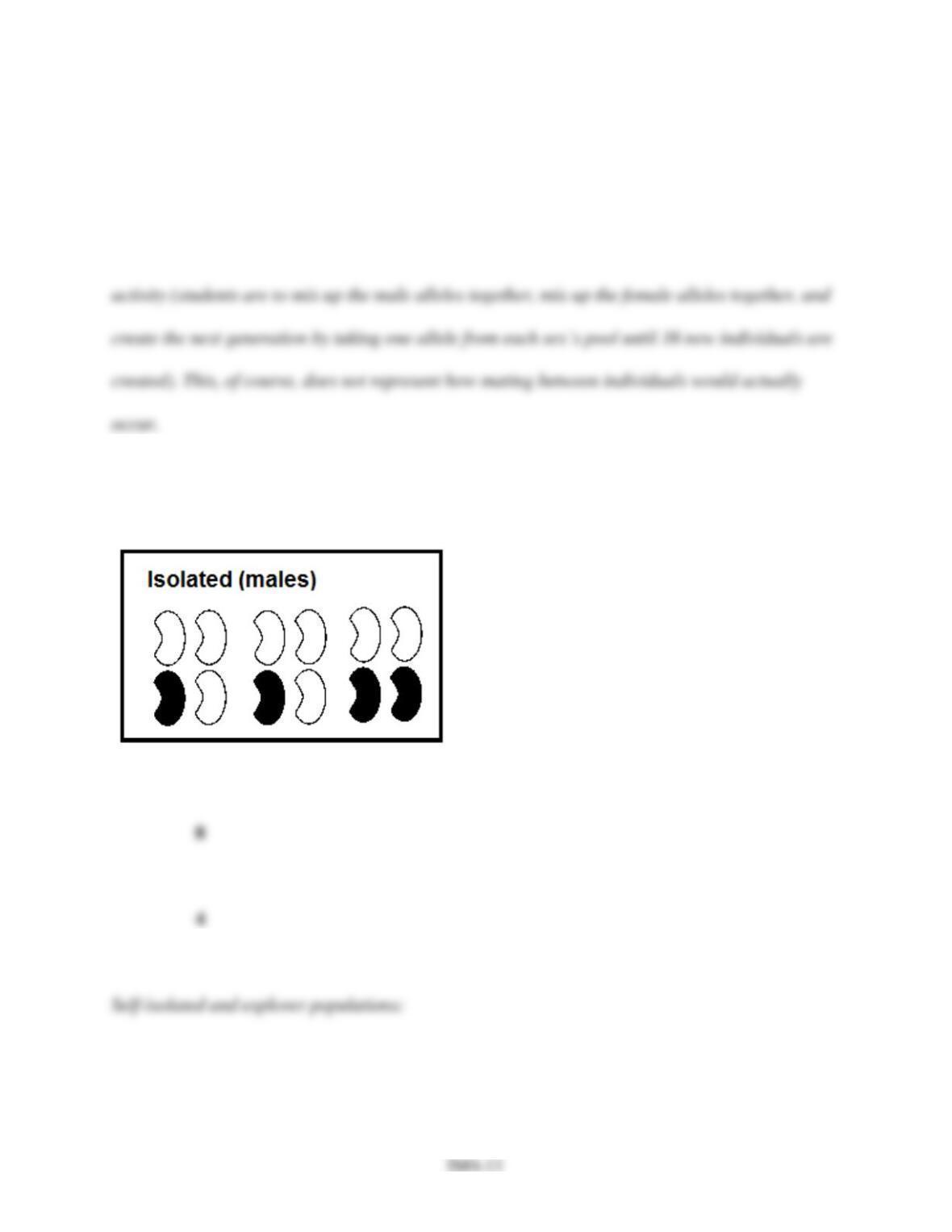
same color beans as in other exercises, to limit how many bean types you need to have on hand.
However, we find that when the same beans are used for multiple exercises, students start to
confuse the exercises and concepts.]
To keep students focused on the gene-flow issue, we simplified the mating stage (Step 4) in the
STEP 2: Create the original, self-isolated population.
Self-isolated population:
1. How many recessive alleles are present in this self-isolated population?
2. How many dominant alleles are present in this self-isolated population?
STEP 3: Create the explorer population.