IM13-1
LABORATORY MANUAL AND WORKBOOK FOR BIOLOGICAL
ANTHROPOLOGY INSTRUCTOR’S MANUAL
Lab 13: Primate Evolution
ANSWERS TO LAB 13 CONCEPT REVIEW QUESTIONS
1. A fossil is defined as the traces or remains of an organism preserved in rock. Fossils
longer snouts, are not usually larger, and do have more enclosed bony orbits).
IM13-2
GUIDE & ANSWERS TO LAB 13 EXERCISES
Exercise 1: Plesiadapiforms (5 to 10 minutes)
For this exercise, you could use your own materials to supplement or replace the images of the
Carpolestes simpsoni skeleton provided in the text.
In 2002, researchers reported the discovery of a partial skeleton from the genus Carpolestes. It
lived in North America around 56 mya. It was about the size of a mouse and had a pronounced
snout. It also had grasping hands and feet and a mix of nails and claws. It did not have a
postorbital bar (instead, the eye socket had very little bony support). This fossil has been
classified as a plesiadapiform.
1. Describe at least one feature that Carpolestes shares in common with other
plesiadapiforms such as Plesiadapis.
IM13-3
3. Do you think this new find forces us to reconsider the relationship between
plesiadapiforms and primates? Why or why not?
Exercise 2: Adapiforms and Omomyoids (5 to 10 minutes)
For this exercise, you could use your own materials to supplement or replace the images
provided in the lab Image Library, showing a cranium and a reconstruction drawing for (A)
Notharctus and (B) Tetonius.
Use the fossil descriptions here and the material provided by your instructor (or the images in the
Lab 13 Exercise Image Library on p. 396) to answer the questions that follow.
Mystery fossil genus A lived in North America in the mid-Eocene. Its teeth had shearing
crests, indicating a folivorous diet.
Mystery fossil genus B lived in North America in the early Eocene. Its teeth suggest it
was insectivorous.
1. Which of these mystery fossils is an adapiform?
IM13-4
2. Which of these mystery fossils is an omomyoid?
3. Describe at least two traits you used to make these identifications. (Be sure to
describe how each trait differs between the two mystery fossils—for example, fossil
A has this trait, but fossil B does not.)
Exercise 3: Darwinius (5 to 10 minutes)
For this exercise, you could use your own materials to supplement or replace the image provided
in the text of the complete Darwinius masillae skeleton.
Use the images provided here to answer the questions that follow.
In 2009, a new fossil species, called Darwinius masillae, was identified in Germany,
represented by a nearly complete skeleton nicknamed Ida (depicted in the lab manual). It lived
around 47 mya. It had a small brain, short protruding snout, large eyes, and postorbital bar. Its
diet probably included a lot of fruit and leaves. It did not have a dental comb. It had nails instead
of claws and was probably an arboreal quadruped. Researchers disagree about whether the fossil
is more similar to living haplorhines (tarsiers, monkeys, and apes) or more similar to
strepsirhines (lemurs and lorises). The skeleton is about 23 inches (58 cm) long including the
tail, and has a body length of about 9 inches (24 cm) without the tail.
1. Describe at least two features that Darwinius shares with living haplorhines.
IM13-5
2. Describe at least two features that the fossil shares with living strepsirhines.
3. Would you classify Darwinius as a haplorhine relative or a strepsirhine relative?
Why?
Exercise 4: Fossil New World and Old World Monkeys (5 to 10 minutes)
For this exercise, you could use your own materials to supplement or replace the images
provided (A = Cercopithecoides cranium and mandible, B = Killikaike blakei cranium).
Use the fossil descriptions here and images here and any supplemental material provided by your
instructor to answer the questions that follow.
Mystery fossil genus A has been dated to the late Pliocene and early Pleistocene. Its
canines were sexually dimorphic, and it had bilophodont molars. Its postcranial traits indicate it
was a terrestrial quadruped, and its overall body size was over 55 lb. (25 kg).
Mystery fossil genus B has been dated to the early Miocene. It is estimated that adults
weighed around 2 lb. (1 kg), with some sexual dimorphism possible in body weight and canine
size.
1. Which of these mystery fossils is a fossil Old World monkey?
2. Which of these mystery fossils is a fossil New World monkey?
3. Describe at least two traits you used to make these identifications. (Be sure to
describe how each trait differs between the two mystery fossils—for example, fossil
A has this trait, but fossil B does not.)
Exercise 5: Theropithecus (5 to 10 minutes)
For this exercise, you could use your own materials to supplement or replace the images
provided of a Theropithecus skeleton and reconstruction.
Use the fossil descriptions here and images here to answer the questions that follow.
Theropithecus lived in Africa at the end of the Pliocene and in the early Pleistocene. It
had two premolars in each mouth quadrant and bilophodont molars. Its teeth indicate an unusual
diet that emphasized grasses. It had larger canines and a much larger body size than its living
primate relatives. Its postcranial traits suggest it was a well-adapted terrestrial quadruped.
IM13-7
1. Do you think this fossil has more in common with living colobines or with living
cercopithecines?
2. Describe at least one trait you used to make this classification.
Exercise 6: Sivapithecus (5 to 10 minutes)
For this exercise, you could use your own materials to supplement or replace the images
provided in the lab Image Library, showing a Sivapithecus cranium between a chimpanzee
cranium and an orangutan cranium for comparison.
Use the fossil description here and any supplemental material provided by your instructor (or the
photos in the Lab 13 Exercise Image Library on p. 396) to answer the questions that follow.
Sivapithecus lived in Asia 12 to 8 mya. It had a 2.1.2.3 dental formula and adaptations for
chewing hard food such as seeds and nuts. It had very few postcranial adaptations for suspensory
locomotion, but it did have long fingers. It also had tall orbits that sat close together.
1. Is Sivapithecus more similar to living Asian great apes or to living African great
apes?
IM13-8
2. Describe at least two traits you used to make this distinction.
Exercise 7: Dating Methods (5 to 10 minutes)
Use the stratigraphy drawing provided to answer the questions that follow.
1. Draw a star next to the oldest layer.
2. Circle the youngest (most recent) layer.
3. In layer B, you find an unfossilized bone. What chronometric dating method could
you use to date this layer? For what date range would this method be appropriate?
4. In layer D, you find a fossilized bone. Layer C and layer E are made of volcanic rock.
Given what is available at the site, what strategy will you use to determine a
chronometric date for layer D? (Be sure to specify the exact dating method or
methods used and the corresponding applicable age ranges.)
IM13-9
ANSWERS TO LAB 13 CRITICAL THINKING QUESTIONS
1. Answers to the questions of what four traits the earliest primates had, the advantages
imparted by the traits, and whether plesiadapiforms had those traits will vary, but
students should focus on traits that are found in most (if not all) primates. They should
2. Mystery fossil primate A (lived in the early to middle Miocene in South America; had
an enclosed bony orbit, three premolars in each mouth quadrant, and dentition suggesting
IM13-10
dimorphic canines and teeth that suggest a frugivorous diet; postcrania indicate some
• Mystery fossil primate C (lived in the late Miocene and Pliocene in Africa; had two
3. Specific answers regarding the traits defining anthropoids, catarrhines, and apes may
vary, but students should touch on major characteristics for each group (and underline the
traits that are likely to preserve in fossils). Anthropoid characteristics would include
IM13-11
4. Completed Fossil Primate Charts, providing date and location, important anatomical
traits, behaviors (such as diet and locomotion), and the most closely related living
5. Answers may vary, but sample answers are provided here:
A. Africa has numerous fossil primates, including Aegyptopithecus, Proconsul,
Nyanzapithecus, and Victoriapithecus. Alternate answer: Europe (adapiforms,
B. The Americas have a limited number of fossils because fossilization is not common
C. Omomyoids compared to Aegyptopithecus: omomyoids had large eyes (with possible
nocturnal lifestyles), a postorbital bar, small bodies, and possible leaping adaptations;
IM13-12
D. Aegyptopithecus compared to Proconsul: Aegyptopithecus had a smaller monkey-
sized body, a tail, and some sexual dimorphism; Proconsul had a large body, no tail,
6. A completed Dating Methods Chart, listing each dating method, whether the method is a
relative or chronometric method, the material needed for analysis, and the approximate
7. Student answers may vary slightly, but should touch upon these main themes:
A. Rocks, particularly volcanic rocks, are commonly used in dating (some methods
B. Anthropologists studying early primate evolution would find stratigraphic dating,

IM13-13
C. Anthropologists studying our more recent lineage would also find stratigraphic
IM13–14
FOSSIL PRIMATE CHART (PART ONE)
Fossil Group or
Species
Dates and
Locations
Anatomical Traits
Behavior
Relationship to
Living Primates
Paleocene
No postorbital bar; no nails; no
grasping hands and feet; small
Possible first
IM13–15
large eyes; short snout; no
dental comb
some leaping
Enclosed bony orbit; fused
Probably frugivorous,
Anthropoid
IM13–16
FOSSIL PRIMATE CHART (PART TWO)
Fossil Group or
Species
Dates and
Locations
Anatomical Traits
Behavior
Relationship to
Living Primates
Bilophodont molars; wide
Frugivory (with heavy
Some adaptations for
IM13–17
Khoratpithecus
Miocene
Broad incisors and orangutan-
Frugivory (probably hard
Ape
(orangutan
IM13–18
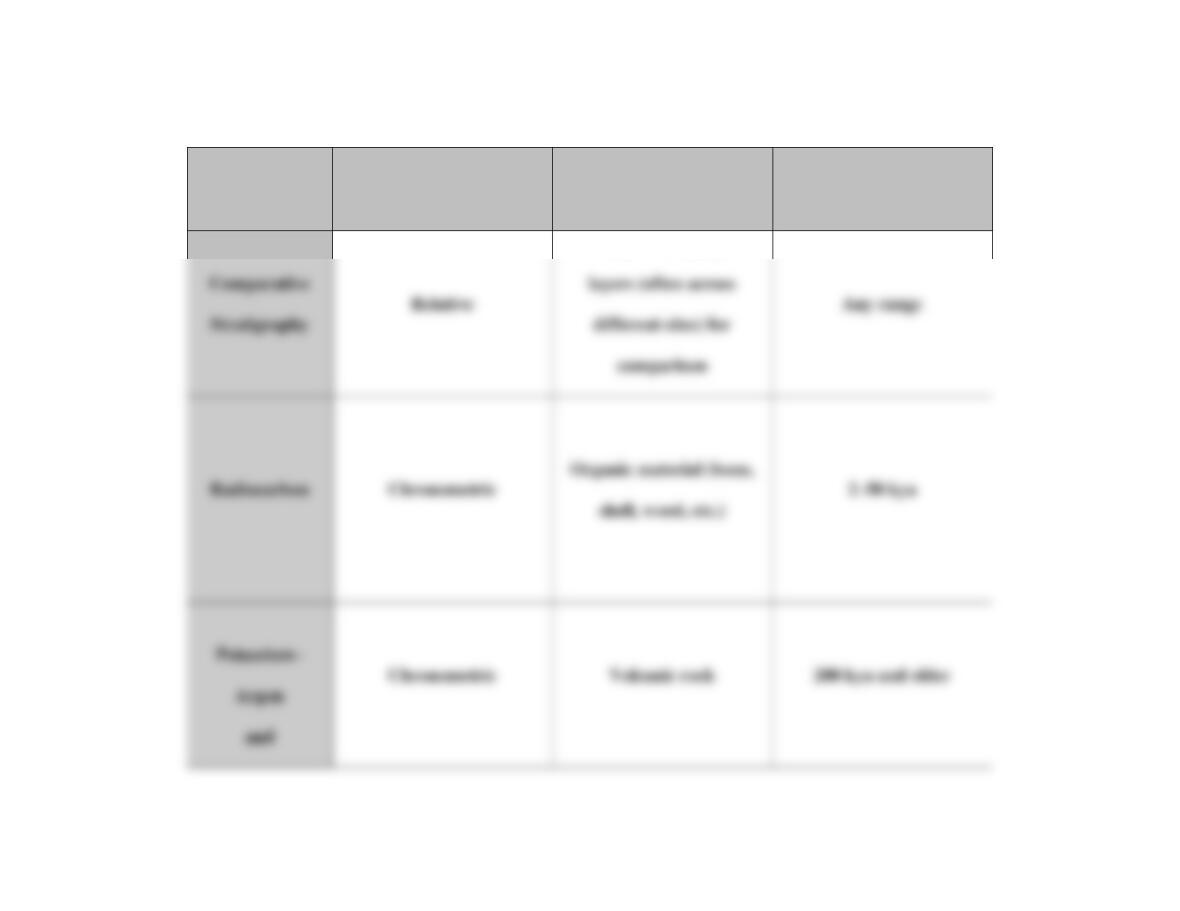
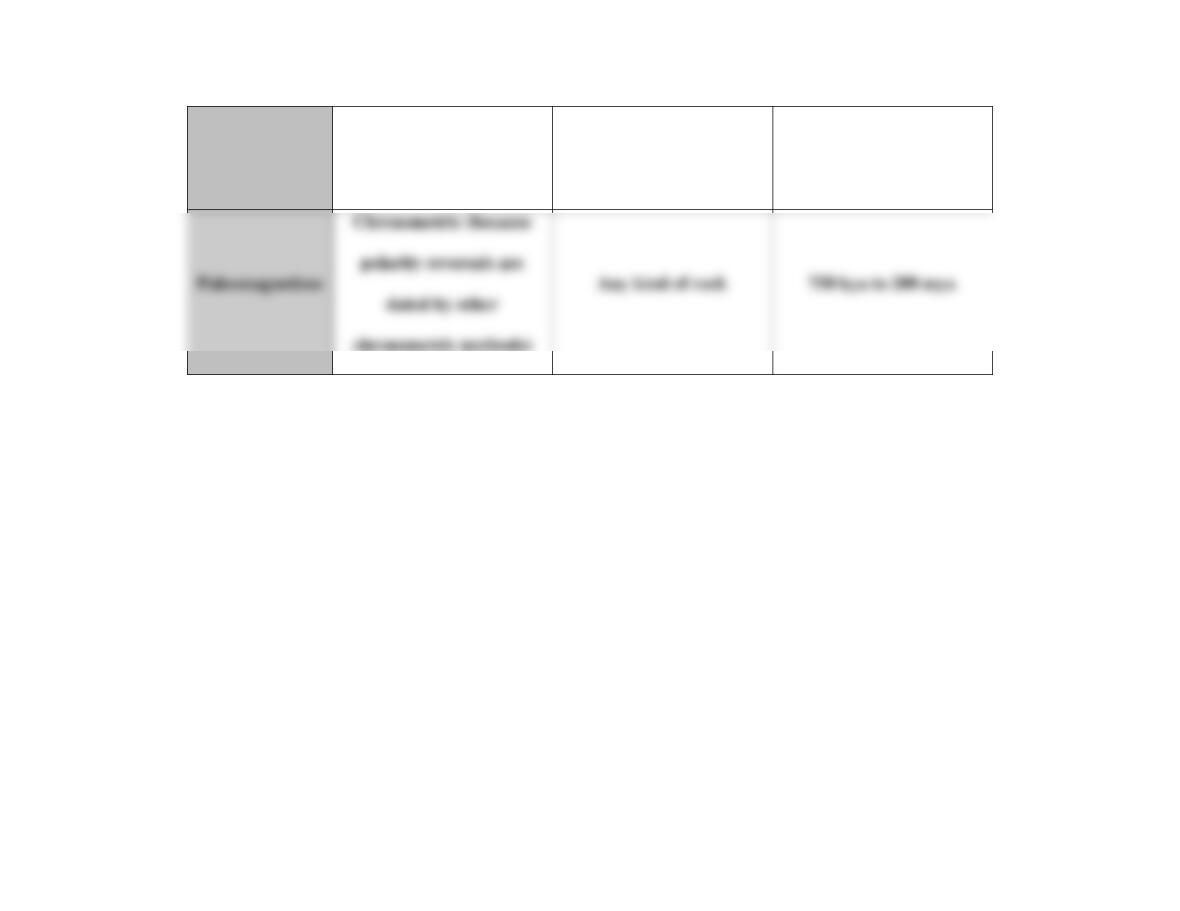
DATING METHODS CHART
Dating Method
Relative or
Chronometric?
Material Needed
Date Range
Multiple stratigraphic
IM13–19
Argon–Argon
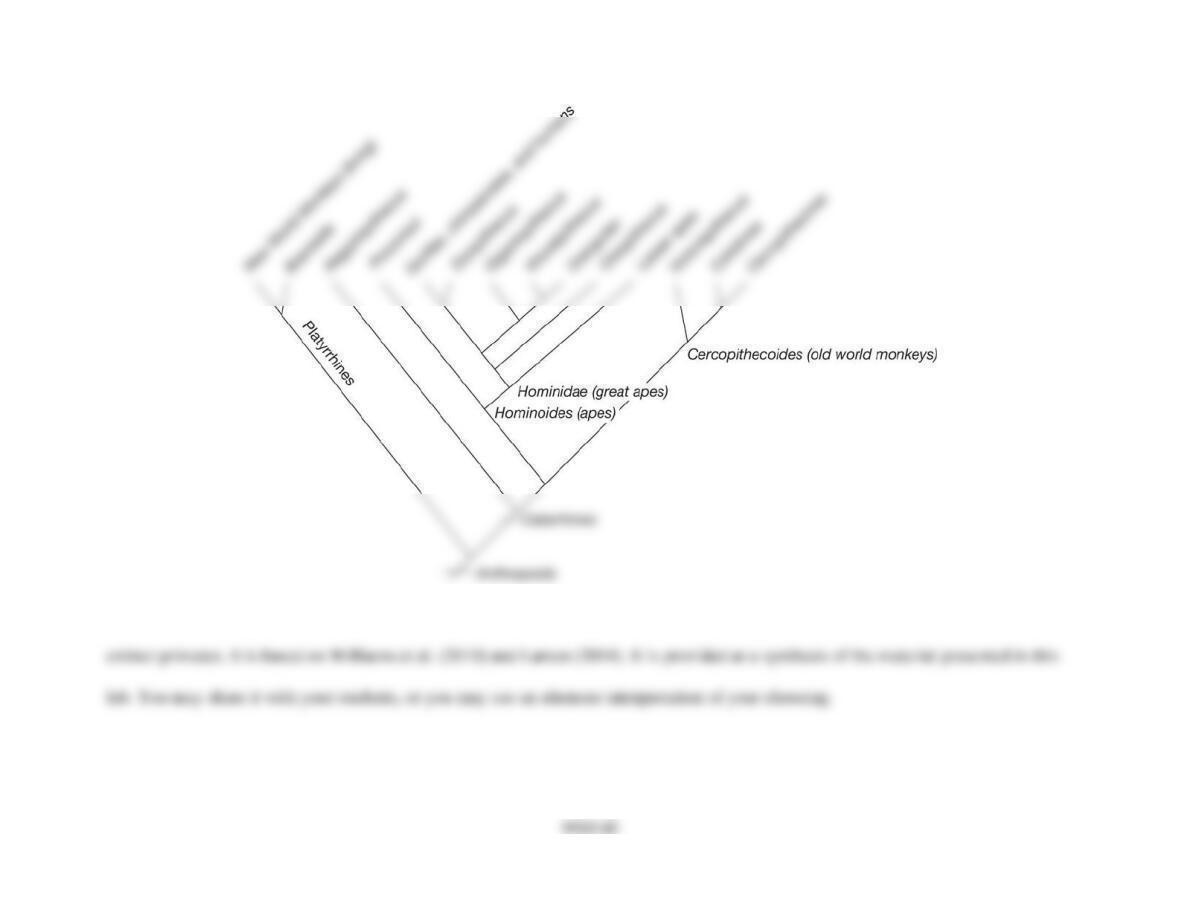
Cladogram of Living and Extinct Primates. This cladogram shows one possible interpretation of the relationship between living and