LABORATORY MANUAL AND WORKBOOK FOR BIOLOGICAL
ANTHROPOLOGY INSTRUCTOR’S MANUAL
Lab 10: Overview of the Living Primates
ANSWERS TO LAB 10 CONCEPT REVIEW QUESTIONS
1. Three traits found in primates that distinguish them from other mammals include any
three of the following: social; uniparous; extended growth and development;
2. A. Lorises are most closely related to lemurs.
5. Traits shared by tarsiers, lorises, and lemurs include small bodies; a diet with a lot of
IM10-2
6. One trait that distinguishes the platyrrhines (Greek platys = “flat”) and catarrhines (Greek
cata- = “down”), including how they differ between groups, could include one of these:
7. C. A prehensile tail is a trait found in some New World monkeys and in none of the Old
8. B. The colobine is the type of primate that lives in the forests of central Africa, is
9. Two traits found in apes but not in other primates include any two of the following: Y-5
10. D. The gibbon is the type of primate that lives in the forests of Southeast Asia, is
arboreal and swings through the trees, has Y-5 molars and eats a lot of fruit, and lives in
GUIDE & ANSWERS TO LAB 10 EXERCISES

IM10-3
For this exercise, the text indicates that students should document at least one trait, so you may
determine the exact number of traits your students should include in their answers. Images of a
primate cranium and nonprimate mammal cranium are provided in the Lab 10 Image Library,
but you could use your own materials to supplement or replace those images. [Note: The Image
Library photo shows a macaque cranium and a dog cranium, but you may use other species of
your choosing.]
Use the mystery mammals provided (or the photos in the Lab 10 Exercise Image Library on p.
303) to complete the chart below. Identify whether the mystery mammal is a primate and list at
least one trait that helped you make this determination.
Primate
(Yes or No)?
Trait(s)
Exercise 2: Lorises and Lemurs (5 to 10 minutes)
For this exercise, the text indicates that students should document at least one trait, so you may
IM10-4
PART A: Use the primate material provided by your instructor (or the photos in the Lab 10
Exercise Image Library on p. 304) to complete the chart below. Identify whether the primate is
nocturnal or diurnal and list at least one trait that helped you make this determination. The lab
Image Library provides photos of a galago and a mandrill.
Nocturnal or
Diurnal?
Trait(s)
PART B: Use the primate crania provided by your instructor (or the photos in the Lab 10
Exercise Image Library on p. 304) to complete the chart below. Identify whether the primate is a
lemur or an anthropoid and list at least one trait that helped you make this determination. The lab
Image Library provides photos of a squirrel monkey cranium and a lemur cranium.
Lemur or
Anthropoid?
Trait(s)
Exercise 3: Tarsiers (5 to 10 minutes)
For this exercise, you could use your own materials to supplement or replace the images of a
tarsier in the wild and a tarsier cranium provided in the lab Image Library.
1. Tarsiers have an unusual mix of anatomical features. Describe at least one anatomical
trait that is unique to tarsiers.
2. Are tarsiers more closely related to lemurs and lorises or to monkeys and apes? Describe
three anatomical traits that can be used as evidence to support your answer.
Exercise 4: Distinguishing New World Monkeys and Old World Monkeys (5 minutes)
For this exercise, the text indicates that students should document at least two traits, so you may
determine the exact number of traits your students should include in their answers. Images of the
inferior views of the upper dentition from a hamadryas baboon and a spider monkey are
provided in the Lab 10 Image Library, but you could use your own materials to supplement or
replace the images provided. You may also choose to use different examples of New World and
Old World monkeys to suit your needs.
1. Which of these monkeys is a New World monkey?
IM10-6
2. Which of these monkeys is an Old World monkey?
3. Describe at least two traits you used to make these identifications. (Be sure to describe
how each trait differs in the two monkeys.)
In each mouth quadrant, monkey B has three premolars as in New World monkeys,
Exercise 5: Distinguishing Old World Monkeys and Apes (5 to 10 minutes)
For this exercise, the text indicates that students should document at least one trait, so you may
determine the exact number of traits your students should include in their answers. Images of
Old World monkeys and apes are provided in the Lab 10 Image Library, but you could use your
own materials to supplement or replace the images provided.
PART A: The lab Image Library provides drawings of the lower premolars and molars of a
colobine and a gorilla. [Note: You may provide crania and mandibles from an Old World
monkey and an ape if you choose. If you provide full crania, students may notice additional
traits, such as the large braincase and orthognathic face in apes (smaller braincase and
prognathic face in Old World monkeys).]
Use the primate crania provided (or the drawings of lower premolar and molar teeth in the Lab
10 Exercise Image Library on p. 306) to complete the chart below. Identify whether the primate
IM10-7
is an Old World monkey or an ape and list at least one dental trait that helped you make this
determination.
Old World
Monkey or Ape?
Trait(s)
PART B: The lab Image Library provides photos of a gibbon and a vervet monkey. [Note: You
may provide complete (or partial) skeletons of an ape and Old World monkey if you choose. If
you provide full skeletons, students may notice additional traits, such as the large braincase, the
orthognathic face, long arms, and long fingers in apes (smaller braincase, prognathic face,
shorter relative arm length, and shorter fingers in Old World monkeys).]
Use the primate material provided (or the photos in the Lab 10 Exercise Image Library on p.
306) to complete the chart below. Identify whether the primate is an Old World monkey or an
ape and list at least one nondental trait that helped you make this determination.
Old World
Monkey or Ape?
Nondental Trait(s)
ANSWERS TO LAB 10 CRITICAL THINKING QUESTIONS
1. Answers will vary depending on the nonprimate mammal selected to compare to
primates. Possible similarities include overall body plan (such as having four limbs),
2. Possible challenges posed by an arboreal lifestyle include problems with balancing on
tree branches, limited availability of certain food types (such as fruit or grass), and
difficulty in seeing predators and potential mates through dense vegetation. To help with
balancing in trees, primate have grasping hands and feet, tactile pads on their hands to
collect information about what they touch, stereoscopic vision to help gauge distances,
IM10-9
3. Students may choose any nocturnal primate (strepsirhine, tarsier, owl monkey). They
should generally note that the eyes are close together, large, sometimes shiny (due to
tapetum lucidum). Students may note that primates have some degree of bony protection
for the eye (postorbital bar in strepsirhines and full enclosure in tarsier and owl monkey),
4. Answers to this question, where students view a primate fact sheet and evaluate whether
geographic distribution agrees with taxonomic classification, will vary depending on the
primate chosen. Students should highlight the defining characteristics seen in the
IM10-10
5. Answers to this will vary, but students should support their opinion with relevant
information from the ethical guidelines laid out by expert primatologists (such as the
American Society of Primatologists:
6. Answers may vary, but sample answers are provided here:
A. Africa has numerous nonhuman primates, including lemurs (in Madagascar), lorises
(specifically galagos), Old World monkeys, gorillas, chimpanzees, and bonobos.
IM10-11
B. Antarctica does not have any nonhuman primates. (North America has very few, with
C. Comparing the lemur compared to the chimpanzee: They have numerous general
primate traits in common (grasping hands and feet, stereoscopic vision, bony eye
support, tactile pads on hands and feet, etc.). Distinguishing traits: Lemurs have small
bodies, postorbital bars, long snouts, rhinaria, unfused mandibles, dental combs, more
D. Comparing New World monkeys to Old World monkeys: They have numerous
general primate traits in common (grasping hands and feet, stereoscopic vision, bony
eye support, tactile pads on the hands and feet, etc.) and numerous anthropoid traits in
IM10-12
E. A fruit diet is found in some lemurs, NWM, OWM, gibbons, and orangutans. A diet
F. Locomotion on all fours in trees is found in lorises, lemurs, NWM, and OWM.
G. Students should select an ape, ideally a chimpanzee/bonobo or gorilla. They should
IM10-13
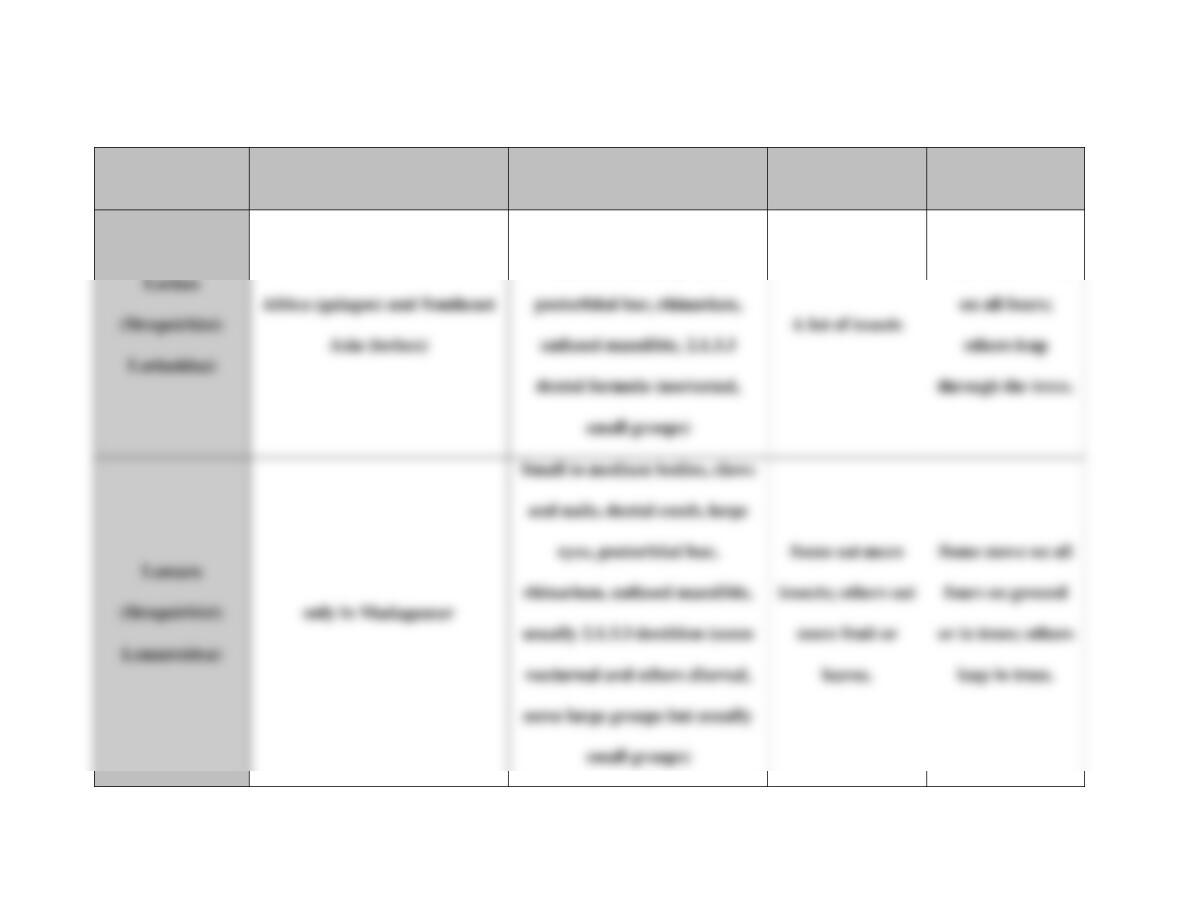
LIVING PRIMATE CHART (PART ONE)
Primate Group
Geographic Location
3 to 5 Anatomical Traits
(Some behavior also noted here
in case students include it)
Diet
Primary
Locomotion
Small bodies, claws and nails,
dental comb, large eyes,
Some move slowly
IM10-14
Tarsiers
(Haplorhini:
Southeast Asia
Small bodies, claws and nails,
no dental comb, very large
eyes, more bony eye support,
no rhinarium, very long legs
A lot of insects
Leaping through
IM10-15
Medium to large bodies, color
vision, full bony eye support,
Colobines eat
IM10-16
LIVING PRIMATE CHART (PART TWO)
Primate Group
Geographic Location
3 to 5 Anatomical Traits
(Some behavior also noted here
in case students include it)
Diet
Primary
Locomotion
Medium bodies, color vision, full
bony eye support, fused
(diurnal and solitary/small
groups)
Large bodies, color vision, full
bony eye support, fused
IM10-18