Archives
978-0133020267 Chapter 01
Managerial Economics, 7e (Keat) Chapter 1 Introduction Multiple-Choice Questions 1) The best definition of economics is A) how choices are made under conditions of scarcity. B) how money is used. C) how goods and services are produced. D) how businesses […]
978-0133020267 Chapter 02
Managerial Economics, 7e (Keat) Chapter 2 The Firm and Its Goals Multiple-Choice Questions 1) Transaction costs include A) costs of negotiating contracts with other firms. B) cost of enforcing contracts. C) the existence of asset-specificity. D) All of the above […]
978-0133020267 Chapter 03 Part 1
Managerial Economics, 7e (Keat) Chapter 3 Supply and Demand (Appendix 3A) Multiple-Choice Questions 1) How long is the “short-run” time period in the economic analysis of the market? A) three months or one business quarter B) total time in which […]
978-0133020267 Chapter 03 Part 2
30) Which of the following would lead to a short-run market surplus for tomatoes? A) The price of tomatoes increases. B) A new government study shows that tomatoes have a greater risk of contamination from salmonella. C) An increase in […]
978-0133020267 Chapter 04 Part 1
Managerial Economics, 7e (Keat) Chapter 4 Demand Elasticity (Appendix 4A) Multiple-Choice Questions 1) The price elasticity of demand is a measure of A) the responsiveness of the quantity demanded to price changes. B) the quantity demanded at a given price. […]
978-0133020267 Chapter 04 Part 2
30) If the price elasticity of supply of a good is elastic and the good price increases, then the increase in the good’s supply should be A) greater than the increase in price. B) less than the increase in price. […]
978-0133020267 Chapter 05 Part 1
Managerial Economics, 7e (Keat) Chapter 5 Demand Estimation and Forecasting (Appendices 5A and 5B) Multiple-Choice Questions 1) Regression analysis can best be described as A) a statistical technique for estimating the best relationship between one variable and a set of […]
978-0133020267 Chapter 05 Part 2
43) Quantitative forecasting that projects past data without explaining the reasons for future trends is called A) scientific forecasting. B) dumb forecasting. C) empirical forecasting. D) naïve forecasting. 44) Which of the following is not a drawback of forecasting using […]
978-0133020267 Chapter 06 Part 1
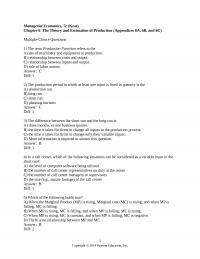
Managerial Economics, 7e (Keat) Chapter 6 The Theory and Estimation of Production (Appendices 6A, 6B, and 6C) Multiple-Choice Questions 1) The term Production Function refers to the A) use of machinery and equipment in production. B) relationship between costs and […]
978-0133020267 Chapter 06 Part 2
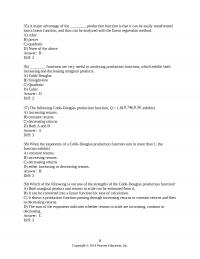
35) A major advantage of the ________ production function is that it can be easily transformed into a linear function, and thus can be analyzed with the linear regression method. A) cubic B) power C) quadratic D) None of the […]
978-0133020267 Chapter 07 Part 1
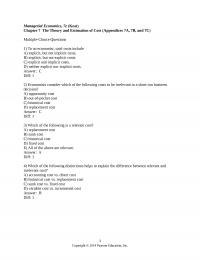
Managerial Economics, 7e (Keat) Chapter 7 The Theory and Estimation of Cost (Appendices 7A, 7B, and 7C) Multiple-Choice Questions 1) To an economist, total costs include A) explicit, but not implicit costs. B) implicit, but not explicit costs. C) explicit […]
978-0133020267 Chapter 07 Part 2
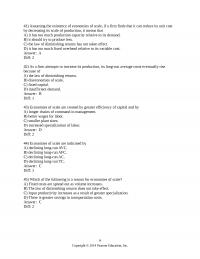
41) Assuming the existence of economies of scale, if a firm finds that it can reduce its unit cost by decreasing its scale of production, it means that A) it has too much production capacity relative to its demand. B) […]
978-0133020267 Chapter 08 Part 1
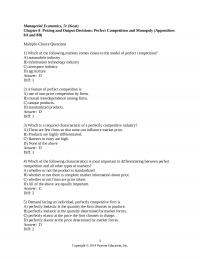
Managerial Economics, 7e (Keat) Chapter 8 Pricing and Output Decisions: Perfect Competition and Monopoly (Appendices 8A and 8B) Multiple-Choice Questions 1) Which of the following markets comes closes to the model of perfect competition? A) automobile industry B) information technology […]
978-0133020267 Chapter 08 Part 2
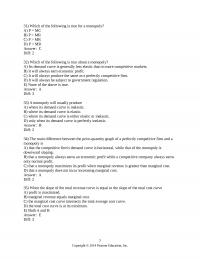
31) Which of the following is true for a monopoly? A) P = MC B) P = MR C) P > MR D) P < MR 32) Which of the following is true about a monopoly? A) Its demand curve […]
978-0133020267 Chapter 09
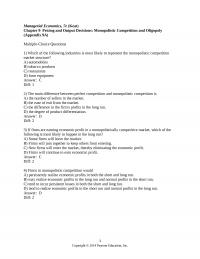
Managerial Economics, 7e (Keat) Chapter 9 Pricing and Output Decisions: Monopolistic Competition and Oligopoly (Appendix 9A) Multiple-Choice Questions 1) Which of the following industries is most likely to represent the monopolistic competition market structure? A) automobiles B) tobacco products C) […]
978-0133020267 Chapter 1 Solution Manual
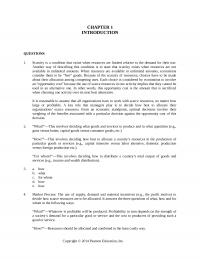
CHAPTER 1 INTRODUCTION QUESTIONS 1. Scarcity is a condition that exists when resources are limited relative to the demand for their use. Another way of describing this condition is to state that scarcity exists when resources are not 2. “What?”—This […]
978-0133020267 Chapter 10 Part 1
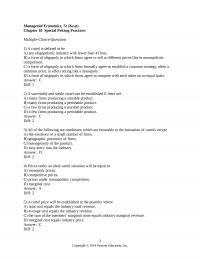
Managerial Economics, 7e (Keat) Chapter 10 Special Pricing Practices Multiple-Choice Questions 1) A cartel is defined to be A) any oligopolistic industry with fewer than 4 firms. B) a form of oligopoly in which firms agree to sell at different […]
978-0133020267 Chapter 10 Part 2
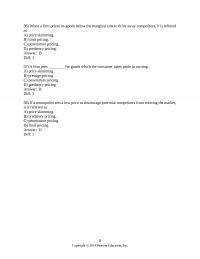
36) When a firm prices its goods below the marginal cost to drive away competitors, it is referred as A) price skimming. B) limit pricing. C) penetration pricing. D) predatory pricing. 37) A firm uses ________ for goods which the […]
978-0133020267 Chapter 10 Solution Manual
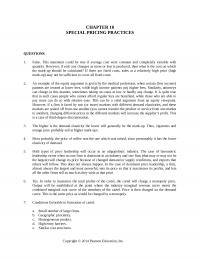
CHAPTER 10 SPECIAL PRICING PRACTICES QUESTIONS 1. False. This statement could be true if average cost were constant and completely variable with 2. An example of the equity argument is given by the medical profession, when certain (low income) patients […]
978-0133020267 Chapter 11
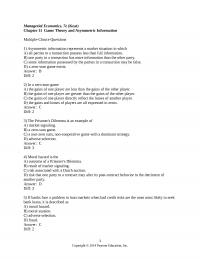
Managerial Economics, 7e (Keat) Chapter 11 Game Theory and Asymmetric Information Multiple-Choice Questions 1) Asymmetric information represents a market situation in which A) all parties to a transaction possess less than full information. B) one party in a transaction has […]
978-0133020267 Chapter 11 Solution Manual
CHAPTER 11 GAME THEORY AND ASYMMETRIC INFORMATION QUESTIONS 1. It is more of a problem for one-shot games. 2. It is a variable sum game. 3. It is more problematic for non-cooperative games. 4. It is easier for an irrational […]
978-0133020267 Chapter 12 Part 1
Managerial Economics, 7e (Keat) Chapter 12 Capital Budgeting and Risk (Appendix 12A) Multiple-Choice Questions 1) The term capital budgeting refers to decisions A) which are made in the short run. B) which concern the spreading of expenditures over a period […]
978-0133020267 Chapter 12 Part 2
39) In evaluating the required rate of return for equity financing of a capital project, the Beta value is A) the expected rate of growth in a firm’s profits. B) the expected future value of a firm’s stock. C) the […]
978-0133020267 Chapter 12 Solution Manual
CHAPTER 12 CAPITAL BUDGETING AND RISK QUESTIONS 1. The objective of capital budgeting is to assess the worth of projects which usually entail large 2. The term “time value of money” simply says that a dollar today is worth more […]
978-0133020267 Chapter 13
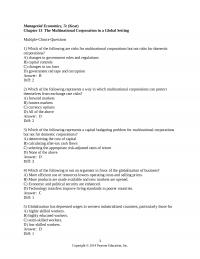
Managerial Economics, 7e (Keat) Chapter 13 The Multinational Corporation in a Global Setting Multiple-Choice Questions 1) Which of the following are risks for multinational corporations but not risks for domestic corporations? A) changes in government rules and regulations B) capital […]
978-0133020267 Chapter 13 Solution Manual
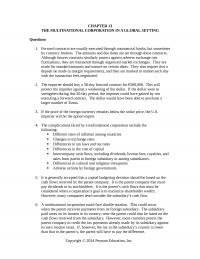
CHAPTER 13 THE MULTINATIONAL CORPORATION IN A GLOBAL SETTING Questions 1. Forward contracts are usually executed through commercial banks, but sometimes by currency brokers. The amounts and due dates are set through these contracts. 2. The importer should buy a […]
978-0133020267 Chapter 14
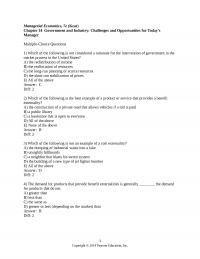
Managerial Economics, 7e (Keat) Chapter 14 Government and Industry: Challenges and Opportunities for Today’s Manager Multiple-Choice Questions 1) Which of the following is not considered a rationale for the intervention of government in the market process in the United States? […]
978-0133020267 Chapter 14 Solution Manual
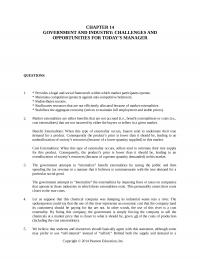
CHAPTER 14 GOVERNMENT AND INDUSTRY: CHALLENGES AND OPPORTUNITIES FOR TODAY’S MANAGER QUESTIONS 1. * Provides a legal and social framework within which market participants operate. 2. Market externalities are either benefits that are not accrued (i.e., benefit externalities) or costs […]
978-0133020267 Chapter 15
Managerial Economics, 7e (Keat) Chapter 15 The Global Soft Drink Industry Multiple-Choice Questions 1) Which of the following best describes the entire U. S. refreshment beverage market? A) monopoly B) oligopoly C) monopolistic competition D) perfect competition 2) Demand in […]
978-0133020267 Chapter 2 Solution Manual
CHAPTER 2 THE FIRM AND ITS GOALS QUESTIONS 1. Yes. The company can profit from this action in several ways. Graduate students, impressed with 2. This is an incomplete objective, and may not be consistent with the objective of profit […]
978-0133020267 Chapter 3 Solution Manual
CHAPTER 3 SUPPLY AND DEMAND QUESTIONS 1. Demand: Quantities of a good or service that people are ready to buy within a given time period “Demand” encompasses all possible quantities demanded at different prices, while “quantity demanded” refers to one […]
978-0133020267 Chapter 4 Solution Manual
CHAPTER 4 DEMAND ELASTICITY QUESTIONS 1. Elasticity refers to the percentage change in one variable relative to a percentage change in another 2. Point elasticity (in connection with the price elasticity of demand) refers to the elasticity at a given […]
978-0133020267 Chapter 5 Solution Manual
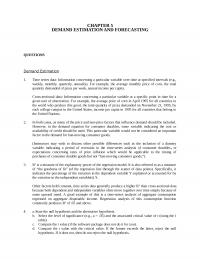
CHAPTER 5 DEMAND ESTIMATION AND FORECASTING QUESTIONS Demand Estimation 1. Time series data: Information concerning a particular variable over time at specified intervals (e.g., 2. In both cases, as many of the price and non-price factors that influence demand should […]
978-0133020267 Chapter 6 Solution Manual
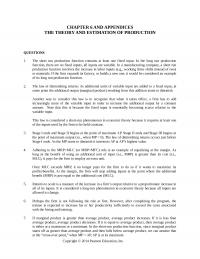
CHAPTER 6 AND APPENDICES THE THEORY AND ESTIMATION OF PRODUCTION QUESTIONS 1. The short run production function contains at least one fixed input. In the long run production 2. The law of diminishing returns: As additional units of variable input […]
978-0133020267 Chapter 7 Solution Manual Part 1
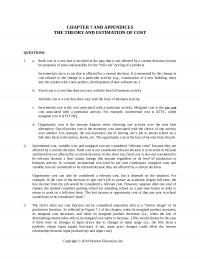
CHAPTER 7 AND APPENDICES THE THEORY AND ESTIMATION OF COST QUESTIONS 1. a. Sunk cost is a cost that is incurred in the past that is not affected by a current decision (except b. Fixed cost is a cost that […]
978-0133020267 Chapter 7 Solution Manual Part 2
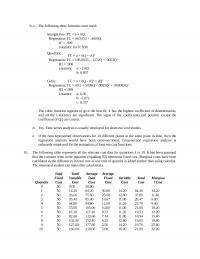
b.-c. The following three formulas were used: The cubic function appears to give the best fit; it has the highest coefficient of determination, and all the t-statistics are significant. The signs of the coefficients (all positive except the coefficient of […]
978-0133020267 Chapter 8 Appendix B
CHAPTER 8 APPENDIX B BREAK-EVEN ANALYSIS (VOLUME-COST-PROFIT) QUESTIONS 1. Volume-cost-profit (break-even) analysis ordinarily utilizes straight-line cost curves. Thus it Since V-C-P analysis also utilizes a straight line revenue curve, it does not identify a maximum profit. It shows profit increasing […]
978-0133020267 Chapter 8 Solution Manual
CHAPTER 8 PRICING AND OUTPUT DECISIONS: PERFECT COMPETITION AND MONOPOLY QUESTIONS 1. All four of the characteristics listed in Figure 8.1A of Chapter 8 are important to ensuring that a. Large number of relatively small sellers: This factor provides buyers […]
978-0133020267 Chapter 9 Solution Manual
CHAPTER 9 PRICING AND OUTPUT DECISIONS: MONOPOLISTIC COMPETITION AND OLIGOPOLY QUESTIONS 1. The key difference is “product differentiation.” 2. a. In a pure monopoly, no one else can enter the market. Thus, the monopolist will enjoy (Instructors may wish to […]
978-0133020267 online only
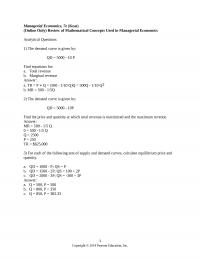
Managerial Economics, 7e (Keat) (Online Only) Review of Mathematical Concepts Used in Managerial Economics Analytical Questions 1) The demand curve is given by: QD = 5000 – 10 P Find equations for: a. Total revenue b. Marginal revenue 2) The […]
978-0133020267 Review Concepts Solution Manual
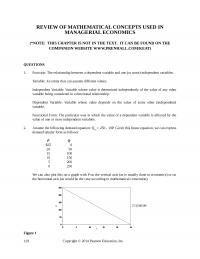
REVIEW OF MATHEMATICAL CONCEPTS USED IN MANAGERIAL ECONOMICS (*NOTE: THIS CHAPTER IS NOT IN THE TEXT. IT CAN BE FOUND ON THE COMPANION WEBSITE WWW.PRENHALL.COM/KEAT) QUESTIONS 1. Function: The relationship between a dependent variable and one (or more) independent variables. […]
978-0133020267 Situations And Solutions Situations And Solutions
SUGGESTED WAYS TO USE THE SITUATIONS AND SOLUTIONS Instructors will probably have their own approaches to using the situations and solutions presented in each chapter. However, we have several suggestions for doing so. First, the situation may be used as […]
BUS 29239
A cartel price will be established at the quantity where A) total cost equals the industry total revenue. B) average cost equals the industry revenue. C) the sum of the members’ marginal costs equals industry marginal revenue. D) marginal cost […]
BUS 62586
The “law” of demand can be best described by A) people will buy things that they enjoy. B) if incomes rise, people will buy more. C) a rise in price will cause shortages. D) a fall in price will increase […]
ECB 13587
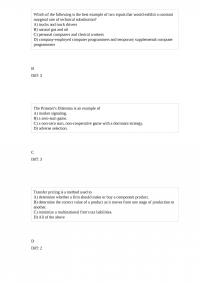
Which of the following is the best example of two inputs that would exhibit a constant marginal rate of technical substitution? A) trucks and truck drivers B) natural gas and oil C) personal computers and clerical workers D) company-employed computer […]
ECB 38228
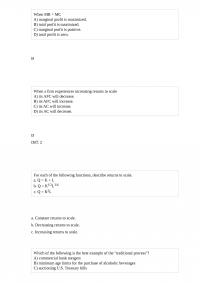
When MR = MC A) marginal profit is maximized. B) total profit is maximized. C) marginal profit is positive. D) total profit is zero. When a firm experiences increasing returns to scale A) its AFC will decrease. B) its AFC […]
ECB 47741
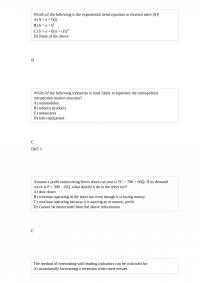
Which of the following is the exponential trend equation to forecast sales (S)? A) S = a + b(t) B) S = a + bt C) S = a + b(t) + c(t)2 D) None of the above Which of […]
ECB 69759
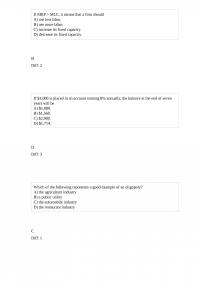
If MRP > MLC, it means that a firm should A) use less labor. B) use more labor. C) increase its fixed capacity. D) decrease its fixed capacity. If $1,000 is placed in an account earning 8% annually, the balance […]
ECB 72028
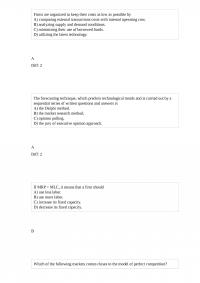
Firms are organized to keep their costs as low as possible by A) comparing external transactions costs with internal operating cost. B) analyzing supply and demand conditions. C) minimizing their use of borrowed funds. D) utilizing the latest technology. The […]
ECB 80540
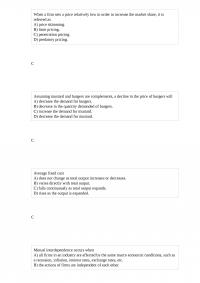
When a firm sets a price relatively low in order to increase the market share, it is referred as A) price skimming. B) limit pricing. C) penetration pricing. D) predatory pricing. Assuming mustard and burgers are complements, a decline in […]
ECON 13814
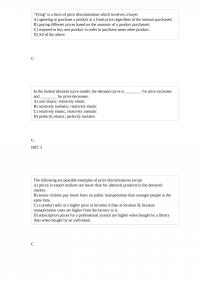
“Tying” is a form of price discrimination which involves a buyer A) agreeing to purchase a product at a fixed price regardless of the amount purchased. B) paying different prices based on the amounts of a product purchased. C) required […]
ECON 15773
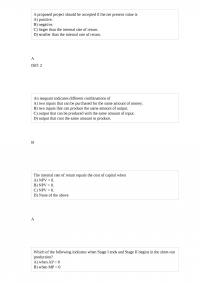
A proposed project should be accepted if the net present value is A) positive. B) negative. C) larger than the internal rate of return. D) smaller than the internal rate of return. An isoquant indicates different combinations of A) two […]
ECON 35714
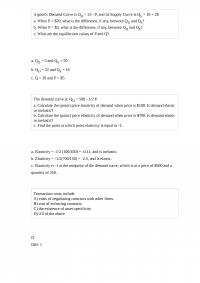
A good’s Demand Curve is QD = 25 – P, and its Supply Curve is QS = 10 + 2P. a. When P = $20, what is the difference, if any, between QD and QS? b. When P = $3, […]
ECON 56043
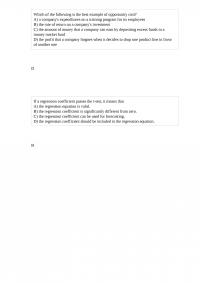
Which of the following is the best example of opportunity cost? A) a company’s expenditures on a training program for its employees B) the rate of return on a company’s investment C) the amount of money that a company can […]
ECON 56356
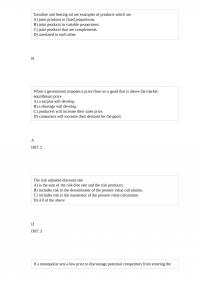
Gasoline and heating oil are examples of products which are A) joint products in fixed proportions. B) joint products in variable proportions. C) joint products that are complements. D) unrelated to each other. When a government imposes a price floor […]
ECON 85411
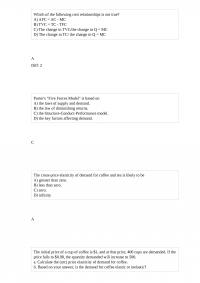
Which of the following cost relationships is not true? A) AFC = AC – MC B) TVC = TC – TFC C) The change in TVC/the change in Q = MC D) The change in TC/ the change in Q […]
ECON 86336
The certainty equivalent approach to accounting for risk in capital budgeting involves A) adjusting the discount rate used to calculate net present values. B) adjusting the expected cash flows. C) estimating the coefficient of variation. D) estimating the standard deviation […]
ECON 88187
The Trend Projection approach to forecasting is represented by A) time-series regressions. B) exponential smoothing. C) opinion polls. D) All of the above The main difference between the price-quantity graph of a perfectly competitive firm and a monopoly is A) […]
ECon A 80465
True, false, or uncertain? Any firm that is not covering fixed costs should shut down in the short run. True, false, or uncertain? Any firm that is not covering fixed costs should shut down in the short run. False. Fixed […]
ECon A 91642
A stock whose rate of return fluctuates less than the rate of return of a market portfolio will have a beta that equals A) 1. B) less than 1. C) more than 1. D) Either A or C above Given […]
ECon A 95868
In perfect competition, if firms enter the market in the long run A) total supply will increase causing market price to increase. B) total supply will decrease causing market price to decrease. C) total supply will decrease causing market price […]
ECON E 48312
In the long run, the most helpful action that a monopolistically competitive firm can take to maintain its economic profit is to A) continue its efforts to differentiate its product. B) raise its price. C) lower its price. D) do […]
ECON E 56332
Which of the following will not cause a short-run shift in the supply curve? A) a change in the number of sellers B) a change in the cost of resources C) a change in the price of the product D) […]
ECON E 68465
Prices under an ideal cartel situation will be equal to A) monopoly prices. B) competitive prices. C) prices under monopolistic competition. D) marginal cost. The demand for products that provide benefit externalities is generally ________ the demand for products that […]
Economics 20893
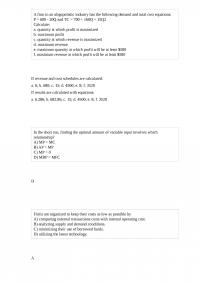
A firm in an oligopolistic industry has the following demand and total cost equations: P = 600 – 20Q and TC = 700 + 160Q + 15Q2 Calculate: a. quantity at which profit is maximized b. maximum profit c. quantity […]
Economics 47281
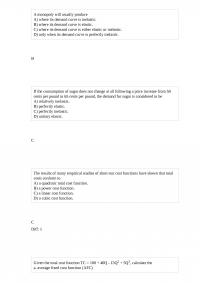
A monopoly will usually produce A) where its demand curve is inelastic. B) where its demand curve is elastic. C) where its demand curve is either elastic or inelastic. D) only when its demand curve is perfectly inelastic. If the […]
Economics 52112
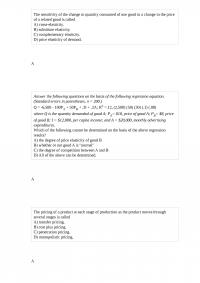
The sensitivity of the change in quantity consumed of one good to a change in the price of a related good is called A) cross-elasticity. B) substitute elasticity. C) complementary elasticity. D) price elasticity of demand. Answer the following questions […]
Economics 56720
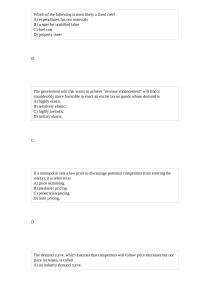
Which of the following is most likely a fixed cost? A) expenditures for raw materials B) wages for unskilled labor C) fuel cost D) property taxes The government unit that wants to achieve “revenue enhancement” will find it considerably more […]
Economics 73856
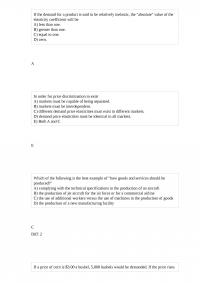
If the demand for a product is said to be relatively inelastic, the “absolute” value of the elasticity coefficient will be A) less than one. B) greater than one. C) equal to one. D) zero. In order for price discrimination […]
Economics 84341
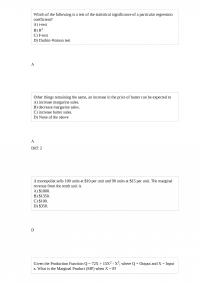
Which of the following is a test of the statistical significance of a particular regression coefficient? A) t-test B) R2 C) F-test D) Durbin-Watson test Other things remaining the same, an increase in the price of butter can be expected […]
MicroEconomic 12527
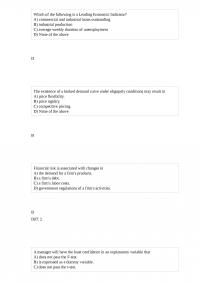
Which of the following is a Leading Economic Indicator? A) commercial and industrial loans outstanding B) industrial production C) average weekly duration of unemployment D) None of the above The existence of a kinked demand curve under oligopoly conditions may […]
MicroEconomic 18453
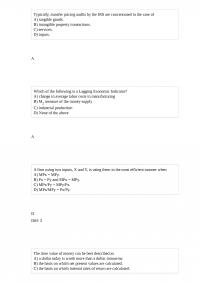
Typically, transfer pricing audits by the IRS are concentrated in the case of A) tangible goods. B) intangible property transactions. C) services. D) inputs. Which of the following is a Lagging Economic Indicator? A) change in average labor costs in […]
MicroEconomic 94044
Which of the following is the best example of how the question of “what goods and services to produce?” is answered by the command process? A) government subsidies for windmill energy production B) laws regarding equal opportunity in employment C) […]