
True, false, or uncertain? Any firm that is not covering fixed costs should shut down in
the short run.
True, false, or uncertain? Any firm that is not covering fixed costs should shut down in
the short run.
If government imposes a price ceiling on a good that is below the market equilibrium
price
A) a surplus will develop.
B) a shortage will develop.
C) producers will reduce their sales price.
D) consumers will reduce their demand for the good.
Assume a perfectly competitive firm’s short-run cost is TC = 100 + 160Q + 3Q2. If the
market price is $196, what should it do?
A) produce 5 units and continue operating
B) produce 6 units and continue operating
C) produce zero units (i.e., shut down)
D) Cannot be determined from the above information
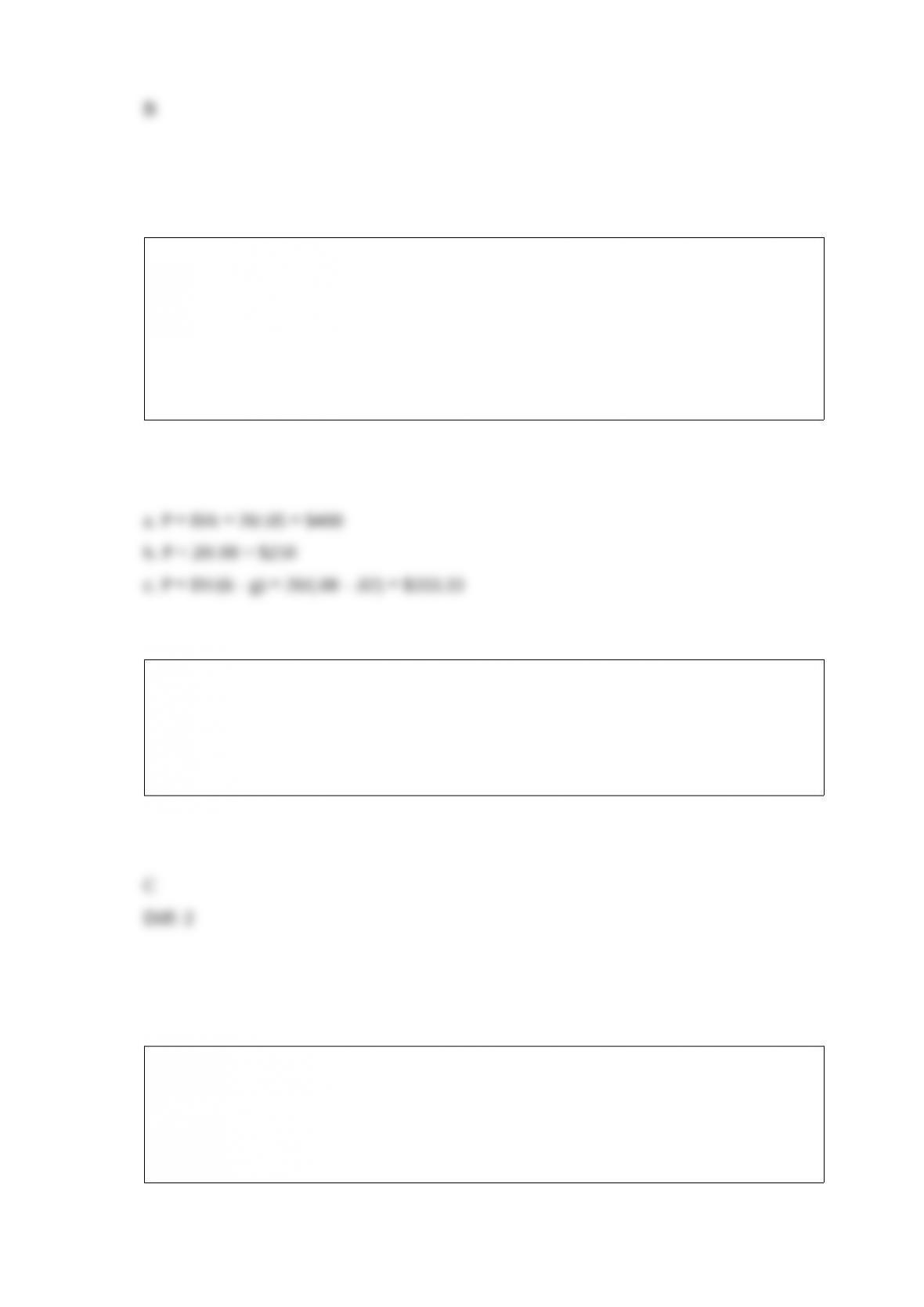
a. If a stock is expected to pay an annual dividend of $20 forever, what is the
approximate present value of the stock, given that the discount rate is 5%?
b. If a stock is expected to pay an annual dividend of $20 forever, what is the
approximate present value of the stock, given that the discount rate is 8%?
c. If a stock is expected to pay an annual dividend of $20 this year, what is the
approximate present value of the stock, given that the discount rate is 8% and dividends
are expected to grow at a rate of 2% per year?
Stage III of the short-run Production Function is
A) the most efficient mix of inputs.
B) the least costly level of output.
C) where additional units of variable inputs will lead to less output.
D) where additional units of variable inputs will lead to more output.
Diseconomies of scale can be caused by
A) the law of diminishing returns.
B) bureaucratic inefficiencies.
C) increasing advertising and promotional costs.
D) All of the above

From the standpoint of a soft drink company the question of “What goods and services
should be produced?” is best represented by which of the following decisions?
A) whether or not to hire additional workers
B) whether or not to increase its advertising
C) whether or not to shut down selected manufacturing facilities
D) None of the above are examples.
Average fixed cost is
A) AC minus AVC.
B) TC divided by Q.
C) AVC minus MC.
D) TC minus TVC.
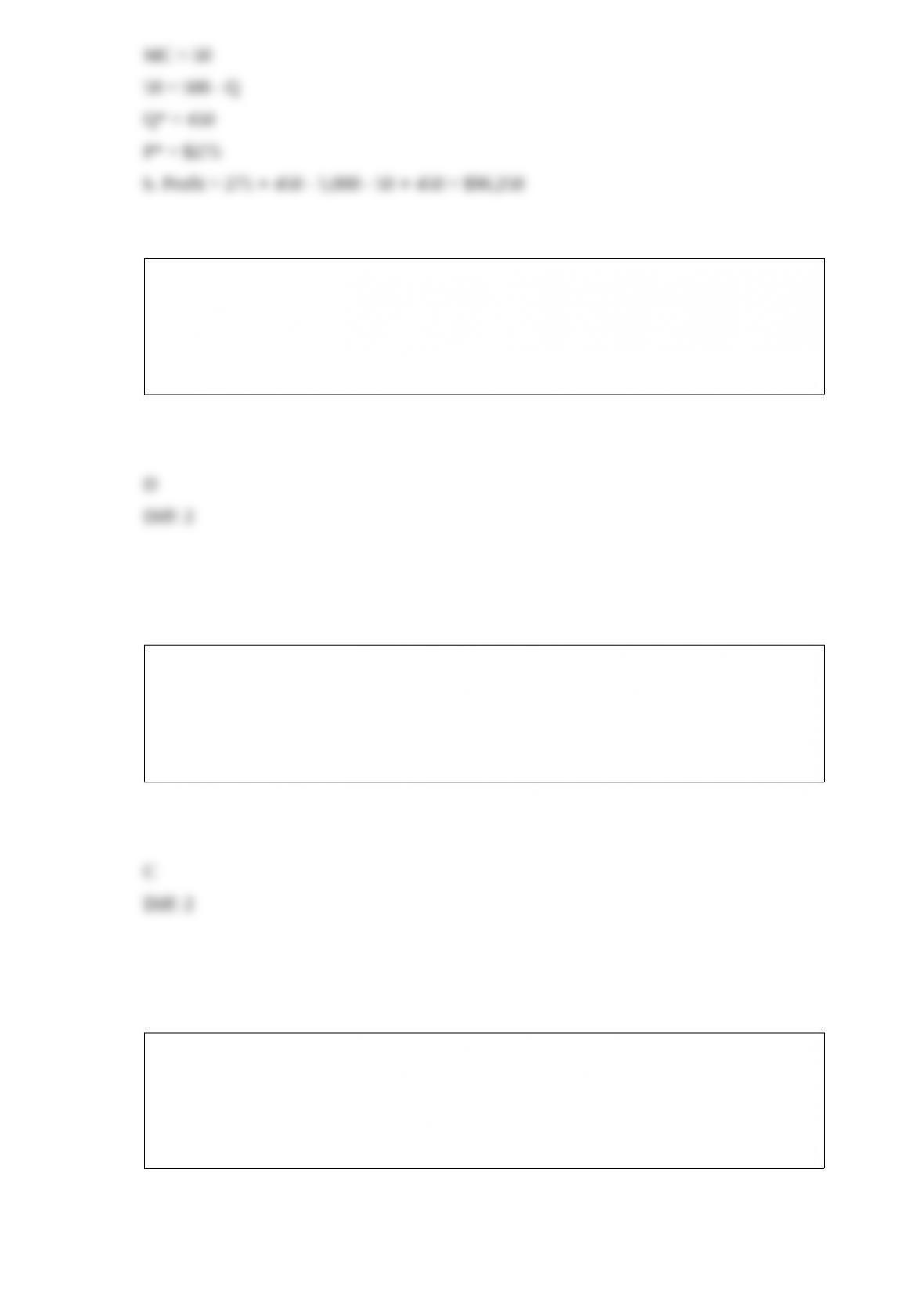
A monopolist has demand and cost curves given by:
QD = 1000 – 2P
TC = 5,000 + 50Q
a. Find the monopolist’s profit-maximizing quantity and price.
b. Find the monopolist’s profit.
Demand facing an individual, perfectly competitive firm is
A) perfectly inelastic at the quantity the firm chooses to produce.
B) perfectly inelastic at the quantity determined by market forces.
C) perfectly elastic at the price the firm chooses to charge.
D) perfectly elastic at the price determined by market forces.
If a product which costs $8 is sold at $10, the profit margin is
A) $2.
B) 25%.
C) 20%.
D) None of the above
The guiding function of price is
A) the movement of price to clear the market of any shortages or surpluses.
B) the use of price as a signal to guide government on the use of market subsidies.
C) a long-run function resulting in the movement of resources into or out of markets.
D) the movement of price as a result of changes in the demand for a product.

When using regression analysis for forecasting, the confidence interval indicates
A) the degree of confidence that one has in the equation’s R2.
B) the range in which the value of the dependent variable is expected to lie with a given
degree of probability.
C) the degree of confidence that one has in the regression coefficients.
D) the range in which the actual outcome of a forecast is going to lie.
Which of the following indicates when Stage II ends and Stage III begins in the
short-run production function?
A) when AP = 0
B) when MP = 0
C) when MP = AP
D) when MP starts to diminish
The results of many empirical studies of short-run cost functions have shown that total
costs conform to
A) a quadratic total cost function.
B) a power cost function.
C) a linear cost function.
D) a cubic cost function.

Table 1
The following information is provided for Tony Romo’s income and expenditures.
Quantity Purchased per Month
Monthly Income Steaks Pizzas
$2,000 2 8
$3,000 4 6
In Table 1, Tony’s income elasticity of demand for steaks is
A) 1.0.
B) greater than 1.0.
C) less than 1.0.
D) zero.
Net present value and internal rate of return capital budgeting decisions can differ
because
A) the initial costs of the capital outlays differ.
B) the cash flow streams differ.
C) the discount rates differ for different time periods.
D) All of the above
Third-degree price discrimination exists when
A) the seller knows exactly how much each potential customer is willing to pay and
will charge accordingly.
B) different prices are charged by blocks of services.
C) when the seller can separate markets by geography, income, age, etc., and charge
different prices to these different groups.
D) when the seller will bargain with buyers in each of the markets to obtain the best

possible
price.
If firms are earning economic profit in a monopolistically competitive market, which of
the following is most likely to happen in the long run?
A) Some firms will leave the market.
B) Firms will join together to keep others from entering.
C) New firms will enter the market, thereby eliminating the economic profit.
D) Firms will continue to earn economic profit.
The use of a dummy variable in regression analysis indicates
A) that a researcher does not really know what to include in the equation.
B) that a categorical variable is expected to have an impact on a dependent variable.
C) that insufficient data is available for the analysis.
D) the use of hypothetical data.
The F-test is used to determine if
A) a regression coefficient is significant.
B) multicollinearity exists.
C) a regression equation significantly accounts for the variation in the value of a
dependent variable.
D) an identification problem is present.

Isocost curves represent
A) least cost combinations of inputs.
B) combinations of inputs that can be purchased given their prices for the same total
cost.
C) a producers cost function.
D) None of the above
The kinked demand curve model best reflects
A) mutual interdependence among sellers.
B) a game theory approach to price-output decisions.
C) price rigidities in oligopolistic markets.
D) All of the above
The result for the seller of being able to practice price discrimination will be
A) higher profits.
B) lower demand elasticity.
C) lower quantity sold.
D) cost minimization.

The Trend Projection approach to forecasting is represented by
A) time-series regressions.
B) exponential smoothing.
C) opinion polls.
D) All of the above
Which of the following would cause a decrease in the price of a good?
A) an increasing shift in the supply of a good and no shift in demand
B) a decreasing shift in the supply of a good and no shift in demand
C) an increasing shift in the demand for good and no shift in supply
D) an increasing shift in the demand for good and a decreasing shift in supply
In the Baumol model, a change in fixed costs will
A) increase total quantity sold.
B) have no effect on total quantity sold.
C) decrease total quantity sold.
D) have an effect on total quantity sold.

Under conditions of first-degree price discrimination
A) production will equal that which would exist under perfect competition.
B) production will exceed that which would prevail under perfect competition.
C) prices will be lower than under perfect competition.
D) production will always be lower than under perfect competition.
The use of a dummy variable in regression analysis indicates
A) that a researcher does not really know what to include in the equation.
B) that a categorical variable is expected to have an impact on a dependent variable.
C) that insufficient data is available for the analysis.
D) the use of hypothetical data.
When two mutually exclusive projects are considered, the NPV calculations and the
IRR calculations may, under certain circumstances, give conflicting recommendations
as to which project to accept. The reason for this result is that in the NPV calculation,
cash inflows are assumed to be reinvested at the cost of capital, while in the IRR
solution, reinvestment takes place at
A) the hurdle rate.
B) the accounting rate of return.
C) the prime rate.
D) the project’s internal rate of return.
MVA (Market Value Added)
A) will always be a positive number.
B) may be a negative number.
C) measures the market value of the firm.
D) None of the above
Mutual interdependence means that
A) all firms are price takers.
B) each firm sets its own price based on its anticipated reaction by its competitors.
C) all firms collaborate to establish one price.
D) all firms are free to enter or leave the market.
How would you choose to estimate a production function for a single plant? How
would you choose to estimate a production function for a number of firms in an
industry? Explain.
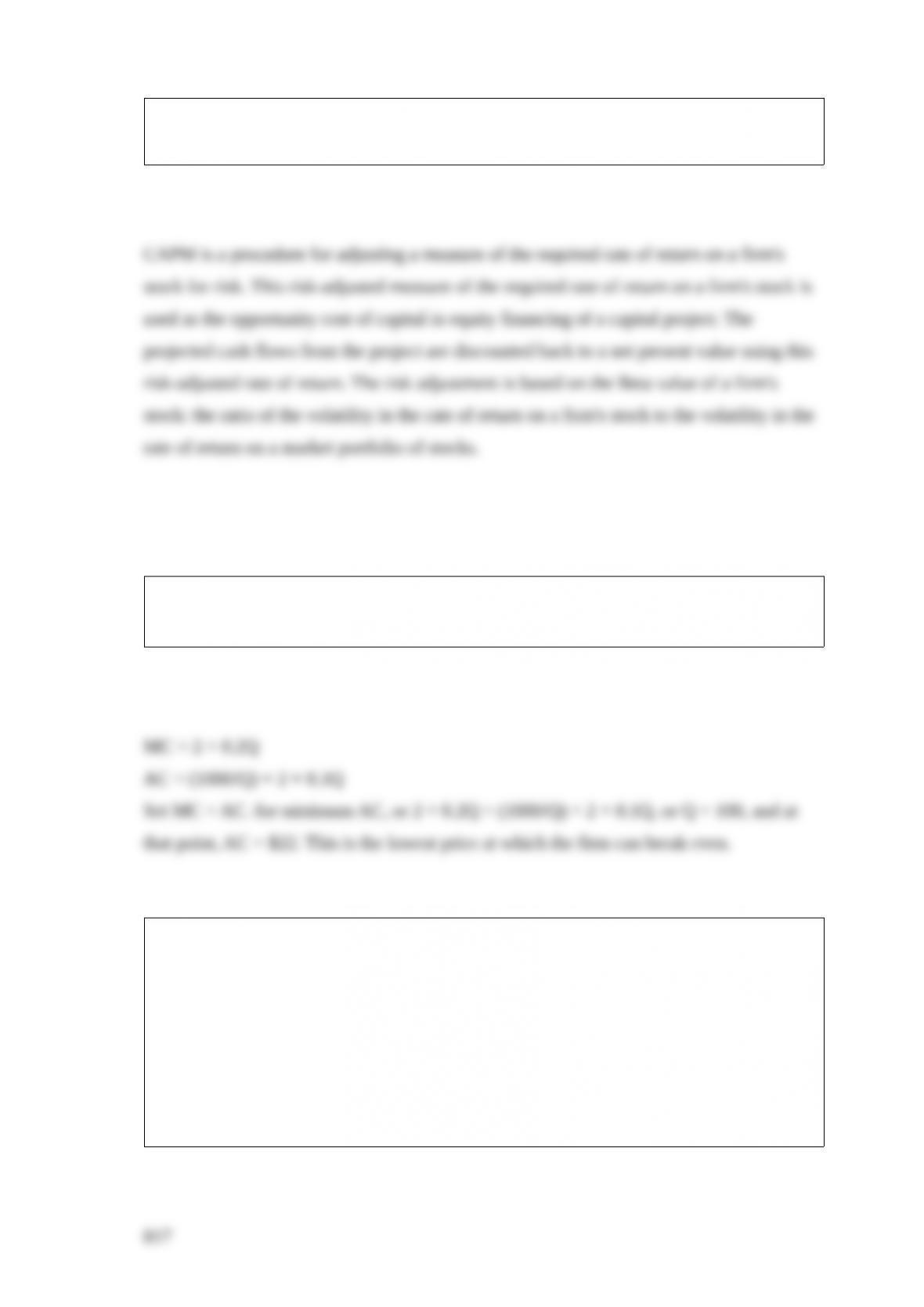
Describe the Capital Asset Pricing Model (CAPM) and how it is used in capital
budgeting decisions.
A perfectly competitive firm has the cost function TC = 1000 + 2Q + 0.1 Q2. What is
the lowest price at which this firm can break even?
The following are the actual sales for the last six periods:
Period Sales
1 750
2 820
3 600
4 850
5 900
6 700
Using a 3-month moving average, what would be your prediction for period 7?

The following are the sales achieved by Jensen Fabrics during the last 7 years:
2007 $116,000
2008 124,000
2009 127,000
2010 146,000
2011 155,000
2012 154,000
2013 162,000
Using the compound growth rate calculation, what would be your estimate for sales in
2014?
In the Sunday newspaper, there are usually coupons that you can clip and take to the
store to save money on products. Anyone can buy a newspaper, and the value of the
coupons easily exceeds the price of the newspaper for most consumers. Is this an
example of price discrimination? Explain.
When one automaker begins offering low cost financing or rebates, others tend to do
the same. What two oligopoly models might offer an explanation of this behavior?
Inc.’s stock is currently $50. The last dividend that they paid was $1. If dividends are
expected to increase at a 10% annual rate, what is the firm’s equity cost of capital?
What is “asymmetric information”?
The following are the actual sales for the last six periods:
Period Sales
1 750
2 820
3 600
4 850
5 900
6 700
Using a 3-month moving average, what would be your prediction for period 7?
What are the main factors driving the food companies to change their product lines in
the beverage industry and how has the industry responded?
What additional complexities arise when multinational corporations consider capital
projects on a global basis?
Describe the basic motives for businesses to merge.
Q = K1/2L1/2
w = $2, r = $2
The firm would like to know the maximum output that can be produced for $8,000.
Find the combination of inputs that maximizes output for a cost of $8,000, the amount
of output that can be produced, and identify the expansion path.
The following questions refer to this regression equation, (standard errors in
parentheses.)
Q = 8,400 – 10 P + 5 A + 4 Px + 0.05 I, (1,732) (2.29) (1.36) (1.75) 0.15)
R2 = 0.65
N = 120
F = 35.25
Standard error of estimate = 34.3
Q = Quantity demanded
P = Price = 1,000
A = Advertising expenditures, in thousands = 40
PX = price of competitor’s good = 800
I = average monthly income = 4,000
Should this firm be concerned if macroeconomic forecasters predict a recession?
Explain.
A function of government is to regulate “natural monopolies.” Explain what is a natural
monopoly and why it requires government regulation.