
35) A major advantage of the ________ production function is that it can be easily transformed
into a linear function, and thus can be analyzed with the linear regression method.
A) cubic
B) power
C) quadratic
D) None of the above
36) ________ functions are very useful in analyzing production functions, which exhibit both
increasing and decreasing marginal products.
A) Cobb-Douglas
B) Straight-line
C) Quadratic
D) Cubic
37) The following Cobb-Douglas production function, Q = 1.8L0.74K0.36, exhibits
A) increasing returns.
B) constant returns.
C) decreasing returns.
D) Both A and B
38) When the exponents of a Cobb-Douglas production function sum to more than 1, the
function exhibits
A) constant returns.
B) increasing returns.
C) decreasing returns.
D) either increasing or decreasing returns.
39) Which of the following is not one of the strengths of the Cobb-Douglas production function?
A) Both marginal product and returns to scale can be estimated from it.
B) It can be converted into a linear function for ease of calculation.
C) It shows a production function passing through increasing returns to constant returns and then
to decreasing returns.
D) The sum of the exponents indicates whether returns to scale are increasing, constant or
decreasing.
8

40) An advantage of using the cross-sectional regression method in estimating production is that
A) the problem of technological change over time is overcome.
B) there is no need to adjust data, which are in monetary terms for geographical differences.
C) we can assume that all plants operate at their most efficient input combinations.
D) All of the above
Analytical Questions
Number of
Workers Output
0 0
1 50
2 110
3 300
4 450
5 590
6 665
7 700
8 725
9 710
10 705
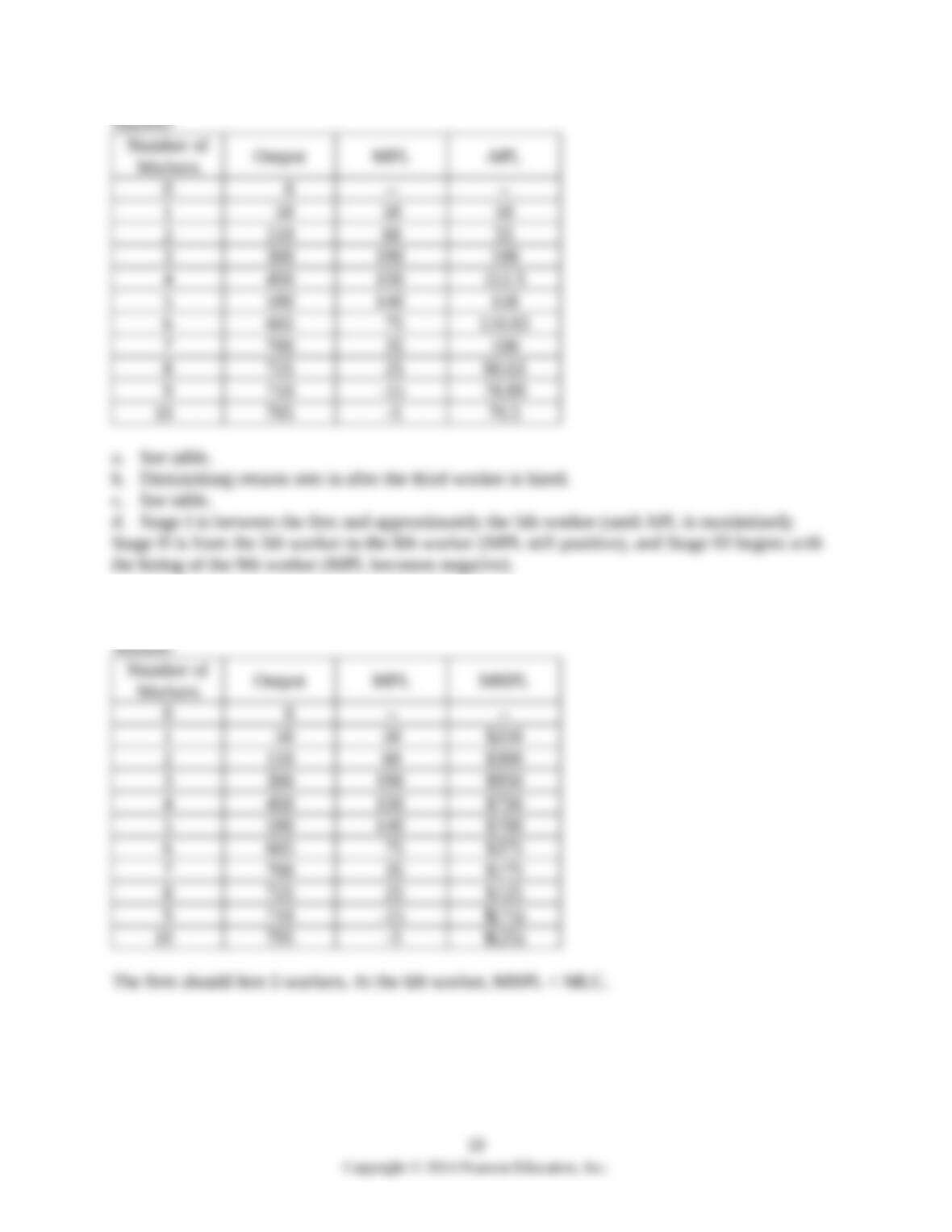
1) The table above shows the weekly relationship between output and number of workers for a
factory with a fixed size of plant.
a. Calculate the marginal product of labor.
b. At what point does diminishing returns set in?
c. Calculate the average product of labor.
d. Find the three stages of production.
9
2) Based on the table above, if the wage rate is $500 and the price of output is $5, how many
workers should the firm hire?
3) A firm has two plants, one in the United States and one in Mexico, and it cannot change the
size of the plants or the amount of capital equipment. The wage in Mexico is $5. The wage in the
U.S. is $20. Given current employment, the marginal product of the last worker in Mexico is
100, and the marginal product of the last worker in the U.S. is 500.
a. Is the firm maximizing output relative to its labor cost? Show how you know.
b. If it is not, what should the firm do?
4) A firm is making a long-run planning decision. It wants to decide on the optimal size of plant
and labor force. It is considering building a medium-sized plant and hiring 100 workers.
Engineering estimates suggest that at those levels, the marginal product of capital will be 100
and the marginal product of labor will be 75. If the wage rate is $5 and the rental rate on capital
is $10, is the firm making the right decision? Support your answer.
5) For each of the following functions, describe returns to scale.
a. Q = K + L
b. Q = K1/2L3/4
c. Q = K2L
6) How would you choose to estimate a production function for a single plant? How would you
choose to estimate a production function for a number of firms in an industry? Explain.

7) What are the major issues that must be considered in measuring inputs for regression analysis
of production functions?
8) What does the expansion path represent?
9) Q = K1/2L1/2
w = $2, r = $2
The firm would like to know the minimum cost of producing 2000 units of output. Find the
combination of inputs that minimizes the cost of producing 2000 units, the total cost, and
identify the expansion path.
10) Q = K1/2L1/2
w = $2, r = $2
The firm would like to know the maximum output that can be produced for $8,000. Find the
combination of inputs that maximizes output for a cost of $8,000, the amount of output that can
be produced, and identify the expansion path.
11) If the price of capital is $24, the price of labor is $15, and the marginal product of capital is
16, the least costly combination of capital and labor requires that the marginal product of labor
be ________.
12) If a production function is given by the equation Q = 12X + 10X2 – X3, where Q = Output
and X = Input, then calculate the equations for
a. average product
b. marginal product
c. point of diminishing average returns
d. point of diminishing marginal returns
13) Given the Production Function Q = 72X + 15X2 – X3, where Q = Output and X = Input
a. What is the Marginal Product (MP) when X = 8?
b. What is the Average Product (AP) when X = 6?
c. At what value of X will Q be at its maximum?
d. At what value of X will Diminishing Returns set in?