Archives: Quiz
Economics 434 In the Keynesian
In the Keynesian aggregate expenditures model, “aggregate expenditures” refer to: a. the amount of GDP that could be produced if unemployment were zero. b. the combined expenditures of consumers, businesses, governments, and foreigners (net exports). c. the amount of demand […]
BUS 450 Test 2
Which of the following best represents the effects of an increase in the price of coffee, other things being equal? a. A leftward shift in the demand curve for coffee. b. A downward movement along the demand curve for coffee. […]
Economics 254 Which of the
Which of the following events is the most likely to create stagflation? a. An increase in the money supply. b. A reduction in the amount spent on national defense. c. A doubling of oil prices. d. A decrease in investment […]
ECON E 771 Quiz 2
The marginal propensity to consume is defined as the: a. fraction of total income not spent on consumption. b. proportion of any change in income that is spent on consumption. c. fraction of total income spent on consumption. d. fraction […]
Economics 379 Test 2
Which of the following provides the best explanation of why money is valuable? a. Money is valuable because it is indivisible. b. Money is valuable because it is scarce. c. Money is valuable because it is backed by precious metals, […]
ECON E 770 Midterm 1
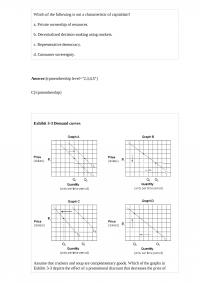
Which of the following is not a characteristic of capitalism? a. Private ownership of resources. b. Decentralized decision-making using markets. c. Representative democracy. d. Consumer sovereignty. Exhibit 3-3 Demand curves Assume that crackers and soup are complementary goods. Which of […]
ECB 847 Quiz 2
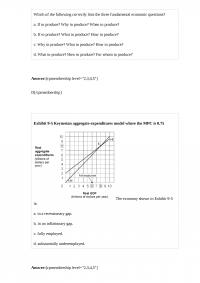
Which of the following correctly lists the three fundamental economic questions? a. If to produce? Why to produce? When to produce? b. If to produce? What to produce? How to produce? c. Why to produce? What to produce? How to […]
ECB 131 Midterm 2
Supply-siders feel that high levels of government spending: a. assist private sector investing by creating infrastructure. b. have no impact on private sector investment. c. complement private spending. d. cause private sector investment to decline because of crowding out. e. […]
ECON 475 Quiz
If a country’s goods exports are less than its goods imports, then it experiences a: a. balance of payments surplus. b. balance of payments deficit. c. balance of trade surplus. d. balance of trade deficit. Actual GDP will be below […]
Economics 782
Which of the following statements is not true? a. If marginal social cost and marginal private cost are the same, any externality that exists will be positive. b. If marginal externality costs are not zero, externalities exist. c. An expansion […]
ECON 127
According to the quantity theory of money, if M’s growth is lower than Q’s, then: a. V falls. b. V rises. c. P stays the same d. P falls. e. P rises People who often impose cost on the majority […]
MicroEconomic 564
Assume the economy is operating at a real GDP above full-employment real GDP. Keynesian economists would prescribe which of the following policies? a. Nonintervention b. Fixed rule c. Contractionary d. Expansionary The use of a dollar bill to buy a […]
ECB 287 Quiz 2
Which of the following is not a function of the Federal Reserve System? a. To control the money supply. b. To print new money. c. To supervise and regulate banks. d. To aid in the check clearing process. e. To […]
BUS 258 Quiz 3
Foreachstatementprovided,choosetheletteroftheappropriatetermfromthelistthateachstate mentbestdescribes.Sometermsmaybeusedmorethanonce,whileothersarenotusedatall. a. Capital stock b. Asset c. Owners’ equity d. Time period e. Dividends f. Economic entity concept g. Expense h. Retained earnings i. Cost principle j. Creditor k. Liability l. Revenue m. Going concern n. Monetary unit o. […]
ECON E 846
A competitive market economy is unlikely to provide an efficient quantity of some public goods because: a. only the government has the vast resources necessary to produce public goods. b. the nature of public goods makes it difficult for producers […]
Economics 177
Comparative advantage indicates that: a. specialization and exchange will permit trading partners to maximize their joint consumption. b. a nation can gain from trade only if it is not at an absolute disadvantage in producing all goods. c. a nation […]
ECB 250 Homework
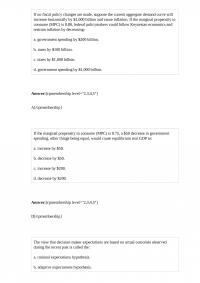
If no fiscal policy changes are made, suppose the current aggregate demand curve will increase horizontally by $1,000 billion and cause inflation. If the marginal propensity to consume (MPC) is 0.80, federal policymakers could follow Keynesian economics and restrain inflation […]
ECB 469 Quiz
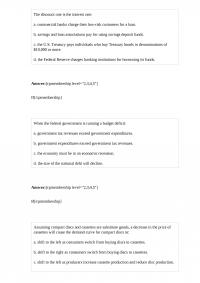
The discount rate is the interest rate: a. commercial banks charge their low-risk customers for a loan. b. savings and loan associations pay for using savings deposit funds. c. the U.S. Treasury pays individuals who buy Treasury bonds in denominations […]
ECON A 565 Test 1
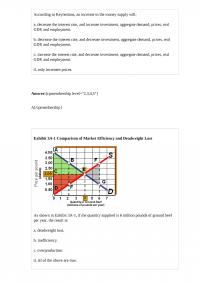
According to Keynesians, an increase in the money supply will: a. decrease the interest rate, and increase investment, aggregate demand, prices, real GDP, and employment. b. decrease the interest rate, and decrease investment, aggregate demand, prices, real GDP, and employment. […]
MicroEconomic 625 Quiz 3
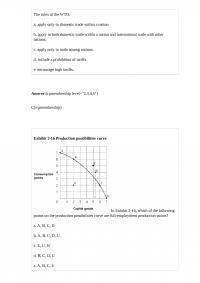
The rules of the WTO: a. apply only to domestic trade within a nation. b. apply to both domestic trade within a nation and international trade with other nations. c. apply only to trade among nations. d. include a prohibition […]
ECON 135 Midterm 2
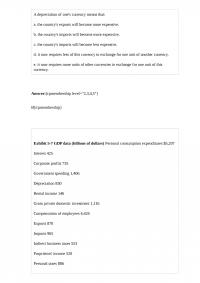
A depreciation of one’s currency means that: a. the country’s exports will become more expensive. b. the country’s imports will become more expensive. c. the country’s imports will become less expensive. d. it now requires less of this currency in […]
ECON E 851 Midterm
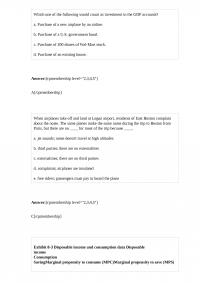
Which one of the following would count as investment in the GDP accounts? a. Purchase of a new airplane by an airline. b. Purchase of a U.S. government bond. c. Purchase of 100 shares of Wal-Mart stock. d. Purchase of […]
ECON E 209 Quiz
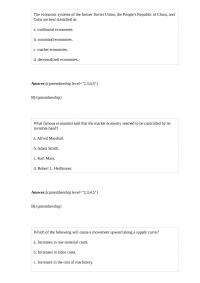
The economic systems of the former Soviet Union, the People’s Republic of China, and Cuba are best classified as: a. traditional economies. b. command economies. c. market economies. d. decentralized economies. What famous economist said that the market economy seemed […]
BUS 580 Test 1
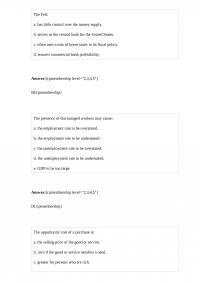
The Fed: a. has little control over the money supply. b. serves as the central bank for the United States. c. often uses a mix of lower taxes in its fiscal policy. d. ensures commercial bank profitability. The presence of […]
ECON A 375 Midterm 1
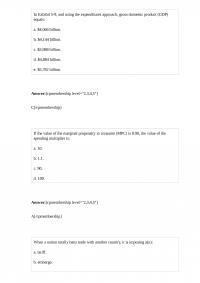
In Exhibit 5-9, and using the expenditures approach, gross domestic product (GDP) equals: a. $4,066 billion. b. $4,144 billion. c. $3,988 billion. d. $4,884 billion. e. $5,782 billion. If the value of the marginal propensity to consume (MPC) is 0.90, […]
Economics 783 Midterm 1
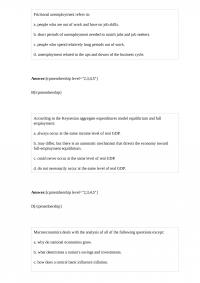
Frictional unemployment refers to: a. people who are out of work and have no job skills. b. short periods of unemployment needed to match jobs and job seekers. c. people who spend relatively long periods out of work. d. unemployment […]
ECON A 223
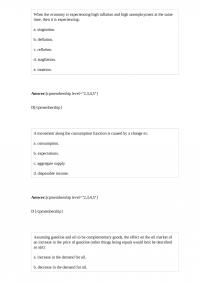
When the economy is experiencing high inflation and high unemployment at the same time, then it is experiencing: a. stagnation. b. deflation. c. reflation. d. stagflation. e. innation. A movement along the consumption function is caused by a change in: […]
MicroEconomic 242
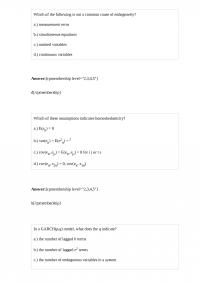
Which of the following is not a common cause of endogeneity? a.) measurement error b.) simultaneous equations c.) omitted variables d.) continuous variables Which of these assumptions indicates homoskedasticity? a.) E(eit) = 0 b.) var(eit) = E(e2 it) = 2 […]
ECON A 868 Final What does R2 the
What does R2, the coefficient of determination, measure? a.) the probability of the true value falling within the forecast interval b.) the p-value on the coefficient we are using to test our hypothesis of interest c.) the confidence interval of […]
ECON 396 Quiz 3
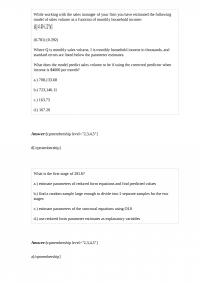
While working with the sales manager of your firm you have estimated the following model of sales volume as a function of monthly household income: (0.781) (0.392) Where Q is monthly sales volume, I is monthly household income in thousands, […]
MicroEconomic 376
What is the null hypothesis when performing an F-test to test the strength of an instrument? a.) the instrument is weak, with no different from 0. b.) it is a strong instrument with all significantly different from 0. c.) the […]
Economics 506 The expected value
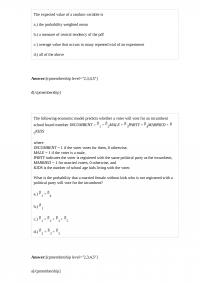
The expected value of a random variable is a.) the probability weighted mean b.) a measure of central tendency of the pdf c.) average value that occurs in many repeated trial of an experiment d.) all of the above The […]
ECB 502 Quiz 2
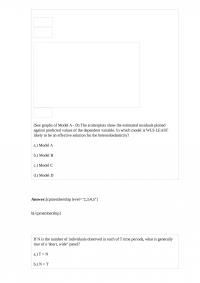
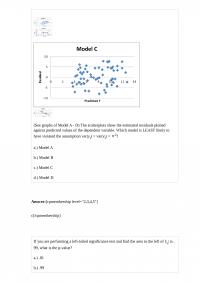
(See graphs of Model A – D) The scatterplots show the estimated residuals plotted against predicted values of the dependent variable. In which model is WLS LEAST likely to be an effective solution for the heteroskedasticity? a.) Model A b.) […]
ECB 660 Test 1
When is a Tobit model used? a.) when you have censored data b.) for categorical data with a normally distributed error term c.) when you want to combine a probit and multinomial logit d.) to estimate varying marginal effects in […]
Economics 260 Final
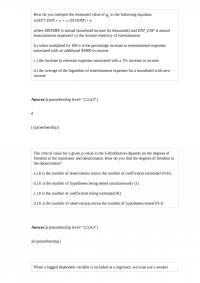
How do you interpret the estimated value of g1 in the following equation: where INCOME is annual household income (in thousands) and ENT_EXP is annual entertainment expenses? a.) the income elasticity of entertainment b.) when multiplied by 100 it is […]
ECON E 404
If L is the number of exogenous instruments and B is the number of endogenous regressors in the model, when L = B the model is a.) just identified b.) over identified c.) under identified d.) precisely identified What mathematical […]
MicroEconomic 773
(See graphs of Model A – D) The scatterplots show the estimated residuals plotted against predicted values of the dependent variable. Which model is LEAST likely to have violated the assumption var(yi) = var(ei) = 2? a.) Model A b.) […]
ECON A 231 Midterm
What type of model provides information about sources of volatility? a.) a VAR model b.) an impulse response function c.) variance decomposition d.) an ARDL model Unobservable variables that enter into decisions are called a.) latent variables b.) endogenous variables […]
ECON A 429
The critical value for a given p-value in the F-distribution depends on the degrees of freedom in the numerator and denominator. How do you find the degrees of freedom in the numerator? a.) It is the number of observations minus […]
ECON A 342 Test
Which type of model has coefficients that vary with i, but are constant with t? a.) pooled model b.) fixed effects c.) random effects d.) none of these Which of the following variables is most likely to be quantitative? a.) […]
ECON A 498 Midterm 1
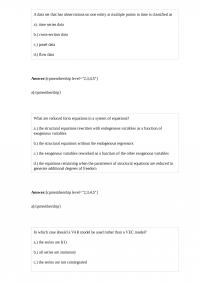
A data set that has observations on one entity at multiple points in time is classified as a). time series data b.) cross-section data c.) panel data d.) flow data What are reduced form equations in a system of equations? […]
Economics 307 Midterm 1
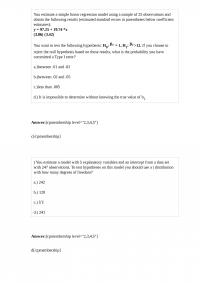
You estimate a simple linear regression model using a sample of 25 observations and obtain the following results (estimated standard errors in parentheses below coefficient estimates): y = 97.25 + 19.74 *x (3.86) (3.42) You want to test the following […]
Economics 376 Midterm 1
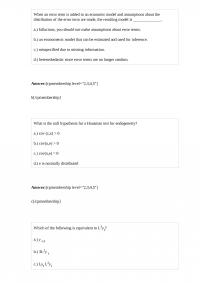
When an error term is added to an economic model and assumptions about the distribution of the error term are made, the resulting model is ______________. a.) fallacious, you should not make assumptions about error terms. b.) an econometric model […]
ECON A 814 Quiz 3
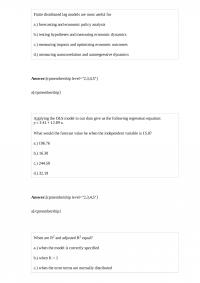
Finite distributed lag models are most useful for a.) forecasting and economic policy analysis b.) testing hypotheses and measuring economic dynamics c.) measuring impacts and optimizing economic outcomes d.) measuring autocorrelation and autoregressive dynamics Applying the OLS model to our […]
ECON E 106 Quiz 3
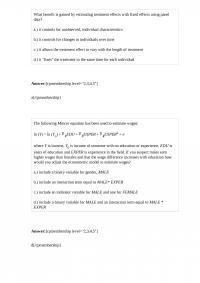
What benefit is gained by estimating treatment effects with fixed effects using panel data? a.) it controls for unobserved, individual characteristics b.) it controls for changes in individuals over time c.) it allows the treatment effect to vary with the […]
ECON 563 Quiz 2
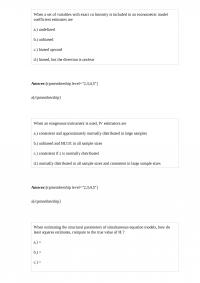
When a set of variables with exact co linearity is included in an econometric model coefficient estimates are a.) undefined b.) unbiased c.) biased upward d.) biased, but the direction is unclear When an exogenous instrument is used, IV estimators […]
ECB 708 Quiz 2
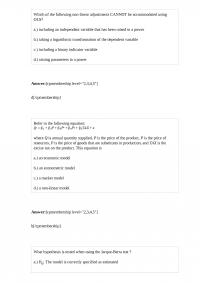
Which of the following non-linear adjustments CANNOT be accommodated using OLS? a.) including an independent variable that has been raised to a power b.) taking a logarithmic transformation of the dependent variable c.) including a binary indicator variable d.) raising […]
MOB 265 Quiz 3
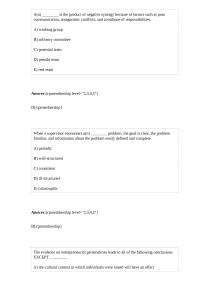
A(n) ________ is the product of negative synergy because of factors such as poor communication, antagonistic conflicts, and avoidance of responsibilities. A) working group B) advisory committee C) potential team D) pseudo team E) real team When a supervisor encounters […]
MSC 302 Test 1
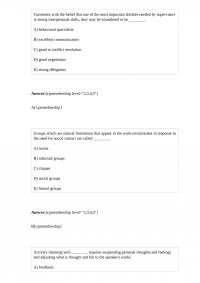
Consistent with the belief that one of the most important abilities needed by supervisors is strong interpersonal skills, they may be considered to be ________. A) behavioral specialists B) excellent communicators C) good at conflict resolution D) good negotiators E) […]
MG 336 Quiz 3
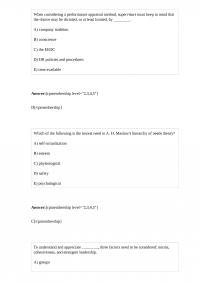
When considering a performance appraisal method, supervisors must keep in mind that the choice may be dictated, or at least limited, by ________. A) company tradition B) conscience C) the EEOC D) HR policies and procedures E) time available Which […]