Archives: Quiz
ECB 467 Test 1
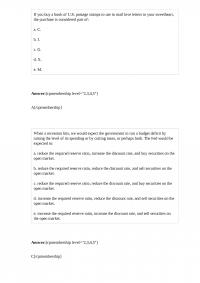
If you buy a book of U.S. postage stamps to use to mail love letters to your sweetheart, the purchase is considered part of: a. C. b. I. c. G. d. X. e. M. When a recession hits, we would […]
Economics 684 Quiz 3
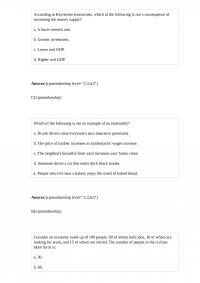
According to Keynesian economists, which of the following is not a consequence of increasing the money supply? a. A lower interest rate. b. Greater investment. c. Lower real GDP. d. Higher real GDP. Which of the following is not an […]
ECON A 276 Test 1
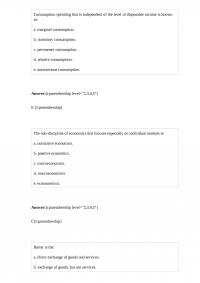
Consumption spending that is independent of the level of disposable income is known as: a. marginal consumption. b. transitory consumption. c. permanent consumption. d. relative consumption. e. autonomous consumption. The sub-discipline of economics that focuses especially on individual markets is: […]
ECB 332 Midterm 2
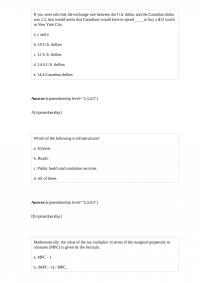
If you were told that the exchange rate between the U.S. dollar and the Canadian dollar was 1.2, that would mean that Canadians would have to spend ____ to buy a $12 watch in New York City. a. c and […]
BUS 842 Midterm 2
Which of the following would not be classified as a capital resource? a. The Empire State Building. b. A Caterpillar bulldozer. c. A Macintosh computer. d. 100 shares of stock in General Motors. Collusive action among producers creates higher prices […]
ECON 779
A drought destroys much of the grape crop. As a result, consumer surplus in the market for wine: a. decreases. b. increases. c. remains unchanged. d. depends on the deadweight loss. Which of the following would not be counted in […]
BUS 725
M1 refers to: a. Federal Reserve Notes and gold certificates. b. Currency held by the public plus checking account balances. c. The largest of the money-supply definitions. d. None of these. Demand-pull inflation is associated with: a. decreasing total spending […]
Economics 221 Quiz 1
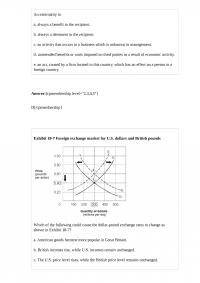
An externality is: a. always a benefit to the recipient. b. always a detriment to the recipient. c. an activity that occurs in a business which is unknown to management. d. unintended benefits or costs imposed on third parties as […]
MicroEconomic 744 Midterm 1
The impact of the multiplier effect is to: a. smooth out the up and down swings of the business cycle. b. promote price stability. c. magnify small changes in spending into much larger changes in real GDP. d. reduce the […]
MicroEconomic 317
Full employment occurs when the rate of unemployment consists of: a. structural plus frictional unemployment. b. cyclical plus frictional unemployment. c. structural, frictional, and cyclical unemployment. d. none of these. In the United States, the Phillips curve in the 1960s: […]
BUS 804 Test 1
Supply-side economics is based on the theory that: a. budget deficits will stimulate demand, output, and employment. b. budget deficits will lead to higher interest rates, which will weaken their expansionary impact. c. higher tax rates will increase tax revenues. […]
ECB 779 Exhibit 181 Production
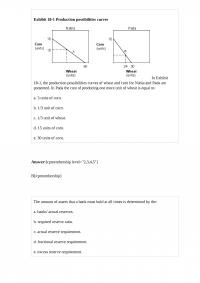
Exhibit 18-1 Production possibilities curves In Exhibit 18-1, the production possibilities curves of wheat and corn for Nabia and Pada are presented. In Pada the cost of producing one more unit of wheat is equal to: a. 3 units of […]
MicroEconomic 884 Quiz 3
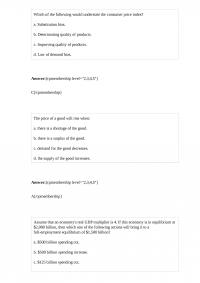
Which of the following would understate the consumer price index? a. Substitution bias. b. Deteriorating quality of products. c. Improving quality of products. d. Law of demand bias. The price of a good will rise when: a. there is a […]
ECON E 821 Quiz 2
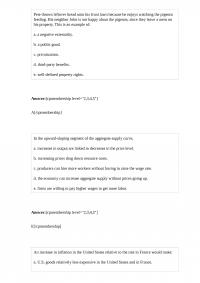
Pete throws leftover bread onto his front lawn because he enjoys watching the pigeons feeding. His neighbor John is not happy about the pigeons, since they leave a mess on his property. This is an example of: a. a negative […]
ECON A 459 Quiz 1
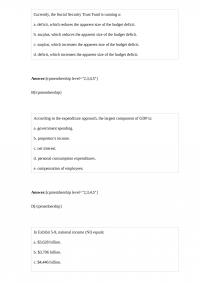
Currently, the Social Security Trust Fund is running a: a. deficit, which reduces the apparent size of the budget deficit. b. surplus, which reduces the apparent size of the budget deficit. c. surplus, which increases the apparent size of the […]
BUS 625 Quiz 1
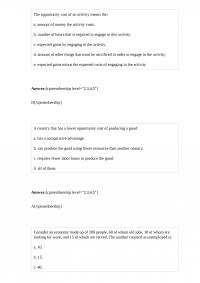
The opportunity cost of an activity means the: a. amount of money the activity costs. b. number of hours that is required to engage in this activity. c. expected gains by engaging in the activity. d. amount of other things […]
BUS 169
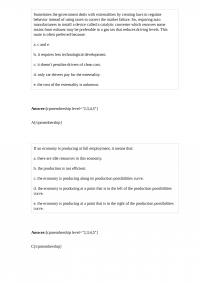
Sometimes the government deals with externalities by creating laws to regulate behavior instead of using taxes to correct the market failure. So, requiring auto manufacturers to install a device called a catalytic converter which removes some toxins from exhaust may […]
ECON A 715 Quiz 3
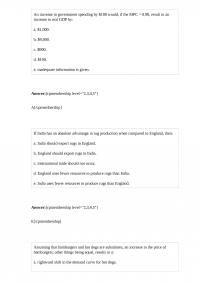
An increase in government spending by $100 would, if the MPC = 0.90, result in an increase in real GDP by: a. $1,000. b. $9,000. c. $900. d. $190. e. inadequate information is given. If India has an absolute advantage […]
Economics 400 Homework
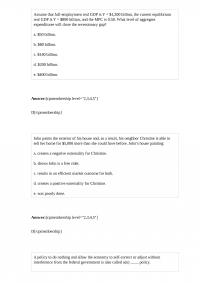
Assume that full-employment real GDP is Y = $1,200 billion, the current equilibrium real GDP is Y = $800 billion, and the MPC is 0.50. What level of aggregate expenditures will close the recessionary gap? a. $50 billion. b. $80 […]
ECON 506 Quiz 1
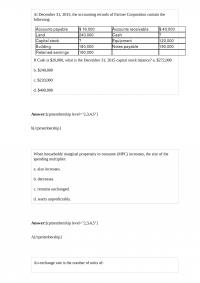
At December 31, 2015, the accounting records of Farmer Corporation contain the following: If Cash is $26,000, what is the December 31, 2015 capital stock balance? a. $272,000 b. $240,000 c. $220,000 d. $400,000 When households’ marginal propensity to consume […]
BUS 564 Midterm
When people become unemployed because of a higher minimum wage, this type of unemployment is called: a. frictional. b. structural. c. cyclical. d. abnormal. On a production possibilities curve, the opportunity cost of good X, in terms of good Y, […]
Economics 218
The precautionary demand for money: a. varies inversely with the income level. b. varies inversely with the price level. c. is used as an insurance agent against unexpected needs. d. states that nominal income must exceed real income. e. is […]
ECB 461
What famous economist said, “By pursuing his own interest he (an individual) frequently promotes that of the society more effectually than when he really intends to promote it?” a. Alfred Marshall. b. Adam Smith. c. Karl Marx. d. Robert L. […]
ECON A 435 Midterm
Supply curves slope upward because: a. the quality is assumed to vary with price. b. technology improves over time, increasing the ability of firms to produce more at each possible price. c. increases in the price of a good lead […]
ECON 856 Quiz 1
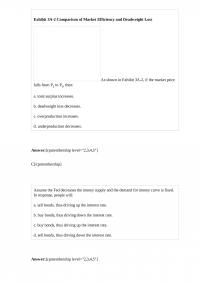
Exhibit 3A-2 Comparison of Market Efficiency and Deadweight Loss As shown in Exhibit 3A-2, if the market price falls from P2 to P3, then: a. total surplus increases. b. deadweight loss decreases. c. overproduction increases. d. underproduction decreases. Assume the […]
BUS 493 Test 1
When the value of our goods exports is less than the value of our goods imports, a. d and e. b. the value of the dollar must fall. c. there will be domestic unemployment. d. there will be an unfavorable […]
MicroEconomic 191 Test
If a bank has $100,000 in checkable deposits, reserves of $20,000, and no excess reserves, then the required reserve ratio is: a. 10 percent. b. 20 percent. c. 25 percent. d. 30 percent. e. 50 percent. Which of the following […]
ECON A 656 Quiz 1
People react to an excess supply of money by: a. selling bonds, thus driving up the interest rate. b. selling bonds, thus driving down the interest rate. c. buying bonds, thus driving up the interest rate. d. buying bonds, thus […]
Economics 819 Albert Betty
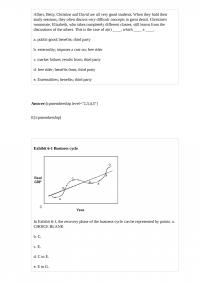
Albert, Betty, Christine and David are all very good students. When they hold their study sessions, they often discuss very difficult concepts in great detail. Christine’s roommate, Elizabeth, who takes completely different classes, still learns from the discussions of the […]
ECON E 780
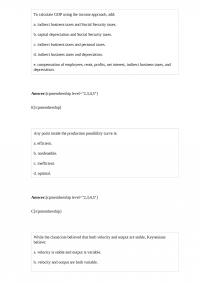
To calculate GDP using the income approach, add: a. indirect business taxes and Social Security taxes. b. capital depreciation and Social Security taxes. c. indirect business taxes and personal taxes. d. indirect business taxes and depreciation. e. compensation of employees, […]
ECON E 319
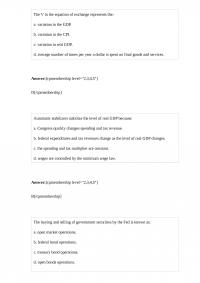
The V in the equation of exchange represents the: a. variation in the GDP. b. variation in the CPI. c. variation in real GDP. d. average number of times per year a dollar is spent on final goods and services. […]
ECON E 695 Midterm 1
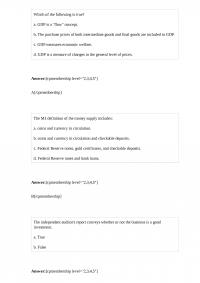
Which of the following is true? a. GDP is a “flow” concept. b. The purchase prices of both intermediate goods and final goods are included in GDP. c. GDP measures economic welfare. d. GDP is a measure of changes in […]
Economics 848
Suppose u = those adults who are unemployed and seeking work; e = those adults who are employed; and NLF = those adults not in the labor force. Which expression would equal the BLS definition of the unemployment rate? a. […]
Economics 448 Final
A change in demand cannot be caused by a change in: a. tastes. b. population. c. the prices of other goods. d. expectations of future prices. e. the price of the good itself. Which of the following is not a […]
ECON 606 Midterm 1
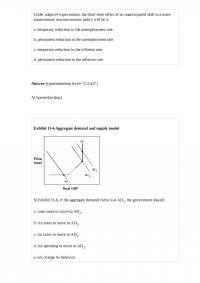
Under adaptive expectations, the short-term effect of an unanticipated shift to a more expansionary macroeconomic policy will be a: a. temporary reduction in the unemployment rate. b. permanent reduction in the unemployment rate. c. temporary reduction in the inflation rate. […]
MicroEconomic 452 Test
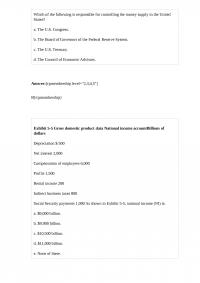
Which of the following is responsible for controlling the money supply in the United States? a. The U.S. Congress. b. The Board of Governors of the Federal Reserve System. c. The U.S. Treasury. d. The Council of Economic Advisors. Exhibit […]
Economics 714 Midterm 2
Which of the following categories accounted for the third largest percentage of total federal government expenditures? a. Education and health. b. National defense. c. Income security. d. Interest on the national debt. Producer surplus is the: a. amount by which […]
ECON A 480 Quiz
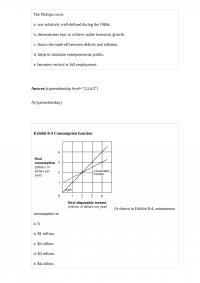
The Phillips curve: a. was relatively well-defined during the 1960s. b. demonstrates how to achieve stable economic growth. c. shows the trade-off between deficits and inflation. d. helps to stimulate entrepreneurial profits. e. becomes vertical at full employment. Exhibit 8-4 […]
BUS 566 Test 2
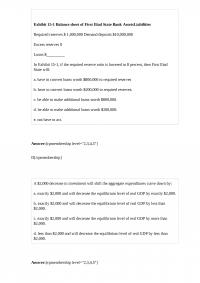
Exhibit 15-1 Balance sheet of First Iliad State Bank AssetsLiabilities Required reserves $ 1,000,000 Demand deposits $10,000,000 Excess reserves 0 Loans $ In Exhibit 15-1, if the required reserve ratio is lowered to 8 percent, then First Iliad State will: […]
MicroEconomic 208 Test
Computer programs or software are an example of: a. land. b. labor. c. capital. d. none of these. By definition, M1 includes: a. savings accounts. b. money market mutual accounts. c. small denomination time deposits. d. checkable deposits. Answer: D […]
ECON E 265
Contractionary fiscal policy is deliberate government action to influence aggregate demand and the level of real GDP through: a. expanding and contracting the money supply. b. encouraging business to expand or contract investment. c. regulating net exports. d. decreasing government […]
BUS 269 Use the aggregate
Use the aggregate expenditures model and assume the marginal propensity to consume (MPC) is 0.90. A decrease in government spending of $1 billion would result in a decrease in GDP of: a. $0. b. $0.9 billion. c. $1.0 billion. d. […]
BUS 476 Final
A lowering of the required reserve ratio might not expand the money supply if: a. tax rates are also lowered at the same time. b. tax rates are increased at the same time. c. borrowers are unwilling to borrow the […]
ECON 322 Final
Which one of the following items is correct concerning the time element of financial statements? a. The balance sheet covers a period of time. b. The statement of retained earnings explains changes during a particular period. c. An income statement […]
ECB 601 Test 2
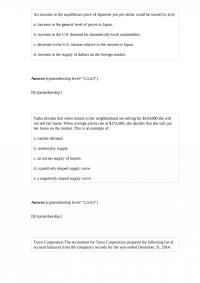
An increase in the equilibrium price of Japanese yen per dollar could be caused by a(n): a. increase in the general level of prices in Japan. b. increase in the U.S. demand for domestically-built automobiles. c. decrease in the U.S. […]
BUS 770 Quiz 1
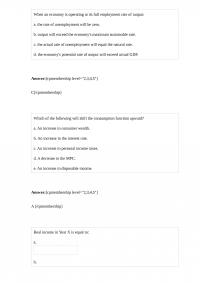
When an economy is operating at its full employment rate of output: a. the rate of unemployment will be zero. b. output will exceed the economy’s maximum sustainable rate. c. the actual rate of unemployment will equal the natural rate. […]
ECON 440
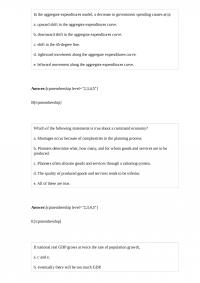
In the aggregate expenditures model, a decrease in government spending causes a(n): a. upward shift in the aggregate expenditures curve. b. downward shift in the aggregate expenditures curve. c. shift in the 45-degree line. d. rightward movement along the aggregate […]
BUS 149 In the aggregate
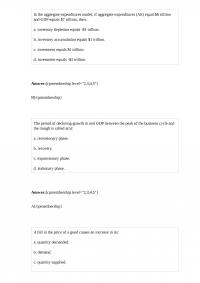
In the aggregate expenditures model, if aggregate expenditures (AE) equal $6 trillion and GDP equals $7 trillion, then: a. inventory depletion equals -$1 trillion. b. inventory accumulation equals $1 trillion. c. investment equals $1 trillion. d. investment equals -$1 trillion. […]
ECON E 722 Final
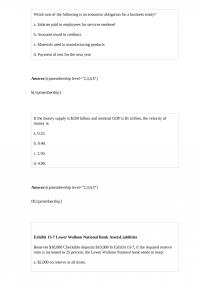
Which one of the following is an economic obligation for a business entity? a. Salaries paid to employees for services rendered b. Amounts owed to creditors c. Materials used in manufacturing products d. Payment of rent for the next year […]
ECB 897 Quiz 3
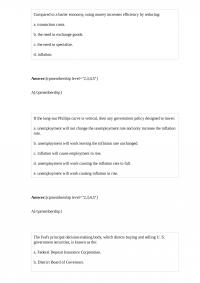
Compared to a barter economy, using money increases efficiency by reducing: a. transaction costs. b. the need to exchange goods. c. the need to specialize. d. inflation. If the long-run Phillips curve is vertical, then any government policy designed to […]