Archives: Quiz
Management 504 Quiz 1
If your instructor has an attendance policy, she/he is using a(n): a. programmed decision. b. unique approach. c. condition of ambiguity. d. nonprogrammed decision. e. none of these. During the______ stage, the company will need to make greater use of […]
EMBA 493 Final
Which of these perspectives emphasized a rational, scientific approach to the study of management and sought to make organizations efficient operating machines? a. The Humanistic Perspective b. The Behavioral Sciences Approach c. The Classical Perspective d. The TQM approach e. […]
EMBA 545 Midterm 1
_____ provide more challenging assignments, prescribe new responsibilities, and help employees grow by expanding and developing their abilities. a. Promotions b. Appraisals c. Evaluations d. Endorsements e. Coaching Which of these is used for solving intradepartmental problems, interdepartmental coordination, and […]
BUS 382 Quiz 3
Which of the following structures works best in an uncertain organizational environment? a. A tight structure b. A mechanistic structure c. A horizontal structure d. A functional structure e. A vertical structure Economic responsibility, carried to the extreme, is called […]
Economics 498 quotIt would be an
“It would be an undue hardship to require people whose income is below $15,000 per year to pay income taxes.” This statement reflects which of the following principles for a tax? a. Benefits-received. b. Inexpensive-to-collect. c. Ability-to-pay. d. Fairness of […]
ECON E 822 Test
When economists say the quantity supplied of a product has decreased, they mean the: a. supply curve has shifted to the left. b. supply curve has shifted to the right. c. price of the product has risen, and consequently, suppliers […]
ECON E 502 Midterm 2
Advances in technology will shift the aggregate: a. demand curve rightward. b. supply curve rightward. c. demand curve leftward. d. supply curve leftward. The most broadly based price index is the: a. real GDP price index. b. consumer price index. […]
BUS 632 Test
Which of the following statements is true? a. The simple money multiplier equals the reciprocal of the required reserve ratio. b. Required reserves is the minimum balance that the Fed requires a bank to hold in vault cash or on […]
ECON 172 Quiz
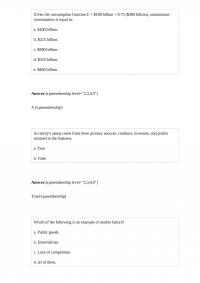
Given the consumption function C = $100 billion + 0.75 ($300 billion), autonomous consumption is equal to: a. $100 billion. b. $225 billion. c. $300 billion. d. $325 billion. e. $400 billion. An entity’s assets come from three primary sources: […]
Economics 753 Midterm
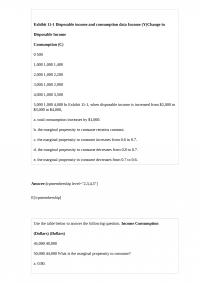
Exhibit 11-1 Disposable income and consumption data Income (Y)Change in Disposable Income Consumption (C) 0 500 1,000 1,000 1,400 2,000 1,000 2,200 3,000 1,000 2,900 4,000 1,000 3,500 5,000 1,000 4,000 In Exhibit 11-1, when disposable income is increased from […]
ECON A 455 Final
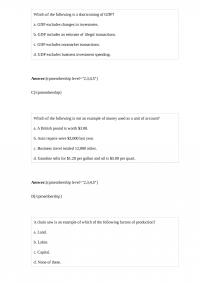
Which of the following is a shortcoming of GDP? a. GDP excludes changes in inventories. b. GDP includes an estimate of illegal transactions. c. GDP excludes nonmarket transactions. d. GDP excludes business investment spending. Which of the following is not […]
ECB 232
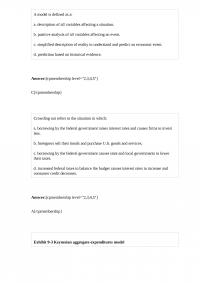
A model is defined as a: a. description of all variables affecting a situation. b. positive analysis of all variables affecting an event. c. simplified description of reality to understand and predict an economic event. d. prediction based on historical […]
ECON A 770
Which of the following would not cause market demand for a normal good to decline? a. An increase in the price of a substitute. b. An increase in the price of a complement. c. A decline in consumer income. d. […]
ECON A 287 Quiz
As the size of a nation’s outstanding debt gets larger and larger relative to the size of the economy: a. eventually it will become difficult for the country to borrow in global credit markets. b. the country will have to […]
MicroEconomic 253 Midterm 2
The social security tax is a: a. progressive tax at all income levels. b. regressive tax above a certain income level. c. proportional tax at all income levels. d. none of these. When Brazil can generate a product using fewer […]
ECON 198
Which of the following is not a component of the M1 money supply? a. Demand deposits. b. Large-denomination (more than $100) bills. c. Interest-earning checking deposits. d. Outstanding balances on credit cards. The natural rate of unemployment occurs if there […]
Economics 495 Quiz 2
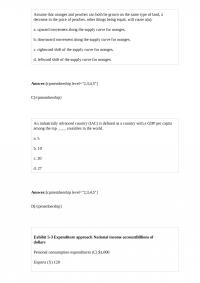
Assume that oranges and peaches can both be grown on the same type of land, a decrease in the price of peaches, other things being equal, will cause a(n): a. upward movement along the supply curve for oranges. b. downward […]
BUS 240 Test 2
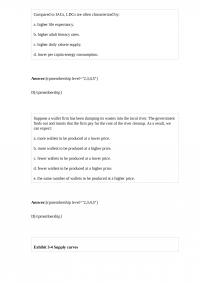
Compared to IACs, LDCs are often characterized by: a. higher life expectancy. b. higher adult literacy rates. c. higher daily calorie supply. d. lower per capita energy consumption. Suppose a wallet firm has been dumping its wastes into the local […]
Economics 755 Final
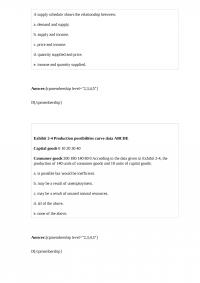
A supply schedule shows the relationship between: a. demand and supply. b. supply and income. c. price and income. d. quantity supplied and price. e. income and quantity supplied. Exhibit 2-4 Production possibilities curve data ABCDE Capital goods 0 10 […]
Economics 462 Homework
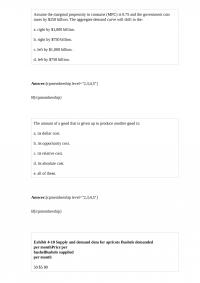
Assume the marginal propensity to consume (MPC) is 0.75 and the government cuts taxes by $250 billion. The aggregate demand curve will shift to the: a. right by $1,000 billion. b. right by $750 billion. c. left by $1,000 billion. […]
ECB 284 Test 2
Which of the following is not a characteristic of a public good? a. It is scarce. b. It is not diminished in amount as additional people consume the product. c. Its benefits cannot be withheld from anyone. d. It is […]
MicroEconomic 886 Test 1
As shown in Exhibit 7-2, the rate of inflation for Year 5 is: a. 5 percent b. 10 percent. c. 20 percent. d. 25 percent. Consider two people, Sandy Smith, who earns $25,000, and Gary Carver, who earns $50,000. If […]
ECB 537
Other factors held constant, a decrease in resource prices will shift the aggregate: a. demand curve leftward. b. demand curve rightward. c. supply curve leftward. d. supply curve rightward. Exhibit 9-2 Keynesian aggregate-expenditures model As shown in Exhibit 9-2, if […]
ECB 650 Quiz 3
In order for a bank to earn as much profit as possible, its excess reserves should be: a. equal to its required reserves. b. as small as possible. c. less than its vault cash. d. growing at a constant rate. […]
Economics 240 Midterm 1
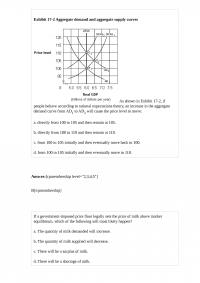
Exhibit 17-2 Aggregate demand and aggregate supply curves As shown in Exhibit 17-2, if people behave according to rational expectations theory, an increase in the aggregate demand curve from AD1 to AD2 will cause the price level to move: a. […]
Economics 684 Quiz 1
Which of the following is a characteristic of an LDC? a. Capital flight. b. Vicious circle of poverty. c. Lack of entrepreneurs. d. All of these. An increase in government spending will have the greatest expansionary impact on the economy […]
ECON 688 Test
The percentage of checkable deposits that banks and other financial intermediaries are required to keep in cash reserves is known as: a. the fractional reserve requirement. b. the excess reserve requirement. c. the required reserve ratio. d. the discount rate. […]
MicroEconomic 390 Homework
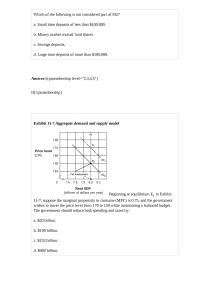
Which of the following is not considered part of M2? a. Small time deposits of less than $100,000. b. Money market mutual fund shares. c. Savings deposits. d. Large time deposits of more than $100,000. Exhibit 11-7 Aggregate demand and […]
Economics 727 Final
When the aggregate demand curve shifts to the right, intersecting the aggregate supply curve on its upward-sloping or vertical segment, a. demand-pull inflation occurs. b. cost-push inflation occurs. c. stagflation occurs. d. deflation occurs. e. the shift pulls the price […]
ECB 674
The largest component of GDP as measured by the expenditure approach is: a. wages and salary earnings. b. personal consumption. c. net profits of corporations. d. gross private investment. A technological breakthrough lowers the cost of manufacturing DVDs. As a […]
ECON 125 Quiz
The four components of the aggregate expenditures model are: a. consumption, investment, inventories, and government purchases. b. consumption, planned investment, unplanned changes in inventory, and exports. c. consumption, investment, government purchases, and net exports. d. consumption, investment, exports, and imports. […]
ECON E 630 Test 2
Most economists consider the case for jawboning to control inflation is strongest when this policy is used: a. for a long period of time. b. to combat inflation that is out of control. c. to combat cost-push inflation. d. All […]
MicroEconomic 528 Test
Starting from an initial long-run equilibrium, under the rational expectations hypothesis, an anticipated shift to a more expansionary policy will increase: a. prices but not real output in the short run. b. real output but not prices in the short […]
MicroEconomic 335 Test
Which of the following will most likely cause a nation’s currency to appreciate on the foreign exchange market? a. A decrease in domestic interest rates b. An increase in foreign interest rates c. Domestic inflation of 10 percent while the […]
ECB 369 Quiz 1
When an economy dips into recession, automatic stabilizers will: a. enlarge the budget deficit (or reduce the surplus). b. reduce the budget deficit (or increase the surplus). c. ensure that the budget remains in balance. d. expand the supply of […]
ECON 102 Quiz 1
According to the Phillips curve, a more expansionary macro-policy that causes inflation to be greater will: a. place downward pressure on prices. b. reduce unemployment. c. reduce output. d. reduce the natural rate of unemployment. Which of the following is […]
BUS 587 Test 2
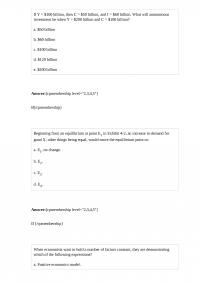
If Y = $100 billion, then C = $50 billion, and I = $60 billion. What will autonomous investment be when Y = $200 billion and C = $100 billion? a. $50 billion b. $60 billion c. $100 billion d. […]
MicroEconomic 441
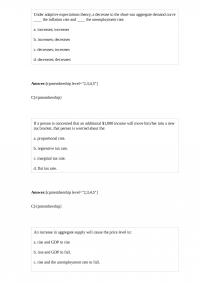
Under adaptive expectations theory, a decrease in the short-run aggregate demand curve ____ the inflation rate and ____ the unemployment rate. a. increases; increases b. increases; decreases c. decreases; increases d. decreases; decreases If a person is concerned that an […]
ECON 638 Final In a dynamic
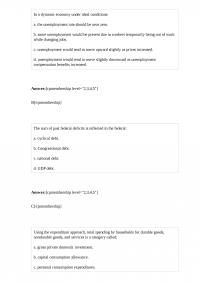
In a dynamic economy under ideal conditions: a. the unemployment rate should be near zero. b. some unemployment would be present due to workers temporarily being out of work while changing jobs. c. unemployment would tend to move upward slightly […]
ECON A 722 Test 2
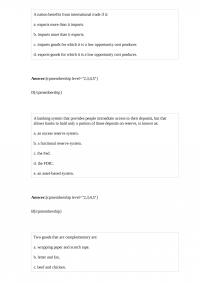
A nation benefits from international trade if it: a. exports more than it imports. b. imports more than it exports. c. imports goods for which it is a low opportunity cost producer. d. exports goods for which it is a […]
ECON 627 Final
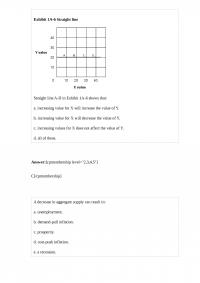
Exhibit 1A-6 Straight line Straight line A-D in Exhibit 1A-6 shows that: a. increasing value for X will increase the value of Y. b. increasing value for X will decrease the value of Y. c. increasing values for X does […]
ECB 459 Test 2
A movement along a consumption function is caused by: a. a change in households’ real assets. b. a change in interest rates. c. changes in taxation policy. d. expectations of price changes. e. changes in households’ disposable incomes. If Japan […]
Economics 159
Incomes policies of the federal government include: a. presidential jawboning. b. wage-price guidelines. c. wage-price controls. d. All of these. Assume we have a simplified banking system in balance-sheet equilibrium. Also assume that all banks are subject to a uniform […]
Economics 384 Midterm 1
Comparing how many dollars it takes to attend college each year to annual earnings on a job represents the use of money as a: a. medium of exchange. b. unit of account. c. store of value. d. store of coincidence. […]
MicroEconomic 394 Test
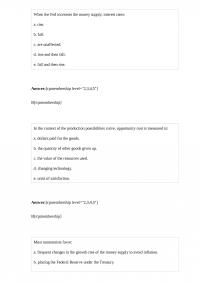
When the Fed increases the money supply, interest rates: a. rise. b. fall. c. are unaffected. d. rise and then fall. e. fall and then rise. In the context of the production possibilities curve, opportunity cost is measured in: a. […]
ECB 113 Midterm
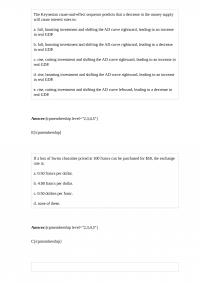
The Keynesian cause-and-effect sequence predicts that a decrease in the money supply will cause interest rates to: a. fall, boosting investment and shifting the AD curve rightward, leading to an increase in real GDP. b. fall, boosting investment and shifting […]
MicroEconomic 765 Final
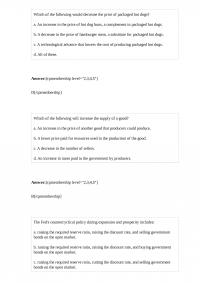
Which of the following would decrease the price of packaged hot dogs? a. An increase in the price of hot dog buns, a complement to packaged hot dogs. b. A decrease in the price of hamburger meat, a substitute for […]
ECON E 882 Quiz 2
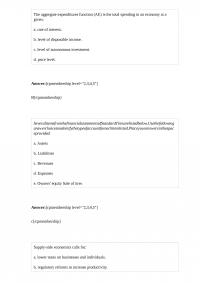
The aggregate expenditures function (AE) is the total spending in an economy at a given: a. rate of interest. b. level of disposable income. c. level of autonomous investment. d. price level. SeveralitemsfromthefinancialstatementsofStandardTiresarelistedbelow.Usethefollowing answerchoicestoidentifythetypeofaccountforeachitemlisted.Placeyouranswersinthespac eprovided. a. Assets b. Liabilities c. […]
ECON E 362 Quiz
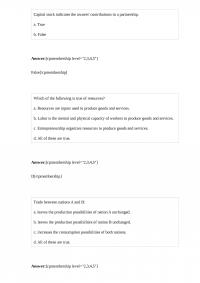
Capital stock indicates the owners’ contributions to a partnership. a. True b. False Which of the following is true of resources? a. Resources are inputs used to produce goods and services. b. Labor is the mental and physical capacity of […]
ECB 830 Midterm 1
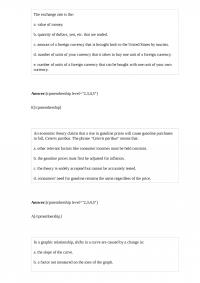
The exchange rate is the: a. value of money. b. quantity of dollars, yen, etc. that are traded. c. amount of a foreign currency that is brought back to the United States by tourists. d. number of units of your […]