
How do you interpret the estimated value of g1 in the following equation:
where INCOME is annual household income (in thousands) and ENT_EXP is annual
entertainment expenses? a.) the income elasticity of entertainment
b.) when multiplied by 100 it is the percentage increase in entertainment expenses
associated with an additional $1000 in income
c.) the increase in entertain expenses associated with a 1% increase in income
d.) the average of the logarithm of entertainment expenses for a household with zero
income
The critical value for a given p-value in the F-distribution depends on the degrees of
freedom in the numerator and denominator. How do you find the degrees of freedom in
the denominator?
a.) It is the number of observations minus the number of coefficients estimated (N-K)
b.) It is the number of hypotheses being tested simultaneously (J)
c.) It is the number of coefficients being estimated (K)
d.) It is the number of observations minus the number of hypotheses tested (N-J)
When a lagged dependent variable is included as a regressor, we must use a weaker

form of assumption TSMR2 that allows the error term to be correlated with future
values of explanatory variables, but not present or past values. What implications does
this weaker assumption have for our regressors?
a.) biased, but consistent
b.) unbiased, but no longer BLUE
c.) unbiased, but no longer linear
d.) biased, but with minimum variance
Suppose you have a long, narrow panel of data and estimate a single equation with
indicator variables and interaction terms for the individuals. In doing this what
assumption from the pooled model have you relaxed?
a.) coefficients on variables are equal across individuals
b.) errors are uncorrelated with any x‘s
c.) expected value of errors are zero
d.) variances of error terms are equal across individuals
If your regression results show a high R2, adj R2, and a significant F-test, but low t
values for the coefficients, what is the most likely cause?
a.) omitted relevant variables
b.) irrelevant variables included

c.) collinearity
d.) heteroskedasiticity
Heteroskedasticity is a violation of which assumption of the MR model?
a.) The values of each xik are not random and are not exact linear functions of the other
explanatory variables
b.) var(yi.) = var(ei) = 2
c.) E(yi) = 1 + 2xi2 + 3xi3 + ‘¦’¦. + kxik, <=>E(ei) = 0
d.) cov(yi, yj) = cov(ei, ej) = 0; (i≠j)
Which of the following is not a problem with the linear probability model?
a.) assumes constant marginal effects
b.) generates predictions outside the (0,1) interval
c.) heteroskedastic error term
d.) coefficient estimates are biased

Functions that show how variables adjust to shocks over time are known as
a.) adjustment functions
b.) system dynamic functions
c.) impulse response functions
d.) expansion paths
Which of the following statements is not true regarding a logit model?
a.) it allows for marginal effects that vary with explanatory variables
b.) it is estimated by maximum likelihood
c.) it can be adjusted to accommodate more than 2 choice options
d.) it always generates larger marginal effects than a probit model
When using WLS to correct for heteroskedasticity, what weight should be used?
a.) whatever weight scales all variables and creates a homoskedastic error variance
b.) the inverse of the error variance at x̄
c.) whatever weight is determined by the Goldfeld-Quandt test
d.) the residuals from the initial regression model
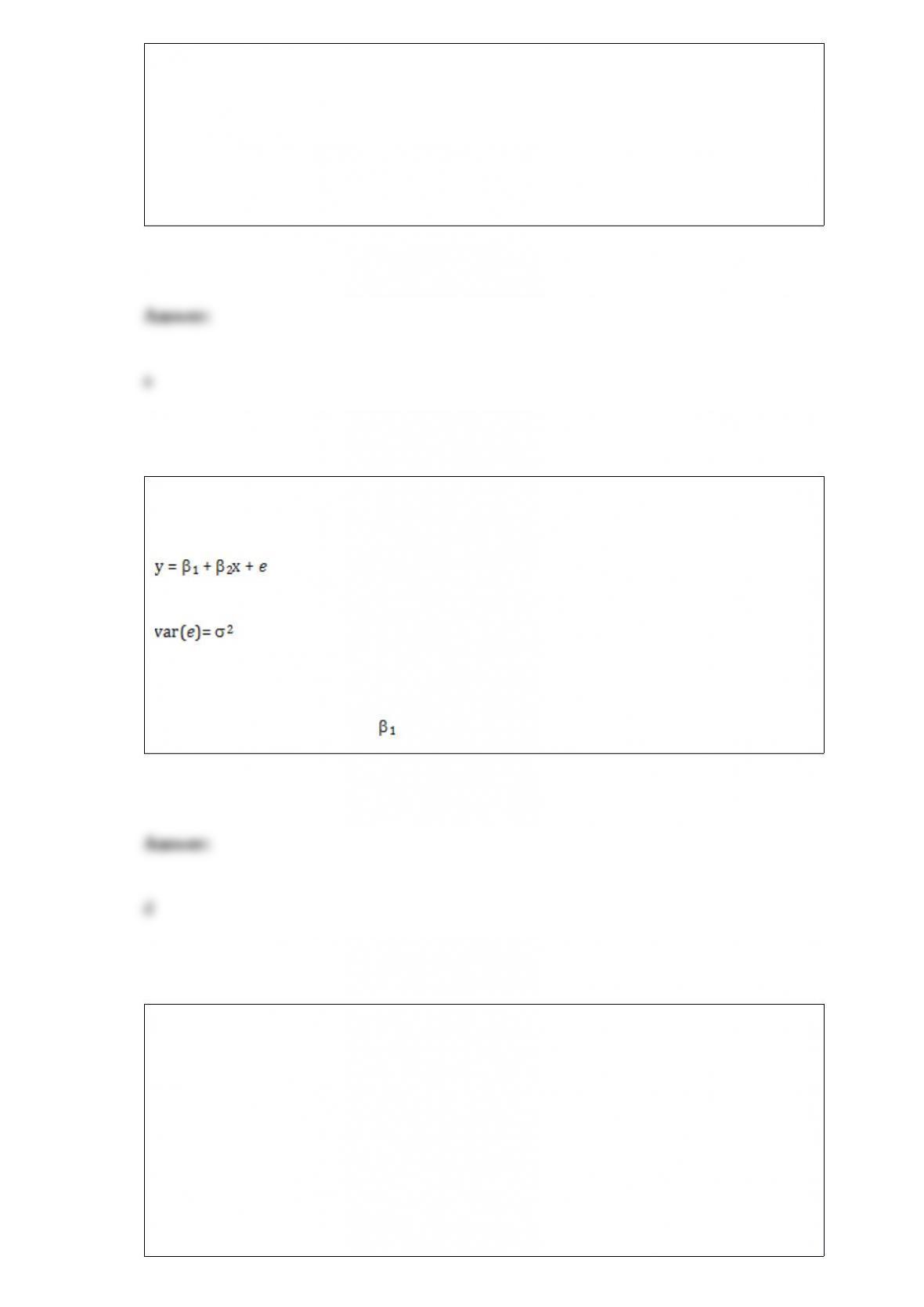
Which of the following is NOT an assumption of the Simple Linear Regression Model?
a.) The value of y, for each value of x, is
b.)The variance of the random error e is
c.) The covariance between any pair of random errors ei and ej is zero
d.) The parameter estimate of is unbiased.
If series y and z have similar stochastic trends, but are otherwise unrelated, they are said
to be
a.) cointegrated
b.) cotrending
c.) converging
d.) jointly stationary

Suppose there is a series, Yt, modeled by the following three equations:
yt = +et
etIt-1 ~ N(0, ht)
ht = 0+ 1e2t-1, 0>0, 0=< 1<1
Equation 2 indicates the error term is
a.) normally distributed
b.) conditionally normal
c.) bi-modally distributed
d.) binomially distributed