Archives: Quiz
MicroEconomic 11025
Assume that the required reserve rate is ten percent, banks want to hold excess reserves in an amount that equals three percent of deposits, and the public withdraws ten percent of every deposit in cash. An open market purchase of […]
ECON E 60724
If someone wants to start a bank today they would have to: A. obtain a charter from the federal government. B. simply have $5 million is startup capital, a charter is no longer needed. C. obtain a charter either from […]
ECB 89408
Secondary credit provided by the Fed is designed for: A. banks who qualify for a lower interest than what is available under primary credit. B. banks that are in trouble and cannot obtain a loan from anyone else. C. banks […]
ECON 97361
At any fixed interest rate, an increase in time, n, until a payment is made: A. increases the present value. B. has no impact on the present value since the interest rate is fixed. C. reduces the present value. D. […]
Economics 36315
If the lender of last resort function of the government is to be effective in working to minimize a crisis, it must be: A. reserved only for those banks that are most deserving. B. used on a limited basis. C. […]
ECON 79332
The government’s role of lender of last resort is directed to: A. large manufacturing firms that employ thousands of people. B. depositors; this is role the government plays when they insure depositors’ balances in banks that fail. C. developing countries […]
Economics 44104
On November 20, 1985, the Bank of New York needed to use the lender of last resort function due to: A. a run on the bank started by a rumor that the president of the bank embezzled tens of millions […]
ECON A 95854
If U.S. assets are seen as having greater risk relative to foreign assets in the market for foreign exchange, this should cause the: A. demand for dollars to increase. B. supply of dollars to decrease. C. supply of dollars to […]
ECON 22407
The size of the bond dealer’s spread is mainly a function of the: A. purchase price of the bond. B. current yield. C. liquidity of the bond market. D. face value of the bond. Answer: Considering the euro/U.S. dollar exchange […]
BUS 23700
If policymakers are aggressive in keeping current inflation near the target inflation rate then the monetary policy reaction curve will: A. be steep. B. be flat. C. have an undefined slope. D. be vertical. Answer: Suppose that Fly-By-Night Airlines Inc., […]
ECON 53708
Governments employ three strategies to contain the risks created by government safety nets. These include each of the following, except: A. government supervision. B. an excise tax on bank profits. C. government regulation. D. formal bank examination. Answer: The components […]
ECON E 17623
Commercial banks differ from credit unions in the following way: A. credit unions focus on consumer loans while commercial banks primarily make loans to businesses. B. credit unions make loans and accept deposits while commercial banks just make loans. C. […]
BUS 45093
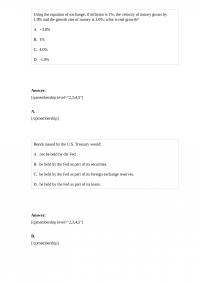
Using the equation of exchange, if inflation is 1%, the velocity of money grows by 1.0% and the growth rate of money is 3.0%; what is real growth? A. +3.0% B. 1% C. 4.0% D. -1.0% Answer: Bonds issued by […]
ECON E 88737
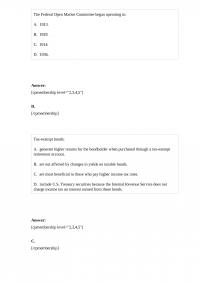
The Federal Open Market Committee began operating in: A. 1913. B. 1929. C. 1914. D. 1936. Answer: Tax-exempt bonds: A. generate higher returns for the bondholder when purchased through a tax-exempt retirement account. B. are not affected by changes in […]
BUS 12038
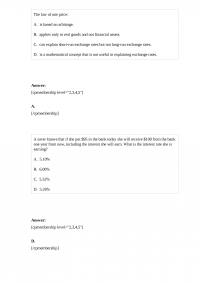
The law of one price: A. is based on arbitrage. B. applies only to real goods and not financial assets. C. can explain short-run exchange rates but not long-run exchange rates. D. is a mathematical concept that is not useful […]
BUS 70022
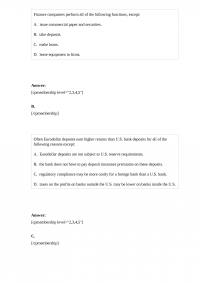
Finance companies perform all of the following functions, except: A. issue commercial paper and securities. B. take deposits. C. make loans. D. lease equipment to firms. Answer: Often Eurodollar deposits earn higher returns than U.S. bank deposits for all of […]
ECB 98375
A lender usually knows less about the creditworthiness of a borrower than the borrower does. This is an example of: A. opportunistic behavior. B. economies of scale. C. diminishing marginal returns. D. information asymmetry. Answer: An investment has grown from […]
MicroEconomic 41152
The development of money market mutual funds contributed to the growth of ________ since the money market mutual funds need to hold liquid, high-quality, short-terms assets. A) the commercial paper market B) the municipal bond market C) the corporate bond […]
ECON A 46136
If a bank needs to raise the amount of capital relative to assets, a bank manager might choose to A) buy back bank stock. B) pay higher dividends. C) shrink the size of the bank. D) sell securities the bank […]
ECB 19256
The ________ states that exchange rates between any two currencies will adjust to reflect changes in the price levels of the two countries. A) theory of purchasing power parity B) law of one price C) theory of money neutrality D) […]
Economics 45634
If you have a very low tolerance for risk, which of the following bonds would you be least likely to hold in your portfolio? A) a U.S. Treasury bond B) a municipal bond C) a corporate bond with a rating […]
ECON E 54118
A decline in the money supply shifts the LM curve to the left, causing the interest rate to ________ and output to ________, everything else held constant. A) rise; rise B) rise; fall C) fall; rise D) fall; fall Answer: […]
ECON A 32071
Suppose that from a new checkable deposit, First National Bank holds two million dollars in vault cash, eight million dollars on deposit with the Federal Reserve, and nine million dollars in excess reserves. Given this information, we can say First […]
BUS 76155
The most liquid securities traded in the capital market are A) corporate bonds. B) municipal bonds. C) U.S. Treasury bonds. D) mortgage-backed securities. Answer: Everything else held constant, a decrease in wealth A) increases the demand for stocks. B) increases […]

BUS 67341
Keynes’s liquidity preference theory indicates that the demand for money A) is purely a function of income, and interest rates have no effect on the demand for money. B) is purely a function of interest rates, and income has no […]
ECB 86979
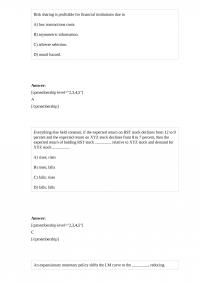
Risk sharing is profitable for financial institutions due to A) low transactions costs. B) asymmetric information. C) adverse selection. D) moral hazard. Answer: Everything else held constant, if the expected return on RST stock declines from 12 to 9 percent […]
Economics 25948
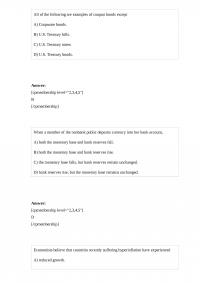
All of the following are examples of coupon bonds except A) Corporate bonds. B) U.S. Treasury bills. C) U.S. Treasury notes. D) U.S. Treasury bonds. Answer: When a member of the nonbank public deposits currency into her bank account, A) […]
BUS 43342
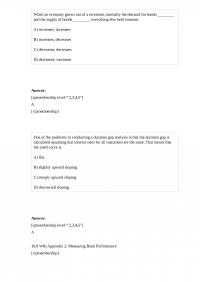
When an economy grows out of a recession, normally the demand for bonds ________ and the supply of bonds ________, everything else held constant. A) increases; increases B) increases; decreases C) decreases; decreases D) decreases; increases Answer: One of the […]
ECON E 41931
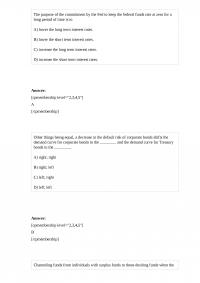
The purpose of the commitment by the Fed to keep the federal funds rate at zero for a long period of time is to A) lower the long term interest rates. B) lower the short term interest rates. C) increase […]
ECON 84307
In the ten year period 1981-1990, 1202 commercial banks were closed, with a peak of 206 failures in 1989. This rate of failures was approximately ________ times greater than that in the period from 1934 to 1980. A) two B) […]
MicroEconomic 30150
________ are the only depository institutions that are tax-exempt. A) Commercial banks B) Savings and loans C) Mutual savings banks D) Credit unions Answer: The expectations-augmented Phillips curve implies that as expected inflation increases, nominal wages ________ to prevent real […]
ECON A 92037
The most comprehensive measure of aggregate output is A) gross domestic product. B) net national product. C) the stock value of the industrial 500. D) national income. Answer: One factor contributing to the rapid growth of the commercial paper market […]
ECON E 65268
An increase in interest rates A) increases the value of the dollar, net exports, and equilibrium output. B) increases the value of the dollar, reducing net exports and equilibrium output. C) reduces the value of the dollar, net exports, and […]
Economics 70023
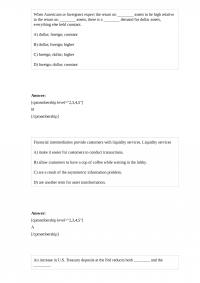
When Americans or foreigners expect the return on ________ assets to be high relative to the return on ________ assets, there is a ________ demand for dollar assets, everything else held constant. A) dollar; foreign; constant B) dollar; foreign; higher […]
ECON A 12762
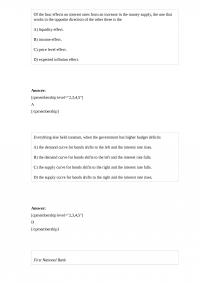
Of the four effects on interest rates from an increase in the money supply, the one that works in the opposite direction of the other three is the A) liquidity effect. B) income effect. C) price level effect. D) expected […]
ECON A 98823
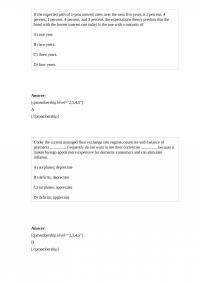
If the expected path of 1-year interest rates over the next five years is 2 percent, 4 percent, 1 percent, 4 percent, and 3 percent, the expectations theory predicts that the bond with the lowest interest rate today is the […]
ECON E 42036
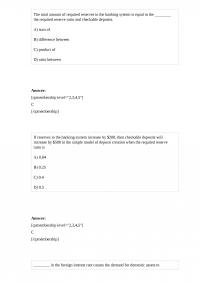
The total amount of required reserves in the banking system is equal to the ________ the required reserve ratio and checkable deposits. A) sum of B) difference between C) product of D) ratio between Answer: If reserves in the banking […]
ECON A 31498
When the interest rate on a bond is ________ the equilibrium interest rate, in the bond market there is excess ________ and the interest rate will ________. A) above; demand; rise B) above; demand; fall C) below; supply; fall D) […]
BUS 50426
If a $5,000 face-value discount bond maturing in one year is selling for $5,000, then its yield to maturity is A) 0 percent. B) 5 percent. C) 10 percent. D) 20 percent. Answer: The risk that interest payments will not […]
ECB 22121
A return to the gold standard, that is, using gold for money will ________ the ________ for gold, ________ its price, everything else held constant. A) increase; demand; increasing B) decrease; demand; decreasing C) increase; supply; increasing D) decrease; supply; […]
Economics 31620
A credit market instrument that pays the owner a fixed coupon payment every year until the maturity date and then repays the face value is called a A) simple loan. B) fixed-payment loan. C) coupon bond. D) discount bond. Answer: […]
ECB 35568
An analysis of the political economy of the savings and loan crisis helps one to understand A) why politicians aided the efforts of thrift regulators, raising regulatory appropriations and encouraging closing of insolvent thrifts. B) why thrift regulators were so […]
BUS 74636
________ is the field of study that applies concepts from social sciences such as psychology and sociology to help understand the behavior of securities prices. A) Behavioral finance B) Strategical finance C) Methodical finance D) Procedural finance Answer: FIRREA increased […]

BUS 32561
In the market for reserves, if the federal funds rate is between the discount rate and the interest rate paid on excess reserves, a ________ in the reserve requirement decreases the demand for reserves, ________ the federal funds interest rate, […]
MicroEconomic 29687
State banks that are not members of the Federal Reserve System are most likely to be examined by the A) Federal Reserve System. B) FDIC. C) FHLBS. D) Comptroller of the Currency. Answer: Municipal bonds have default risk, yet their […]
ECON A 95847
Which of the following would a bank not hold as insurance against the highest cost of deposit outflow-bank failure? A) Excess reserves B) Secondary reserves C) Bank capital D) Mortgages Answer: The National Bank Act of 1863, and subsequent amendments […]
MicroEconomic 31986
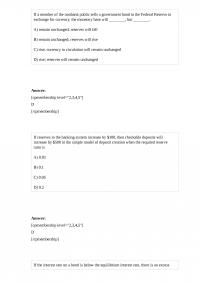
If a member of the nonbank public sells a government bond to the Federal Reserve in exchange for currency, the monetary base will ________, but ________. A) remain unchanged; reserves will fall B) remain unchanged; reserves will rise C) rise; […]
MicroEconomic 50790
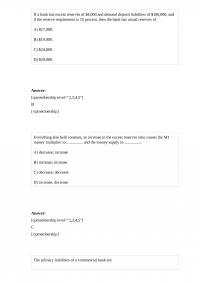
If a bank has excess reserves of $4,000 and demand deposit liabilities of $100,000, and if the reserve requirement is 15 percent, then the bank has actual reserves of A) $17,000. B) $19,000. C) $24,000. D) $29,000. Answer: Everything else […]
ECB 76974
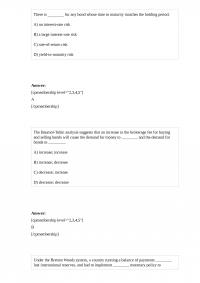
There is ________ for any bond whose time to maturity matches the holding period. A) no interest-rate risk B) a large interest-rate risk C) rate-of-return risk D) yield-to-maturity risk Answer: The Baumol-Tobin analysis suggests that an increase in the brokerage […]
ECB 81320
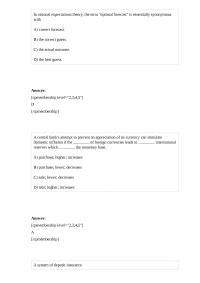
In rational expectations theory, the term “optimal forecast” is essentially synonymous with A) correct forecast. B) the correct guess. C) the actual outcome. D) the best guess. Answer: A central bank’s attempt to prevent an appreciation of its currency can […]