Archives: Quiz
Economics 30654
Which of the following stock price indexes is a price-weighted index? A. Dow Jones Industrial Average B. Standard & Poor’s 500 Index C. Nasdaq D. Wilshire 5000 Answer: Which of the following is not an example of bartering? A. Sue […]
Economics 32430
Most financial markets in the United States operate under a system: A. without any formal rules or regulation. B. with many rules and regulation to ensure a fair market. C. where it depends on which state where the financial market […]
ECB 78110
The principal-agent problem is: A. a form of adverse selection. B. when stockholders are not acting in the best interest of managers. C. a form of moral hazard. D. due to managers not being able to monitor stockholder behavior. Answer: […]
MicroEconomic 66174
When the current yield and the coupon rate are equal, the bond is: A. purchased at a discount. B. purchased at a price that equals the face value. C. a zero-coupon bond. D. purchased at a price that exceeds its […]
ECB 95705
Checkable deposits have decreased since the 1970’s mainly because: A. regulators allowed higher rates to be paid on these accounts and banks found them to be highly unprofitable. B. people prefer to use credit cards rather than writing checks. C. […]
ECON E 23011
Credit Unions are regulated by a combination of agencies which includes: A. state authorities. B. The Federal Reserve. C. The Federal Deposit Insurance Corporation. D. The Office of the Comptroller of the Currency. Answer: Criteria used to judge a central […]
Economics 16352
Which of the following features would characterize a good monetary policy instrument? A. observable only to monetary policy officials. B. tightly linked to monetary policy objectives. C. controllable and rigid. D. difficult to change. Answer: Which of the following financial […]
MicroEconomic 73859
Asymmetric information poses two important obstacles to the smooth flow of funds from savers to investors. They are: A. adverse selection, which arises before the transaction occurs, and moral hazard, which occurs after the transaction. B. moral hazard, which arises […]
BUS 18970
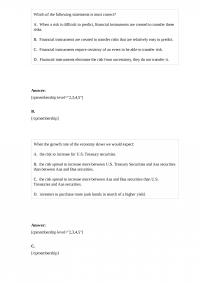
Which of the following statements is most correct? A. When a risk is difficult to predict, financial instruments are created to transfer these risks. B. Financial instruments are created to transfer risks that are relatively easy to predict. C. Financial […]
BUS 32684
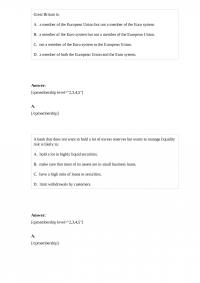
Great Britain is: A. a member of the European Union but not a member of the Euro system. B. a member of the Euro system but not a member of the European Union. C. not a member of the Euro […]
ECON 10776
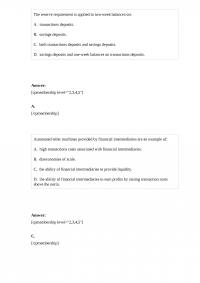
The reserve requirement is applied to two-week balances on: A. transactions deposits. B. savings deposits. C. both transactions deposits and savings deposits. D. savings deposits and one-week balances on transactions deposits. Answer: Automated teller machines provided by financial intermediaries are […]
ECON E 62611
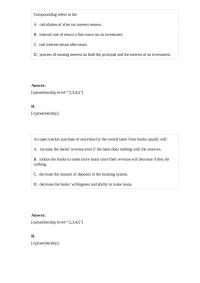
Compounding refers to the A. calculation of after tax interest returns. B. internal rate of return a firm earns on an investment. C. real interest return after taxes. D. process of earning interest on both the principal and the interest […]
ECON E 98441
The principal in an interest rate swap is: A. always transferred from the originator to the counterparty of the swap. B. is usually held by a clearinghouse to guarantee payment. C. usually borrowed from a third party. D. is not […]
ECON E 90413
One way insurance companies deal with the problem of adverse selection is by: A. charging the same price to everyone. B. screening applicants. C. monitoring policyholders after they have purchased insurance. D. spreading the risk in the same geographic area. […]
ECON A 69787
If the target federal funds rate reaches zero: A. the FOMC would run out of policy options. B. monetary policy would no longer be of use. C. the FOMC would turn to unconventional measures, such as forward guidance. D. the […]
Economics 61203
The dividend-discount model of stock valuation: A. is an application of the net present value formula. B. takes the net present value of expected dividends and add it to the future sale price of the stock. C. takes the net […]
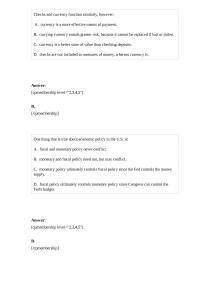
BUS 12069
Checks and currency function similarly, however: A. currency is a more effective means of payment. B. carrying currency entails greater risk, because it cannot be replaced if lost or stolen. C. currency is a better store of value than checking […]
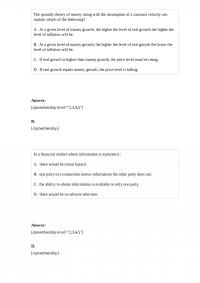
Economics 72171
The quantity theory of money along with the assumption of a constant velocity can explain which of the following? A. At a given level of money growth, the higher the level of real growth the higher the level of inflation […]
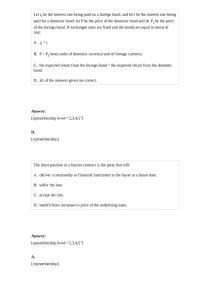
BUS 31335
Let if be the interest rate being paid on a foreign bond, and let i be the interest rate being paid for a domestic bond; let P be the price of the domestic bond and let Pf be the price […]
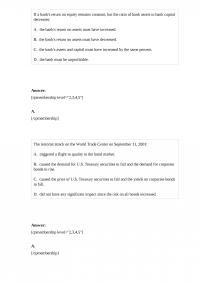
ECB 99078
If a bank’s return on equity remains constant, but the ratio of bank assets to bank capital decreases: A. the bank’s return on assets must have increased. B. the bank’s return on assets must have decreased. C. the bank’s assets […]
BUS 18547
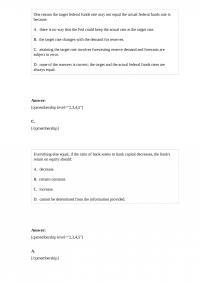
One reason the target federal funds rate may not equal the actual federal funds rate is because: A. there is no way that the Fed could keep the actual rate at the target rate. B. the target rate changes with […]
ECB 63440
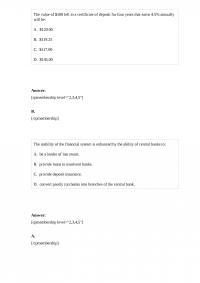
The value of $100 left in a certificate of deposit for four years that earns 4.5% annually will be: A. $120.00 B. $119.25 C. $117.00 D. $145.00 Answer: The stability of the financial system is enhanced by the ability of […]
ECON A 89799
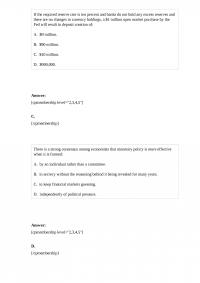
If the required reserve rate is ten percent and banks do not hold any excess reserves and there are no changes in currency holdings, a $1 million open market purchase by the Fed will result in deposit creation of: A. […]
ECON E 40306
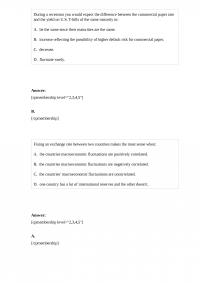
During a recession you would expect the difference between the commercial paper rate and the yield on U.S. T-bills of the same maturity to: A. be the same since their maturities are the same. B. increase reflecting the possibility of […]
ECB 40282
One reason it took so long to have a central bank in the United States is that: A. it wasn’t needed. B. states feared centralization of power. C. state currencies worked fine. D. all of the answer options are correct. […]
Economics 79898
During most of the 1970s, officials at the Fed: A. overestimated inflation and underestimated the growth rate of potential GDP. B. overestimated the growth rate of potential GDP and underestimated inflation. C. underestimated both the growth rate of output and […]
ECON A 67639
The option writer is: A. the seller of an option. B. the buyer of an option. C. the underlying asset of the option. D. the individual who obtains the rights. Answer: If the nominal interest rate increases: A. the cost […]
Economics 94608
We should expect a country that experiences volatile inflation to also have: A. volatile nominal interest rates. B. volatile real interest rates but stable nominal rates. C. stable nominal interest rates. D. volatile real interest rates. Answer: The Fed purchases […]
ECON 40670
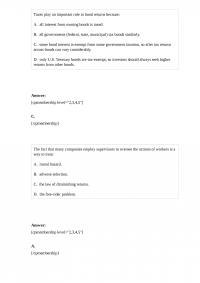
Taxes play an important role in bond returns because: A. all interest from owning bonds is taxed. B. all governments (federal, state, municipal) tax bonds similarly. C. some bond interest is exempt from some government taxation, so after tax returns […]
BUS 39772
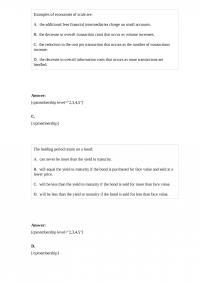
Examples of economies of scale are: A. the additional fees financial intermediaries charge on small accounts. B. the decrease in overall transaction costs that occur as volume increases. C. the reduction in the cost per transaction that occurs as the […]
BUS 95074
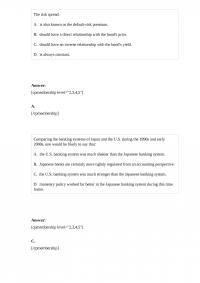
The risk spread: A. is also known as the default-risk premium. B. should have a direct relationship with the bond’s price. C. should have an inverse relationship with the bond’s yield. D. is always constant. Answer: Comparing the banking systems […]
ECB 94428
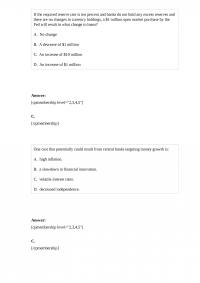
If the required reserve rate is ten percent and banks do not hold any excess reserves and there are no changes in currency holdings, a $1 million open market purchase by the Fed will result in what change in loans? […]
ECON A 54722
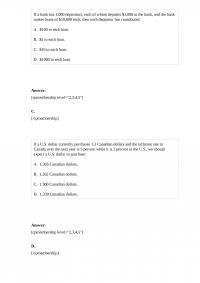
If a bank has 1,000 depositors, each of whom deposits $1,000 in the bank, and the bank makes loans of $10,000 each, then each depositor has contributed: A. $100 to each loan. B. $1 to each loan. C. $10 to […]
Economics 24112
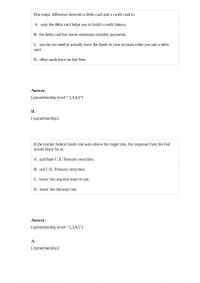
One major difference between a debit card and a credit card is: A. only the debit card helps you to build a credit history. B. the debit card has lower minimum monthly payments. C. you do not need to actually […]
Economics 25712
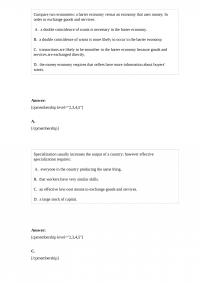
Compare two economies: a barter economy versus an economy that uses money. In order to exchange goods and services: A. a double coincidence of wants is necessary in the barter economy. B. a double coincidence of wants is more likely […]
Economics 12897
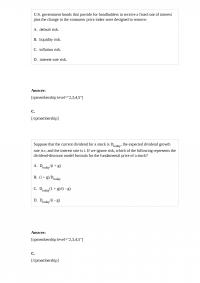
U.S. government bonds that provide for bondholders to receive a fixed rate of interest plus the change in the consumer price index were designed to remove: A. default risk. B. liquidity risk. C. inflation risk. D. interest-rate risk. Answer: Suppose […]
ECON 81771
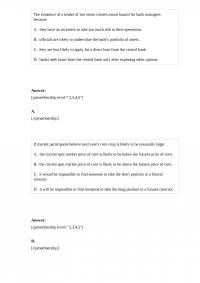
The existence of a lender of last resort creates moral hazard for bank managers because: A. they have an incentive to take too much risk in their operations. B. officials are likely to undervalue the bank’s portfolio of assets. C. […]
BUS 71243
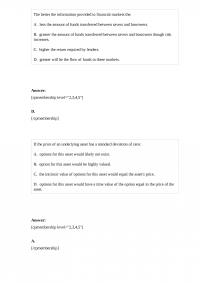
The better the information provided to financial markets the: A. less the amount of funds transferred between savers and borrowers. B. greater the amount of funds transferred between savers and borrowers though risk increases. C. higher the return required by […]
ECB 34727
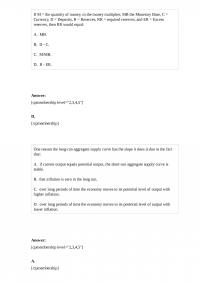
If M = the quantity of money, m the money multiplier, MB the Monetary Base, C = Currency, D = Deposits, R = Reserves, RR = required reserves, and ER = Excess reserves, then RR would equal: A. MB. B. […]
ECON A 79848
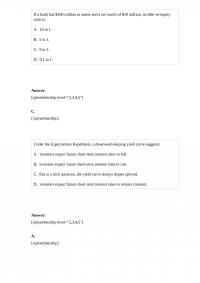
If a bank has $100 million in assets and a net worth of $10 million, its debt-to-equity ratio is: A. 10 to 1. B. 5 to 1. C. 9 to 1. D. 0.1 to 1. Answer: Under the Expectations Hypothesis, […]
ECON 33809
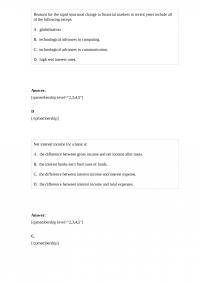
Reasons for the rapid structural change in financial markets in recent years include all of the following except: A. globalization. B. technological advances in computing. C. technological advances in communication. D. high real interest rates. Answer: Net interest income for […]
Economics 19043
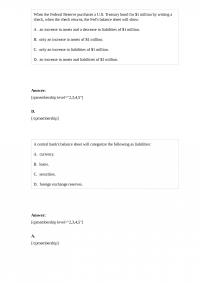
When the Federal Reserve purchases a U.S. Treasury bond for $1 million by writing a check, when the check returns, the Fed’s balance sheet will show: A. an increase in assets and a decrease in liabilities of $1 million. B. […]
Economics 83365
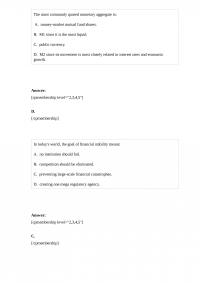
The most commonly quoted monetary aggregate is: A. money-market mutual fund shares. B. M1 since it is the most liquid. C. public currency. D. M2 since its movement is most closely related to interest rates and economic growth. Answer: In […]
ECON A 49147
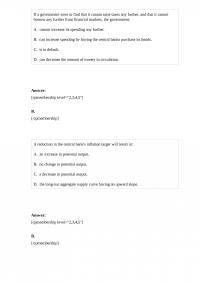
If a government were to find that it cannot raise taxes any further, and that it cannot borrow any further from financial markets, the government: A. cannot increase its spending any further. B. can increase spending by having the central […]
Economics 11932
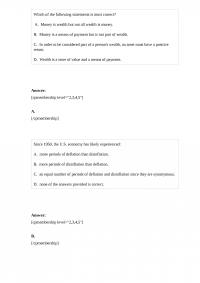
Which of the following statements is most correct? A. Money is wealth but not all wealth is money. B. Money is a means of payment but is not part of wealth. C. In order to be considered part of a […]
ECON E 61618
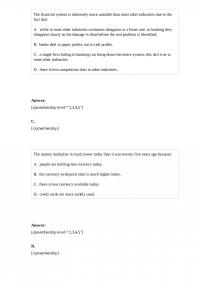
The financial system is inherently more unstable than most other industries due to the fact that: A. while in most other industries customers disappear at a faster rate, in banking they disappear slowly so the damage is done before the […]
MicroEconomic 25343
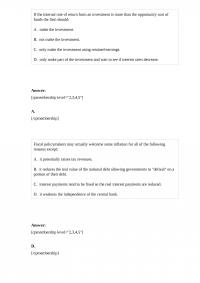
If the internal rate of return from an investment is more than the opportunity cost of funds the firm should: A. make the investment. B. not make the investment. C. only make the investment using retained earnings. D. only make […]
ECON E 95768
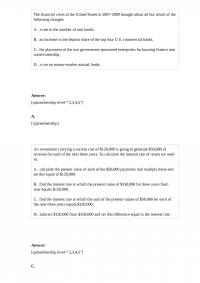
The financial crisis in the United States in 2007-2009 brought about all but which of the following changes: A. a rise in the number of unit banks. B. an increase in the deposit share of the top four U.S. commercial […]
ECON A 41216
One valuable lesson investors should learn from the stock market behavior during the late 1990s and early 2000s is that the Fed: A. can control the stock market. B. can reduce the idiosyncratic risk of investing but not the systematic […]
ECB 44561
If a bank’s return on equity remains constant, but the ratio of bank assets to bank capital increases: A. the bank’s return on assets must have increased. B. the bank’s return on assets must have decreased. C. the bank’s assets […]