
Most financial markets in the United States operate under a system:
A. without any formal rules or regulation.
B. with many rules and regulation to ensure a fair market.
C. where it depends on which state where the financial market is located since some
states do not have any regulations.
D. that is totally controlled by the federal government.
Answer:
According to the Expectations Hypothesis, if investors believed that, for a given
holding period, the average of the expected future short-term yields was greater than the
long-term yield for the holding period, they would act so as to drive:
A. down the price of the short-term bond and drive up the price of the long-term bond.
B. up the price of the short-term bond and drive down the price of the long-term bond.
C. up the prices of both the short- and long-term bonds.
D. down the prices of both the short- and long-term bonds.
Answer:

The impact from rapid dividend growth on a stock’s current price will be:
A. negative, since the company is paying out profits to stockholders.
B. positive, since rapid dividend growth causes stockholders to expect higher future
dividends.
C. zero; only current dividends are used to determine the current price of a stock.
D. positive, but only if the corporation does not have any debt.
Answer:
If the Fed were to enter the foreign exchange market and purchase euros, the impact on
domestic banking reserves would be:
A. the opposite of what it would be with an open market purchase.
B. domestic banking reserves would decrease.
C. the same as it would be with an open market purchase.
D. uncertain.

Answer:
The challenges facing policymakers today include each of the following, except:
A. the economy’s sustainable growth rate is highly stable.
B. nominal interest rates cannot fall below zero.
C. stock and property values are subject to booms and busts.
D. the structure of the economy and financial system continues to evolve.
Answer:
If financial markets didn’t exist:
A. required returns would be lower since fewer instruments would trade.
B. liquidity would diminish and returns would be lower.
C. more funds would flow directly between borrowers and savers.

D. liquidity would diminish, reducing the flow of funds between borrowers and savers.
Answer:
As general business conditions deteriorate, all other factors constant:
A. the bond supply curve will shift left.
B. there will be a movement down the existing bond supply curve.
C. the bond demand curve shifts left.
D. the price of bonds will decrease.
Answer:
Bank’s hold marketable securities as part of their assets. For U.S. banks these
marketable securities include:
A. stocks and bonds.

B. only the stocks of U.S. corporations.
C. only the bonds of the U.S. treasury.
D. only bonds.
Answer:
We would expect the relationship between the risk spread on Baa bonds and U.S.
Treasury securities of similar maturities to:
A. vary directly with economic growth.
B. show no variation over the business cycle.
C. vary inversely with economic growth.
D. be uncorrelated with economic growth.
Answer:
The key to the success of forward guidance as a monetary policy tool is:

A. timing.
B. a favorable exchange rate.
C. transparency.
D. credibility.
Answer:
If the Federal Reserve surprises investors by announcing an easing of monetary policy:
A. it should have no impact on the slope of the yield curve.
B. we should expect the yield curve to possibly become inverted.
C. the yield curve would flatten.
D. we should expect the yield curve to steepen.
Answer:

Which of the following would lead to a decrease in bond demand?
A. An increase in expected inflation.
B. An increase in wealth.
C. A decrease in risk.
D. A decrease in liquidity.
Answer:
If U.S. assets are seen as having greater risk relative to foreign assets in the market for
foreign exchange, this should cause the:
A. demand for dollars to increase.
B. supply of dollars to decrease.
C. supply of dollars to increase.
D. dollar to appreciate.
Answer:

In countries with low inflation:
A. M2 growth is a very strong forecaster of inflation.
B. there tends to be a greater reliance on checks than electronic payments.
C. M2 growth is a poor forecaster of inflation.
D. money stocks are a larger percentage of GDP.
Answer:
The reason that a run on a single bank can turn into a bank panic that threatens the
entire financial system is:
A. information asymmetries.
B. moral hazard.
C. the lack of regulation.
D. the increased reliance on web-based funds transfers.
Answer:

Which of the following is not a positive effect of the Basel Accord?
A. It forced regulators to change the way they thought about bank capital.
B. It promoted a more uniform international system.
C. It provided a framework that less developed countries could use to improve the
regulation of their banks.
D. It provided a system to differentiate between bonds based on their systemic risk.
Answer:
If the quantity of bonds supplied exceeds the quantity of bonds demanded, bond prices
would:
A. rise and yields would fall.
B. fall and yields would rise.
C. rise but yields will remain constant.
D. fall and yields would fall.
Answer:

Assume an investor has a choice of 3 consecutive one-year bonds or one 3-year bond.
Assuming the Expectations Hypothesis of the term structure of interest rates is correct
the:
A. average interest rate of the three consecutive one-year bonds should be less than the
3-year bond to reflect the risk premium.
B. interest rate of the 3-year bond should equal the average interest rate of the 3
one-year bonds.
C. three consecutive one-year bonds must have the same interest rate.
D. current one-year interest rate must equal the current 3-year interest rate.
Answer:
The most prominent of asset-backed securities is:
A. shares of stock in corporations since stockholders own the assets.
B. securities backed by home mortgages.
C. U.S. Treasury bonds since they are backed by all public assets.
D. movie box-office receipts.

Answer:
If in late 2016 100 U.S. dollars exchanged for 118 euros and in mid-2017 100 U.S.
dollars exchanged for 127 euros, then:
A. the euro appreciated relative to the dollar.
B. the dollar appreciated relative to the euro.
C. European goods became more expensive to Americans.
D. American goods became more expensive to Americans.
Answer:
One of the lessons from the 2007-2009 financial crisis regarding the management of
risk by financial institution is that:
A. many banks lacked real-time information that would allow them to assess their
various risk exposures at the bank-wide level.
B. some banks, especially large ones, overestimated the trading risk associated with
mortgage backed securities.
C. banks were holding too much capital as a protection against market risk.

D. many of the usual mechanisms for managing liquidity risk actually worked pretty
well.
Answer:
When nominal interest rates are high, the velocity of money should:
A. be low.
B. also be high.
C. not change; the velocity of money does not vary with the interest rate.
D. decrease by the same percent that the nominal interest rate has increased.
Answer:
Most central banks, including the Fed and the ECB, provide discount loans at a rate:
A. equal to the target interest rate.

B. below the target interest rate.
C. above the target interest rate.
D. that is equal to the overnight interbank lending rate.
Answer:
A lesson that policymakers should learn from the Argentinean experience with currency
boards is:
A. poor fiscal policies can undermine any monetary policy regime.
B. a flexible exchange rate is always preferred to a pegged exchange rate.
C. the only fixed exchange rate that works is the gold standard.
D. they never work.
Answer:
Policymakers are often reluctant to turn to unconventional monetary policy measures

because:
A. they are uncertain of the quantitative impact of using them.
B. such policies are potentially too powerful.
C. such policies require Congressional approval and Congress is often slow to act.
D. such policies require coordination with the central bankers of foreign countries.
Answer:
When an individual obtains a car loan and makes all of the regular monthly payments,
the sum of the payments made will exceed the purchase price of the car. This is due
primarily to the core principle:
A. risk requires compensation.
B. information is the basis for decisions.
C. markets determine prices and allocate resources.
D. time has value.
Answer:

Which of the following is a problem of moral hazard?
A. A lender cannot distinguish good risk from bad risk borrowers.
B. An individual who purchases auto insurance begins to leave his or her keys in the
car while running into a store.
C. Life insurance companies offer an average premium to smokers and non-smokers so
they do not have to have two different premiums.
D. An auto insurance company charges higher premiums to younger drivers than what
they charge to older drivers.
Answer:
Prior to the financial crisis of 2007-2009 banks did all but which of the following to
bulk up their profit:
A. bought or sponsored hedge funds.
B. traded securities for customers.
C. purchased equities for their own account.
D. colluded to fix benchmark interest rates.
Answer:

The fundamental characteristics influencing the value of a financial instrument include
each of the following except:
A. the size of the payment promised.
B. when the promised payment will be made.
C. where the instrument is traded.
D. the likelihood of payment.
Answer:
In considering the holding period return, the longer the term of the bond the:
A. less important is the capital gain and the more important in the current yield.
B. less important is the coupon rate and the more important is the current yield.
C. less important is the capital gain.
D. more important is the capital gain.

Answer:
Higher home values can increase output in the economy if:
A. people take some of the equity out of their homes and spend it on a vacation.
B. people sell their existing home and build a new one.
C. people finance their child’s college education by securing a second mortgage on
their now higher-valued home.
D. all of the answers given are correct.
Answer:
Empirical evidence points to the fact that financial crises:
A. are newsworthy but have no impact on economic growth.
B. have a negative impact on economic growth only for the year of the crisis.
C. have a negative impact on economic growth for years.
D. can have a positive impact on economic growth as weak borrowers are weeded out.

Answer:
The primary concern of current critics of fiat money is that:
A. fiat money is too costly to produce.
B. governments issue too much money threatening its value.
C. fiat money is too easy to counterfeit.
D. government will issue too little threatening economic growth.
Answer:
Today the primary distinction between direct and indirect finance is in:
A. direct finance the asset holder has a claim on a financial institution while in indirect
finance the asset holder has a direct claim on the borrower.
B. indirect finance the lender has a direct claim on the borrower while in direct finance
the lender has a claim on a financial institution.
C. direct finance the asset holder has a direct claim on the borrower while in indirect
finance the asset holder has a claim on a financial institution.
D. indirect finance the asset holder has a claim on the government while in direct
finance the asset holder has a direct claim on a private sector corporation.
Answer:
Answer:
Answer:
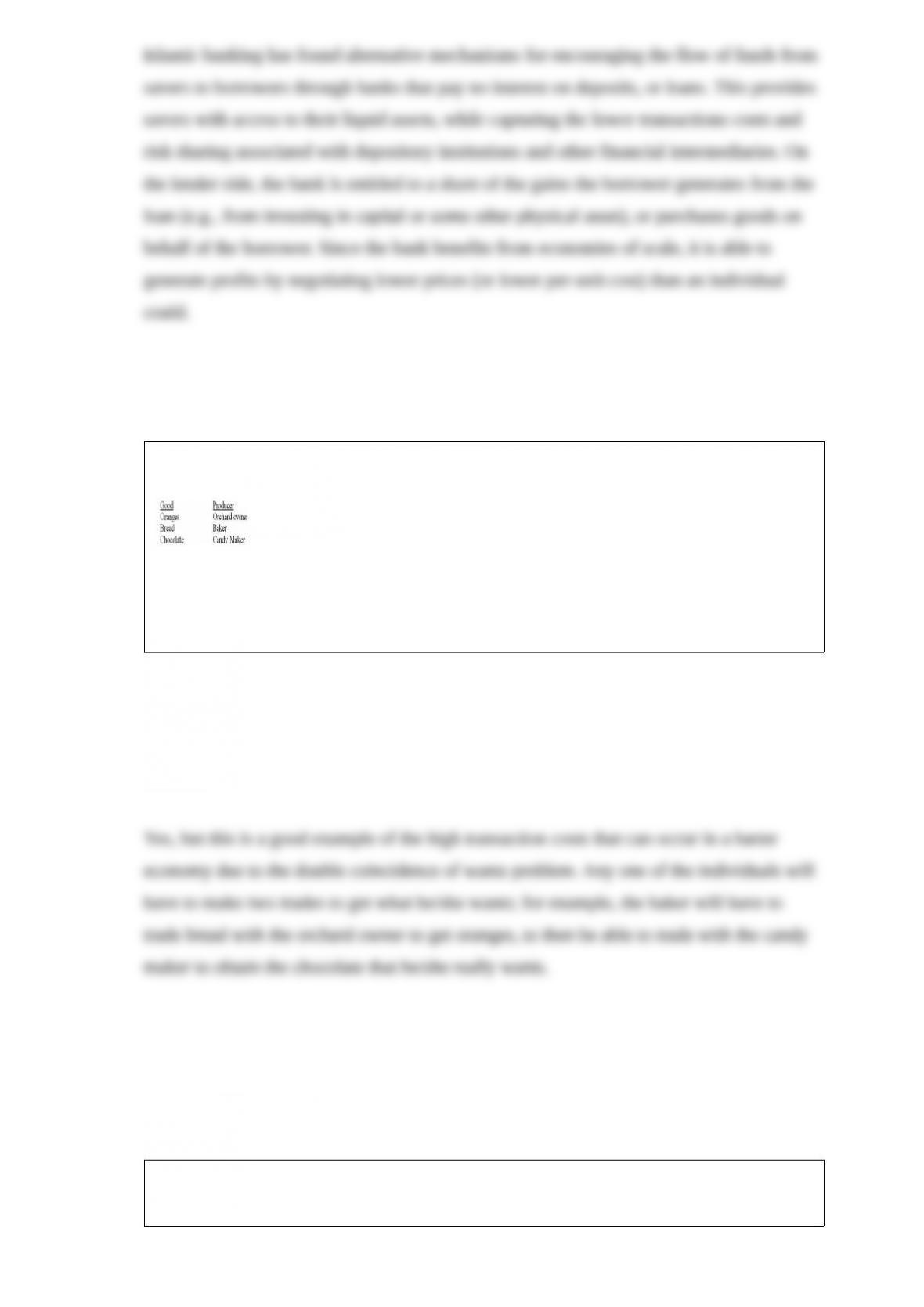
There are three goods produced in an economy by three individuals:
If the orchard owner likes only bread, the baker likes only chocolate, and the candy
maker likes only oranges, will any trade between these three persons take place in a
barter economy? Explain.
Answer:
Answer:
Answer:
Answer:
Answer:
Answer:
Answer:
Answer:
Answer:
Answer:
Answer:
Answer:
Answer:
Answer: