Archives: Quiz
ECON A 40111
The acronym CAMELS, which is the criteria used by supervisors to evaluate the health of banks, includes the following, except: A. asset quality. B. losses. C. management. D. earnings. Answer: A society without any money: A. could never exchange goods […]
ECON 16254
The law of one price fails as a result of: A. low tariffs. B. insignificant transportation costs. C. similar technical specifications. D. goods that cannot be traded. Answer: Agencies exist which rate bonds based on characteristics of the borrower Such […]
ECON E 86745
The demand for U.S. government bonds is high relative to other bond issues because: A. liquidity of other bond issues is high relative to U.S. government bonds. B. U.S. bond market has low transaction spreads due to high illiquidity. C. […]
MicroEconomic 90478
The bank-lending channel of monetary policy focuses on: A. the interest rate banks charge their largest customer. B. the banks’ willingness and ability to lend. C. how central bank policy influences the solvency of banks. D. the deposit insurance premiums […]
Economics 82698
The interest rate decisions made by the Federal Open Market Committee: A. can be overridden by the President. B. can be overridden by the Secretary of the Treasury. C. can be overridden by the U.S. Senate by a two-thirds majority. […]
ECB 72454
The risk structure of interest rates refers to the: A. relationship among the interest rates of bonds with different maturities. B. relationship among the interest rates of bonds from different issuers with the same maturities. C. relationship among the interest […]
ECON A 66052
Which of the following statements is most correct? A. The use of monetary policy in the U.S. has not changed much since the creation of the Fed. B. The quantitative impact on output of altering the target federal funds rate […]
MicroEconomic 68357
The number of regional Federal Reserve Banks is: A. nine. B. seven. C. five. D. twelve. Answer: Which of the following statements is most correct? A. The FOMC is more successful at keeping the market rate closer to the target […]
ECB 27754
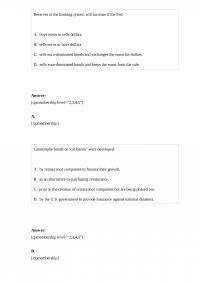
Reserves in the banking system will increase if the Fed: A. buys euros or sells dollars. B. sells euros or buys dollars. C. sells euro-dominated bonds and exchanges the euros for dollars. D. sells euro-dominated bonds and keeps the euros […]
ECB 48120
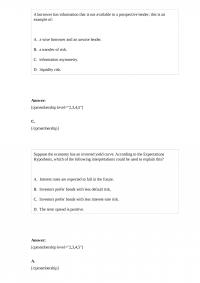
A borrower has information that is not available to a prospective lender; this is an example of: A. a wise borrower and an unwise lender. B. a transfer of risk. C. information asymmetry. D. liquidity risk. Answer: Suppose the economy […]
ECON 24313
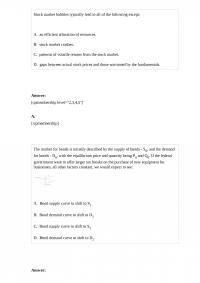
Stock market bubbles typically lead to all of the following except: A. an efficient allocation of resources. B. stock market crashes. C. patterns of volatile returns from the stock market. D. gaps between actual stock prices and those warranted by […]
ECB 52292
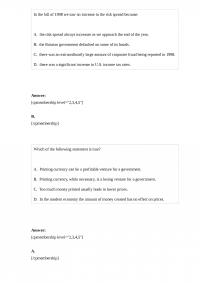
In the fall of 1998 we saw an increase in the risk spread because: A. the risk spread always increases as we approach the end of the year. B. the Russian government defaulted on some of its bonds. C. there […]
MicroEconomic 79655
One monopoly that modern central banks have is in: A. regulating other banks. B. making loans to banks. C. issuing U.S. Treasury securities. D. issuing currency. Answer: An expected appreciation of the dollar, everything else held constant, should cause: A. […]
ECB 77700
Stock prices may rise from a reduction in interest rates because: A. consumer and business confidence about future growth improves. B. stockholders will expect lower future earnings. C. financial market participants are less optimistic about future earnings. D. the present […]
MicroEconomic 85827
Mutual funds offer investors: A. a greater return for greater risk than what an investor can earn on his own. B. a lower return for more risk than what the investor could earn on his own. C. a lower return […]
ECB 15232
Which of the following statements is most correct for U.S. commercial banks? A. Net interest margin is much larger than return on equity. B. Net interest margin is about equal to return on equity. C. Net interest margin averages about […]
Economics 88172
Assuming the free flow of capital across borders, if country A wants to fix its exchange rate with country B, then: A. country A’s inflation rate will have to match country B’s. B. country A’s monetary policy must be conducted […]
Economics 14146
Considering the data on real and nominal interest rates for the U.S. from 1979 to 2012, which of the following statements is most accurate? A. The real interest rate remains unchanged over time. B. There have been times when the […]
ECB 90513
The money multiplier is much lower today than it was twenty-five years ago because: A. people are holding less currency today. B. the currency-to-deposit ratio is much higher today. C. there is less currency available today. D. credit cards are […]
ECON E 78626
The expected return from a portfolio made up equally of two assets that move perfectly opposite of each other would have a standard deviation equal to: A. 1.0 B. -1.0 C. 0.0 D. 0.5 Answer: Suppose Tom receives a one-year […]
ECON 32199
A foreign exchange intervention by a central bank affects the value of a country’s currency if it: A. alters banking system reserves. B. leaves domestic interest rates unchanged. C. results in a fixed exchange rate. D. alters banking system reserves […]
Economics 70964
The use of deposit sweeping allows banks to: A. pay higher rates of interest than are allowed by law. B. reduce the amount of required reserves they must hold. C. pay less for FDIC insurance. D. weed out less profitable […]
BUS 96349
Reasons for the rapid structural change in financial markets in recent years include all of the following except: A. globalization. B. technological advances in computing. C. technological advances in communication. D. high real interest rates. Answer: The fact that people […]
ECON E 25144
The relationship between the long-run real interest rate and potential output: A. is direct. B. is inverse. C. is constant since the long-run real interest rate is primarily determined by risk. D. depends on the actions of central bankers. Answer: […]
ECON 38416
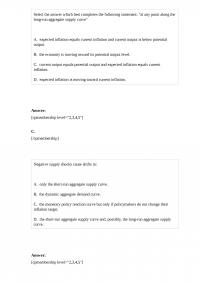
Select the answer which best completes the following statement: “at any point along the long-run aggregate supply curve” A. expected inflation equals current inflation and current output is below potential output. B. the economy is moving toward its potential output […]
Economics 49529
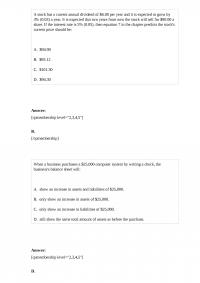
A stock has a current annual dividend of $6.00 per year and it is expected to grow by 3% (0.03) a year. It is expected that two years from now the stock will sell for $90.00 a share. If the […]
ECON A 63394
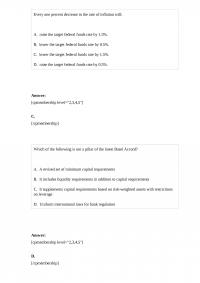
Every one percent decrease in the rate of inflation will: A. raise the target federal funds rate by 1.5%. B. lower the target federal funds rate by 0.5%. C. lower the target federal funds rate by 1.5%. D. raise the […]
ECON A 69325
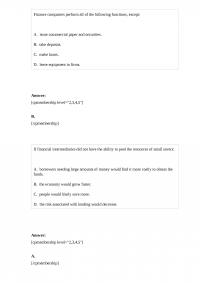
Finance companies perform all of the following functions, except: A. issue commercial paper and securities. B. take deposits. C. make loans. D. lease equipment to firms. Answer: If financial intermediaries did not have the ability to pool the resources of […]
ECON 92183
If the slope of the monetary policy reaction curve is relatively flat, it means that central bankers are: A. very concerned about keeping inflation close to the target rate. B. not concerned at all about inflation. C. less concerned about […]
MicroEconomic 99758
A coupon bond is a bond that: A. always sells at a price that is less than the face value. B. provides the owner with regular payments. C. pays the owner the sum of the coupons at the bond’s maturity. […]
ECON A 78675
Most of the buying and selling in primary markets: A. is in the public view. B. is highly transparent and closely monitored by the SEC. C. involve an investment bank. D. is done by the Federal Reserve. Answer: Secondary credit […]
ECON E 34724
On a particular day, the actual federal funds rate can deviate from the target federal funds rate. This might be due to all of the following except: A. unexpected changes in the demand for reserves. B. the forecasts of the […]
ECON E 49046
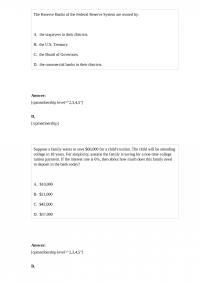
The Reserve Banks of the Federal Reserve System are owned by: A. the taxpayers in their districts. B. the U.S. Treasury. C. the Board of Governors. D. the commercial banks in their districts. Answer: Suppose a family wants to save […]
BUS 27352
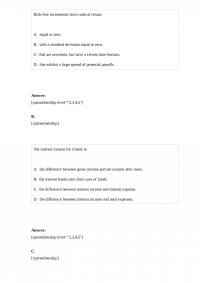
Risk-free investments have rates of return: A. equal to zero. B. with a standard deviation equal to zero. C. that are uncertain, but have a certain time horizon. D. that exhibit a large spread of potential payoffs. Answer: Net interest […]
ECB 65177
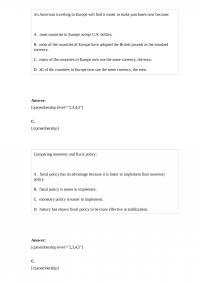
An American traveling to Europe will find it easier to make purchases now because: A. most countries in Europe accept U.S. dollars. B. most of the countries of Europe have adopted the British pounds as the standard currency. C. many […]
ECON E 11727
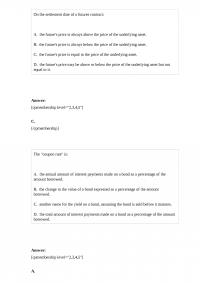
On the settlement date of a futures contract: A. the future’s price is always above the price of the underlying asset. B. the future’s price is always below the price of the underlying asset. C. the future’s price is equal […]
BUS 37729
The fact that many corporations use debt financing as well as equity financing creates all of the following except: A. the opportunity for a greater expected return for the stockholders. B. greater risk for the stockholders. C. leverage for the […]
Economics 63006
The Dow Jones Industrial Average: A. gives equal weight to a change in the price of the stock of any company in the index. B. reflects that a 10% increase in a share of stock selling for $30 will have […]
ECON 77539
Loans made between borrowers and lenders are: A. usually not taxable at the federal level. B. legal only in the state of origination. C. assets of the lenders. D. assets of the borrowers. Answer: Suppose the tax rate is 25% […]
BUS 68585
As a person’s wealth increases we would expect the demand for money to: A. decrease. B. increase dollar for dollar with wealth. C. increase but at a rate less than dollar for dollar. D. not change; money demand does not […]
ECON 48681
In a financial market where information is symmetric: A. there would be moral hazard. B. one party to a transaction knows information the other party does not. C. the ability to obtain information is available to only one party. D. […]
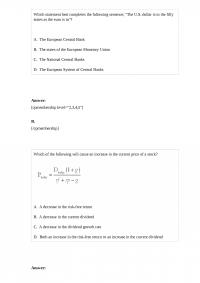
Economics 29426
Which statement best completes the following sentence; “The U.S. dollar is to the fifty states as the euro is to”? A. The European Central Bank B. The states of the European Monetary Union C. The National Central Banks D. The […]
MicroEconomic 42419
To minimize the cost of holding reserves for small banks, the: A. required reserve rate decreases as the amount of deposits increases. B. required reserve rate is constant. C. required reserve rate is not applied for transaction deposits less than […]
MicroEconomic 11669
Economists study the link between money and inflation because: A. they want to understand how to keep inflation low and stable. B. economists believe that inflation in the 3-6% range is healthy for an economy. C. as prices increase money […]
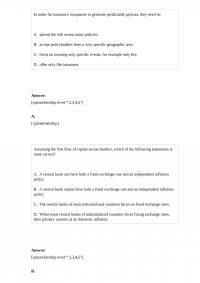
ECON E 75051
In order for insurance companies to generate predictable payouts, they need to: A. spread the risk across many policies. B. accept policyholders from a very specific geographic area. C. focus on insuring only specific events, for example only fire. D. […]
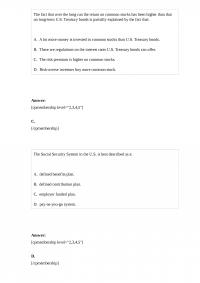
ECB 74336
The fact that over the long run the return on common stocks has been higher than that on long-term U.S. Treasury bonds is partially explained by the fact that: A. A lot more money is invested in common stocks than […]
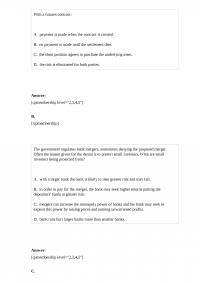
ECON A 76882
With a futures contract: A. payment is made when the contract is created. B. no payment is made until the settlement date. C. the short position agrees to purchase the underlying asset. D. the risk is eliminated for both parties. […]
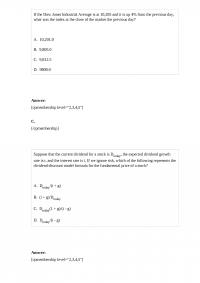
ECON 89798
If the Dow Jones Industrial Average is at 10,205 and it is up 4% from the previous day, what was the index at the close of the market the previous day? A. 10,201.0 B. 9,805.0 C. 9,812.5 D. 9800.0 Answer: […]
ECON A 51750
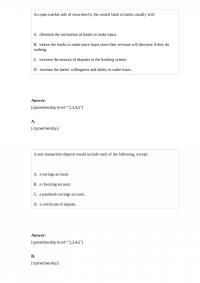
An open market sale of securities by the central bank to banks usually will: A. diminish the inclination of banks to make loans. B. induce the banks to make more loans since their revenue will decrease if they do nothing. […]
ECON E 53678
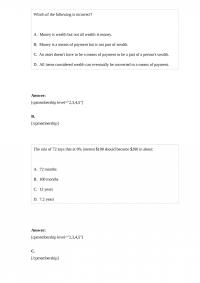
Which of the following is incorrect? A. Money is wealth but not all wealth is money. B. Money is a means of payment but is not part of wealth. C. An asset doesn’t have to be a means of payment […]