
The acronym CAMELS, which is the criteria used by supervisors to evaluate the health
of banks, includes the following, except:
A. asset quality.
B. losses.
C. management.
D. earnings.
Answer:
A society without any money:
A. could never exchange goods and/or services.
B. would find people doing everything for themselves.
C. would have to rely on barter.
D. would be more efficient since people would be more self-sufficient.
Answer:

Savings banks and savings and loans are regulated by a combination of agencies which
includes the:
A. Federal Reserve System.
B. Office of the Comptroller of the Currency.
C. Securities and Exchange Commission.
D. Internal Revenue Service.
Answer:
Consider the following ratio: the average annual inflation rate/the average annual
money growth rate. If a country’s rate of money growth consistently exceeds the rate of
inflation the ratio would be:
A. less than one.
B. greater than one.
C. that is infinite.
D. exactly one.
Answer:

As a result of technology, many small businesses today:
A. are located closer to their bank.
B. are located further from their bank.
C. have more face-to-face interactions with their banker.
D. no longer need banks.
Answer:
Which of the following statements is not true?
A. A value-weighted index is a better index to use to reflect changes in the economy’s
overall wealth.
B. A price-weighted index is a better index to use to reflect the average change in the
price of a typical share of stock.
C. The Dow Jones Industrial Average is a price-weighted index.
D. The S&P 500 is a price-weighted index.
Answer:

Futures markets and derivatives contribute to economic growth by:
A. decreasing speculation.
B. increasing the risk-taking capacity of the economy.
C. deterring the transfer of risk.
D. forcing people to accept the risk their decisions create.
Answer:
Which of the following statements is most accurate?
A. Potential output is determined by current output.
B. When an expansionary gap exists, current output is below potential output.
C. Current output cannot exceed potential output.
D. During a recessionary gap, current output is below potential output.

Answer:
The price of a stock is currently $750 and the stock will pay a $43 dividend. The
interest rate is 7.5%. Based on equation 7 in the chapter, what is the expected price of
this stock for next year?
A. $651.17
B. $657.67
C. $691.17
D. $763.25
Answer:
The higher the nominal interest rate:
A. the less money individuals will hold for any given level of transactions and the
higher the velocity of money.
B. the more money individuals will hold for any given level of transactions and the
higher the velocity of money.
C. the more money individuals will hold for any given level of transactions and the
lower the velocity of money.

D. the less money individuals will hold for any given level of transactions and the
lower the velocity of money.
Answer:
All of the following are consequences of an economy operating above its potential level
except:
A. high rates of inflation.
B. high interest rates.
C. low unemployment.
D. stable prices.
Answer:
Discount lending by the Fed:

A. is the key component of monetary policy.
B. is more important today than in years past.
C. is not as important today as it was in the past.
D. amounts to five billion dollars in volume during an average week.
Answer:
The holding period return has relevance because:
A. most bonds are held by the original purchaser until maturity.
B. most bonds are held by the original purchaser until they mature.
C. bonds are frequently traded.
D. current yields are not that important to bondholders.
Answer:
The services the Federal Reserve provides to foreign central banks and other

international organizations are handled:
A. directly by the Board of Governors in Washington D.C.
B. by all of the Reserve Banks.
C. only by the Reserve Bank in New York.
D. only by the Reserve Bank in San Francisco.
Answer:
Money held for precautionary reasons is included in the demand for money:
A. as a third, separate category called the precautionary demand for money.
B. as part of transactions demand.
C. as part of portfolio demand.
D. partly as transactions demand and partly as portfolio demand.
Answer:
When the price level increases, the purchasing power of money:
A. increases by a similar amount.
B. stays the same since the purchasing power of money is not impacted by price levels.
C. decreases.
D. first increases and then decreases as people get used to higher prices.
Answer:
Please use the graphs to show what happens to the risk (yield) differential in each
situation and why?
Assume the corporate and Treasury bonds have the same maturity.
a) If the corporate bonds are default-risk free, what could you tell about the price and
yields of each?
b) If the corporate bonds are now viewed as having the possibility of default, what
happens in each market?
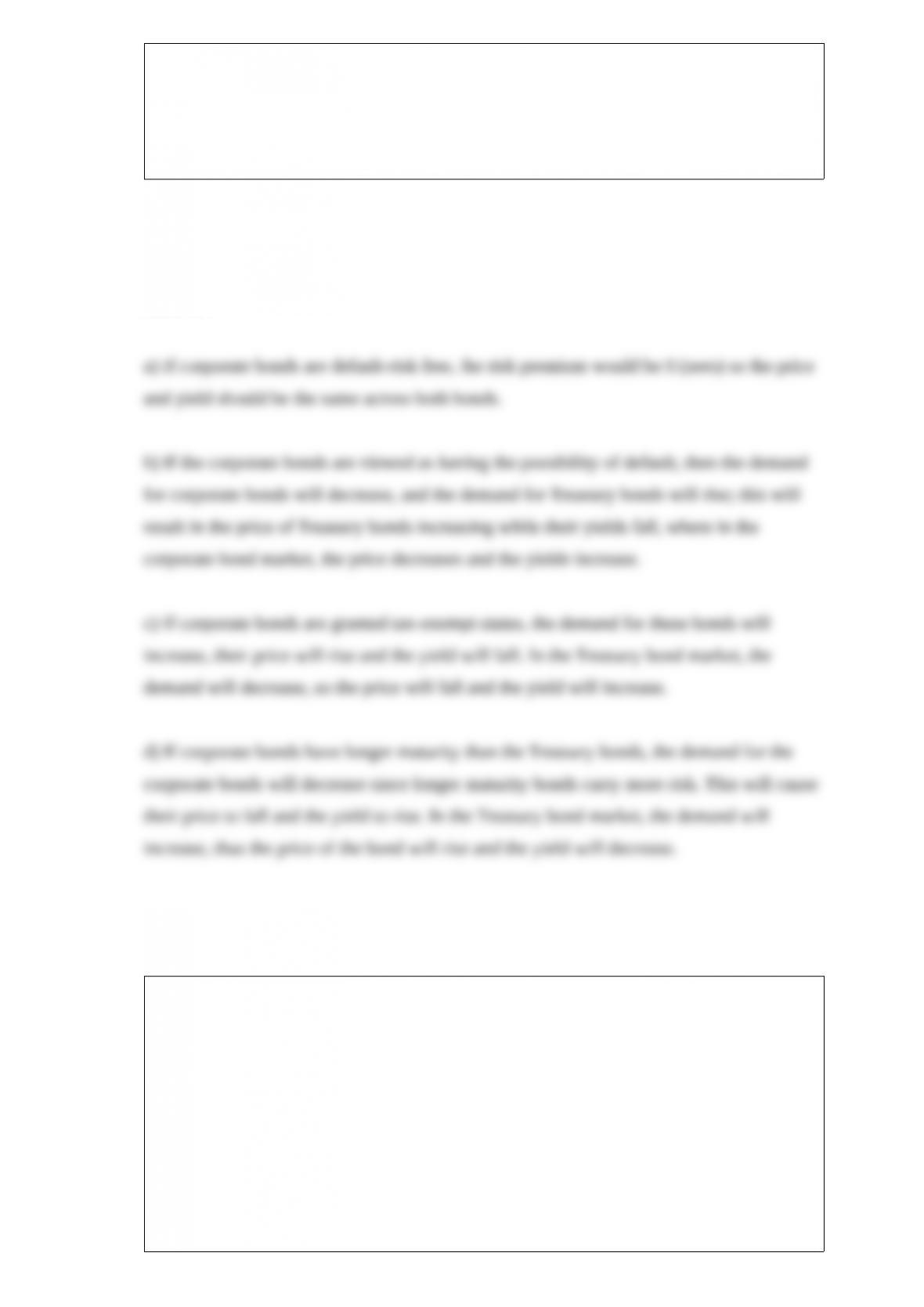
c) If the corporate bonds are granted tax-exempt status, what happens in each market?
d) If the corporate bonds have a longer maturity than the Treasury bonds what would
happen?
Answer:
Inflation refers to growth in the economy’s:
A. Gross Domestic Product (GDP).
B. interest rates.
C. money.
D. prices.

Answer:
Differences in inflation rates between two countries can explain:
A. short-run changes in the exchange rate but not long-run changes.
B. changes in the real exchange rate over the long run, but not changes in the nominal
exchange rate.
C. long-run changes in the exchange rate but not short-run changes.
D. changes in the exchange rate in both the short run and the long run.
Answer:
The reason for the increase in inflation risk over time is due to the fact that:
A. the inflation rate always increases over time.
B. we always have inflation.
C. it is more difficult to forecast inflation over longer periods of time.

D. investors are more focused on nominal returns than real returns.
Answer:
One reason the target federal funds rate may not equal the actual federal funds rate is
because:
A. there is no way that the Fed could keep the actual rate at the target rate.
B. the target rate changes with the demand for reserves.
C. attaining the target rate involves forecasting reserve demand and forecasts are
subject to error.
D. none of the answers is correct; the target and the actual federal funds rates are
always equal.
Answer:
The risk spread is:

A. the difference between a bond’s purchase price and selling price.
B. the difference between the bond’s yield and the yield on a U.S. Treasury bond of the
same maturity.
C. less than 0 (zero) for a U.S. Treasury bond.
D. assigned by a bond-rating agency.
Answer:
The gap between LIBOR and the expected Federal Reserve policy interest rate provides
a key measure of which of the following:
A. the direction of movement of the Euro relative to the U.S. dollar on the foreign
exchange market.
B. the persistence and intensity of the liquidity crisis.
C. the expected length of a coming global recession.
D. the movement of the U.S. stock market.
Answer:

If the U.S. government’s borrowing needs increase, in the bond market this would be
seen as the:
A. bond demand curve shifting right.
B. bond supply curve shifting right.
C. bond demand curve shifting left.
D. bond supply curve shifting left.
Answer:
A put option that is described as in the money would find:
A. the market price of the stock above the strike price.
B. the strike price is above the market price of the stock.
C. the market and strike prices are the same.
D. the option has been exercised.
Answer:

A moral hazard situation arises in the lender of last resort function because:
A. a central bank finds it difficult to distinguish illiquid from insolvent banks.
B. a central bank usually will only make a loan to a bank after it becomes insolvent.
C. a central bank usually undervalues the assets of a bank in a crisis.
D. the central bank is the first place a bank facing a crisis will turn.
Answer:
One reason it took so long to have a central bank in the United States is that:
A. it wasn’t needed.
B. states feared centralization of power.
C. state currencies worked fine.
D. all of the answer options are correct.
Answer:

Suppose there is a decrease in the price at which a bondholder sells her bond. In this
case, the holding period return will:
A. increase, since yields and prices are inversely related.
B. decrease, since this lowers the capital gain.
C. be negative.
D. equal the coupon rate.
Answer:
A borrower who has to pay an interest rate of 8% rather than 6% due to risk spread will
pay:
A. $20 more in interest annually for every $100 borrowed.
B. 33.3% higher interest in dollar terms.
C. 2% in net interest.
D. less interest in total over the life of the loan.
Answer:

If the economy is in long-run equilibrium:
A. inflation should be accelerating.
B. current output should be greater than potential output.
C. current inflation should equal expected inflation.
D. current inflation should be less than expected inflation.
Answer:
The interest rate that equates the price of a bond with the present value of its payments:
A. will vary directly with the value of the bond.
B. should be the one that makes the value equal to the par value of the bond.
C. will vary inversely with the value of the bond.
D. should always be greater than the coupon rate.
Answer:

Derivatives would include all of the following except:
A. options.
B. U.S. Treasury securities.
C. swaps.
D. futures.
Answer:
Bank A has checkable deposits of $140 million, vault cash equaling $1 million and
deposits at the Fed equaling $14 million. If the required reserve rate is ten percent what
is the amount of excess reserves Bank A is holding?
A. It does not have any excess reserves
B. $15 million
C. $2 million
D. $1 million

Answer:
A home mortgage is a good example of:
A. an unsecured loan.
B. a secured loan.
C. a high risk loan.
D. the problem of adverse selection.
Answer: