
The law of one price fails as a result of:
A. low tariffs.
B. insignificant transportation costs.
C. similar technical specifications.
D. goods that cannot be traded.
Answer:
Agencies exist which rate bonds based on characteristics of the borrower Such bond
rating agencies are an example of a financial market response designed to:
A. increase information asymmetry.
B. decrease the real return to bondholders.
C. provide a lower cost solution to the high cost of information.
D. transfer risk from the buyer to the rating agency.
Answer:

Savings banks and savings and loans are regulated by a combination of agencies which
includes all of the following except:
A. The Federal Reserve System.
B. The Comptroller of the Currency.
C. The Federal Deposit Insurance Corporation.
D. state authorities.
Answer:
The price of a coupon bond will increase as the:
A. face value decreases.
B. yield increases.
C. coupon payments increase.
D. term to maturity is shorter.
Answer:

Debt instruments that have maturities less than one year are traded in the:
A. primary market exclusively.
B. bond markets exclusively.
C. bond market if they are already in existence.
D. money market.
Answer:
The Nasdaq Composite Index is:
A. made up of over 50,000 firms traded on the Over-the-Counter market.
B. a price-weighted index.
C. made up of mainly newer firms, and heavily influenced by technology and internet
companies.
D. the most broadly based index in use.
Answer:

Assume we have a stock currently worth $50. We also assume the interest rate is zero,
and we can buy options for this stock with a strike price of $50. If the stock can rise or
fall by $10 with equal probability over the option period, and the option cannot be
exercised until the expiration date, what is the time value of the option?
A. $5
B. $10
C. $50
D. $40
Answer:
When the amount of direct and indirect financing are summed, the result is usually:
A. greater than 100% of GDP.
B. equal to GDP.
C. less than GDP.
D. approximately 50% of GDP.

Answer:
A risk-averse investor compared to a risk-neutral investor would:
A. offer the same price for an investment as the risk-neutral investor.
B. require a higher risk premium for the same investment as a risk-neutral investor.
C. place more focus on expected return and less on return than the risk-neutral investor.
D. place less focus on expected return than the risk-neutral investor.
Answer:
The pool of information collected by financial markets is usually:
A. only available to lenders.
B. summarized in the form of a price.
C. valuable and not made available until the parties pay for it.
D. more than a borrower needs to make a loan.

Answer:
A ‘shock” is something that creates a shift in:
A. the demand curve only.
B. the supply curve only.
C. either the demand curve or the supply curve.
D. both the demand curve and the supply curve at the same time.
Answer:
The value of $100 left in a savings account earning 5% a year, will be worth what
amount after ten years?
A. $150.00
B. $160.50
C. $159.84
D. $162.89

Answer:
An inflation rate above the target rate will result in:
A. a movement up along the monetary policy reaction curve and a movement up the
dynamic aggregate demand curve.
B. a movement down along the monetary policy reaction curve and a movement down
the dynamic aggregate demand curve.
C. a movement up along the monetary policy reaction curve and a leftward shift of the
dynamic aggregate demand curve.
D. a movement up along the monetary policy reaction curve and a rightward shift of
the dynamic aggregate demand curve.
Answer:
If a company reports that it is going to have a difficult time meeting its debt obligations,
you would expect the Ptoday:
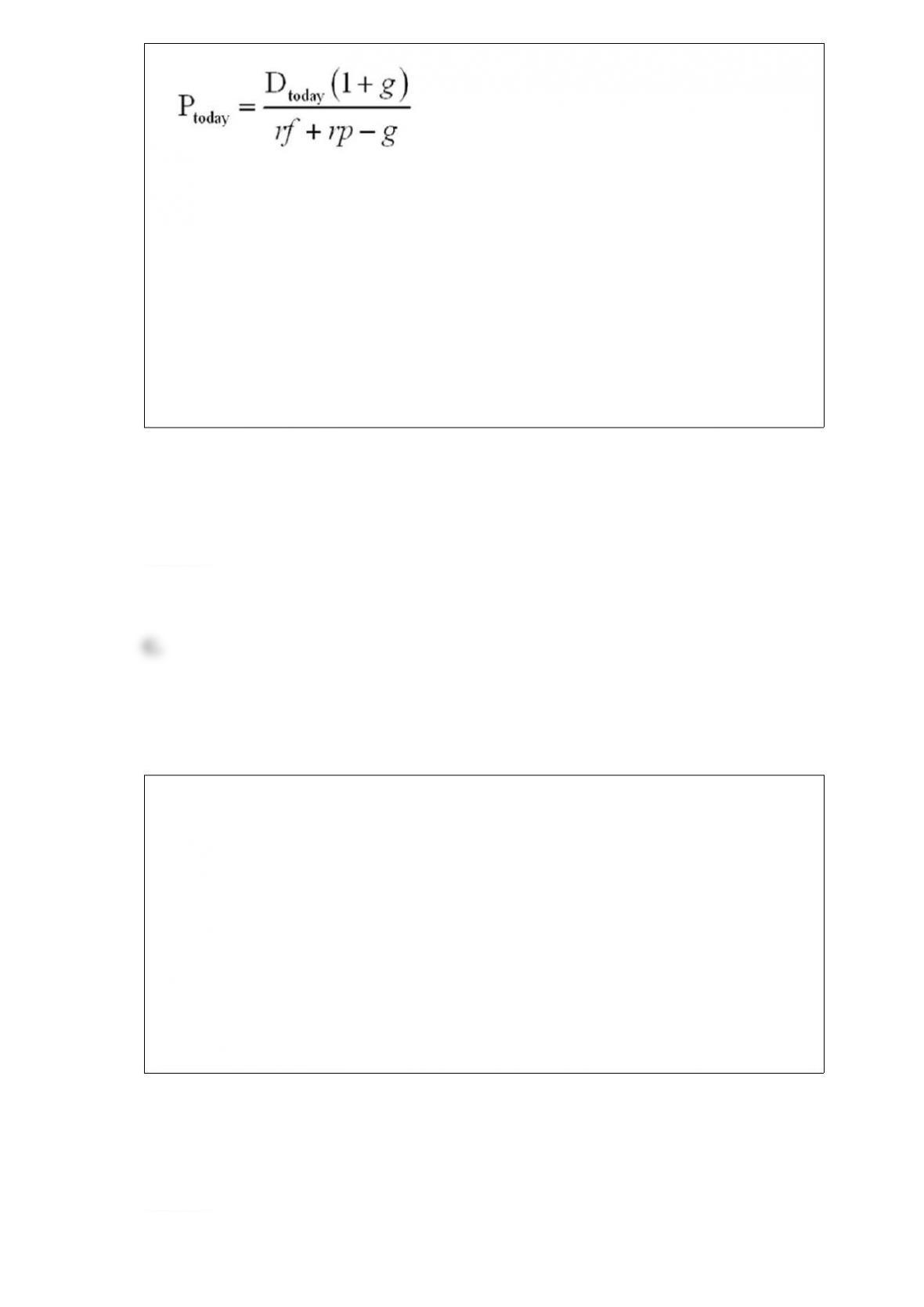
A. to fall since the risk-free return will rise.
B. to rise since the Dtoday will likely fall.
C. to fall since the risk premium will likely rise.
D. to remain about the same until the Dtoday actually changes.
Answer:
The debate over the causes of recessions in the U.S. in recent years has included
arguments about:
A. monetary policy, but not higher oil prices.
B. decreases in exports.
C. higher oil prices, but not monetary policy.
D. both monetary policy and higher oil prices.
Answer:

Studying money and banking through five core principles is helpful because:
A. studies have shown students have a difficult time remembering more than five
XOAXOAs.
B. everything in economics can be reduced to five core principles.
C. money and banking can undergo drastic changes overtime, but the five principles do
not.
D. these five principles are understood by everyone.
Answer:
Under the Liquidity Premium Theory a flat yield curve implies:
A. there is no risk premium for longer-term maturities.
B. short-term interest rates are expected to remain constant.
C. short-term interest rates are expected to decrease.
D. long-term interest rates are higher than short-term interest rates.

Answer:
Consider the effect of business cycles on bondholders versus stockholders. We expect
that business cycles will affect:
A. bondholders and stockholders about the same.
B. bondholders more since the amount they receive depends on profits.
C. stockholders more since they are residual claimants.
D. bondholders more since they do not have any claim to property.
Answer:
A country that has a capital account deficit:
A. is a net seller of assets.
B. imports more goods and services than it exports.
C. has a current account surplus.
D. has a current account deficit.

Answer:
If a consol is offering an annual coupon of $50 and the annual interest rate is 6%, the
price of the consol is:
A. $47.17
B. $813.00
C. $833.33
D. $8333.33
Answer:
Instruments that have been securitized include:
A. mortgage-backed securities held by government-sponsored enterprises.
B. car loans and student loans.
C. credit card debt.
D. all of the answers given are correct.

Answer:
Commercial banks differ from credit unions in the following way:
A. credit unions focus on consumer loans while commercial banks primarily make
loans to businesses.
B. credit unions make loans and accept deposits while commercial banks just make
loans.
C. commercial banks cannot make auto loans to individuals, just to businesses while
credit unions can do both.
D. credit unions do not have to hold reserves while commercial banks do.
Answer:
Which of the following assets is the most liquid?
A. Art
B. Demand deposits

C. Houses
D. Stocks
Answer:
One lesson learned from the bank panics of the early 1930’s is:
A. the lender of last resort function almost guarantees that bank panics are a thing of
the past.
B. the mere existence of a lender of last resort will not keep the financial system from
collapsing.
C. only the U.S. Treasury can be a true lender of last resort.
D. the financial system will collapse without a lender of last resort.
Answer:
A company currently pays a dividend of $4.00 per share. It expects the growth rate of
the dividend to be 3% (0.03) annually. If the interest rate is 6% (0.06) what does the

dividend-discount model predict the current price of the stock should be?
A. $103.33
B. it doesn’t, you need an expected future selling price to use the model.
C. $137.33
D. $66.67
Answer:
An investor puts $2,000 into an investment that will pay $2,500 one-fourth of the time;
$2,000 one-half of the time, and $1,750 the rest of the time. What is the investor’s
expected return?
A. 12.5%
B. $250.00
C. 6.25%
D. 3.125%
Answer:

The quantity theory of money along with the assumption of a constant velocity can
explain which of the following?
A. At a given level of money growth, the higher the level of real growth the higher the
level of inflation will be.
B. At a given level of money growth, the higher the level of real growth the lower the
level of inflation will be.
C. If real growth is higher than money growth, the price level must be rising.
D. If real growth equals money growth, the price level is falling.
Answer:
Deposit insurance only seems to be viable at the federal level. This is likely due to the
fact that:
A. state funds are less informed about the solvency of national banks.
B. a run on the banks within a state will always spread countrywide.
C. the U.S. Treasury backs the FDIC and can therefore withstand virtually any crisis.
D. the cost of state insurance is prohibitively high.
Answer:

A bank’s Return on Equity (ROE) is calculated by:
A. dividing the bank’s net profit after taxes by the bank’s capital.
B. dividing the banks liabilities by the bank’s capital.
C. taking the bank’s assets plus the net profit after taxes and dividing this sum by the
bank’s capital.
D. dividing the bank’s net profit after taxes by the sum of the bank’s assets and its
liabilities.
Answer:
Which of the following statements best completes the sentence, “All other factors
constant, as the nominal interest rate increases, the opportunity cost of money…”?
A. decreases, the velocity of money decreases, and the quantity of money people want
to hold decreases.
B. increases, the velocity of money decreases, and the quantity of money people want
to hold decreases.
C. decreases, the velocity of money increases, and the quantity of money people want
to hold decreases.
D. increases, the velocity of money increases, and the quantity of money people want

to hold decreases.
Answer: