
Checkable deposits have decreased since the 1970’s mainly because:
A. regulators allowed higher rates to be paid on these accounts and banks found them
to be highly unprofitable.
B. people prefer to use credit cards rather than writing checks.
C. these deposit accounts offer little or no interest so depositors find them to be
expensive.
D. as banks added fees to these accounts people increased their holdings of currency.
Answer:
As interest rates rise the supply of loans may decrease because:
A. borrowers net worth rises.
B. demand for loans falls.
C. lenders are increasingly on the lookout for adverse selection.
D. all of the answers given are correct.
Answer:

M1 has decreased in its usefulness in understanding inflation due to:
A. the increased use of checks in the economy.
B. the introduction of money market mutual fund shares and similar checking
substitutes.
C. more reliance on the use of currency.
D. the increased use of electronic payments.
Answer:
The price of a coupon bond can best be described as the:
A. present value of the face value.
B. future value of the coupon payments.
C. future value of the coupon payments and the face value.
D. present value of the face value plus the present value of the coupon payments.
Answer:

The larger the bond dealer’s spread the:
A. less liquid is the market for that bond.
B. greater is the coupon rate for that bond.
C. more liquid is the market for that bond.
D. less risk there is for the dealer to hold that bond.
Answer:
An advantage of fixed exchange rates for a country that suffers from bouts of high
inflation is:
A. it makes imports less expensive.
B. it establishes a credible low inflation policy.
C. it unties policymakers’ hands so they can alter the reserves of the banking system as
needed.
D. policymakers will have increased control over domestic interest rates.
Answer:

The price for private information is likely higher than it should be due to the problem
of:
A. adverse selection.
B. free-riders.
C. the government regulations regarding information.
D. moral hazard.
Answer:
The scandals involving Enron, World Com, Global Crossing and other large firms:
A. are examples of asymmetric information and have led, at least temporarily, to a less
well functioning stock market.
B. is what should have been expected on the part of investors, that is why there is a risk
premium.
C. have resulted in a cry for less government regulation of public corporations.
D. demonstrate that the government should be responsible for collecting and
distributing financial information on firms.

Answer:
Over-the-counter (OTC) markets:
A. employ specialists to minimize price volatility.
B. are centralized exchanges but you must be a dealer to be part of an exchange.
C. only deal in the stocks of companies with over $100 million in capital.
D. are networks of security dealers linked electronically.
Answer:
In order to benefit from diversification, the returns on assets in a portfolio must:
A. be perfectly positively correlated.
B. be perfectly negatively correlated.
C. positively correlated but not perfectly.
D. have the same idiosyncratic risks.

Answer:
Which of the following provides a strong incentive to supply dollars on the foreign
exchange market?
A. To purchase goods and services produced abroad
B. To get a lower return paid on foreign currencies that is not subject to the risk
associated with exchange-rate fluctuations
C. To invest in U.S. assets
D. To take advantage of higher inflation rates in other countries
Answer:
The interest-rate risk that is associated with bond investing:
A. exists even if an investor plans on holding the bond to maturity.
B. arises because of a mismatch between the investor’s investment horizon and the
maturity of the bond.
C. is not reflected in the risk premium.

D. can be eliminated by holding only consols.
Answer:
Given the following formula for the Taylor rule:
Target federal funds rate = 2 + current inflation + ½(inflation gap) + ½(output
gap). Every one percent increase in the rate of inflation will:
A. increase the real federal funds rate by 1.5%.
B. increase the target federal funds rate by 1.5%.
C. increase the real federal funds rate by 0.5%.
D. increase the target federal funds rate by 1.5% and increase the real federal funds rate
by 0.5%.
Answer:
The federal funds rate is stated as:

A. a real interest rate.
B. a nominal interest rate.
C. a rate that is automatically indexed to inflation.
D. the current rate less the expected rate of inflation.
Answer:
The fact that financial intermediaries employ experts to carry out particular activities
and so lower transactions costs is usually associated with the following economic
concept:
A. the law of demand.
B. economies of scale.
C. comparative advantage.
D. information costs.
Answer:

Which of the following statements best describes financial instruments?
A. All financial instruments are a means of payment.
B. Financial instruments can transfer resources between people but not risk.
C. Financial instruments can transfer resources and risk between people.
D. Financial instruments can transfer risk but not resources between people.
Answer:
The central bank in the United States is:
A. the Bank of America.
B. the Federal Reserve.
C. the U.S. Treasury.
D. the Bank of the United States.
Answer:

Comparing the European and the U.S. central bank systems, the Executive Board of the
European system resembles:
A. the FOMC.
B. the Board of Governors.
C. the Presidents of the regional Federal Reserve Banks.
D. the Chairman of the Board of Governors of the Fed.
Answer:
Roles served by financial markets include the following, except:
A. eliminating risk.
B. providing liquidity.
C. pooling and communicating information.
D. sharing of risk.
Answer:

A country that has a capital account deficit:
A. is a net seller of assets.
B. is importing more goods and services than it exports.
C. also has a current account deficit.
D. is a net buyer of assets.
Answer:
If a public corporation goes bankrupt and does not have enough assets to pay off all
creditors:
A. the stockholders are personally liable for the balance.
B. the fact that stockholders are residual claimants means they may have to pay in
additional capital to cover the obligations.
C. the stockholders receive any dividends due before the other creditors are paid.
D. the stockholders cannot lose more than their investment.
Answer:

Vault cash is not included in the central bank’s liability category of currency because:
A. only non-bank currency is in the liability category of currency.
B. vault cash really is only electronic funds.
C. vault cash is in the asset category of reserves.
D. it is the liability of the U.S. Treasury.
Answer:
Member banks of the Federal Reserve System include:
A. only nationally chartered banks.
B. all state chartered banks with assets exceeding $100 million.
C. nationally chartered banks and state chartered banks that decide to join.
D. nationally chartered banks and all state chartered banks.
Answer:

Since the 1920’s, the ratio of assets to capital has almost tripled for commercial banks.
Many economists believe this is the direct result of:
A. lower quality management in banks.
B. the increase in branch banking.
C. allowing banks to offer non-bank services.
D. government provided deposit insurance.
Answer:
In the U.S. the authority to issue currency is held by:
A. the Federal Reserve.
B. the U.S. Treasury.
C. the Office of the Comptroller of the Currency.
D. the U.S. Mint.

Answer:
The value of a financial instrument rises as:
A. the size of the payment promised decreases.
B. the promised payment is made sooner rather than later.
C. it is less likely the payment will be made.
D. the payments are made when the prospective investor needs them least.
Answer:
The correlation between high rates of inflation and economic growth is:
A. direct; one brings about the other.
B. inverse; high inflation usually means low economic growth.
C. there is no correlation between these measures.
D. is direct at low rates of economic growth and inverse at high rates.

Answer:
In the United Kingdom, regulation of the financial system is concentrated in two
agencies. They are:
A. The Federal Deposit Insurance Conglomerate and the Bank of England.
B. The Financial Conduct Authority and the Bank of England.
C. The Financial Conduct Authority and English Banking Authority.
D. The Bank of England and the U.K. Treasury.
Answer:
Based on the analysis of the equation of exchange, Irving Fisher, derived the quantity
theory of money which states that:
A. velocity changes always offset changes in the supply of money.
B. changes in the aggregate price level are caused solely by changes in velocity.
C. changes in the aggregate price level are caused solely by changes in the quantity of
money.

D. none of the answers given is correct.
Answer:
The high rates of inflation that were experienced in the 1970s could partly be blamed on
all of the following except:
A. the assumption the economy would continue to grow at the rates that the economy
experienced in the 1960s.
B. the Vietnam war.
C. high oil prices.
D. rapid growth rates of potential GDP during the 1970s.
Answer:
Which of the following statements is most accurate?
A. Central bank statements in developed countries are similar both in length and in the

speed with which policy changes are announced.
B. Central bank statements in developed countries differ both in length and in the speed
with which policy changes are announced.
C. Central bank statements in developed countries are similar in length but differ in the
speed with which policy changes are announced.
D. Central bank statements in developed countries differ in length but are similar in the
speed with which policy changes are announced.
Answer:
The Standard & Poor’s 500 Index:
A. gives more weight to large companies than small companies.
B. actually includes more than 500 of the largest corporations in the U.S.
C. is a price-weighted index.
D. assigns equal weight to all the prices of all the stocks in the index.
Answer:
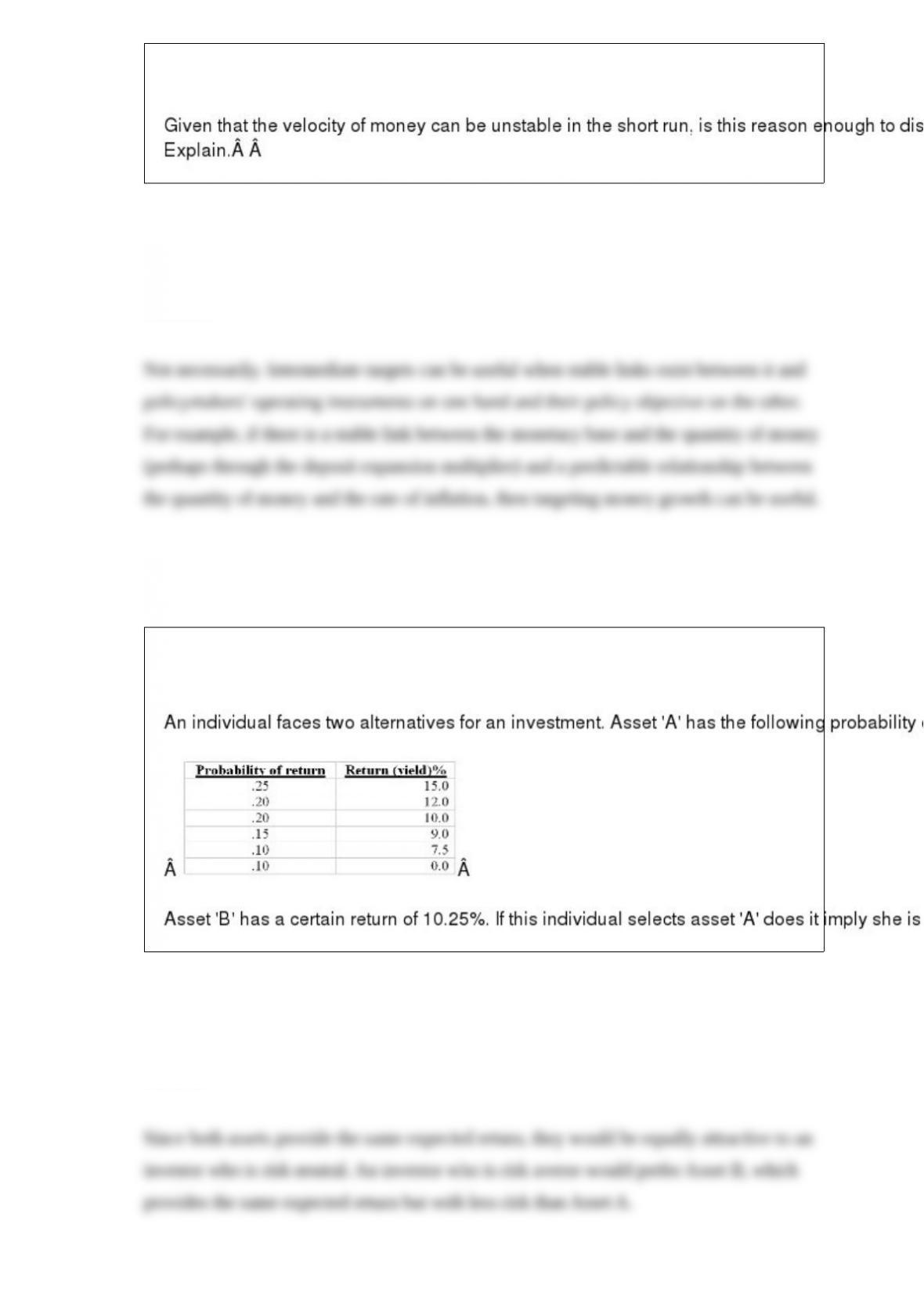
Answer:
Answer:
Answer:
Answer:
Answer:
Answer:
Answer:
Answer:
Answer:
Answer:
Answer:
Answer:
Answer:
Answer:
Answer:
Answer:
Answer:
Answer: