Archives

978-1429278515 Chapter 1 Solution Manual
S-1 Solutions Manual to End-of-Chapter Questions The Global Economy 1. Figures 1-2 and 1-6 rely on data from 2010, and Figure 1-5 relies on data from 2005, to map worldwide trade, migration, and FDI. Updated data for migration and FDI […]
978-1429278515 Chapter 10 Solution Manual
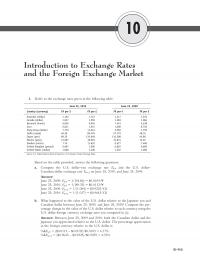
S-95 Introduction to Exchange Rates and the Foreign Exchange Market 1. Refer to the exchange rates given in the following table: Based on the table provided, answer the following questions: a. Compute the U.S. dollar–yen exchange rate E$/¥ and the […]
978-1429278515 Chapter 11 Solution Manual
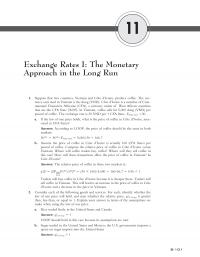
Exchange Rates I: The Monetary Approach in the Long Run 1. Suppose that two countries, Vietnam and Côte d’Ivoire, produce coffee. The cur- rency unit used in Vietnam is the dong (VND). Côte d’Ivoire is a member of Com- munauté […]
978-1429278515 Chapter 12 Solution Manual
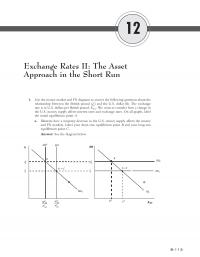
Exchange Rates II: The Asset Approach in the Short Run 1. Use the money market and FX diagrams to answer the following questions about the relationship between the British pound (£) and the U.S. dollar ($). The exchange rate is […]
978-1429278515 Chapter 13 Solution Manual
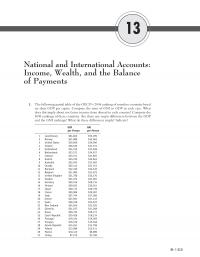
National and International Accounts: Income, Wealth, and the Balance of Payments 1. The following partial table of the OECD’s 2004 ranking of member countries based on their GDP per capita. Compute the ratio of GNI to GDP in each case. […]
978-1429278515 Chapter 14 Solution Manual Part 1
Output, Exchange Rates, and Macroeconomic Policies in the Short Run 1. In 2001, President George W. Bush and Federal Reserve Chairman Alan Greenspan were both concerned about a sluggish U.S. economy. They also were concerned about the large U.S. current […]
978-1429278515 Chapter 14 Solution Manual Part 2
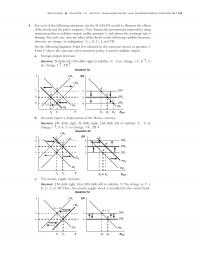
Solutions n Chapter 14 Output, Exchange Rates, and Macroeconomic Policies S-139 5. For each of the following situations, use the IS-LM-FX model to illustrate the effects of the shock and the policy response. Note: Assume the government responds by using […]
978-1429278515 Chapter 15 Solution Manual
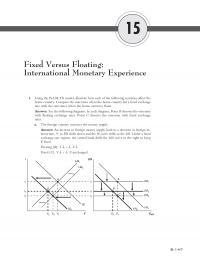
Fixed Versus Floating: International Monetary Experience 1. Using the IS-LM-FX model, illustrate how each of the following scenarios affect the home country. Compare the outcomes when the home country has a fixed exchange rate with the outcomes when the home […]
978-1429278515 Chapter 16 Solution Manual
The Euro 1. One could view the United States as a currency union of 50 states. Compare and contrast the Eurozone and the United States in terms of the optimum currency area (OCA) criteria. 2. After German reunication and the […]
978-1429278515 Chapter 2 Solution Manual
Trade and Technology: The Ricardian Model 1. At the beginning of the chapter there is a brief quotation from David Ricardo; here is a longer version of what Ricardo wrote: England may be so circumstanced, that to produce the cloth […]
978-1429278515 Chapter 3 Solution Manual
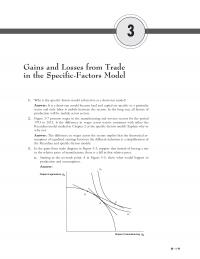
Gains and Losses from Trade in the Specific-Factors Model 1. Why is the specific-factors model referred to as a short-run model? 2. Figure 3-7 presents wages in the manufacturing and services sectors for the period 1973 to 2012. Is the […]
978-1429278515 Chapter 4 Solution Manual
Trade and Resources: The Heckscher-Ohlin Model 1. This problem uses the Heckscher-Ohlin model to predict the direction of trade. Consider the production of handmade rugs and assembly line robots in Canada and India. a. Which country would you expect to […]
978-1429278515 Chapter 5 Solution Manual
Movement of Labor and Capital Between Countries 1. In the short-run specific-factors model, examine the impact on a small country fol- lowing a natural disaster that decreases its population. Assume that land is specific to agriculture, capital is specific to […]
978-1429278515 Chapter 6 Solution Manual
Increasing Returns to Scale and Monopolistic Competition 1. Explain how increasing returns to scale in production can be a basis for trade. 2. Why is trade within a country greater than trade between countries? Answer: Border effects prevent trade between […]
978-1429278515 Chapter 7 Solution Manual
Import Tariffs and Quotas Under Perfect Competition 1. The following questions refer to Side Bar: Key Provisions of the GATT. a. If the United States applies a tariff to a particular product (e.g., steel) imported from one country, what is […]
978-1429278515 Chapter 8 Solution Manual
Import Tariffs and Quotas Under Imperfect Competition 1. Figure 8-1 shows the Home no-trade equilibrium under perfect competition (with the price PC ), and under monopoly (with the price PM ). In this question, we compare the welfare of Home […]

978-1429278515 Chapter 9 Solution Manual
International Agreements: Trade, Labor, and the Environment 1. a. How is a customs union different from a free-trade area? Provide examples of each. b. Why do some economists prefer multilateral trade agreements to regional trade agreements? Answer: Regional trade agreements […]