International Agreements: Trade,
Labor, and the Environment
1. a. How is a customs union different from a free-trade area? Provide examples of
each.
b. Why do some economists prefer multilateral trade agreements to regional trade
agreements?
S-83
9
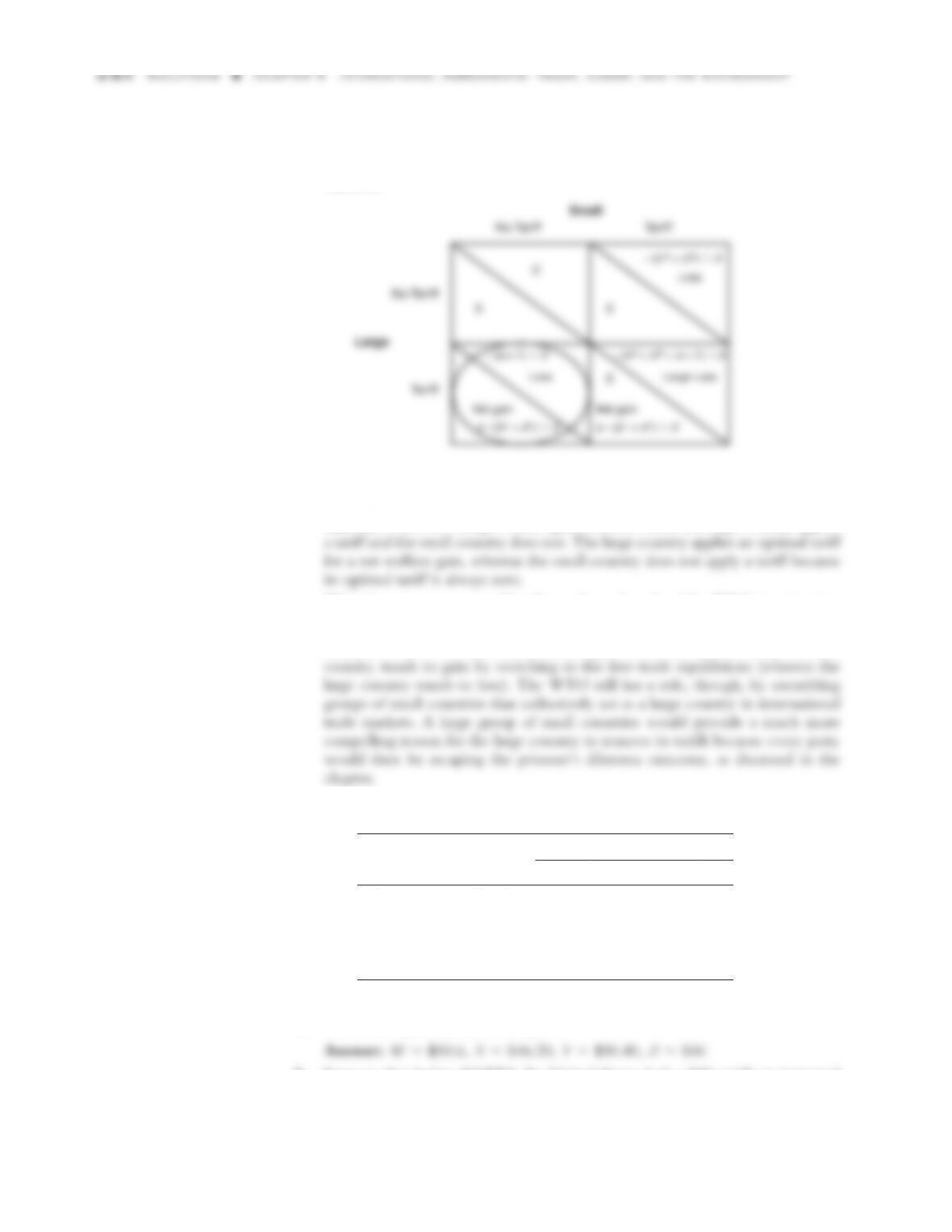
2. Figure 9-2 shows the tariff game among large countries.
a. Redraw the payoff matrix for a game between a large and small country.
Answer:
b. What is/are the Nash equilibrium/equilibria, assuming that the large country
applies an optimal tariff?
Answer: There is a unique Nash equilibrium in which the large country applies
c. What does your answer to (b) tell you about the role of the WTO in a situation
like this?
Answer: The WTO has a more difficult job in this case because only the small
3. Consider the following variation of Table 9-1 for the U.S. semiconductor market:
a. Fill in the values for W, X, Y, and Z.
b. Suppose that before NAFTA the United States had a 20% tariff on imported
semiconductors. Which country supplied the U.S. market? Is it the lowest cost
producer?
Ta riff
e – (b
L
+ d
L
) 0
e –(bL + dL) 0
Net gainNet gain
U.S. Tariff
0% 10% 20%
From Canada, before NAFTA $46 $W $55.2
From Asia, before NAFTA $42 $X $Y
From Canada, after NAFTA $46 $Z $Z
From Asia, after NAFTA $42 $X $Y
From the United States $47 $47 $47
Solutions n Chapter 9 International Agreements: Trade, Labor, and the Environment S-85
c. After NAFTA, who supplies the U.S. market? Has either trade creation or diver-
sion occurred because of NAFTA? Explain.
d. Now suppose that before NAFTA, the United States had a 10% tariff on im-
ported semiconductors. Then repeat parts (b) and (c).
e. In addition to the assumptions made in (d), consider the effect of an increase in
high-technology investment in Canada due to NAFTA, allowing Canadian firms
to develop better technology. As a result, three years after the initiation of NAFTA,
Canadian firms can begin to sell their products to the United States for $46.
What happens to the U.S. trade pattern three years after NAFTA? Has either
trade creation or diversion occurred because of NAFTA? Explain.
4. Assume that Thailand and India are potential trading partners of China. Thailand is a
member of ASEAN but India is not. Suppose the import price of textiles from India
(PIndia) is 50 per unit under free trade and is subject to a 20% tariff. As of January 1,
2010, China and Thailand entered into the China–ASEAN free-trade area, eliminat-
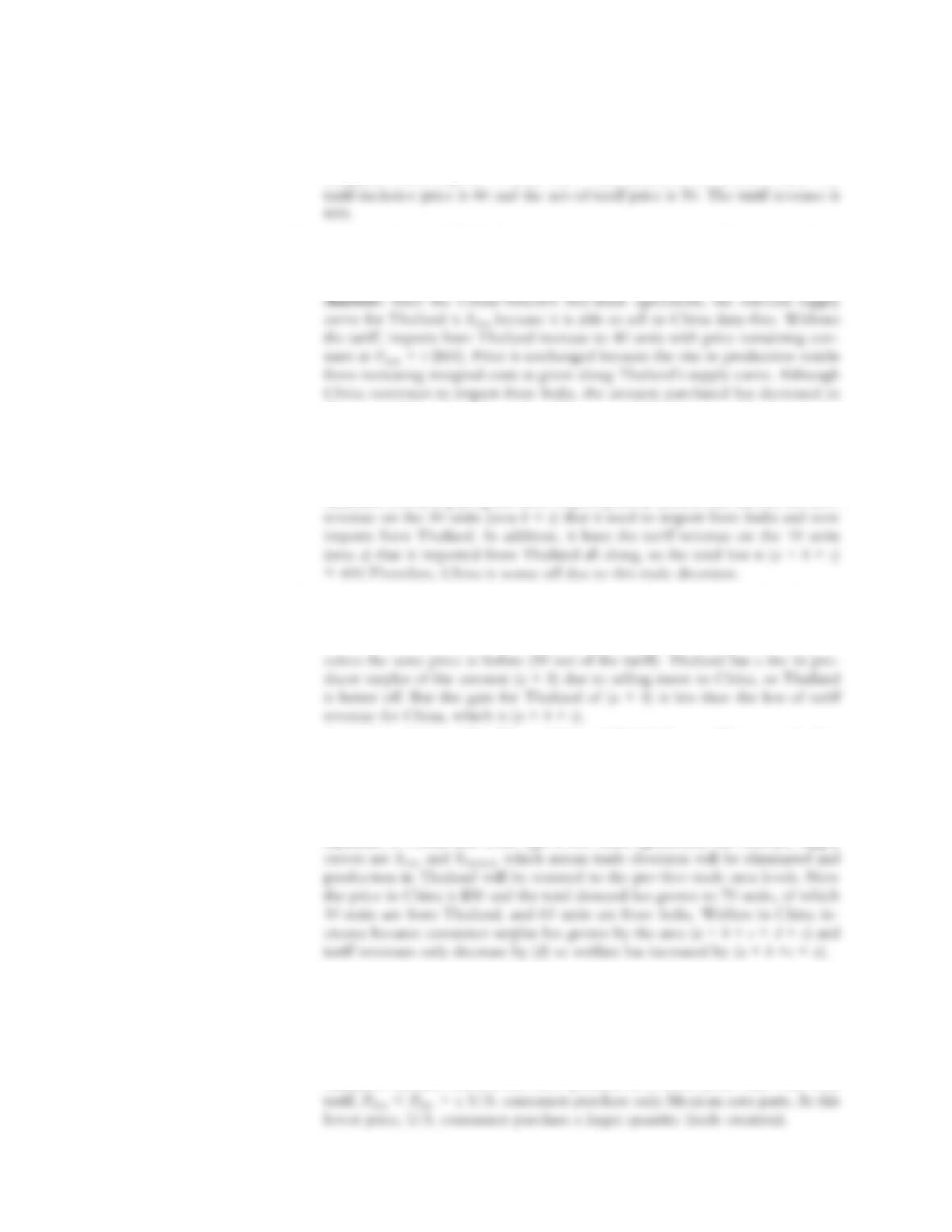
ing tariffs on Thai imports. Use the following figure to answer these questions.
Price
cd eba
Import quantity10 40 60 70
MChina
60 = PIndia + t
50 = PIndia
SThailand + t
SThailand
SIndia + t
SIndia
S-86 Solutions n Chapter 9 International Agreements: Trade, Labor, and the Environment
a. Before the China–ASEAN free-trade area, how much does China import from
each trading partner? What is the import price? Calculate the tariff revenue.
b. After the China–ASEAN free-trade area, how much does China import from
each trade partner? What is the import price? What is the total tariff revenue of
China?
20 units = (60 − 40). The total tariff revenue of China is now 200 = [area d =
$(60 − 50) × (60 − 40)].
c. Based on your answer to part (b), what is the impact of the China–ASEAN free-
trade area on the welfare of China?
d. What is the effect of the China–ASEAN free-trade area on the welfare of Thai-
land and India?
Answer: India has a producer surplus loss because it is selling less yet still re-
e. As mentioned in the Headlines: China–ASEAN Treaty Threatens Indian
Exporters, the China-ASEAN agreement may lead to a similar one between
China and India. How would this affect China’s imports from each country?
What would be the effect on welfare in China, Thailand, and India if such an
agreement was signed?
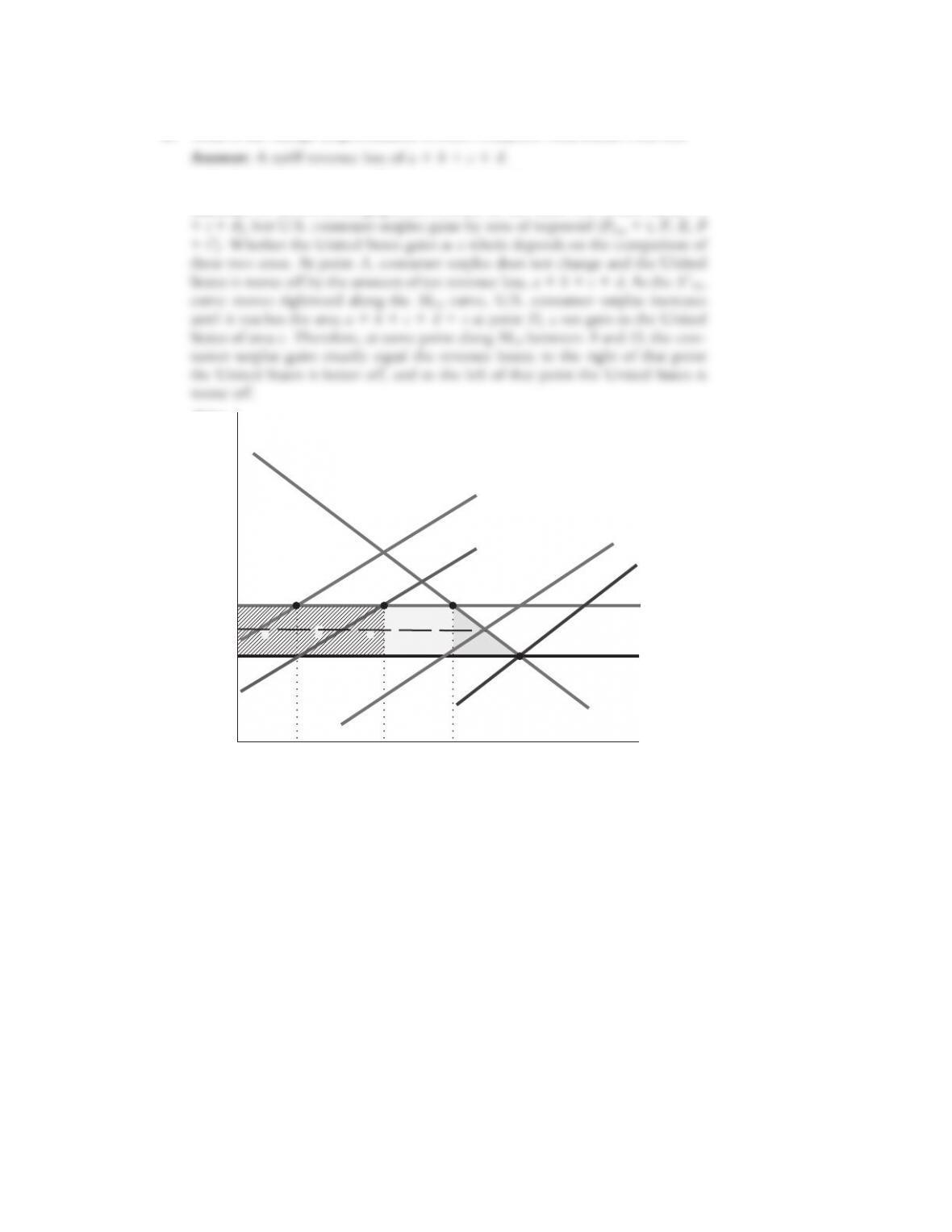
5. Redraw the graph of trade diversion (Figure 9-3) with the S 9Mex curve intersecting
the MUS curve between points A and D.
a. When the United States and Mexico join NAFTA, who supplies auto parts to
the United States? Does the United States import a larger quantity of auto parts
after NAFTA; that is, does trade creation occur?
Solutions n Chapter 9 International Agreements: Trade, Labor, and the Environment S-87
c. Is the United States better off for joining NAFTA?
6. Refer to the survey in Table 9-2 regarding consumers’ attitudes toward working
conditions.
a. Fill in the survey questions for yourself and at least five friends.
Answer: Answers will vary.
b. Average your results and compare them with those in Table 9-2. Are there any
consistent differences in the answers from your friends and those in Table 9-2?
Answer: Answers will vary.
c. Do the answers from your friends show the following two characteristics?
i. Many people are willing to pay at least a small amount to ensure good labor
standards (or simply switch to an alternative with the same price), although
relatively few are willing to pay a lot.
ii. Individuals had to receive a higher discount to purchase a T-shirt made un-
der poor conditions than they were willing to pay for a T-shirt made under
good conditions.
Explain whether these characteristics apply to your friends or not.
Answer: Answers will vary.
D
BCA
de
MUS
Price
Q2Q3Q1Import quantity
SMex + t
PAsia + t
PAsia
SAsia + t
SMex
S’Mex
SAsia
abc
F
E
P + t’
S’’Mex
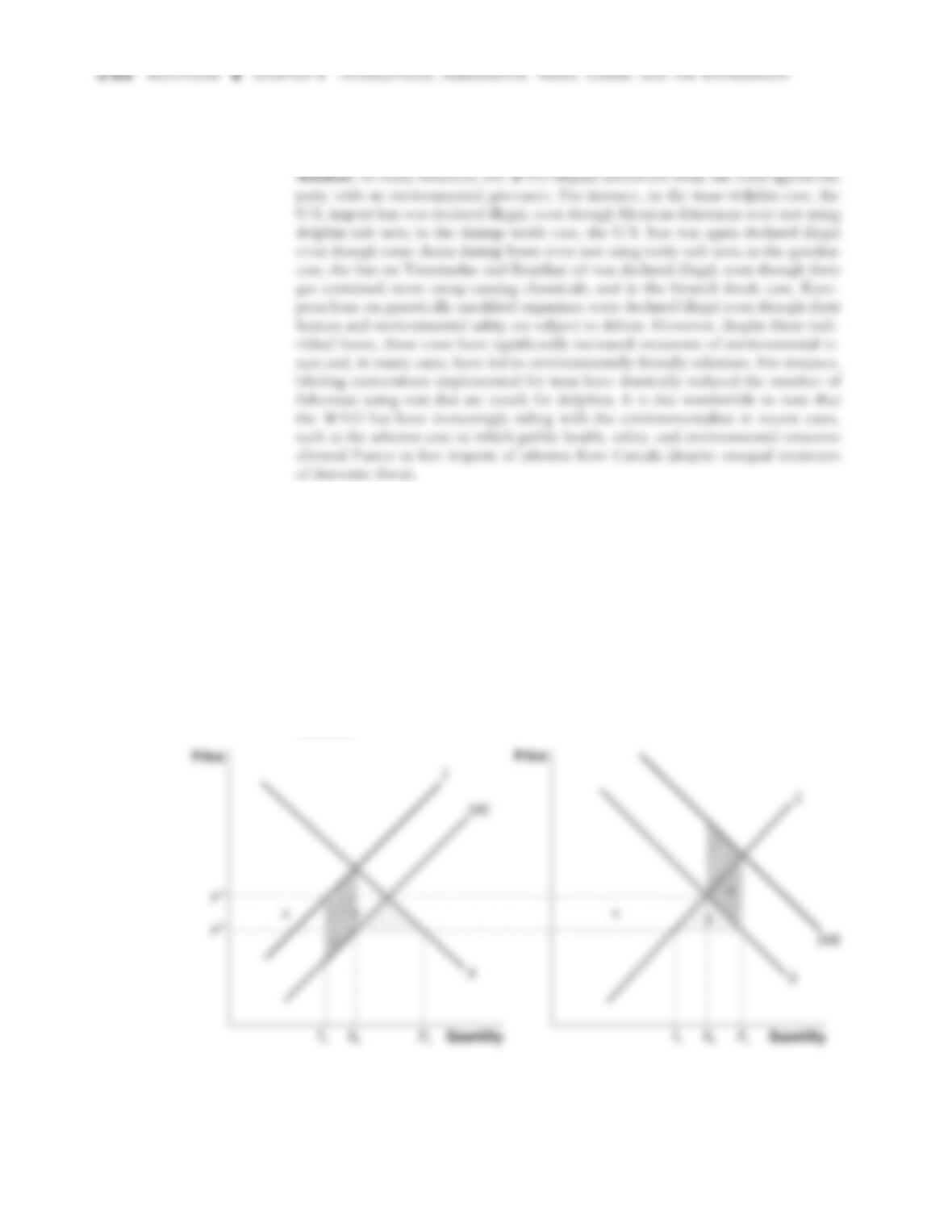
7. Using Table 9-3, explain why environmentalists have “lost the battle but won the
war” in their dealings with the WTO. Refer to specific WTO cases in your answer.
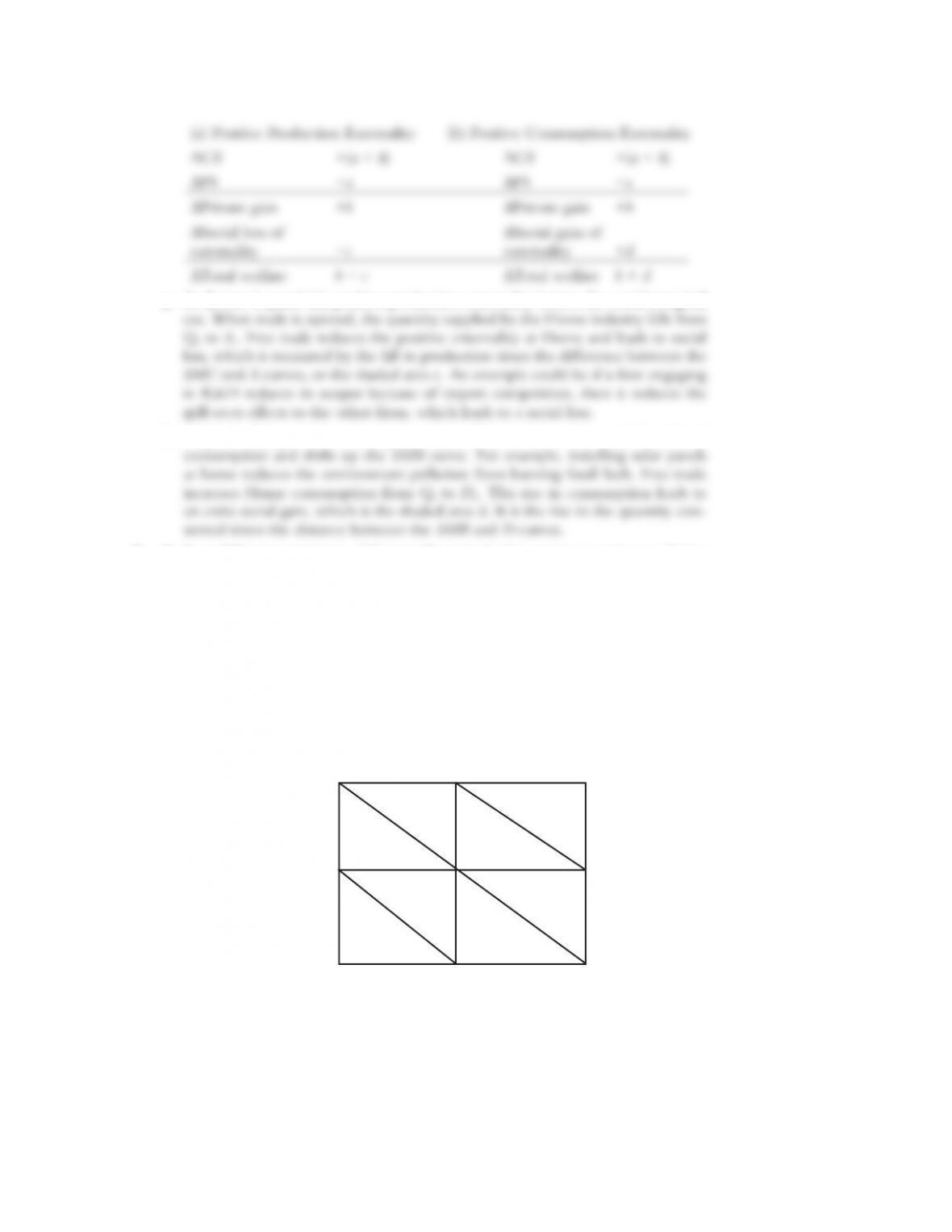
8. Refer to Figure 9-4 when answering this question.
a. Redraw Figure 9-4, panel (a), assuming that the production externality is positive so
that the SMC curve lies below the supply curve. Label the area c that reflects the
change in the cost of the externality when trade is opened. Is this area an ad-
ditional social gain from free trade or an offsetting cost?
Can you think of a real-world example of this case?
b. Redraw Figure 9-4, panel (b), assuming that the consumption externality is posi-
tive so that the SMB curve lies above the demand curve. Label the area d that
arises when trade is opened, and explain why this area is an additional social gain
from free trade. (You can refer to the discussion of solar panels earlier in the
chapter.)
Answer:
Price Price
b
ba
a
PA
SMC
S
S
d
Solutions n Chapter 9 International Agreements: Trade, Labor, and the Environment S-89
b. In panel (b), positive consumption externality increases the social benefit of
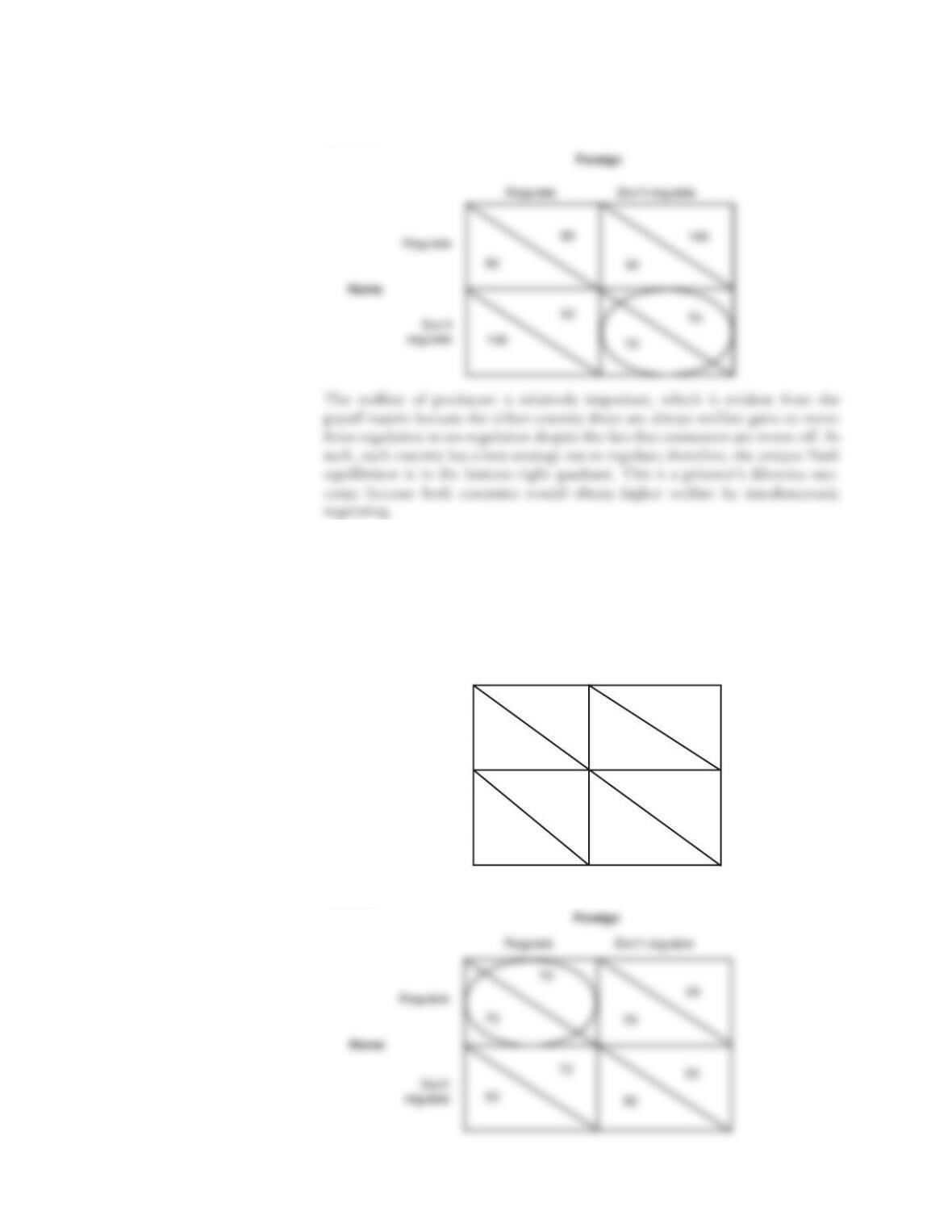
9. Refer to following variations of the payoff matrix for the environmental game shown
in Figure 9-7. In this problem, a number is assigned to represent the welfare level of
each outcome for Home and Foreign.
a. First, consider the case of global pollution, in which the government puts more
weight on producer profits than consumer well-being when calculating welfare
(this is so since a portion of consumer costs are borne by the other country).
How can you tell that the government favors producers over consumers from
the following payoff matrix? What is the Nash equilibrium for this environmen-
tal game? Is it a prisoner’s dilemma? Briefly explain.
Home
Foreign
Regulate
Regulate
Don’t
regulate
Don’t regulate
100 70
70
100
50
50
80
80
S-90 Solutions n Chapter 9 International Agreements: Trade, Labor, and the Environment
Answer:
b. Next, consider the case of local pollution in which the government puts more
weight on consumer well-being than producer profits when calculating welfare.
How can you tell that the government favors consumers over producers from
the following payoff matrix? What is the Nash equilibrium for this environmen-
tal game? Is it a prisoner’s dilemma? Briefly explain.
Answer:
Home
Don’t
regulate
50 70
70
100
Foreign
Home
Regulate
Regulate
Don’t
regulate
Don’t regulate
50 50
50
50
70
70
70
70
Home
Regulate
Don’t
regulate
70 50
50
50
50
70
70
10. In 2007, several members of Congress in the United States proposed that any further
trade negotiations be accompanied by a “grand bargain” on labor standards. The
problem with this action is that the current labor practices of the United States some-
times run afoul of the guidelines of the International Labour Organization (ILO),
which would open up the United States to criticism and potential sanctions from
that agency. The article “Why a ‘Grand Deal’ on Labor Could End Trade Talks”
describes these concerns and argues that such a “grand deal” would be a mistake
for the United States. A full text of this article is available at http://www.iie.com/
publications/opeds/oped.cfm?ResearchID=716.
Answer the following: Do you agree or disagree with the proposal for the United States
to pursue a “grand deal” on labor standards, bringing its own laws into line with
those of the International Labour Organization?
Why a ‘Grand Deal’ on Labour Could End Trade Talks
Excerpted from: Theodore Moran and Gary Hufbauer, “Why a ‘grand deal’ on labor could
end trade talks” The Financial Times, March 13, 2007, p. 15.
US congressional Democrats, led by Sandy Levin and Barney Frank, are insisting that
core labor standards promoted by the United Nations’ International Labor Organization
(ILO) be included in forthcoming trade agreements as part of a “grand bargain.” They want
to make ratification of free-trade agreements (with Panama, Peru, and Colombia)—and
renewal of President George W. Bush’s fast-track trade negotiating authority to conclude
the Doha round—conditional on the inclusion of enforceable ILO standards.
An inconvenient truth poses a huge obstacle to the proposed “bargain:” US labor laws
are either openly inconsistent with core ILO standards, or they could be challenged by law–
yers if ILO standards trumped established statutes and long-standing interpretations. A trade
agreement that enthroned ILO standards would not only alter federal labor law, it would
also override state laws—triggering a constitutional howl from Sacramento to Albany. The
practical effect would be to stop US trade negotiations. Few legislators would want to sub–
ordinate huge swaths of labor law to broad principles enunciated in trade agreements.
The four ILO standards are freedom of association and, in effect, recognition of the
right to collective bargaining; the elimination of all forms of forced or compulsory labor;
the abolition, in effect, of child labor; and the elimination of discrimination in respect of
employment and occupation.
The devil is in details. For example, under ILO jurisprudence the employment of
prisoners contradicts the injunction against forced labor. But 20 US states require all able-
bodied prisoners to accept jobs as a condition of parole eligibility. The Bureau of Prisons
S-92 Solutions n Chapter 9 International Agreements: Trade, Labor, and the Environment
operates 100 factories where prisoners are not covered by the Fair Labor Standards Act or
minimum wage laws.
With regard to freedom of association and right to collective bargaining—in political
terms, the most important standard—the ILO forbids governments from punishing work-
ers who threaten to strike or exercise that threat when negotiations fail. But US legislation
permits employers to hire permanent replacements for striking workers. The ILO lists the
United States with Burkina Faso, Cape Verde, Central African Republic, Djibouti, Mada-
gascar, and Niger as countries that allow the hiring of new permanent workers to replace
strikers. The ILO has not so far ruled whether US actions are “extensive” enough to violate
ILO conventions. But it is not implausible that the ILO, an arbitration panel or a federal
court would declare US practice inconsistent with the ILO standard. . . .
The ratification of trade agreements that allowed labor complaints crafted under ILO
principles to be brought against member countries would mean that ILO standards gradu-
ally supplanted US legislation. Congress and state legislatures would find their handiwork
undone by trade panels and courts wielding fines and injunctions. In light of this incon-
venient fact, what is being sold as a “grand bargain” allowing trade negotiations to move
forward may end up bringing an abrupt halt to the entire trade negotiation process. If so,
the losers will be millions of impoverished people in Latin America, Africa, and Asia.
Answer: Answers will vary.
11. In March 2007 it was announced that several restaurants in the greater San Francisco area
would no longer provide bottled water to their patrons to save on the environmental
costs of transporting that water: do a web search for the phrase “bottled water backlash”
to find articles about the San Francisco restaurants and other companies taking this ac–
tion. Instead, these companies would install filtering equipment that would allow them
to serve local water. Although these actions are intended to be more environmentally
friendly, they will affect firms and countries that sell bottled water. One of these coun–
tries is Fiji, which obtains a major portion of its export earnings from bottled water.
Answer the following: Do you agree or disagree with the actions taken by the restau-
rants in San Francisco?
Bottled Water Backlash
Excerpted from Michelle Locke, The Associated Press, “Bottled water backlash,” Davis
Enterprise, March 29, 2007, p. 1.
BERKELEY – Bye, bye bottled water. Hello eau de tap. A new trend is in the pipeline
with some upscale restaurants ditching packaged H2O in the name of conservation.
The bottled water backlash, which recently spread to the venerable Chez Panisse restau-
rant in Berkeley, is spurred by environmental concerns over the energy used in transporta-
tion as well as the disposal of all those containers. “We just decided this was something
we had to do,” said Mike Kossa-Rienzi, general manager of Chez Panisse, where owner
Alice Waters has pioneered the eat local, eat fresh concept. “It just makes sense to us to
not have to use all the energy and resources to bottle water in Italy and then truck it to our
restaurant and then after that deal with the recycling of it.” Chez Panisse stopped serving
bottled nonsparkling water last year and expects to stop serving bottled carbonated water in
a few weeks, just as soon as they get their new carbonator installed, said Kossa-Rienzi, who
visited a San Francisco restaurant, Incanto, to see how they made the switch some years ago.
Across the San Francisco Bay at Poggio in Sausalito, Larry Mindel has been serving fil-
tered tap water—he has a machine that filters and carbonates—since the restaurant opened
in 2003. Environmental concerns are one factor. Another is price. Even though he could
charge diners double or triple what he pays for water, he said it gives him a “stab” to pay
so much—or charge others—for something that falls from the sky. “Haven’t you gone to
a restaurant and they just expect you to order two or three bottles of water and it’s $27 by
the time you’re done?” he said. “I just thought that from a consumer’s point of view that
they were getting shortchanged.”
Solutions n Chapter 9 International Agreements: Trade, Labor, and the Environment S-93
While lots of restaurants serve tap water, the trend of upscale places going exclusively
to tap appears to be new, said Gigi Kellett, associate campaigns director for Corporate Ac–
countability International, a Boston-based group that is campaigning against bottled water as
privatizing a public resource. Not surprisingly, the notion of giving up the bottle fizzled with
the International Bottled Water Association, based in Alexandria, Va. Spokesman Stephen
Kay argued the switch wouldn’t have that big of a conservation impact and restricts customer
choices.
On the other hand, Susan Leal, general manager of the San Francisco Public Utilities
Commission, thinks the switch is fabulous. “They’re taking a step against the, I believe,
deception that’s going on out there which is that somehow bottled water is superior to tap
water,” Leal said. Switching to municipal water can put a damper on profits since there’s
a healthy markup on bottled water—no sommelier savvy required. Back when he banned
the bottle, Mindel recalls other restaurateurs raised their eyebrows and asked if he knew
what he was doing. In fact, said Mindel, he did. “It’s not like we’ve got bad water here.
Our water’s terrific,” Mindel said. “I don’t think we’ve had one single person that’s said,
‘Oh, can’t you bring me Perrier’.”
Other resources: www.bottledwater.org, and www.stopcorporateabuse.org
Answer: Answers will vary.