Solutions n Chapter 14 Output, Exchange Rates, and Macroeconomic Policies S-139
5. For each of the following situations, use the IS-LM-FX model to illustrate the effects
of the shock and the policy response. Note: Assume the government responds by using
monetary policy to stabilize output, unlike question 3, and assume the exchange rate is
floating. For each case, state the effect of the shock on the following variables (increase,
decrease, no change, or ambiguous): Y, i, E, C, I, and TB.
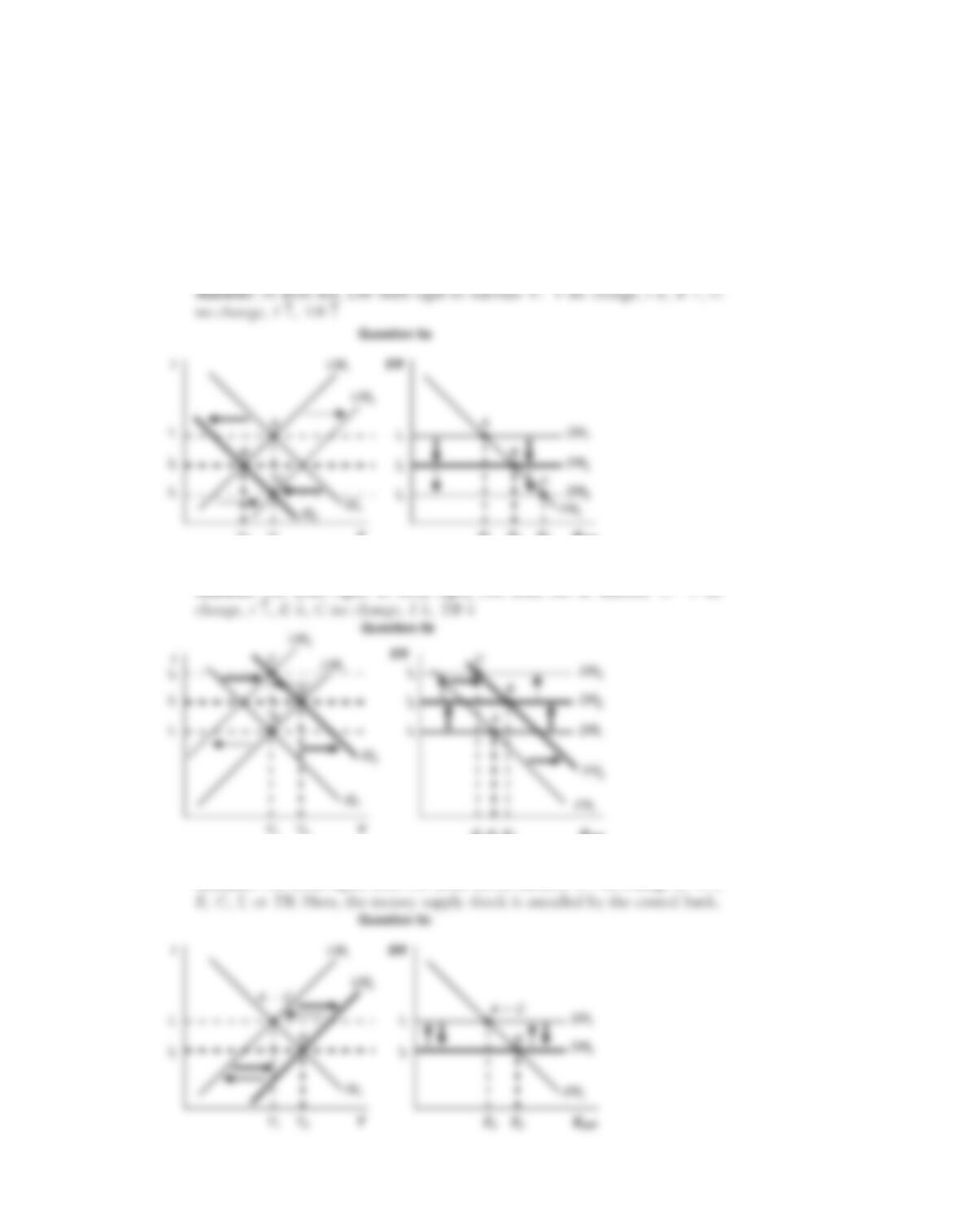
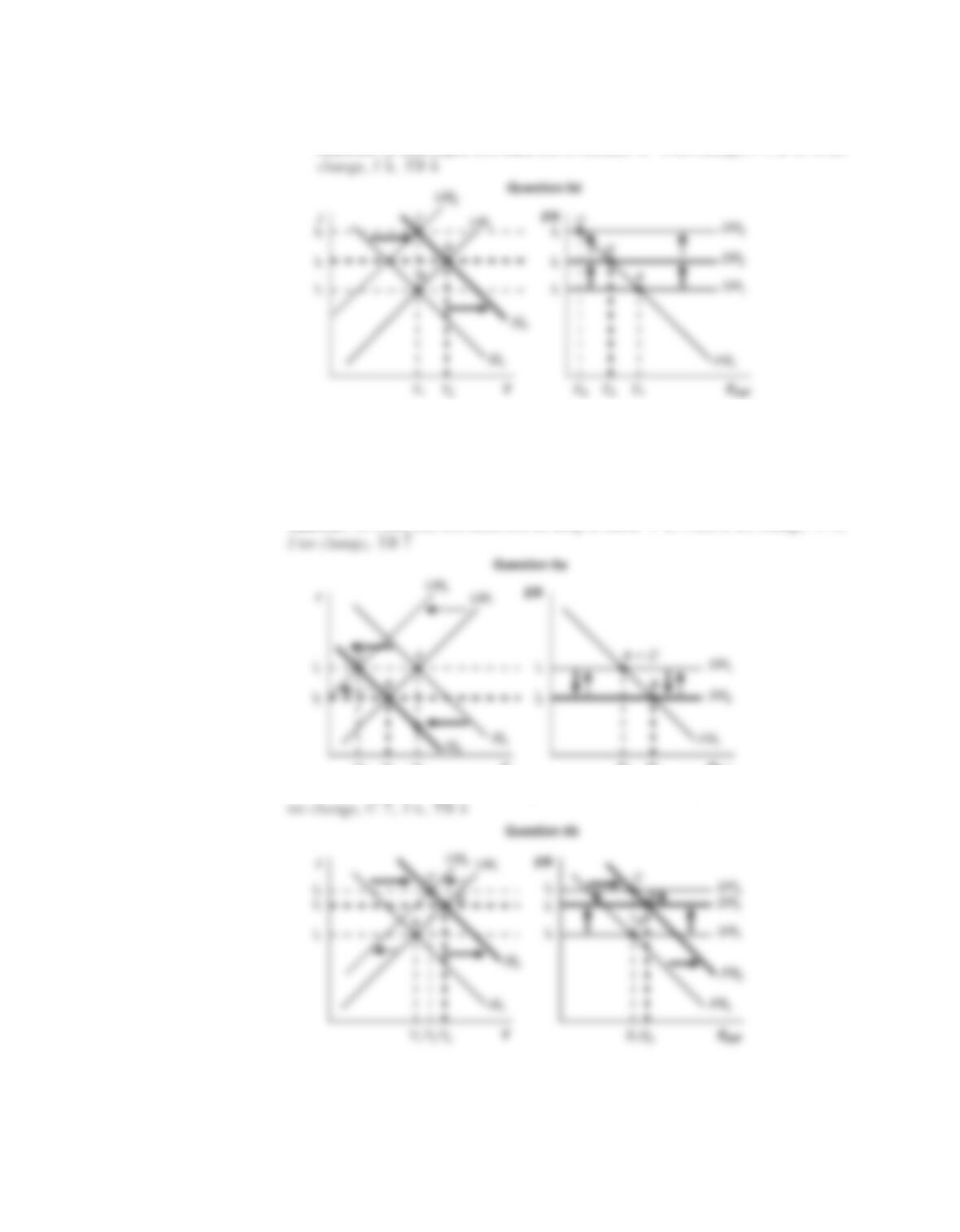
See the following diagrams. Point B is identical to the outcomes shown in question 3.
Point C shows the outcome when monetary policy is used to stabilize output.
a. Foreign output decreases.
i3
IS1
IS2
Y2Y1Y
i3DR3
FR1
E2E3EH/F
E1
b. Investors expect a depreciation of the Home currency.
i
i1
i2
LM1
LM2
IS1
A C
B
Y2
Y1Y
ER
i1
i2
FR1
DR2
DR1
A C
B
E2EH/F
E1
S-140 Solutions n Chapter 14 Output, Exchange Rates, and Macroeconomic Policies
d. Government spending increases.
Y2
Y3
Y1Y
E1E2EH/F
Solutions n Chapter 14 Output, Exchange Rates, and Macroeconomic Policies S-141
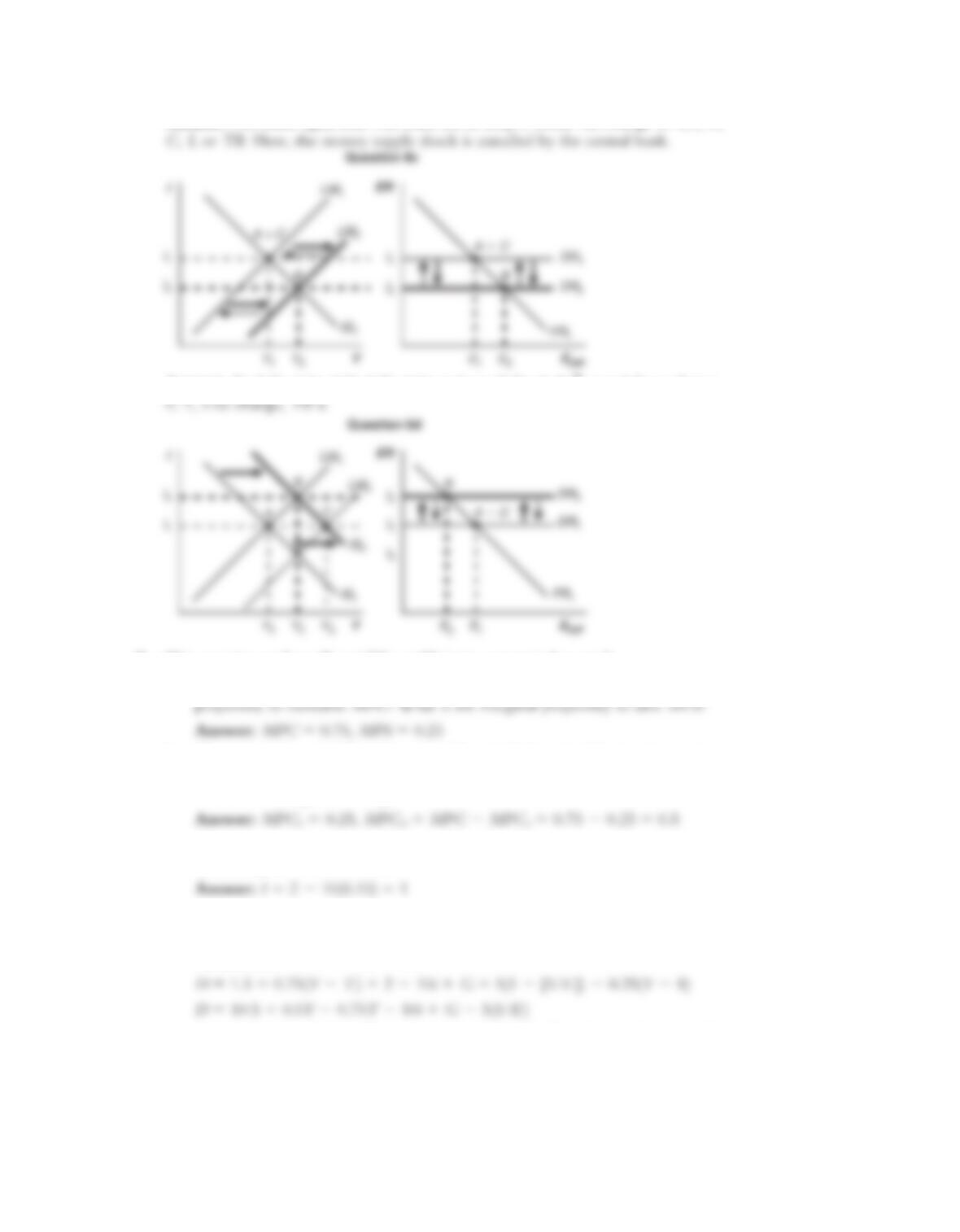
Answer: IS shifts right, LM shifts right to keep E fixed: Y ↑, i and E no change,
Answer: LM shifts right, then LM shifts left to keep E fixed: No change in Y, i, E,
C, I, or TB. Here, the money supply shock is annulled by the central bank.
i
i1
i2
i1
i2
LM1
LM2
IS1
A = C
B
Y2Y
Y1
ER
FR1
A C
B
E1E2EH/F
DR1
DR2
Question 6c
i
i1
i2
LM1
LM2
IS1
IS2
AC
B
Y2Y3Y
Y1
ER
i1
i2
i3
DR2
DR1
FR1
A C
B
E1
E2EH/F
7. This question explores IS and FX equilibria in a numerical example.
a. The consumption function is C 5 1.5 1 0.75(Y 2 T). What is the marginal
b. The trade balance is TB 5 5(1 2 [1/E]) 2 0.25(Y 2 8). What is the marginal
propensity to consume foreign goods MPCF? What is the marginal propensity to
consume home goods MPCH?
c. The investment function is I 5 2 2 10i. What is investment when the interest
rate i is equal to 0.10 5 10%?
d. Assume government spending is G. Add up the four components of demand and
write down the expression for D.
Answer: D 5 C 1 I 1 G 1 TB
e. Assume forex market equilibrium is given by i 5 ([1/E] 2 1) 1 0.10, where the
two foreign return terms on the right are expected depreciation and the foreign
interest rate. What is the foreign interest rate? What is the expected future ex-
change rate?
Answer: i* 5 10%; Ee 5 1 (this is the UIP condition)
8. [More difficult] Continuing the last question, solve for the IS curve, obtain an ex-
pression for Y in terms of i, G, and T (eliminate E).
9. Assume that initially the IS curve is given by
IS1: Y 5 12 2 1.5T 2 30i 1 2G
and that the price level P is 1, and the LM curve is given by
LM1: M 5 Y(1 2 i)
The home central bank uses the interest rate as its policy instrument. Initially, the
home interest rate equals the foreign interest rate of 10% or 0.1. Taxes and govern-
ment spending both equal 2. Call this case 1.
a. According to the IS1 curve, what is the level of output Y? Assume this is the
desired full employment level of output.
Answer: IS: Y 5 12 2 1.5(2) 2 30(0.1) 1 2(2) 5 10
b. According to the LM1 curve, at this level of output, what is the level of the home
money supply?
Answer: LM: M 5 10(1 2 0.1) 5 9
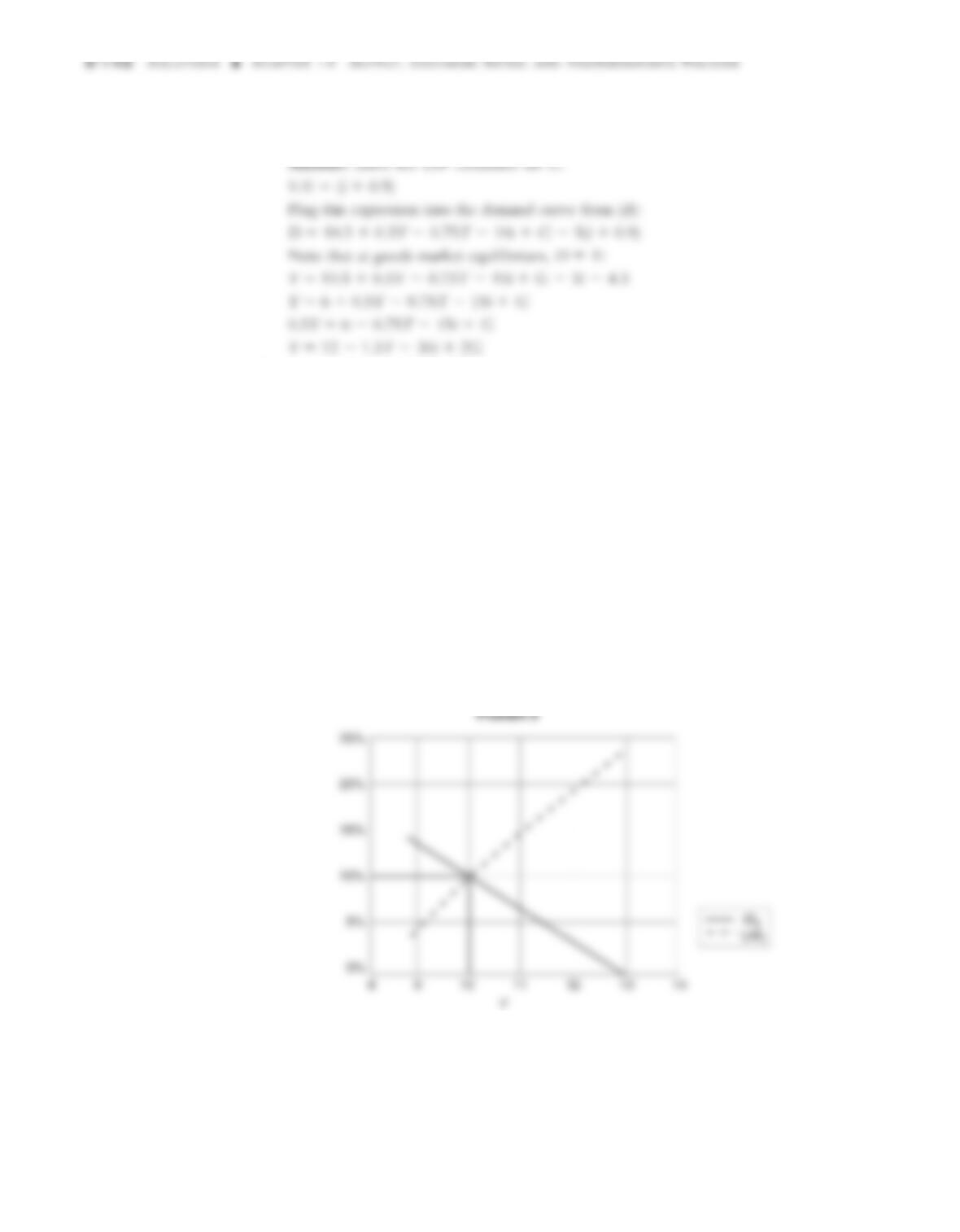
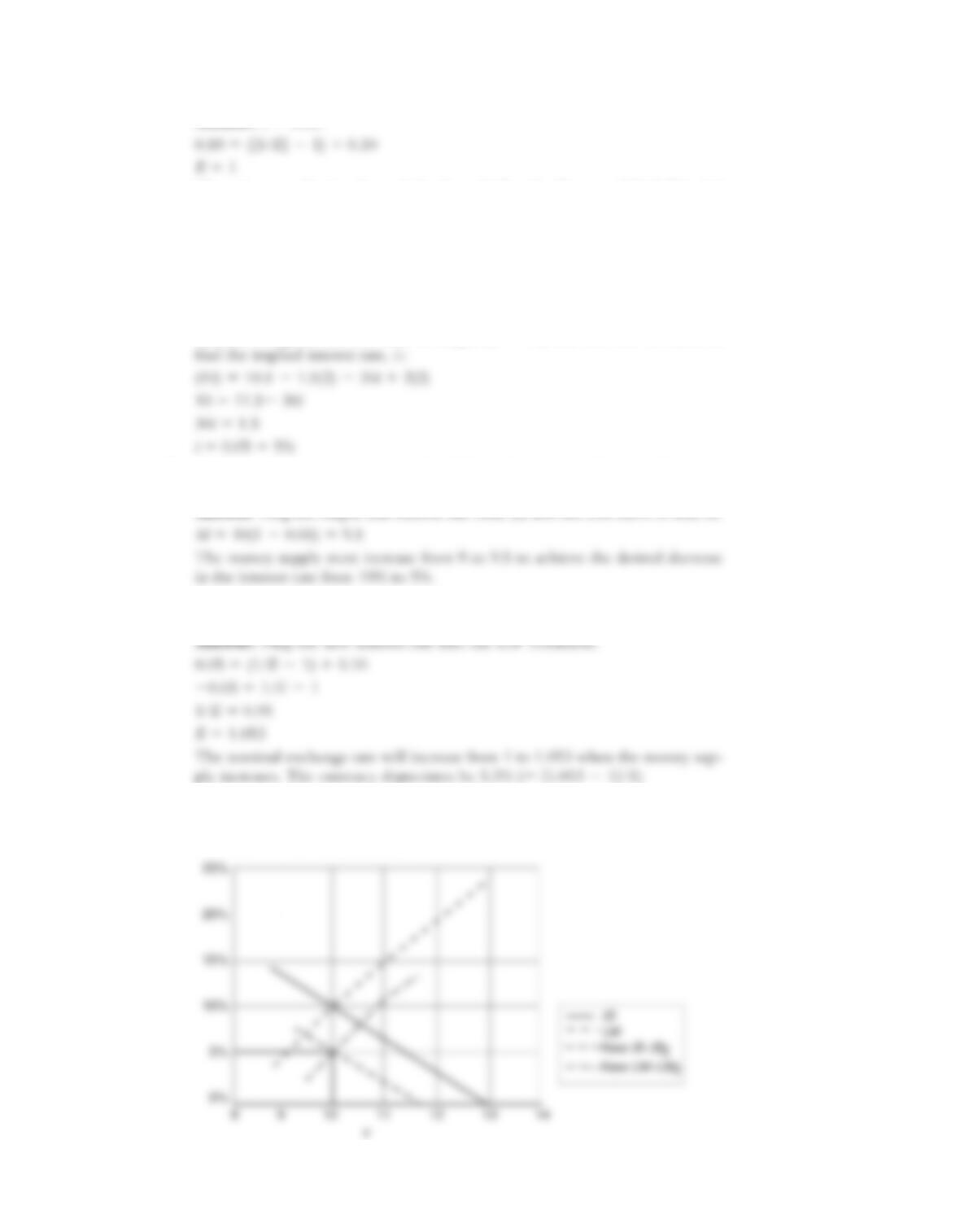
c. Plot the IS1 and LM1 curves for case 1 on a chart. Label the axes, and the equi-
librium values.
Answer: See the following diagram.
d. Assume that forex market equilibrium is given by i 5 ([1/E] 2 1) 1 0.10, where
the two foreign return terms on the right are expected depreciation and the for-
eign interest rate. The expected future exchange rate is 1. What is today’s spot
exchange rate?
0%
8 9 10 11 12 13 14
Y
Problem 9
Solutions n Chapter 14 Output, Exchange Rates, and Macroeconomic Policies S-143
e. There is now a foreign demand shock, such that the IS curve shifts left by 1.5
units at all levels of the interest rate, and the new IS curve is given by
IS2: Y 5 10.5 2 1.5T 2 30i 1 2G
The government asks the central bank to stabilize the economy at full employ–
ment. To stabilize and return output back to the desired level, according to this
new IS curve, by how much must the interest rate be lowered from its initial level
of 0.1? (Assume taxes and government spending remain at 2.) Call this case 2.
Answer: Plug the desired value of output (Y 5 10) into the new IS curve to
f. At the new lower interest rate and at full employment, on the new LM curve
(LM2), what is the new level of the money supply?
g. According to the forex market equilibrium, what is the new level of the spot
exchange rate? How large is the depreciation of the home currency?
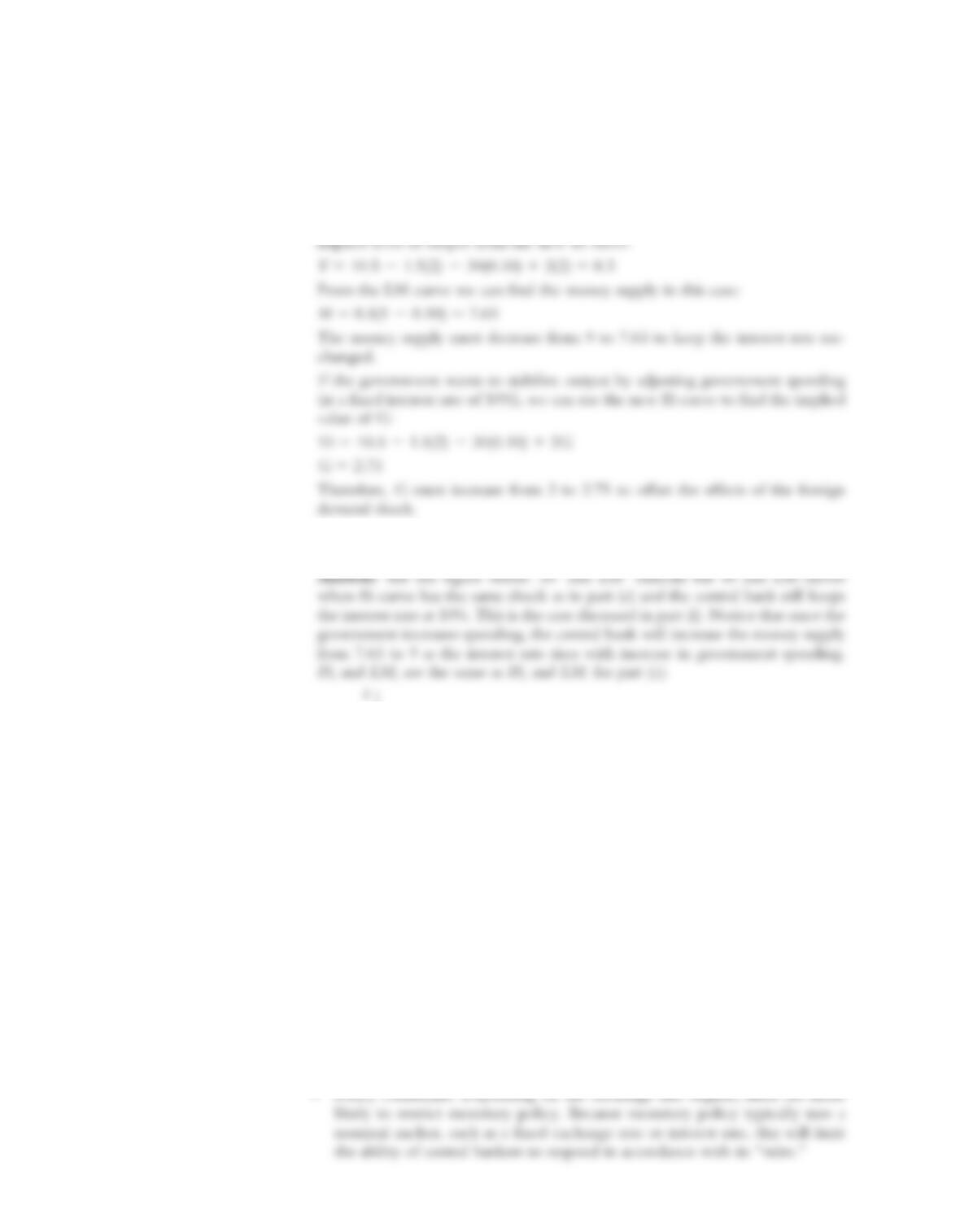
h. Plot the new IS2 and LM2 curves for case 2 on a chart. Label the axes, and the
equilibrium values.
Answer: See the diagram below.
0%
8 9 10 11 12 13 14
Y
S-144 Solutions n Chapter 14 Output, Exchange Rates, and Macroeconomic Policies
i. Return to (e). Now assume that the central bank refuses to change the interest
rate from 10%. In this case, what is the new level of output? What is the money
supply? And if the government decides to use fiscal policy instead to stabilize
output, then according to the new IS curve, by how much must government
spending be increased to achieve this goal? Call this case 3.
Answer: If the central bank wishes to keep i 5 i1 5 10%, then we can find the
j. Plot the new IS3 and LM3 curves for case 3 on a chart. Label the axes and the
equilibrium values.
IS3
IS
LM3
LM
A C
B
i1 10%
8.5 10 Y
10. In this chapter, we’ve studied how policy responses affect economic variables in an open
economy. Consider each of the problems in policy design and implementation discussed
in this chapter. Compare and contrast each problem as it applies to monetary policy
stabilization versus fiscal policy stabilization.
Answer: Consider the following limitations:
Solutions n Chapter 14 Output, Exchange Rates, and Macroeconomic Policies S-145