Exchange Rates I: The Monetary
Approach in the Long Run
1. Suppose that two countries, Vietnam and Côte d’Ivoire, produce coffee. The cur-
rency unit used in Vietnam is the dong (VND). Côte d’Ivoire is a member of Com-
munauté Financiére Africaine (CFA), a currency union of West African countries
that use the CFA franc (XOF). In Vietnam, coffee sells for 5,000 dong (VND) per
pound of coffee. The exchange rate is 30 VND per 1 CFA franc, EVND/XOF 530.
a. If the law of one price holds, what is the price of coffee in Côte d’Ivoire, mea-
sured in CFA francs?
PC
b. Assume the price of coffee in Côte d’Ivoire is actually 160 CFA francs per
pound of coffee. Compute the relative price of coffee in Côte d’Ivoire versus
Vietnam. Where will coffee traders buy coffee? Where will they sell coffee in
this case? How will these transactions affect the price of coffee in Vietnam? In
Côte d’Ivoire?
Answer: The relative price of coffee in these two markets is:
coffee)/Pcoffee 5 (30 3 160)/5,000 5 160/66.7 5 0.96 , 1
11
S-101
2. Consider each of the following goods and services. For each, identify whether the
law of one price will hold, and state whether the relative price, qg
US/Foreign, is greater
than, less than, or equal to 1. Explain your answer in terms of the assumptions we
make when using the law of one price.
a. Rice traded freely in the United States and Canada
Answer: qg
US/Foreign 5 1
LOOP should hold in this case because its assumptions are met.
b. Sugar traded in the United States and Mexico; the U.S. government imposes a
quota on sugar imports into the United States
Answer: qg
US/Foreign > 1
S-102 Solutions n Chapter 11 Exchange Rates I: The Monetary Approach in the Long Run
c. The McDonald’s Big Mac sold in the United States and Japan
d. Haircuts in the United States and the United Kingdom
Answer: qg
US/Foreign 1
3. Use the table that follows to answer this question. Treat the country listed as the
home country, and the United States as the foreign country. Suppose the cost of the
market basket in the United States is PUS 5 $190. Check to see whether PPP holds
for each of the countries listed, and determine whether we should expect a real ap-
preciation or real depreciation for each country (relative to the United States) in the
long run. For the answer, create a table similar to the one shown and fill in the blank
cells. (Hint: Use a spreadsheet application such as Excel.)
Country Price of Is FX currency
(currency Price of U.S. basket Real Is FX expected to
measured market in FX exchange Does PP currency have Real
in FX Per $, basket (PUS times rate hold? overvalued or appreciation or
units) EFX/$ (in FX) EFX/$) qCOUNTRY/US (yes/no) undervalued? depreciation?
Brazil 2.1893 520
(real)
India 46.6672 12,000
(rupee)
Mexico 11.0131 1,800
(peso)
South Africa 6.9294 800
(rand)
Zimbabwe 101,347 4,000,000
(Z$)
Country Price of Is FX currency
(currency Price of U.S. basket Real Is FX expected to
measured market in FX exchange Does PP currency have Real
in FX Per $, basket (PUS times rate hold? overvalued or appreciation or
units) EFX/$ (in FX) EFX/$) qCOUNTRY/US (yes/no) undervalued? depreciation?
Brazil 2.1893 520 415.97 0.80 No Real overvalued Real exchange rate
(real) will depreciate
India 46.6672 12,000 8,866.77 0.74 No Rupee overvalued Real exchange rate
(rupee) will depreciate
Mexico 11.0131 1,800 2,092.49 1.16 No Peso undervalued Real exchange rate
(peso) will appreciate
South Africa 6.9294 800 1,316.59 1.65 No Rand undervalued Real exchange rate
(rand) will appreciate
Zimbabwe 101,347 4,000,000 19,225,930.00 4.81 No ZW$ undervalued Real exchange rate
(Z$) will appreciate
Solutions n Chapter 11 Exchange Rates I: The Monetary Approach in the Long Run S-103
Answer: See the following table. Note that the United States is treated as the for-
4. Table 11-1 in the text shows the percentage undervaluation or overvaluation in the
Big Mac, based on exchange rates in July 2012. Suppose purchasing power parity
holds in the long run, so that these deviations would be expected to disappear. Sup-
pose the local currency prices of the Big Mac remained unchanged. Exchange rates
on year later on July 1, 2013, were as follows (Source: FT.com):
Based on these data and Table 11-1, calculate the change in the exchange rate from
July 2012 to July 2013, and state whether the direction of change was consistent with
the PPP-implied exchange rate using the Big Mac Index. How might you explain
the failure of the Big Mac Index to correctly predict the change in the nominal ex-
change rate between July 2012 and July 2013?
Country Per U.S. Dollar $
Australia (A$) 1.08
Brazil (real) 2.23
Canada (C$) 1.05
Denmark (DK) 5.72
India (rupee) 59.43
Eurozone (Є) 0.77
Japan (yen) 99.75
Mexico (peso) 12.89
Sweden (SKr) 6.67
S-104 Solutions n Chapter 11 Exchange Rates I: The Monetary Approach in the Long Run
Answer:
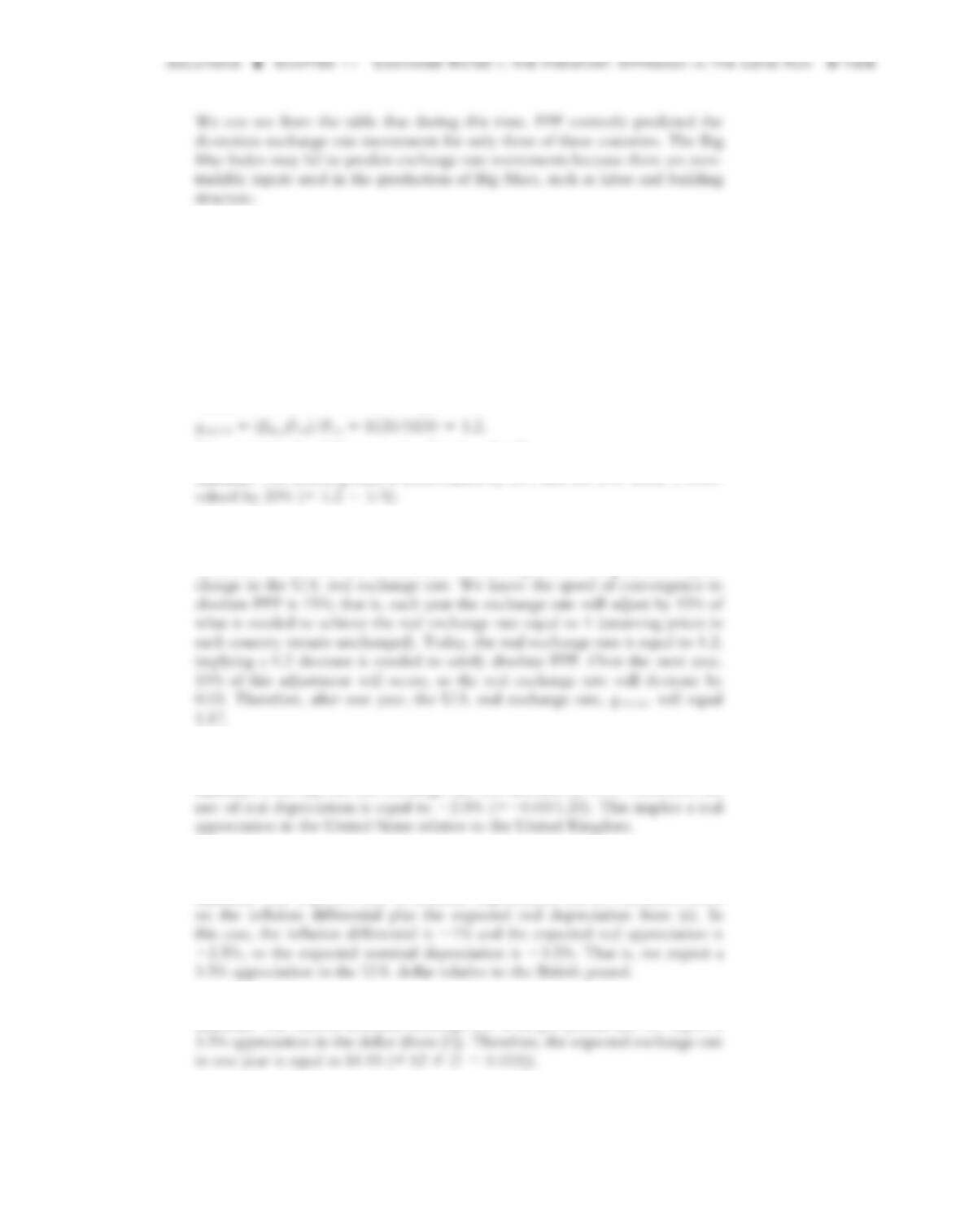
5. You are given the following information. The current dollar–pound exchange rate is
$2 per British pound. A U.S. basket that costs $100 would cost $120 in the United
Kingdom. For the next year, the Fed is predicted to keep U.S. inflation at 2% and the
Bank of England is predicted to keep U.K. inflation at 3%. The speed of convergence
to absolute PPP is 15% per year.
a. What is the expected U.S. minus U.K. inflation differential for the coming year?
Answer: The inflation differential is equal to 21% (5 2% 2 3%).
b. What is the current U.S. real exchange rate, qUS/UK, with the United Kingdom?
Answer: The current real exchange rate is:
c. How much is the dollar overvalued/undervalued?
d. What do you predict the U.S. real exchange rate with the United Kingdom will
be in one year’s time?
Answer: We can use the information on convergence to compute the implied
e. What is the expected rate of real depreciation for the United States (versus the
United Kingdom)?
f. What is the expected rate of nominal depreciation for the United States (versus
the United Kingdom)?
g. What do you predict will be the dollar price of one pound a year from now?
6. Describe how each of the following factors might explain why PPP is a better guide
for exchange rate movements in the long run versus the short run: (1) transactions
costs, (2) nontraded goods, (3) imperfect competition, and (4) price stickiness. As
markets become increasingly integrated, do you suspect PPP will become a more
useful guide in the future? Why or why not?
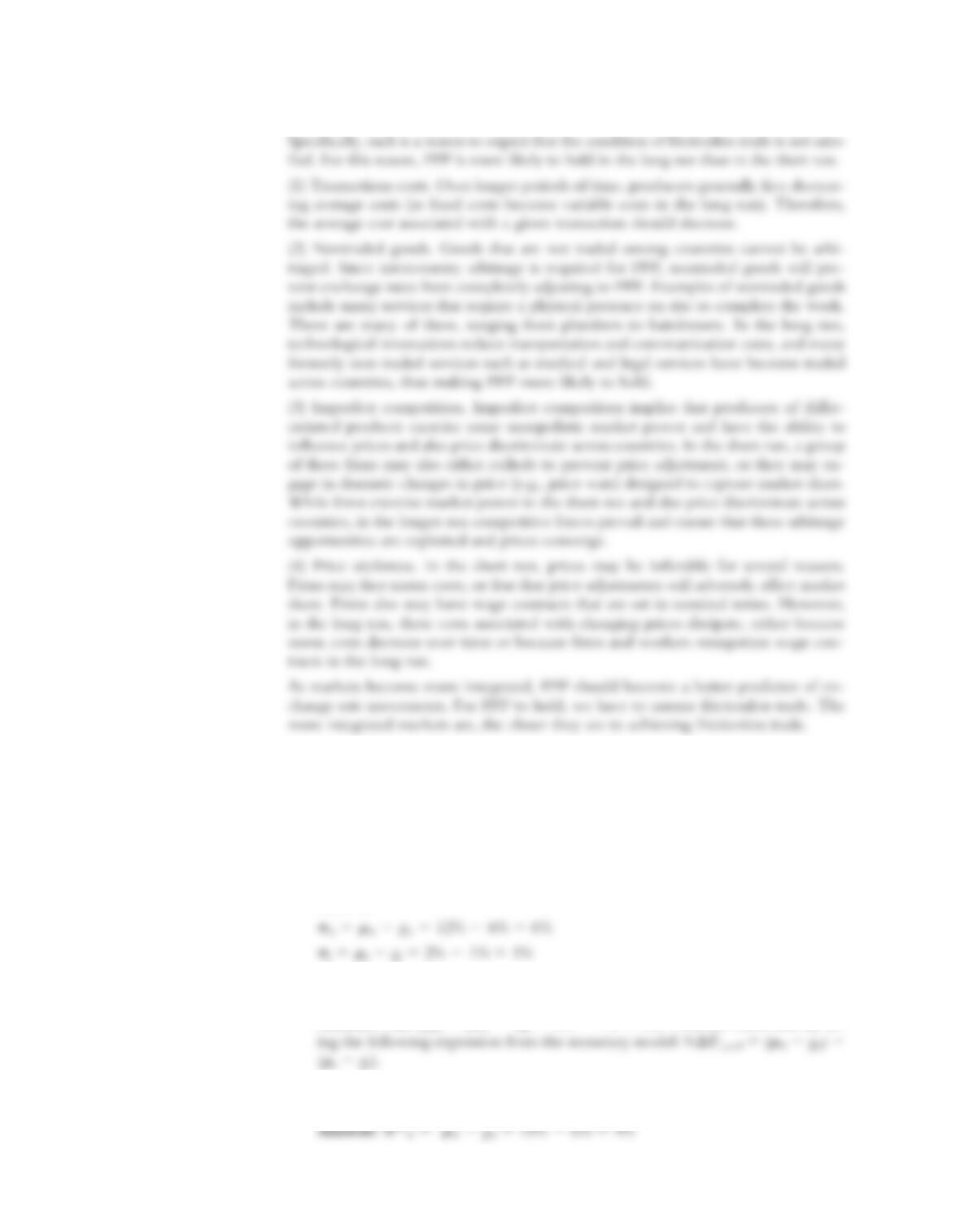
S-106 Solutions n Chapter 11 Exchange Rates I: The Monetary Approach in the Long Run
Answer: Each of these factors hinders trade more in the short run than in the long run.
7. Consider two countries, Japan and Korea. In 1996, Japan experienced relatively slow
output growth (1%), whereas Korea had relatively robust output growth (6%). Suppose
the Bank of Japan allowed the money supply to grow by 2% each year, whereas the
Bank of Korea chose to maintain relatively high money growth of 12% per year.
For the following questions, use the simple monetary model (where L is constant). You
will find it easiest to treat Korea as the home country and Japan as the foreign country.
a. What is the inflation rate in Korea? In Japan?
Answer:
b. What is the expected rate of depreciation in the Korean won relative to the
Japanese yen (¥)?
c. Suppose the Bank of Korea increases the money growth rate from 12% to 15%.
If nothing in Japan changes, what is the new inflation rate in Korea?
Solutions n Chapter 11 Exchange Rates I: The Monetary Approach in the Long Run S-107
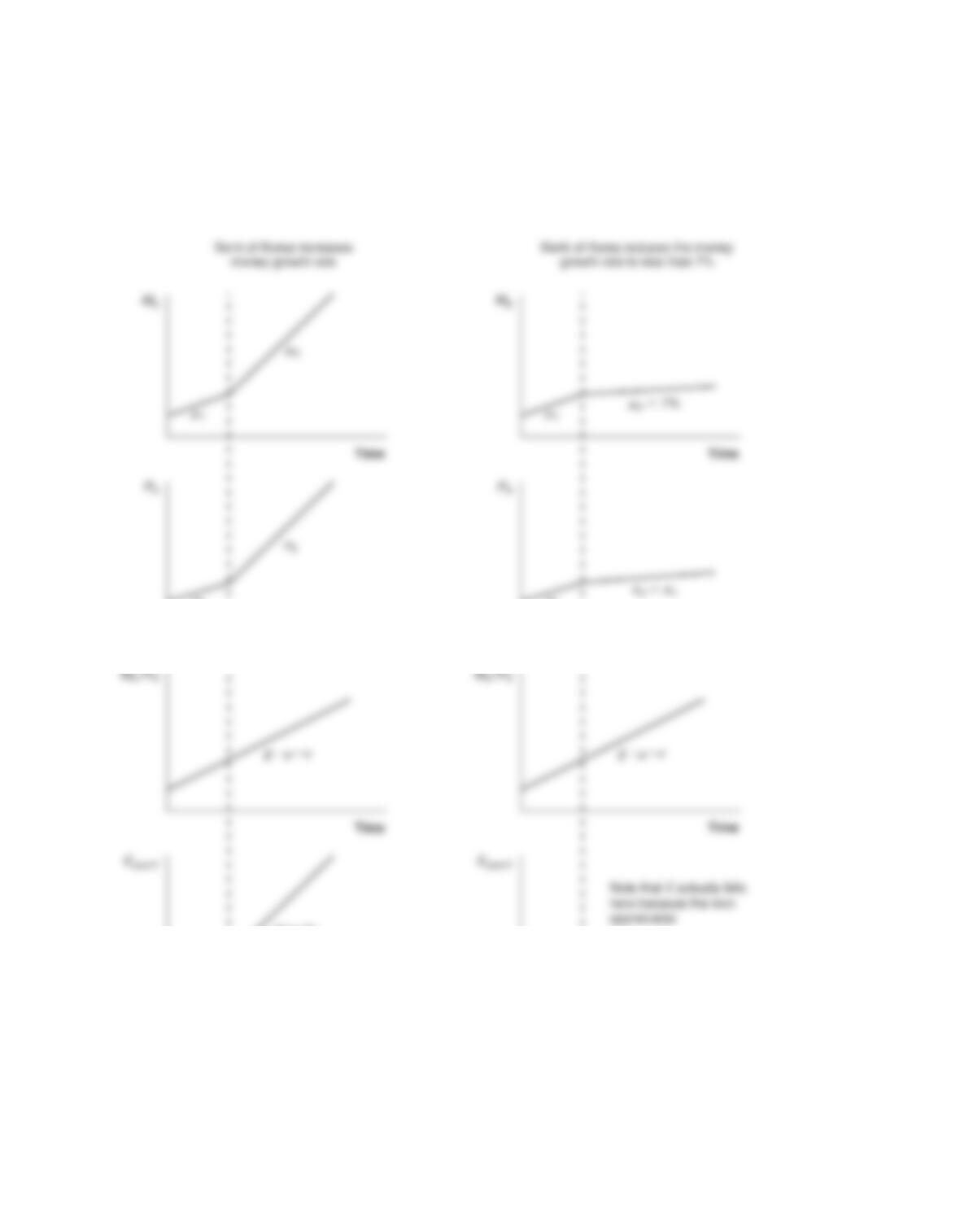
d. Using time series diagrams, illustrate how this increase in the money growth rate
affects the money supply MK, Korea’s interest rate, prices PK, real money sup-
ply, and Ewon/¥ over time. (Plot each variable on the vertical axis and time on the
horizontal axis.)
Answer: See the following diagrams.
T
Ewon/Y
Time
K2J
K1J
T
Ewon/Y
Note that E actually falls
here because the won
appreciates
Time
K2J 0
K1J
S-108 Solutions n Chapter 11 Exchange Rates I: The Monetary Approach in the Long Run
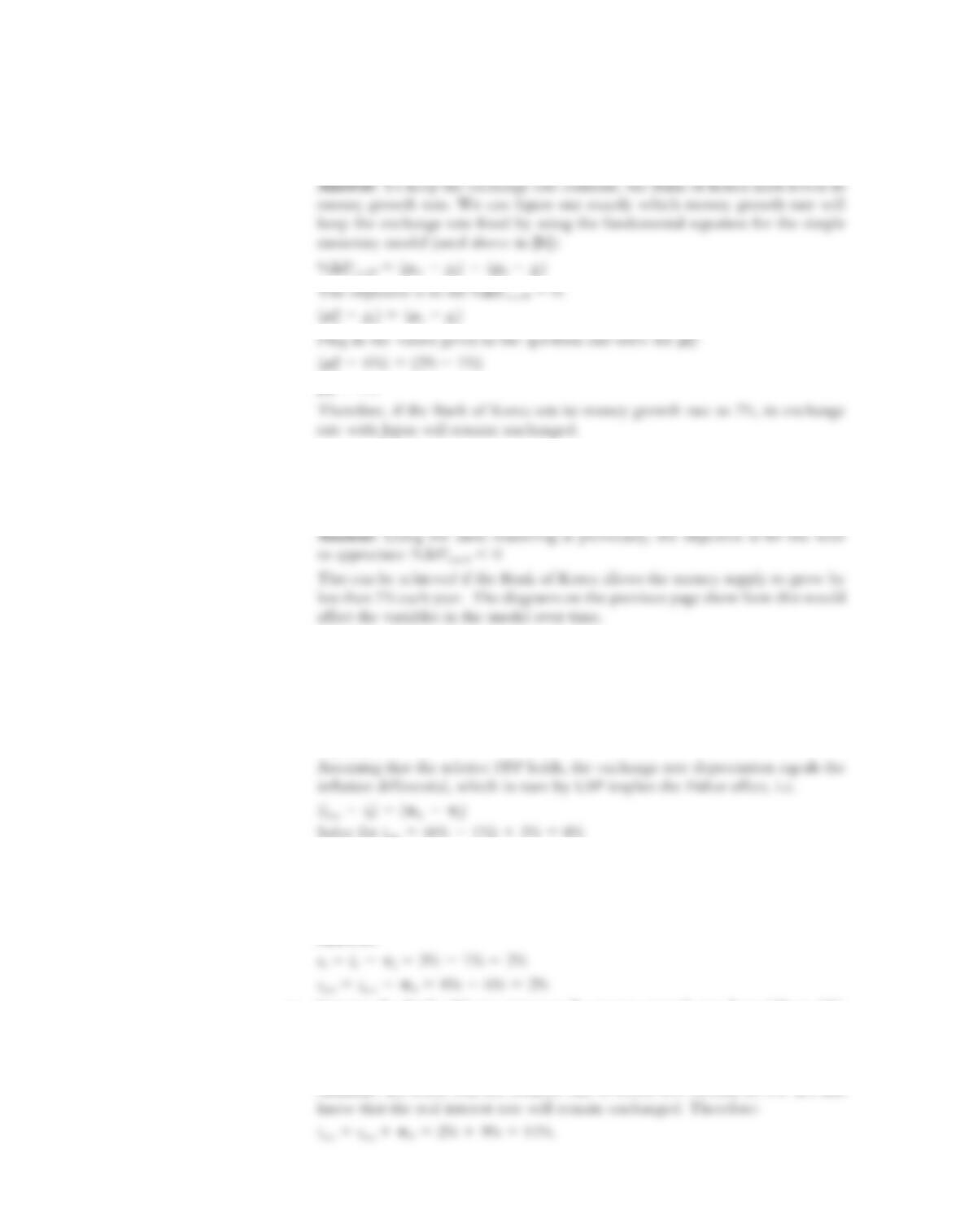
e. Suppose the Bank of Korea wants to maintain an exchange rate peg with the
Japanese yen. What money growth rate would the Bank of Korea have to
choose to keep the value of the won fixed relative to the yen?
f. Suppose the Bank of Korea sought to implement policy that would cause the
Korean won to appreciate relative to the Japanese yen. What ranges of the
money growth rate (assuming positive values) would allow the Bank of Korea
to achieve this objective?
8. This question uses the general monetary model, in which L is no longer assumed
constant and money demand is inversely related to the nominal interest rate. Con-
sider the same scenario described in the beginning of the previous question. In ad-
dition, the bank deposits in Japan pay a 3% interest rate, i¥ 5 3%.
a. Compute the interest rate paid on Korean deposits.
Answer:
b. Using the definition of the real interest rate (nominal interest rate adjusted for
inflation), show that the real interest rate in Korea is equal to the real interest rate
in Japan. (Note that the inflation rates you computed in the previous question
will be the same in this question.)
c. Suppose the Bank of Korea increases the money growth rate from 12% to 15%
and the inflation rate rises proportionately (one for one) with this increase. If the
nominal interest rate in Japan remains unchanged, what happens to the interest
rate paid on Korean deposits?

Solutions n Chapter 11 Exchange Rates I: The Monetary Approach in the Long Run S-109
d. Using time series diagrams, illustrate how this increase in the money growth
rate affects the money supply, MK; Korea’s interest rate; prices, PK; real money
supply; and Ewon/¥ over time. (Plot each variable on the vertical axis and time on
the horizontal axis.)
MK
1
2
PK
T
Time
Time
MK
/ PK
Time
iwon
T
Time
Ewon/Y
Time
9. Both advanced economies and developing countries have experienced a decrease in
inflation since the 1980s (see Table 11-3 in the text). This question considers how
the choice of policy regime has influenced this global disinflation. Use the monetary
model to answer this question.
a. The Swiss Central Bank currently targets its money growth rate to achieve pol-
icy objectives. Suppose Switzerland has output growth of 3% and money growth
of 8% each year. What is Switzerland’s inflation rate in this case? Describe how
the Swiss Central Bank could achieve an inflation rate of 2% in the long run
through the use of a nominal anchor.
S-110 Solutions n Chapter 11 Exchange Rates I: The Monetary Approach in the Long Run
b. Like the Federal Reserve, the Reserve Bank of New Zealand uses an interest
rate target. Suppose the Reserve Bank of New Zealand maintains a 6% interest
rate target and the world real interest rate is 1.5%. What is the New Zealand
inflation rate in the long run? In 1997, New Zealand adopted a policy agreement
that required the bank to maintain an inflation rate no higher than 2.5%. What
interest rate targets would achieve this objective?
c. The central bank of Lithuania maintains an exchange rate band relative to the
euro. This is a prerequisite for joining the Eurozone. Lithuania must keep its
exchange rate within 615% of the central parity of 3.4528 litas per euro. Com-
pute the exchange rate values corresponding to the upper and lower edges of
this band. Suppose PPP holds. If Eurozone inflation is currently 2% per year and
inflation in Lithuania is 5%, compute the rate of depreciation of the lita. Will
Lithuania be able to maintain the band requirement? For how long? Does your
answer depend on where in the band the exchange rate currently sits? A primary
objective of the European Central Bank is price stability (low inflation) in the
current and future Eurozone. Is an exchange rate band a necessary or sufficient
condition for the attainment of this objective?
Answer: From relative PPP: pL 5 %DEelita/€ 1 pE. Plug in the inflation rates
10. Several countries that have experienced hyperinflation adopt dollarization
as a way to control domestic inflation. For example, Ecuador has used the
U.S. dollar as its domestic currency since 2000. What does dollarization
imply about the exchange rate between Ecuador and the United States?
Why might countries experiencing hyperinflation adopt dollarization? Why
might they do this rather than just fixing their exchange rate?
Answer: Dollarization implies a country adopting dollar as its currency. Because
Solutions n Chapter 11 Exchange Rates I: The Monetary Approach in the Long Run S-111
11. You are the central banker for a country that is considering the adoption of a new
nominal anchor. When you take the position as chairperson, the inflation rate is 4%
and your position as the central bank chairperson requires that you achieve a 2.5%
inflation target within the next year. The economy’s growth in real output is cur-
rently 3%. The world real interest rate is currently 1.5%. The currency used in your
country is the lira. Assume prices are flexible.
a. Why is having a nominal anchor important for you to achieve the inflation tar-
get? What is the drawback of using a nominal anchor?
b. What is the growth rate of the money supply in this economy? If you choose to
adopt a money supply target, which money supply growth rate will allow you
to meet your inflation target?
c. Suppose the inflation rate in the United States is currently 2% and you adopt an
exchange rate target relative to the U.S. dollar. Compute the percent apprecia-
tion/depreciation in the lira needed for you to achieve your inflation target. Will
the lira appreciate or depreciate relative to the U.S. dollar?
d. Your final option is to achieve your inflation target using interest rate policy.
Using the Fisher equation, compute the current nominal interest rate in your
country. What nominal interest rate will allow you to achieve the inflation tar-
get?