Archives
Appendix N People have two thinking processes–one visual and intuitive
B. Product Layout C. Cellular Layout D. Fixed-Position Layout III. Technology Automation A. Radio-Frequency Identification (RFID) B. Digital Manufacturing Systems C. Lean Thinking B. Knowledge Management and Web 2.0 C. Enterprise Resource Planning Systems VI. The Internet and E-Business A. […]
Chapter 1 Managers Have Various Tools Help Ensure The
level managers is monitoring the external environment and determining the best strategy to be competitive. In response to big changes taking place in the external environment, managers across all industries are deciding whether to base future plans, goals, products, operations, […]
Chapter 1 Nonprofit Organizations Also Represent Major Application Management
resources needed to attain them. The management activity associated with planning is to select goals and ways to attain them. Organizing typically follows planning and reflects how the organization will try to accomplish the plan. The management activity associated with […]
Chapter 10 Designing Adaptive Organizations 185 Structures Work
• Chapter 10 © 2014 Cengage Learning. All Rights Reserved. May not be scanned, copied or duplicated, or posted to a publicly accessible website, in whole or in part. 180 g. Virtual Network Approach • The biggest advantages are flexibility […]
Chapter 10 Line And Staff Authority Line Departments Perform
CHAPTER 10 DESIGNING ADAPTIVE ORGANIZATIONS CHAPTER OUTLINE What Are Your Leadership Beliefs? I. Organizing the Vertical Structure A. Work Specialization B. Chain of Command New Manager Self-Test: Delegation A. Span of Management B. Centralization and Decentralization II. Departmentalization A. Vertical […]
Chapter 11 Self interest Employees Typically Resist Change They Believe
C. Innovation Roles III. Changing People and Culture A. Training and Development B. Organization Development IV. Implementing Change A. Need for Change B. Resistance to Change C. Force-Field Analysis D. Implementation Tactics forces originate in all environmental sectors including customers, […]
Chapter 12 These Systems Rank Employees According Their Relative
205 © 2014 Cengage Learning. All Rights Reserved. May not be scanned, copied or duplicated, or posted to a publicly accessible website, in whole or in part. IV. Finding the Right People A. Human Resource Planning B. Recruiting C. Selecting […]
Chapter 13 Structures And Policies Many Leading Companies Are
economic environment. These changes include globalization and the changing workforce. In the past, the United States was a place where people of different national origins, ethnicities, races, and religions came together and blended to resemble one another. Opportunities for advancement […]
Chapter 14 Managers Can Help Employees Feel More Satisfied
Understanding Individual Behavior • 253 3. An organized system. Once you’ve decided the actions you need to take, you need to keep reminders in a well-organized system. By building a self-management approach based on these three principles, you can get […]
Chapter 14 People Experience This Attitude When Their Work
CHAPTER 14 UNDERSTANDING INDIVIDUAL BEHAVIOR CHAPTER OUTLINE Are You Self-Confident? I. Understanding Yourself and Others A. The Value and Difficulty of Knowing Yourself B. Enhance Your Self-Awareness II. Attitudes A. High-Performance Work Attitudes B. Conflicts among Attitudes III. Perception A. […]
Chapter 15 Servant Leaders Often Work The Nonprofit World
CHAPTER 15 LEADERSHIP CHAPTER OUTLINE What’s Your Personal Style? I. The Nature of Leadership II. Contemporary Leadership A. Level 5 Leadership B. Servant Leadership C. Authentic Leadership D. Gender Differences New Manager Self-Test: Interpersonal Patterns III. From Management to Leadership […]
Chapter 15 What Transformational Leadership Give Examples Organizational Situations
• Chapter 15 274 NOTES________________________________________________________________________ ______________________________________________________________________________ ______________________________________________________________________________ VII. CHARISMATIC AND TRANSFORMATIONAL LEADERSHIP Research has found that some leadership approaches are more effective than others for bringing about change in organizations. Two types of leadership that can have a substantial impact […]
Chapter 16 According Maslow’s Theory What Needs These Rewards
• Chapter 16 296 B. Job Characteristics Model Exhibit 16.8 1. Hackman and Oldham’s research concerns work redesign, defined as altering jobs to increase both the quality of employees’ work experience and their productivity. The job characteristics model comprises core […]
Chapter 16 The organization’s reward system can be designed
CHAPTER 16 MOTIVATING EMPLOYEES CHAPTER OUTLINE Are You Engaged or Disengaged? I. The Concept of Motivation A. Individual Needs and Motivation B. Managers as Motivators II. Content Perspectives on Motivation A. The Hierarchy of Needs B. ERG Theory C. A […]
Chapter 17 Finally Managers Crisis Situation Must Communicate Vision
• Chapter 17 © 2014 Cengage Learning. All Rights Reserved. May not be scanned, copied or duplicated, or posted to a publicly accessible website, in whole or in part. 316 2. Developing Personal Communication Networks: Personal networking refers to the […]
Chapter 17 Without Feedback The Communication Oneway With Feedback
© 2014 Cengage Learning. All Rights Reserved. May not be scanned, copied or duplicated, or posted to a publicly accessible website, in whole or in part. 305 CHAPTER 17 MANAGING COMMUNICATION CHAPTER OUTLINE Are You Building a Personal Network? I. […]
Chapter 18 A cross-functional team is composed of employees
324 © 2014 Cengage Learning. All Rights Reserved. May not be scanned, copied or duplicated, or posted to a publicly accessible website, in whole or in part. CHAPTER 18 LEADING TEAMS CHAPTER OUTLINE How Do You Like to Work? I. […]
Chapter 18 Think Your Favorite Sports Team Observe Sports
Leading Teams • 335 2. Consequences of Team Cohesiveness a. Morale is higher in cohesive teams because of increased communication among members, and member participation in team decisions and activities. High cohesiveness has almost good effects on the satisfaction and […]
Chapter 19 Budget Reports Usually List The Variance 2014
CHAPTER 19 MANAGING QUALITY AND PERFORMANCE CHAPTER OUTLINE What Is Your Attitude Toward Organizational Regulation and Control? I. The Meaning of Control II. Feedback Control Model A. Steps of Feedback Control B. The Balanced Scorecard III. Budgetary Control A. Expense […]
Chapter 19 What Types Analysis Can Managers Perform Help
• Chapter 19 358 b. TQM is most successful when it enriches jobs and improves employee motivation. c. When participation improves employees’ problem-solving skills, productivity is likely to increase. d. Quality programs have the greatest chance of success in corporate […]
Chapter 2 Technologies Environments And International Cultures When
B. Human Relations Movement C. Human Resources Perspective New Manager Self-Test: What’s Your Mach? D. Behavioral Sciences Approach IV. Management Science V. Recent Historical Trends A. Systems Thinking B. Contingency View C. Total Quality Management VI. Innovative Management Thinking for […]
Chapter 22 Exhibits Beginning Skills Conducting Independent Research Draws
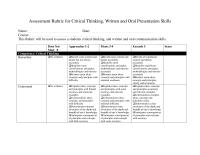
Assessment Rubric for Critical Thinking, Written and Oral Presentation Skills Name: _____________________________ Date: ___________________________________ Course: ________________________________________ This Rubric will be used to assess a students critical thinking, and written and oral communication skills. Does Not Meet 0 Approaches 1-2 Meets […]
Chapter 3 The Organization Very Personal Much Like Extended
task and general environments that provide the resource and information transactions, flows, and linkages necessary for an organization to thrive. The organizational environment consists of all elements existing outside the boundary of the organization that have the potential to affect […]
Chapter 4 Doing Business China Has Never Been Smooth
and people become increasingly interdependent. Globalization has been on the rise since the A Globalization Backlash Serving the Bottom of the Pyramid III. Getting Started Internationally A. Exporting B. Outsourcing C. Licensing D. Direct Investing A. Social Values B. Communication […]
Chapter 5 Its Responsibility Produce The Goods And Services
77 © 2014 Cengage Learning. All Rights Reserved. May not be scanned, copied or duplicated, or posted to a publicly accessible website, in whole or in part. A. Organizational Stakeholders B. The Green Movement C. Sustainability and the Triple Bottom […]
Chapter 6 Buy Franchise Exhibit 68 Franchising Perhaps The
B. Entrepreneurship in the United States III. Who Are Entrepreneurs? A. Minority-Owned Businesses B. Women-Owned Businesses C. Traits of Entrepreneurs A. Tactics for Becoming a Business Owner B. Starting an Online Business VI. Managing a Growing Business A. Stages of […]
Chapter 7 Good Communication Helps Managers Identify Problems Early
113 © 2014 Cengage Learning. All Rights Reserved. May not be scanned, copied or duplicated, or posted to a publicly accessible website, in whole or in part. reason for existence. The mission describes the organization’s values, aspirations and reason for […]
Chapter 8 Strategic management is the set of decisions and actions
A. Purpose of Strategy B. Levels of Strategy III. The Strategic Management Process A. Strategy Formulation Versus Execution B. SWOT Analysis A. The Competitive Environment B. Porter’s Competitive Strategies VI. Formulating Functional-Level Strategy VII. Global Strategy A. Globalization Strategy B. […]
Chapter 9 Advantages Using Computers Making Managerial Decisions Would
• Chapter 9 158 decisions are errors in judgment that originate in the human mind’s limited capacity and in the natural biases managers display during decision making. Awareness of the following six biases can help managers make more enlightened choices: […]
Chapter 9 Uncertainty Means Managers Know Which Goals They
147 © 2014 Cengage Learning. All Rights Reserved. May not be scanned, copied or duplicated, or posted to a publicly accessible website, in whole or in part. CHAPTER 9 MANAGERIAL DECISION MAKING CHAPTER OUTLINE How Do You Make Decisions? I. […]
Management Chapter 1 Barrys Job That Has Really Enjoyed The
52. Which of the following best describes Stacey’s position as a functional manager? a. She is responsible for several departments that perform different functions. b. She organizes people across departments to perform a specific task. c. She is responsible for […]
Management Chapter 1 Which The Following Function Managemental Human
Chapter 1—Innovative Management for a Changing World TRUE/FALSE 1. The nature of management is to control and dictate others in an organization. 2. In today’s turbulent and hypercompetitive global environment, managers must help their companies innovate more than ever. ANS: […]
Management Chapter 10 All of the following are advantages of a divisional structure
b. excellent coordination between functions. c. in-depth skill specialization and development. d. high quality technical problem solving. e. career progress within functional departments. 63. An advantage of functional structures is the: a. resulting economies of scale. b. enlarged tasks for […]
Management Chapter 10 Specialization Principle Unity Command Principle Scalar Principled
Chapter 10—Designing Adaptive Organizations TRUE/FALSE 1. The deployment of organizational resources to achieve strategic goals refers to organizing. 2. Organizing defines what to do while strategy defines how to do it. ANS: F PTS: 1 DIF: Difficulty: Moderate REF: 308 […]
Management Chapter 11 Confrontation, authoritarianism, and disciplined exploration
Chapter 11—Managing Change and Innovation TRUE/FALSE 1. Organizational change refers to the adoption of a new idea or behavior by an organization. 2. Productive innovation refers to innovations in products, services, or processes that radically change an industry’s rules of […]
Management Chapter 11 This rise is inconsistent with Trophy’s goals in this are
49. Which of the following is the reinforcement stage of organization development in which individuals acquire a desired new skill or attitude and are rewarded for it by the organization? a. Refreezing b. Restating c. Unfreezing d. Changing e. Jumping […]
Management Chapter 12 One The Newest Ways Gauging Whether
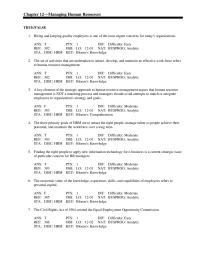
Chapter 12—Managing Human Resources TRUE/FALSE 1. Hiring and keeping quality employees is one of the most urgent concerns for today’s organizations. 2. The set of activities that are undertaken to attract, develop, and maintain an effective work force refers to […]
Management Chapter 12 While on a job interview for an administrative position
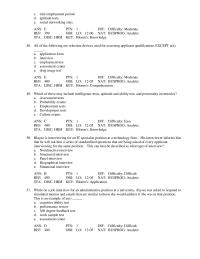
c. trial employment period. d. aptitude tests. e. social networking sites. 48. All of the following are selection devices used for assessing applicant qualifications EXCEPT a(n) _____. a. application form b. interview c. employment test d. assessment center e. drug […]
Management Chapter 13 Unfortunately, companies that foster a diverse
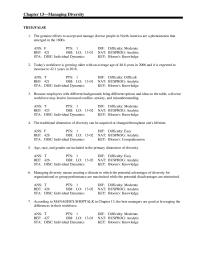
ANS: T PTS: 1 DIF: Difficulty: Difficult REF: 421 OBJ: LO: 13-01 NAT: BUSPROG: Analytic STA: DISC: Individual Dynamics KEY: Bloom’s: Knowledge ANS: T PTS: 1 DIF: Difficulty: Moderate REF: 423 OBJ: LO: 13-02 NAT: BUSPROG: Analytic STA: DISC: Individual […]
Management Chapter 14 Big Five Personality Factoras Agreeableness Openness Experience
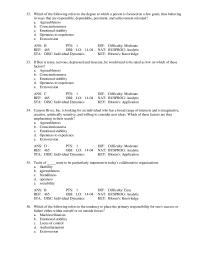
32. Which of the following refers to the degree to which a person is focused on a few goals, thus behaving in ways that are responsible, dependable, persistent, and achievement oriented? a. Agreeableness b. Conscientiousness c. Emotional stability d. Openness […]
Management Chapter 14 Organizing the selected data into patterns for interpretation
Chapter 14—Understanding Individual Behavior TRUE/FALSE 1. Job satisfaction is work behavior that goes beyond job requirements and contributes as needed to the organization’s success. 2. The link between satisfaction and performance, according to research, is generally small and is affected […]
Management Chapter 15 Consideration is the extent to which the leader is task
Chapter 15—Leadership TRUE/FALSE 1. Leadership occurs among people, involves the use of influence, and is used to attain goals. 2. Influence means that the relationship among people is passive. ANS: F PTS: 1 DIF: Difficulty: Moderate REF: 494 OBJ: LO: […]
Management Chapter 15 He has absolutely no experience as a manager
39. The _____ styles works best for employees with moderate readiness, according to Hersey and Blanchard. a. selling and telling b. coaching and participating c. coaching and supporting d. directing and delegating e. entrusting and supporting 40. Two leadership styles […]
Management Chapter 16 Many companies are finding that creating a humane
Chapter 16—Motivating Employees TRUE/FALSE 1. Employee motivation affects productivity, and part of a manager’s job is to channel motivation toward the accomplishment of organizational goals. 2. Two ways to classify rewards are extrinsic and monetary. ANS: F PTS: 1 DIF: […]
Management Chapter 16 One of your fellow team members at work is continually
51. One of your fellow students is continually late to class. The professor has tried numerous verbal warnings and recently took points away from the student’s grade. Based on the above, the professor’s actions are consistent with which of the […]
Management Chapter 17 Characteristics That Amy Suggests Manager Should Recognize
e. telling 39. Listening is _____ of effective communication. a. 10 percent b. 25 percent c. 40 percent d. 50 percent e. 75 percent ANS: E PTS: 1 DIF: Difficulty: Moderate REF: 577 OBJ: LO: 17-03 NAT: BUSPROG: Analytic STA: […]
Management Chapter 17 The Skills Require Receiving Messages
Chapter 17—Managing Communication TRUE/FALSE 1. Managers facilitate strategic conversations by using open communication, actively listening to others, applying the practice of dialogue, and using feedback for learning and change. 2. Managers spend 80 percent of every working day doing desk […]
Management Chapter 18 Self-managed teams consist of 5 to 20
Chapter 18—Leading Teams TRUE/FALSE 1. A team is defined as a group of two or more people who interact and coordinate their work to accomplish a specific objective. 2. A group and a team are interchangeable terms. ANS: F PTS: […]
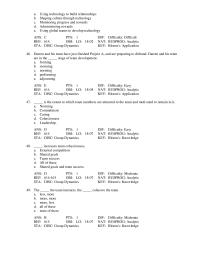
Management Chapter 18 Which of the following is NOT a characteristic of team
a. Using technology to build relationships b. Shaping culture through technology c. Monitoring progress and rewards d. Administering rewards e. Using global teams to develop technology 46. Darren and his team have just finished Project A, and are preparing to […]
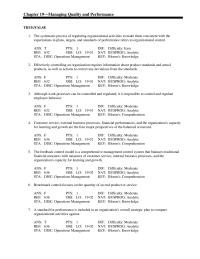
Management Chapter 19 Benchmark control focuses on the quantity of an end product
Chapter 19—Managing Quality and Performance TRUE/FALSE 1. The systematic process of regulating organizational activities to make them consistent with the expectations in plans, targets, and standards of performance refers to organizational control. 2. Effectively controlling an organization requires information about […]
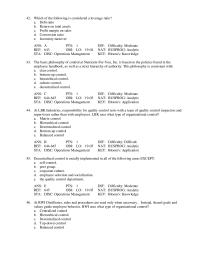
Management Chapter 19 Which The following Ratios Will Give Her The
42. Which of the following is considered a leverage ratio? a. Debt ratio b. Return on total assets c. Profit margin on sales d. Conversion ratio e. Inventory turnover 43. The basic philosophy of control at Nutrients-For-You, Inc. is based […]
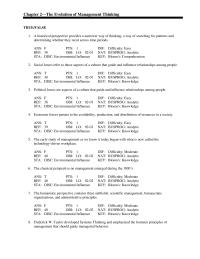
Management Chapter 2 Baby Boomer Generation Xc Generation Yd Generation
Chapter 2—The Evolution of Management Thinking TRUE/FALSE 1. A historical perspective provides a narrower way of thinking, a way of searching for patterns and determining whether they recur across time periods. 2. Social forces refer to those aspects of a […]
Management Chapter 2 This Morning Bender Had Reported That The
43. Theory X and Theory Y was developed by _____. a. Douglas McGregor b. Henry Gantt c. Max Weber d. Mary Parker Follett e. Frank Gilbreth ANS: A PTS: 1 DIF: Difficulty: Moderate REF: 47 OBJ: LO: 02-03 NAT: BUSPROG: […]
Management Chapter 3 The Dimension Includes Government Regulations
e. culture. 46. Which of the following would be considered a visual representation(s) of a company’s corporate culture? a. All department heads have an executive office. b. Each department has an award plaque for employee of the month. c. All […]
Management Chapter 3 Toyota’s response to recent events like the global economic
Chapter 3—The Environment and Corporate Culture TRUE/FALSE 1. In China, business tends to be more personal. 2. It is expected that the Hispanic population in the United States will shrink slightly over the next 30 years. ANS: F PTS: 1 […]
Management Chapter 4 Austria’s cultural preference is for achievement, heroism
d. avoid uncertainty. e. none of these. 46. A value that reflects a loosely knit social framework in which individuals are expected to take care of themselves is called: a. culture. b. individualism. c. ethnocentrism. d. masculinity. e. power distance. […]
Management Chapter 4 Organizations Whose Social Values Reflect Low
Chapter 4—Managing in a Global Environment TRUE/FALSE 1. Business has become a unified, global field as trade barriers fall, communication becomes faster and cheaper, and consumer tastes converge. 2. The global stage of corporate international development is also referred to […]
Management Chapter 5 Although public confidence in business managers
Chapter 5—Managing Ethics and Social Responsibility TRUE/FALSE 1. Ethics, found between the domains of law and free choice, is the code of moral principles that governs any individual or groups. 2. Free choice lies between the domains of codified law […]
Management Chapter 5 Which of the following concepts argues that organizations can
39. Most people have learned to conform to expectations of good behavior expected by colleagues, family, friends, and society. They are in what stage of moral development? a. Preconventional b. Conventional c. Discretionary d. Principled e. Traditional ANS: B PTS: […]
Management Chapter 6 Small businesses, according to the Small Business Administration
Chapter 6—Managing Small Business Start-Ups TRUE/FALSE 1. Approximately 600,000 new businesses are launched in the U.S. each year by entrepreneurs. 2. The process of initiating a business venture, gathering and organizing the appropriate resources, and assuming the associated risks and […]
Management Chapter 6 Which of these is true about the business incubator?
38. A venture capital firm wants to invest in businesses with a high rate of return. In return, they will: a. invest large amounts of money. b. provide necessary assistance and advice. c. provide information to help the entrepreneur prosper. […]
Management Chapter 7 Intelligence Team Functional Team Task Forced Project
d. Mission development e. Vision development 39. High Fence Corporation is currently implementing an MBO program. Managers and employees jointly set objectives and develop action plans, and goal achievement is evaluated on an annual basis. High Fence is missing which […]
Management Chapter 7 Which These Method Management Whereby Managers
Chapter 7—Managerial Planning and Goal Setting TRUE/FALSE 1. Managers must understand no plan is perfect, but should grow and change to meet new conditions. 2. A desired future state that the individual or organization attempts to realize is a goal. […]
Management Chapter 8 All The Following Are Porters Competitive
Chapter 8—Strategy Formulation and Execution TRUE/FALSE 1. Research has shown that strategic thinking and planning positively affect a firm’s performance and financial success. 2. Strategic thinking is more important -profit businesses than for non-profit organizations. ANS: F PTS: 1 DIF: […]
Management Chapter 8 These functional-level strategies are consistent with
e. potential new entrants. 41. Which of the following is NOT one of Porter’s competitive forces? a. Potential new entrants b. Bargaining power of suppliers c. Bargaining power of stockholders d. Bargaining power of customers e. Rivalry among competitors ANS: […]
Management Chapter 9 Decision Objectives Are Often Vague Conflicting And
53. All of these are basic assumptions of the political model except: a. organizations are made up of groups with diverse interests, goals, and values. b. information is clear and complete. c. managers do not have the time, resources, or […]
Management Chapter 9 The main difference between risk and uncertainty
Chapter 9—Managerial Decision Making TRUE/FALSE 1. Making a choice is the most significant part of the decision-making process. 2. A decision is a choice made from available alternatives. ANS: T PTS: 1 DIF: Difficulty: Easy REF: 270 OBJ: LO: 09-01 […]