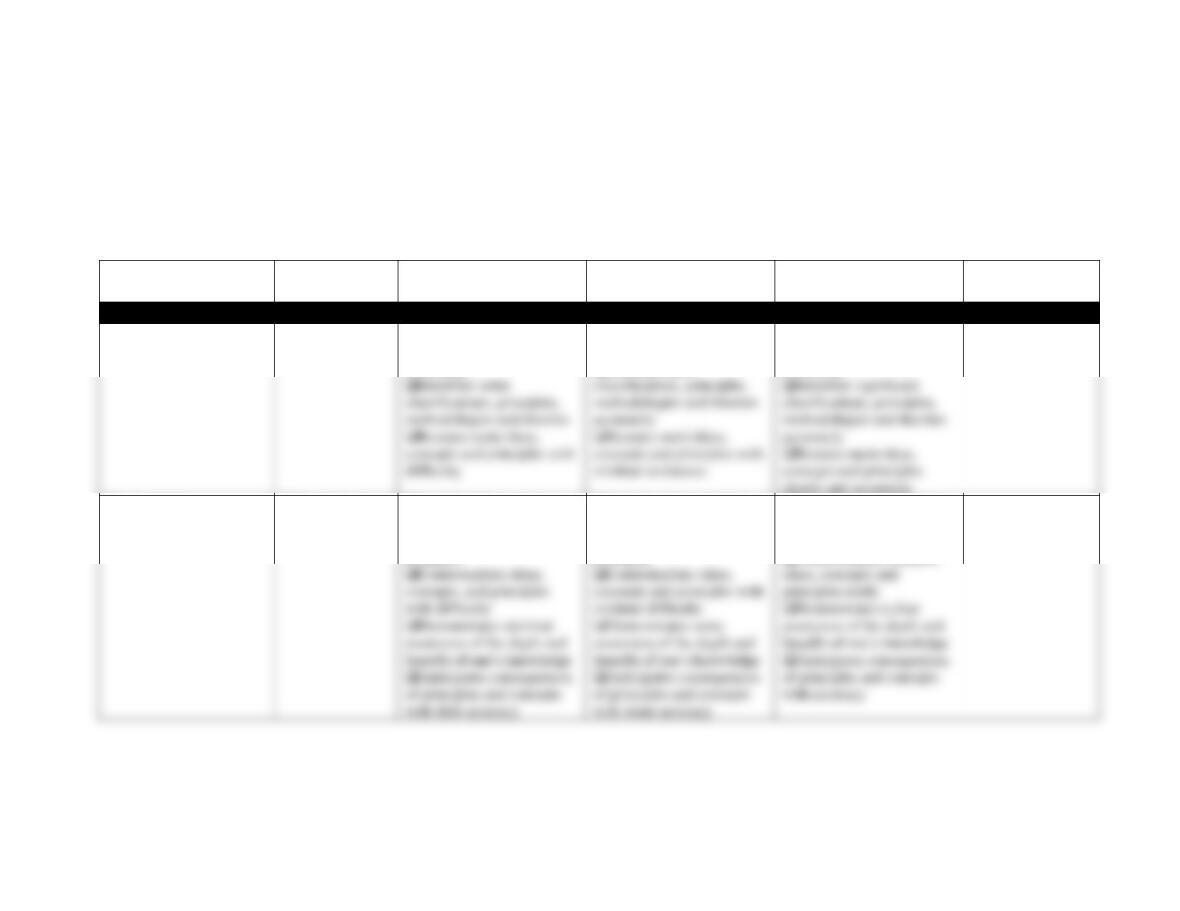
Assessment Rubric for Critical Thinking, Written and Oral Presentation Skills
Name: _____________________________ Date: ___________________________________
Course: ________________________________________
This Rubric will be used to assess a students critical thinking, and written and oral communication skills.
Does Not
Meet 0
Approaches 1-2
Meets 3-4
Exceeds 5
Score
Competency: Critical Thinking
Remember
❑No evidence
❑Recalls some content and
details but not always
accurately
❑Recalls most content and
details accurately
❑Identifies most
❑Recalls all significant
content and details
accurately
Understand
❑No evidence
❑Explains ideas, concepts
and principles with limited
accuracy and irrelevant
examples
❑Explains ideas, concepts
and principles with some
accuracy and relevant
examples
❑Explains ideas, concepts
and principles accurately
and relevant examples
❑Contextualizes complex
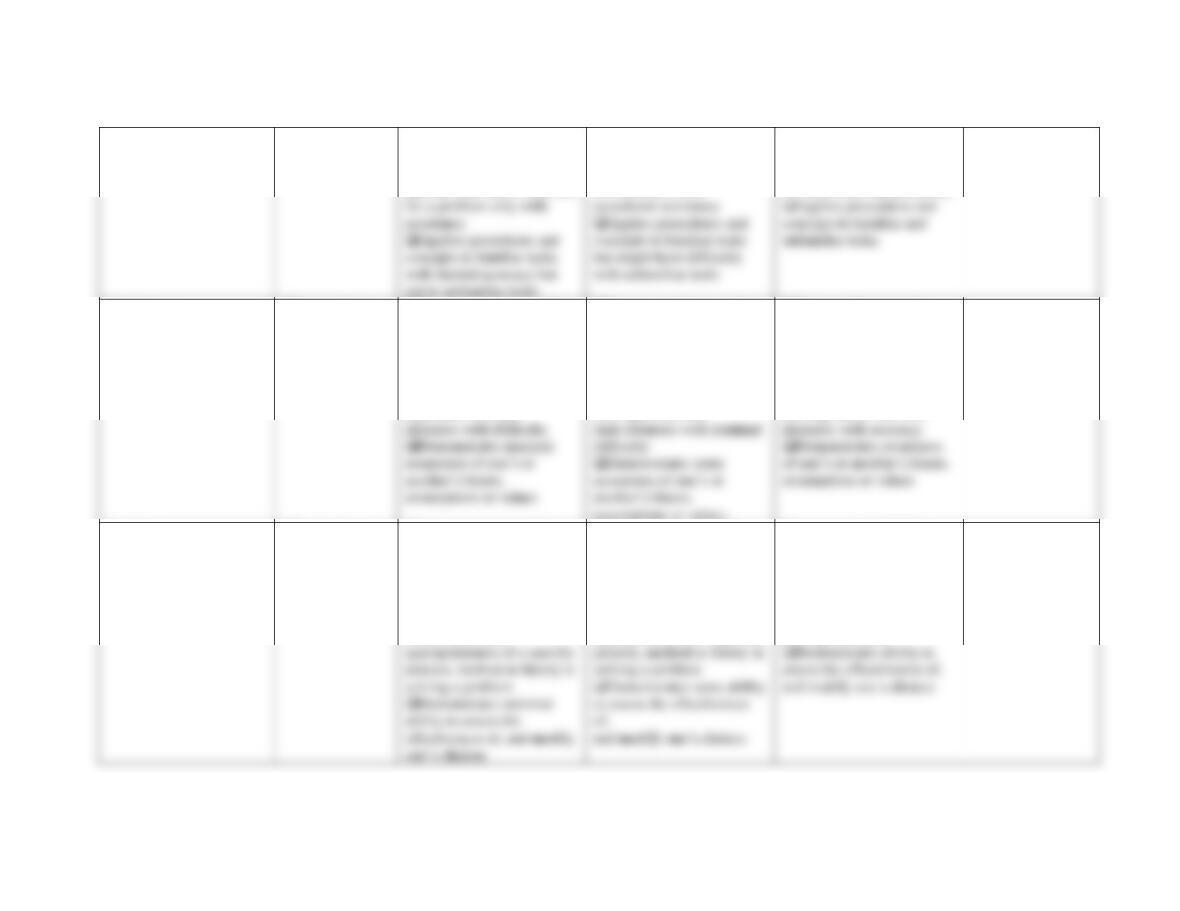
Apply
❑No evidence
❑Applies knowledge with
little consistency or
accuracy
❑Seeks alternative solutions
❑Applies knowledge with
some degree of accuracy
❑Seeks alternative solutions
for a problem with
❑Applies knowledge
consistently and accurately
❑Seeks alternative solutions
for a problem independently
Analyze
❑No evidence
❑Draws conclusions with
difficulty
❑Distinguishes relevant
from irrelevant information
with difficulty
❑Breaks down theories, and
arguments into their
❑Draws conclusions with
minimal difficulty
❑Distinguishes relevant
from irrelevant information
with minimal difficulty
❑Breaks down theories,
and arguments into
assumptions or values
❑Draws well-reasoned
conclusions consistently
❑Distinguishes relevant
from irrelevant information
easily
❑ Breaks down theories,
and arguments into their
Evaluate
❑No evidence
❑Assesses the reliability
and comprehensiveness of
sources with limited
accuracy
❑Determines with a
minimal degree of
effectiveness and
❑Assesses the reliability
and comprehensiveness of
sources with some accuracy
❑Determines with some
degree
of effectiveness and
appropriateness of a specific
❑Assesses the reliability
and comprehensiveness of
sources with accuracy
❑Determines effectively the
appropriateness of a specific
process, method or theory in
solving a problem
not to unfamiliar tasks
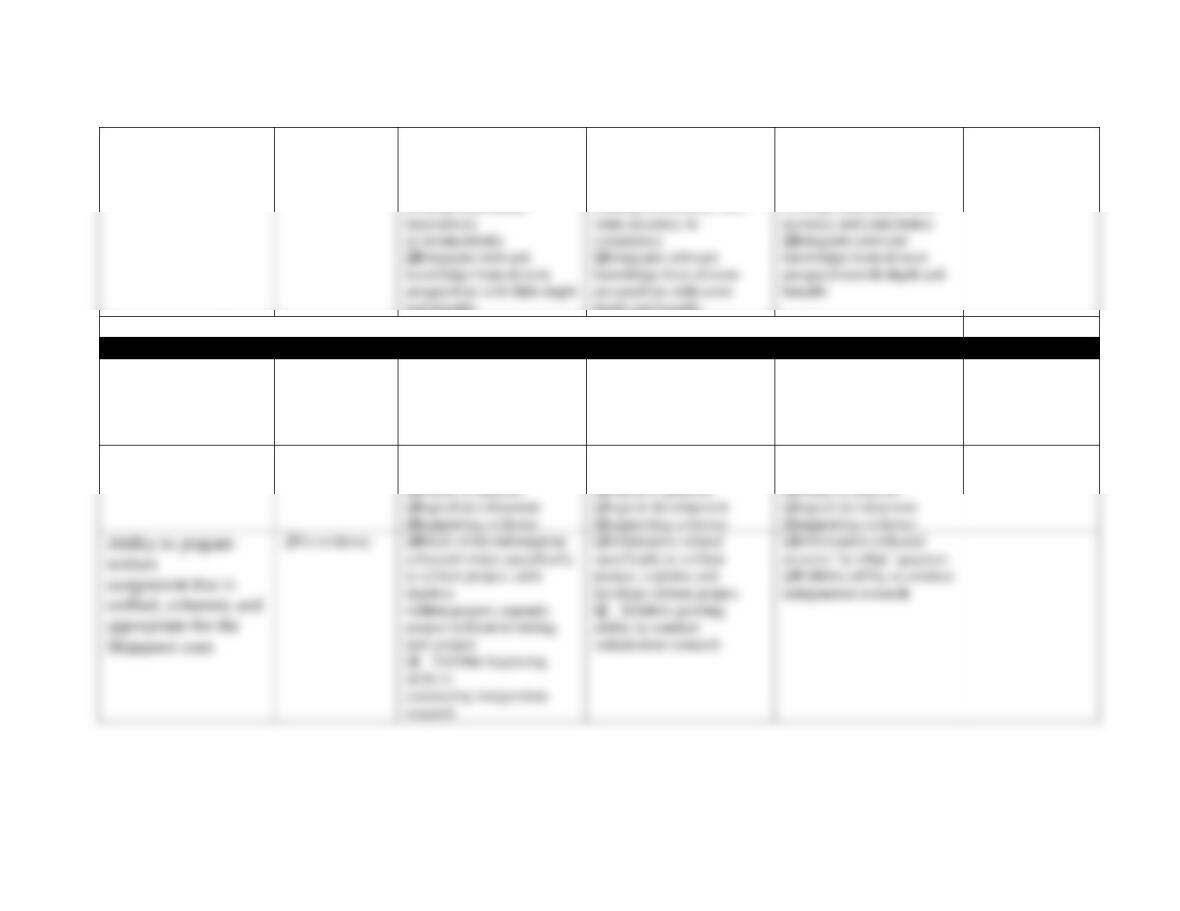
Synthesize
❑No evidence
❑Draws inconsistent or
incomplete generalizations
from data
❑Generates new ideas from
existing information
and breadth
❑Draws generalizations that
are partially consistent and
supportable from data
❑Generates new ideas from
existing information with
depth and breadth
❑Draws generalizations that
are consistent and
supportable from data
❑Generates new ideas from
existing information with
Total Critical Thinking
/30
Competency: Written Communication
Thesis or Purpose
❑No evidence
Thesis demonstrates
rudimentary:
❑supportability
❑clarity
❑complexity
Thesis demonstrates
adequate:
❑supportability
❑clarity
❑complexity
Thesis demonstrates
advanced:
❑supportability
❑clarity
❑complexity
Organization of ideas
❑No evidence
❑clarity of purpose
❑logical development
❑supporting evidence
❑clarity of purpose
❑logical development
❑supporting evidence
❑clarity of purpose
❑logical development
❑supporting evidence
Ability to prepare
❑No evidence
❑Much of the information
collected relates specifically
written project, expands
research
❑Information related
specifically to written
project, explains and
❑Information collected
answers “so what” question
Organization demonstrates
rudimentary:
Organization demonstrates
adequate:
Organization demonstrates
advanced:
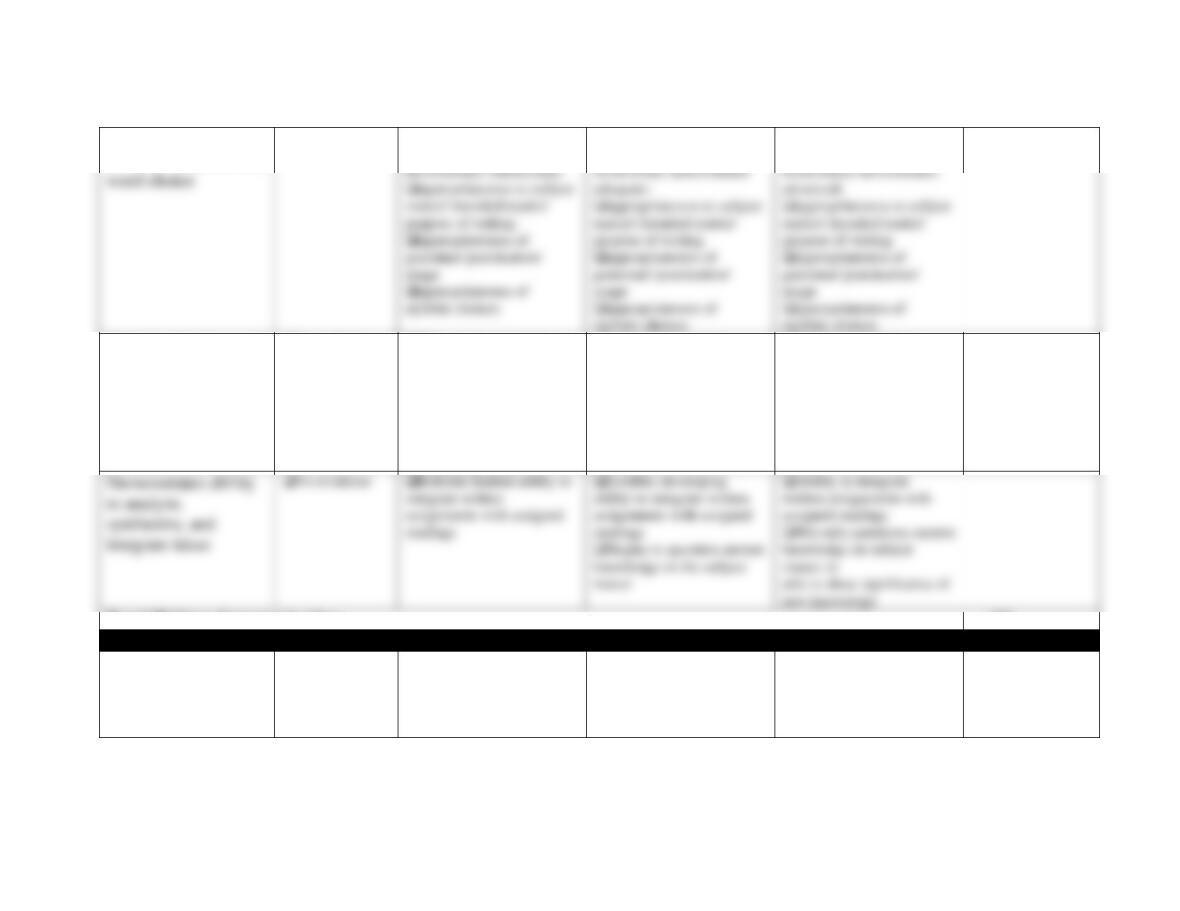
Patterns of writing,
sentence structure and
❑No evidence
Patterns of writing/sentence
structure/ word choice
Patterns of
writing/sentencestructure/
Patterns of
writing/sentencestructure/
Selects references and
citations according to
accepted style
manuals
❑No evidence
❑May use in text citations
with direct quotations; does
not
correctly use citations when
paraphrasing or
summarizing
❑Understands different uses
of MLA and APA
❑Uses in text citations
properly
❑Understands the different
uses of MLA and APA, may
sometimes substitute one for
the other
❑Uses in text citations
properly
❑Uses MLA and APA
citation properly
Demonstrates ability
to analyze,
synthesize, and
integrate ideas
❑No evidence
❑Exhibits limited ability to
integrate written
❑Exhibits developing
ability to integrate written
knowledge on the subject
matter
❑Ability to integrate
written assignments with
knowledge on subject
matter, is
able to show significance of
new knowledge
Total Written Communication
/30
Competency: Presentation Skills
Clarity of Purpose,
Timing
❑No evidence
❑Purpose (thesis) is evident
❑Inappropriate use of time
❑Purpose (thesis) is clear
❑Close to allotted time
❑Purpose (thesis) is clear
and well-developed
❑Completed in allotted
time
stylistic choices
❑appropriateness of
usage
❑appropriateness of
stylistic choices
❑appropriateness of
usage
❑appropriateness of
stylistic choices
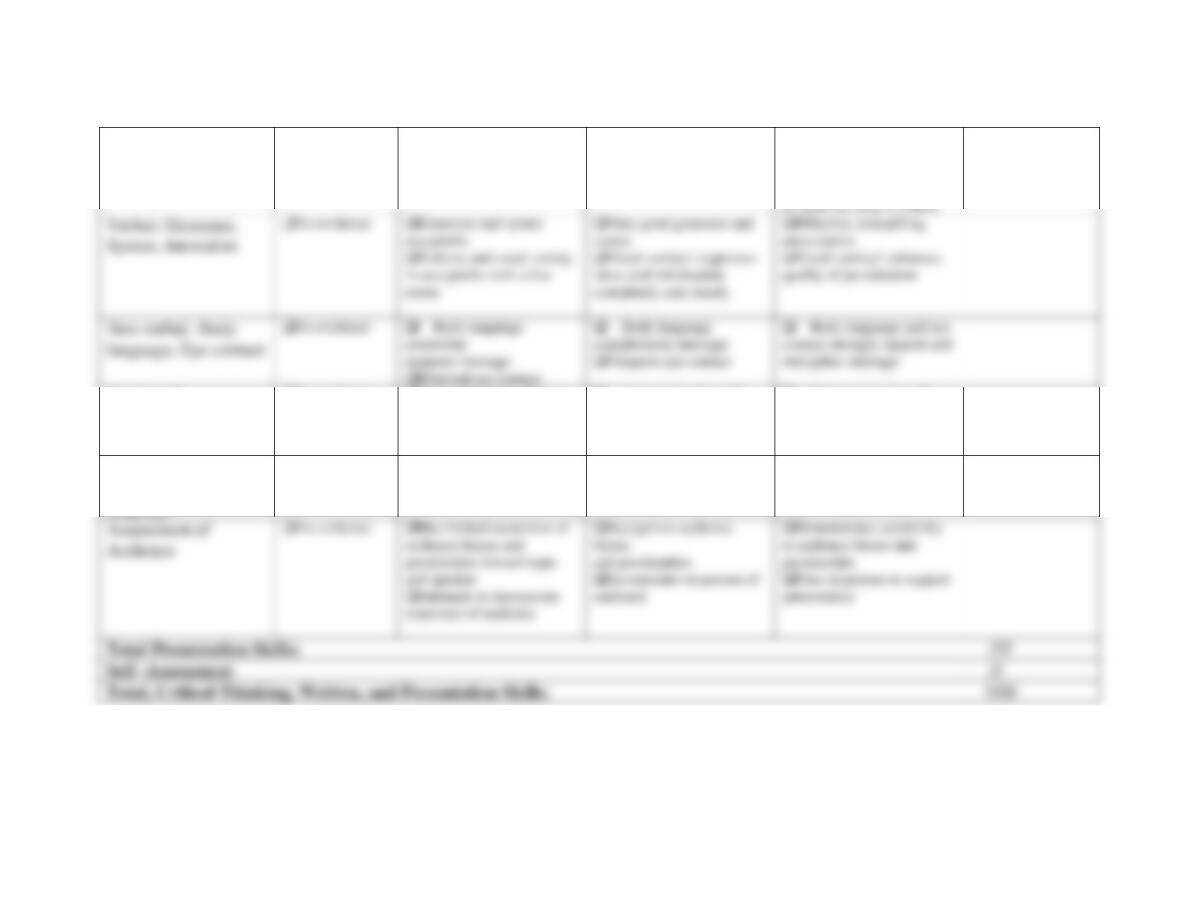
Structure: Opening,
Development,
Closing
❑No evidence
❑May lack clear opening or
closing.
Organization is uneven or
confusing
❑Organization is clear with
an identifiable opening and
closing.
Some unevenness exists
❑Clear and effective
opening, development and
closing. Sequence and
relationships
Media/aids
❑No evidence
❑Communication aids are
poorly prepared or
inappropriately used
❑ Communication aids
positively contribute to the
quality of the presentation
❑ Communication aids
are professionally prepared
to complement and enhance
the presentation
Use of discipline
knowledge and
language
❑No evidence
❑Able to apply concepts/
theories and use examples
❑Able to organize ideas,
concepts, and theories and
differentiate
❑Shows evidence of ability
to evaluate and generate
ideas and hypotheses
/35
/5
/100
of ideas are easy to follow
errors
completely and clearly
Non-verbal: Body
supports message
strengthen message