CHAPTER 3
THE ENVIRONMENT AND CORPORATE CULTURE
CHAPTER OUTLINE
Are You Fit for Managerial Uncertainty?
I. The External Environment
A. General Environment
B. Task Environment
II. The Organization–Environment Relationship
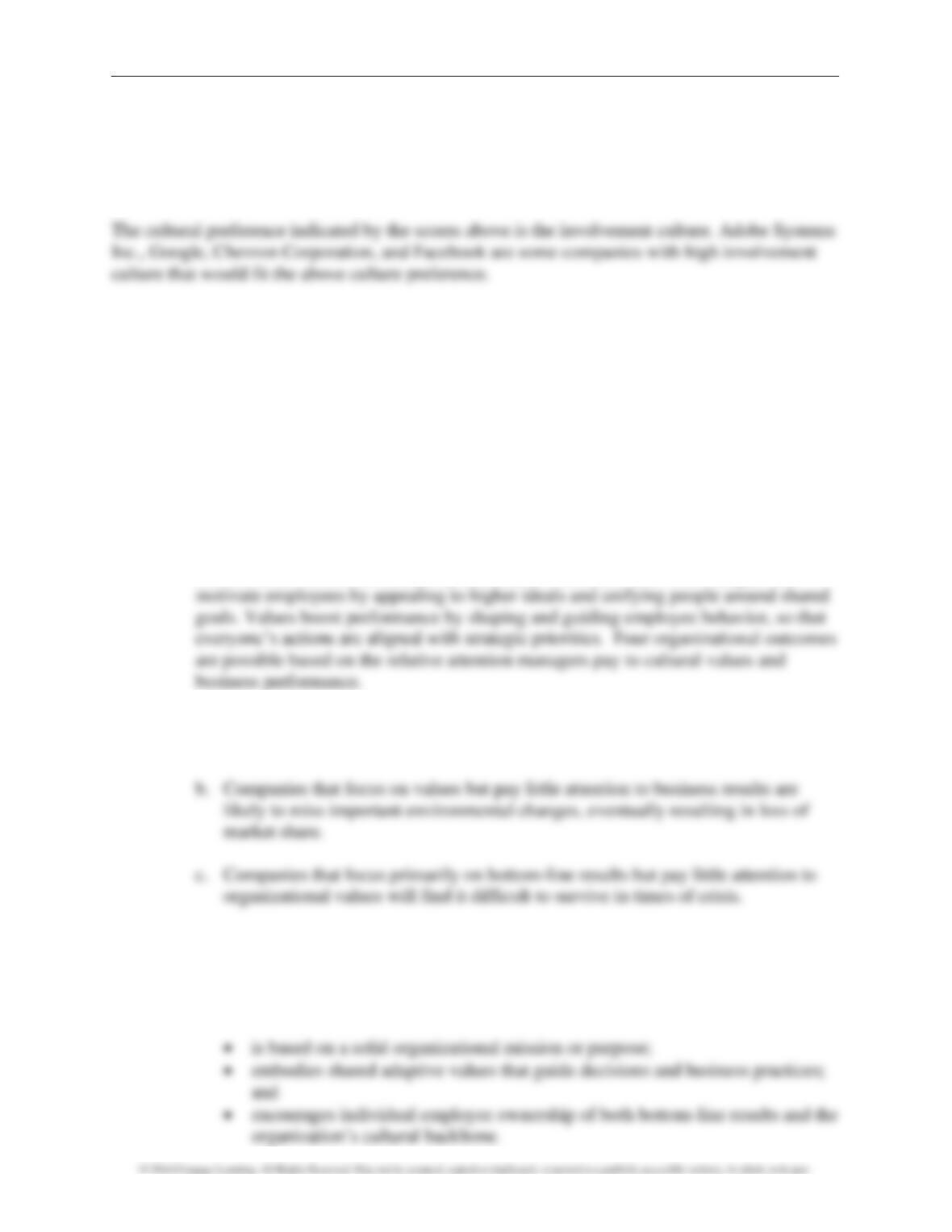
IV. Types of Cultures
A. Adaptability Culture
B. Achievement Culture
C. Involvement Culture
D. Consistency Culture
New Manager Self-Test: Cultural Preference
ANNOTATED LEARNING OBJECTIVES
After studying this chapter, students should be able to:
1. Define an organizational ecosystem and how the general and task environments affect an
organization’s ability to thrive.
An organizational ecosystem is a system formed by the interaction among a community of
organizations in the environment. An ecosystem includes organizations in all the sectors of the
• Chapter 3
40
2. Explain the strategies that managers use to help organizations adapt to an uncertain or
turbulent environment.
The environment creates uncertainty for organization managers. Uncertainty means that
managers do not have sufficient information about environmental factors to understand and
3. Define corporate culture and give organizational examples.
Culture can be defined as the set of key values, beliefs, understandings, and norms shared by
members of an organization. It can be analyzed at two levels. At the surface level are visible
4. Explain organizational symbols, stories, heroes, slogans, and ceremonies and their
relationship to corporate culture.
Fundamental values and corporate culture cannot be observed directly, but they can be
understood through the visible manifestations of symbols, stories, heroes, slogans, and
The Environment and Corporate Culture •
41
5. Describe four types of cultures and how corporate culture relates to the environment.
The adaptability culture is characterized by values that support the company’s ability to rapidly
detect, interpret, and translate signals from the environment into new behavior responses. This
culture emerges in an environment that requires fast response and high-risk decision making.
The achievement culture is a results-oriented culture that values competitiveness, aggressiveness,
6. Define a cultural leader and explain the tools a cultural leader uses to create a high-
performance culture.
A cultural leader is a manager who uses signals and symbols to influence corporate culture.
Cultural leaders influence culture by articulating a vision for the organizational culture that
employees can believe in, and heeding the day-to-day activities that reinforce the cultural vision.
exemplify high-performance in his or her own work activities.
• Chapter 3
42
LECTURE OUTLINE
ARE YOU FIT FOR MANAGERIAL UNCERTAINTY?
Organizations in uncertain environments find that everything seems to be constantly changing.
Such an environment requires that new managers possess the quality of “mindfulness”—being
open-minded and thinking independently. This exercise helps students determine their levels of
mindfulness, indicating whether they would likely perform better in stable or unstable
environments.
I. THE EXTERNAL ENVIRONMENT Exhibit 3.1
The organizational environment includes all elements existing outside the boundary of the
organization that have the potential to affect the organization. The environment includes
competitors, resources, technology, and economic conditions that influence the organization. It
A. General Environment
1. The dimensions of the general environment include international, technological,
sociocultural, economic, natural, and legal-political.
a. The international dimension represents events originating in foreign countries
and opportunities for American companies in other countries. This dimension
b. The technological dimension includes scientific and technological advancements
in a specific industry as well as in society at large. Technology has created
c. The sociocultural dimension represents the demographic characteristics, norms,
customs, and values of the general population. Important sociocultural
The Environment and Corporate Culture •
43
d. The economic dimension represents the general economic health of the country
or region in which the organization operates. Components of the economic
e. The legal-political dimension includes federal, state, and local government
regulations and political activities designed to influence company behavior.
Government regulations influence organizations through a variety of legislation
such as Occupational Safety and Heath Administration (OSHA), the
Environmental Protection Agency (EPA), fair trade practices, and others.
Exhibit 3.2
f. The natural dimension is different from other sectors of the general environment
because it has no voice of its own. It includes all elements that occur naturally on
Discussion Question #5: Why do you think many managers are surprised by environmental
changes and hence are less able to help their organizations adapt?
NOTES________________________________________________________________________
______________________________________________________________________________
______________________________________________________________________________
B. Task Environment
1. The task environment is the layer closest to the organization and includes those
sectors that have a direct working relationship with it. The task environment includes
customers, competitors, suppliers, and the labor market.
Discussion Question #4: Contemporary best-selling management books often argue that
customers are the most important element in the external environment. Do you agree? In what
company situations might this statement be untrue?
NOTES________________________________________________________________________
______________________________________________________________________________
______________________________________________________________________________
b. Competitors are organizations in the same industry or type of business that
• Chapter 3
44
d. The labor market represents people in the environment who can be hired to
work for the organization. Labor market factors that impact organizations
include:
• the growing need for computer-literate knowledge workers;
Exhibit 3.3
Discussion Question #2: Would the task environment for a cellular phone company contain the
same elements as that for a government welfare agency? Discuss.
NOTES________________________________________________________________________
______________________________________________________________________________
______________________________________________________________________________
II. THE ORGANIZATION-ENVIRONMENT RELATIONSHIP
A. Environmental Uncertainty Exhibit 3.4
1. Environmental uncertainty must be managed to make the organization more effective.
Uncertainty means that managers do not have sufficient information about
2. When external factors change rapidly, the organization experiences very high
Discussion Question #3: What strategic issues have the potential to create environmental
uncertainty in the following four industries: (a) automobile; (b) social media; (c) newspaper;
and (d) medical services?
The Environment and Corporate Culture •
45
NOTES________________________________________________________________________
______________________________________________________________________________
______________________________________________________________________________
B. Adapting to the Environment
1. Managers continuously scan the business horizon for both subtle and dramatic
2. Boundary-spanning roles link to and coordinate the organization with key elements
in the external environment. Boundary spanners serve two purposes for the
organization: they detect and process information about changes in the environment,
and they represent the organization’s interests to the environment.
a. People in departments such as marketing and purchasing span the boundary to
work with customers and suppliers through face-to–face and market research.
Exhibit 3.5
3. A popular strategy for adapting to the environment is by reducing boundaries and
increasing collaboration with other organizations through interorganizational
partnerships. Companies are joining together to become more effective and share
Discussion Question #6: Why are interorganizational partnerships so important for today’s
companies? What elements in the current environment might contribute to either an increase or
decrease in interorganizational collaboration? Discuss.
• Chapter 3
46
NOTES________________________________________________________________________
______________________________________________________________________________
______________________________________________________________________________
III. THE INTERNAL ENVIRONMENT: CORPORATE CULTURE Exhibit 3.6
The internal environment includes: corporate culture, production technology, organization
structure, and physical facilities. Corporate culture is extremely important in an organization
attempting to achieve a competitive advantage. The internal culture must fit the needs of the
external environment and company strategy.
Culture is defined as the set of key values, beliefs, understandings, and norms shared by
members of an organization. Culture is a pattern of shared values and assumptions about how
NOTES________________________________________________________________________
______________________________________________________________________________
______________________________________________________________________________
A. Symbols
1. A symbol is an object, act, or event that conveys meaning to others. Symbols
associated with corporate culture convey the organization’s important values.
B. Stories
1. A story is a narrative based on true events that is repeated and shared among
C. Heroes
D. Slogans
1. A slogan is a phrase or sentence that succinctly expresses a key corporate value.
E. Ceremonies
The Environment and Corporate Culture •
47
1. A ceremony is a planned activity that marks up a special event and is conducted for
the benefit of an audience.
Discussion Question #8: Cultural symbols are usually noticed through sight, sound, touch, and
smell. For example, Costco displays a limited amount of low-priced merchandise in a no-frills,
self-service warehouse with concrete floors. What do these elements communicate as symbols
about its corporate culture?
NOTES________________________________________________________________________
______________________________________________________________________________
______________________________________________________________________________
IV. TYPES OF CULTURE Exhibit 3.7
In considering what cultural values are important for the organization, managers consider the
A. Adaptive Culture
1. The adaptability culture is characterized by values that support the company’s
B. Achievement Culture
1. The achievement culture is a results-oriented culture that values competitiveness,
aggressiveness, personal initiative, cost cutting, and willingness to work long and
C. Involvement Culture
1. The involvement culture places high value on meeting the needs of employees and
values cooperation and equality. This culture has an internal focus on the
• Chapter 3
48
D. Consistency Culture
1. The consistency culture values and rewards a methodical, rational, orderly way of
doing things. This culture uses an internal focus and a consistency orientation for a
stable environment
Discussion Question #10: As described in this chapter, Zynga CEO Mark Pincus is obsessed
with high performance, and demanding deadlines define the corporate culture. Describe how
this culture may be good for the short term but ultimately could hurt the organization’s long–
term sustainability.
NOTES________________________________________________________________________
______________________________________________________________________________
______________________________________________________________________________
NEW MANAGER SELF-TEST: Cultural Preference
The fit between a new manager and organizational culture can determine success and
Instructions: The fit between new manager and organizational culture can determine success
and satisfaction. To understand your culture preference, rank the items below from 1 to 8 based
on the strength of your preference (1 = strongest preference).
1. The organization is very personal, much like an extended family. Score-1
2. The organization is dynamic and changing, where people take risks. Score-3
Scoring and interpretation: Each question pertains to one of the four types of culture in Exhibit
3.7. To compute your preference for each type of culture, add together the scores for each set of
two questions as follows:
Involvement culture — total for questions 1, 5: _2_
The Environment and Corporate Culture •
49
preferences. A higher score means the culture would not fit your expectations, and you would
have to change your style and preference to be comfortable. Review the text discussion of the
four culture types. Do your cultural preference seems correct to you? Can you think of
companies that fit your culture preference?
V. SHAPING CORPORATE CULTURE FOR INNOVATIVE RESPONSE
Research shows that one factor that increases a company’s value the most is people and how they
are treated. Corporate culture has become increasingly important to managers as they recognize
its importance in attracting, motivating, and keeping good employees. Culture plays a key role
in creating an organizational climate that enables learning and innovative responses to threats
from the external environment, challenging new opportunities, or organizational crises.
A. Managing the High-Performance Culture Exhibit 3.8
1. Companies that succeed in a turbulent world are those that pay careful attention to
both cultural values and business performance. Cultural values can energize and
a. Companies that pay little attention to either values or business results are unlikely
to survive for long.
d. Companies that emphasize both culture and business performance will develop a
strong organizational culture that gives employees a sense of identity, holds the
company together during tough times, and helps it adapt quickly to a changing
environment. These companies represent the high-performance culture that:
• Chapter 3
50
NOTES________________________________________________________________________
______________________________________________________________________________
______________________________________________________________________________
B. Cultural Leadership
1. One-way managers change norms and values to build a high-performance culture is
through cultural leadership. A cultural leader defines and uses signals and symbols to
influence corporate culture by:
a. articulating a vision for the organizational culture that employees can believe in;
NOTES________________________________________________________________________
______________________________________________________________________________
______________________________________________________________________________
Suggested Answers to End-Of-Chapter Discussion Questions
1. What are the characteristics of a flat world, a term used by Thomas Friedman to describe
today’s business environment? What challenges do they pose? How can you prepare to
manage in a flat world?
In his book The World Is Flat, Thomas Friedman challenges managers to view global markets as
a level playing field where geographical divisions are irrelevant. A flat world, Friedman argues,
2. Would the task environment for a cellular phone provider contain the same elements as that
for a government welfare agency? Discuss.
The Environment and Corporate Culture •
51
There are three components of the task environment: competitors, suppliers, and customers. An
analysis of each of these components for the two organizations illustrates the differences in their
task environments.
3. What strategic issues have the potential to create environmental uncertainty in the following
four industries: (a) automobile; (b) social media; (c) newspaper; and (d) medical services
The forces influencing the environment are competitors, resources, technology, and economic
conditions. The general environment forces include natural, international, technological, social,
4. Contemporary best-selling management books often argue that customers are the most
important element in the external environment. Do you agree? In what company situations
might this statement be untrue?
Companies in the public and private sector must be customer driven to remain competitive.
5. Why do you think many managers are surprised by environmental changes and hence are
less able to help their organizations adapt?
Managers sometimes do not realize the need to carefully monitor the environment so that they
• Chapter 3
52
6. Why are interorganizational partnerships so important for today’s companies? What
elements in the current environment might contribute to either an increase or decrease in
interorganizational collaboration? Discuss.
Interorganizational partnerships are important for today’s companies to survive and grow in the
7. Consider the factors that influence the environmental uncertainty (rate of change in factors
and number of factors in the environment) that are presented in Exhibit 3.4. Classify each of
the following organizations as operating in either (a) a low-uncertainty environment or (b) a
high-uncertainty environment: Hyundai, Facebook, a local Subway franchise, FedEx, a
cattle ranch in Oklahoma, and McDonald’s. Explain your reasoning.
In a high uncertainty environment, the external factors change rapidly whereas in a low
8. Cultural symbols are usually noticed through sight, sound, touch, and smell. For example,
Costco displays a limited amount of low-priced merchandise in a no-frills, self-service
warehouse with concrete floors. What do these elements communicate as symbols about its
corporate culture?
Symbols are important to corporate culture because they are tangible objects, acts, or events that
9. Both China and India are rising economic powers. How might your approach to doing
business with Communist China, a communist country, be different from your approach to
doing business with India, the world’s most populous democracy? In which country would
you expect to encounter the most rules? The most bureaucracy?
China will have many more rules and much more bureaucracy than will India, as its government
tries to strictly control the activities of foreign businesses, as well as those of its own citizens.
The Environment and Corporate Culture •
53
10. As described in this chapter, Zynga CEO Mark Pincus is obsessed with high performance,
and demanding deadlines define the corporate culture. Describe how this culture may be
good for the short term but ultimately could hurt the organization’s long–term sustainability.
Zynga represents itself as an organization that is focused primarily on bottom-line results and
pays little attention to organizational values. This approach is profitable in the long run, but the
Apply Your Skills: Experiential Exercise
Working in an Adaptability Culture
Although this exercise deals with culture in the workplace, some students may not have much
experience with workplace cultures, so it may be useful to ask students about norms on their
campus—a culture with which they may be more familiar. Are there styles of dress, books, bags,
Apply Your Skills: Small Group Breakout
Organizational Culture in the Classroom and Beyond
This exercise asks students to identify cultural norms from their own experiences in three
different settings, then discuss the identified norms in groups of four to six students and group
the norms by common themes and give each group of norms a title. Students will also discuss
the origins of norms, the difference between espoused norms and enacted norms, and
responsibility for establishing norms.
Apply Your Skills: Ethical Dilemma
• Chapter 3
54
Competitive Intelligence Predicament
1. Go ahead and use the documents to the company’s benefit, but make clear to your boss that
you don’t want him passing confidential information to you in the future. If he threatens to
fire you, threaten to leak the news to the press.
This is probably not a good option, since Miquel would feel uncomfortable using the
2. Confront your boss privately and let him know you’re uncomfortable with how the documents
were obtained and what possession of them says about the company’s culture. In addition to
the question of the legality of using the information, point out that it is a public relations
nightmare waiting to happen.
This is probably the best initial option. Miquel should be up front with his boss and let him
3. Talk to the company’s legal counsel and contact the Society of Competitive Intelligence
Professionals for guidance. Then with their opinions and facts to back you up, go to your
boss.
Apply Your Skills: Case for Critical Analysis
Not Measuring Up
1. Do you think Zeitland’s desire for changes in culture are related to changes in the external
environment? Explain.
The task environment component of the external organizational environment includes
competitors, suppliers, customers, and the labor market. The organization also has an internal
2. What additional investigation might Wheeling and Zeitland undertake before settling on a
plan of action?
Wheeling and Zeitland undertake additional investigation before settling on a plan of action as
Cam’s score on his management skills and job performance had not improved despite Cam
The Environment and Corporate Culture •
55
3. In which quarter of Exhibit 3.8 would you place Cam? What are some steps you would
recommend that Cam consider to better connect with the employees who report to him?
Cam could be placed in the first quarter of Exhibit 3.8 under Quadrant A as he meets the
On the Job Video Cases Answers
Camp Bow Wow
1. What aspects of Camp Bow Wow’s corporate culture are visible and conscious? What aspects
are invisible and unconscious?
Visible aspects of Camp Bow Wow’s culture include the company logo, the presence of dogs in
workspaces, the dress code, the camp imagery, and Heidi Ganahl’s life story, which is told and
retold during franchisee meetings. Founder Heidi Ganahl says that one of the unique things about
2. Why did Camp Bow Wow have to change its culture when it became a national franchise?
Camp Bow Wow’s early family-business culture was useful in the startup phase of Camp Bow
Wow’s growth. However, Founder Heidi Ganahl says her company required a different culture
3. What impact does Heidi Ganahl’s story have on employees at Camp Bow Wow?
The story of Heidi Ganahl is famous at all levels of the Camp Bow Wow organization.
Consumers and franchisees who come in contact with Camp Bow Wow learn about the company
by hearing the details of her story. Boulder franchisee Sue Ryan says that Ganahl’s story is

• Chapter 3
56