• Chapter 16
296
B. Job Characteristics Model Exhibit 16.8
1. Hackman and Oldham’s research concerns work redesign, defined as altering jobs
to increase both the quality of employees’ work experience and their productivity.
The job characteristics model comprises core job dimensions, critical
psychological states, and employee growth-need strength.
a. Core Job Dimensions: The more a job contains these core characteristics, the
higher the motivation, quality of performance, and satisfaction will be. A job’s
motivational potential includes:
• Skill variety. The number of diverse activities that compose a job and the
number of skills used to perform it.
b. Critical Psychological States: This model states that core job dimensions are
more rewarding when individuals experience three psychological states in
response to job design.
• Meaningfulness of work. The work itself is satisfying and provides intrinsic
rewards
Motivating Employees •
297
d. Employee Growth-Need Strength: Employee growth-need strength is the final
component of the model. It means that people have different needs for growth
and development. If a person wants to satisfy low-level needs, such as safety
IX. INNOVATIVE IDEAS FOR MOTIVATING Exhibit 16.9
Organizations are increasingly using various types of incentive compensation as a way to
motivate employees to higher levels of performance. Variable compensation and forms of “at
risk” pay are key motivational tools and are becoming more common than fixed salaries at
many companies. The programs can be effective if they are used appropriately and combined
with motivational ideas that also provide intrinsic rewards and meet higher level needs.
A. Building a Thriving Workforce
1. A thriving workforce is one in which people are just not satisfied and productive
but also engaged in creating the future—their own and that of the organization. Two
components of thriving workforce are vitality and learning. Managers can promote
B. Empowering People to Meet Higher Needs
1. Empowerment is power sharing, the delegation of power or authority to
subordinates in an organization. Increasing employee power heightens motivation
for task accomplishment because people improve their own effectiveness, choosing
• Chapter 16
298
2. Empowerment can mean encouraging workers’ ideas while managers retain
authority, or it can mean employees have the freedom and power to make decisions
and exercise initiative. Current methods fall along a continuum from no discretion
for workers to full empowerment where workers participate in formulating strategy.
Discussion Question #9: How does empowerment provide the two conditions (vitality and
learning) for a thriving workforce that are described in the chapter? Do you see any ways in
which a manager’s empowerment efforts might contribute to demotivation among employees?
Discuss.
NOTES________________________________________________________________________
______________________________________________________________________________
______________________________________________________________________________
C. Giving meaning to Work through Engagement Exhibit 16.10
1. Employee engagement means that people enjoy their jobs and are satisfied with
2. Smart managers see that having engaged, motivated employees has less to do with
extrinsic rewards than with fostering an environment in which people can flourish.
Motivating Employees •
299
a. People feel they are working toward something of importance. People experience
a sense of meaningfulness when they have a chance to accomplish something
that provides real value to the world.
Discussion Question #10: Gallup’s 2011 survey shows that highly educated workers are
significantly less likely to be engaged than are those with a high school diploma or less. What
might be some reasons for this lower level of engagement among less-educated employees?
NOTES________________________________________________________________________
______________________________________________________________________________
______________________________________________________________________________
Answers to End-of-Chapter Discussion Questions
1. Why do you think making progress ranks as the most important factor contributing to
motivation according to a recent study? How can managers provide a sense of progress for
employees working on long-range projects that might not show results for months or even
years?
Recent research indicates the importance of making progress toward goals as a key to
motivation. The making progress principle is the idea that the single most important factor that
2. One small company recognizes an employee of the month, who is given a parking spot next to
the president’s space near the front door. What theories would explain the positive
motivation associated with this policy?
• Chapter 16
300
3. Assume that you are a front-line manager at a call center. Try to come up with a specific
motivational idea that fits in each of the four quadrants in Exhibit 16.2: Positive Extrinsic;
Positive intrinsic; Negative Extrinsic; Negative Intrinsic.
Some of the specific motivational ideas students could use as a front-line manager are as
follows:
• Positive Extrinsic: Rewards such as pay raises, bonuses, praise, etc., could be used to
influence behavior that creates pleasure. Giving the employees a chance to earn a bonus
4. In response to security threats in today’s world, the U.S. government federalized airport
security workers. Many argued that simply making screeners federal workers would not
solve the root problem: bored, low-paid, and poorly trained security workers have little
motivation to be vigilant. How might these employees be motivated to provide the security
that travel threats now demand?
Employees may be motivated through extrinsic rewards such as pay increases. Before the
September 11, 2001 terrorist attack, the screeners were getting paid low wages. Motivating the
5. Using Hackman and Oldham’s core job dimensions, compare and contrast the jobs of these
two state employees: (1) Jared, who spends much of his time researching and debating
energy policy to make recommendations that will eventually be presented to the state
legislature and (2) Anise, who spends her days planting and caring for the flower gardens
and grounds surrounding the state capitol building.
Motivating Employees •
301
Skill variety refers to the number of diverse activities that compose a job and the number of
skills used to perform it. Jared and Anise probably have similar amounts of skill variety,
Task significance refers to the degree to which a job is perceived as important and having an
impact on the company or customers. This one is a little difficult to assess. It would be easy, on
the surface, to suggest that Jared’s task significance might be greater than Anise’s because he is
involved in the development of energy policy for his state and Anise is simply caring for plants
and grounds around the capitol building. However, it is quite possible that Anise sees her job as
critical to the physical appearance of the state’s most visible government building(s), and hence
has a significant impact on important visitors to the state’s highest-ranking officials.
6. If an experienced executive assistant discovered that she made the same amount of money as
a newly hired janitor, how do you think she would react? What inputs and outcomes might
she evaluate to make this comparison?
This comparison is based on equity theory, in which people compare the own inputs they bring
to a job and the outcomes they receive from it with those of others. Chances are the executive
• Chapter 16
302
7. A survey of teachers found that two of the most important rewards were the belief that their
work was important and a feeling of accomplishment. According to Maslow’s theory, what
needs do these rewards meet?
The belief that one’s work is important and the feeling of accomplishment would meet esteem
needs and self-actualization needs.
8. The teachers in question 7 also reported that pay and benefits were poor, yet they continue to
teach. Use Herzberg’s two-factor theory to explain this finding.
The teachers believe that the hygiene factors in the teaching job are poor. Of course, hygiene
factors are probably good enough to meet their basic needs, but perhaps pay and benefits are not
as high as in other jobs held by college graduates. Herzberg argued that motivators included
9. How does empowerment provide the two conditions (vitality and learning) for a thriving
workforce that are described in the chapter? Do you see any ways in which a manager’s
empowerment efforts might contribute to demotivation among employees? Discuss.
A thriving workforce is one in which people are just not satisfied and productive but also
engaged in creating the future—their own and that of the organization. Two components of
Motivating Employees •
303
10. Gallup’s 2011 survey shows that highly educated workers are significantly less likely to be
engaged than are those with a high school diploma or less. What might be some reasons for
this lower level of engagement among highly-educated employees?
Employee engagement means that people enjoy their jobs and are satisfied with their work
Apply Your Skills: Experiential Exercise
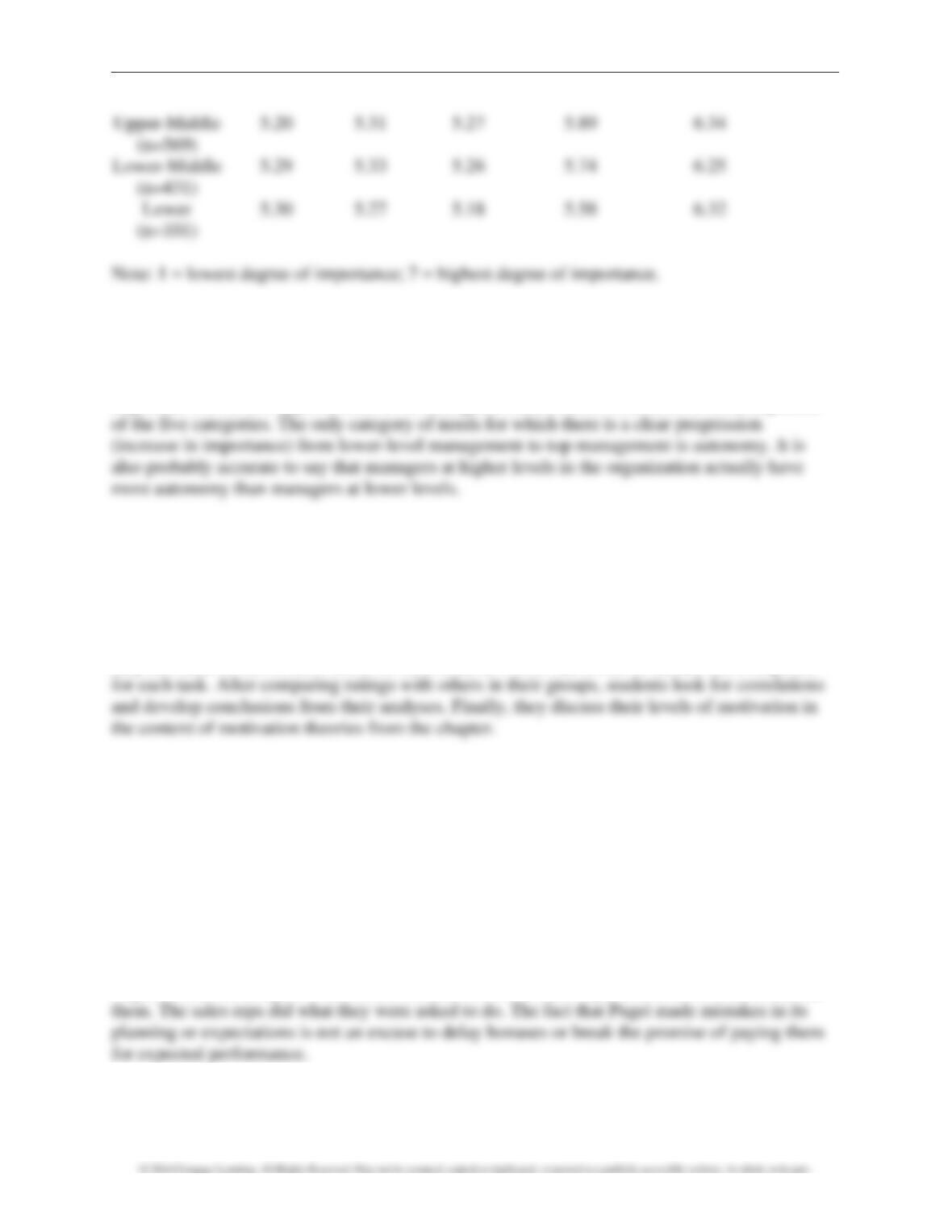
What Motivates You?
This exercise allows students to assess their own needs using Maslow’s need hierarchy. It
indicates primary characteristic associated with job, and which need to be rated by the students.
Sample
Security
Social
Esteem
Autonomy
Self
Actualization
President
(n=114)
5.69
5.38
5.27
6.11
6.50
Vice President
(n=611)
5.44
5.46
5.33
6.10
6.40
• Chapter 16
304
Source: K. Stewart, Instructor’s Manual to accompany Gibson, Ivancevich, and Donnelly,
Organizations, Plano, TX: BPI, 1988, 36.
It is interesting to note that self-actualization needs were rated by managers at all levels as most
important. For all but upper-middle level managers, esteem needs were rated as least important
Apply Your Skills: Small Group Breakout
Should, Need, Like, Love
Students form groups and answer the questions about four tasks provided in the exercise. Then,
they rate their levels of motivation for each task, as well as the levels of mental effort required
Apply Your Skills: Ethical Dilemma
To Renege or Not to Renege?
1. Recommend to the president that a meeting be arranged with the sales representatives
entitled to a bonus and tell them that their checks were going to be delayed until the Puget’s
financial picture clarified. The sales reps would be told that the company had a legal right to
delay payment and that it may not be able to pay the bonuses if its financial situation
continues to deteriorate.
Puget should not delay or withhold the bonuses from the sales representatives who have earned
2. Recommend a meeting with the sales representatives entitled to a bonus and tell them the
company’s deteriorating financial situation triggers one of the contingency clauses in their
Motivating Employees •
305
contract so that the company won’t be issuing their bonus checks. Puget will just have to
deal with the negative impact on sales rep motivation.
Failure to pay the bonuses to the sales representatives will result in loss of morale and a
3. Recommend strongly to the president that Puget pay the bonuses as promised. The legal
contracts and financial situation don’t matter. Be prepared to resign if the bonuses are not
paid as you promised. Your word and a motivated sales team mean everything to you.
This is probably the best option. If the sales representatives know you have fought hard to get
Apply Your Skills: Case for Critical Analysis
Lauren’s Balancing Act
1. What do you see as the advantages and disadvantages of the incentive system that
DeMarco’s is using for sales associates? What impact do you think it is having on the
DeMarco’s culture? Explain.
The incentive system that DeMarco’s is using for sales associates was a change over from
hourly pay to straight commissions. This system has both advantages and disadvantages.
Advantages of the incentive system are:
• The pay is built through the employees’ own initiative and individualized service,
Disadvantages of the incentive system are:
• While some associates soared, there were others who veered toward an aggressive,
pushy sales style or became intimidated by coworkers and teetered, monthly, on the
verge of being replaced because they weren’t making sales.
• Chapter 16
306
2. Do you think the complaints of lower-paid sales associates are legitimate? Why? How do you
suggest Lauren respond to these complaints, such as the gripe that the system offers few
opportunities for large commissions in some departments?
The complaints of lower-paid sales associates at DeMarco’s are legitimate as the difference in
the pay scales among the sales associates is significant. The new incentive system uses straight
3. Have the successes of sales associates such as Katherine or Damien created a situation in
which loyalty to customers is stronger than loyalty to the store? For example, if a successful
associate leaves DeMarco’s, might the customer leave also?
Yes, the successes of sales associates such as Katherine or Damien created a situation in which
loyalty to customers became stronger than loyalty to the store. Reliance on commission inspired
On the Job Video Case Answers
Urban Escapes
1. Which needs in Maslow’s hierarchy are most important to the employees who work for Urban
Escapes, and how can managers use this information to develop a highly motivated workforce?
Urban Escapes is about adventure, experiences, and the great outdoors. People who work at the
Motivating Employees •
307
2. According to equity theory, how might an Urban Escapes guide react if he or she feels
underpaid or unappreciated?
Although employees at Urban Escapes aren’t necessarily “in it for the money,” a person who
feels underpaid or unappreciated could respond in several different ways. According to equity
theory, every employee desires equitable pay and treatment. If an employee feels underpaid, he
likely to leave the company and look elsewhere.
3. What outcomes or rewards possess high valence for managers and guides who work at Urban
Escapes?
According to the expectancy theory of motivation, employees find some rewards to be highly
attractive and motivational. Valence is the value or attraction an individual has for a specific
outcome or reward. For local guides, pay is not necessarily a high motivator, whereas the