Archives
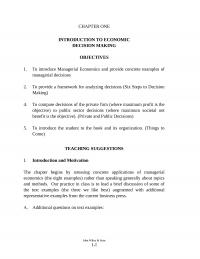
978-1118808948 Chapter 1 Lecture Note
CHAPTER ONE INTRODUCTION TO ECONOMIC DECISION MAKING OBJECTIVES 1. To introduce Managerial Economics and provide concrete examples of managerial decisions 2. To provide a framework for analyzing decisions (Six Steps to Decision Making) 4. To compare decisions of the private […]
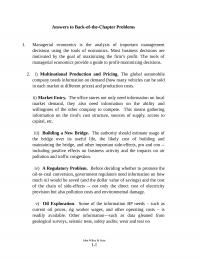
978-1118808948 Chapter 1 Solution Manual
Answers to Back-of-the-Chapter Problems 1. Managerial economics is the analysis of important management 2. i) Multinational Production and Pricing. The global automobile company needs information on demand (how many vehicles can be sold in each market at different prices) and […]
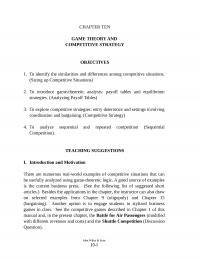
978-1118808948 Chapter 10 Lecture Note
CHAPTER TEN GAME THEORY AND COMPETITIVE STRATEGY OBJECTIVES 1. To identify the similarities and differences among competitive situations. (Sizing up Competitive Situations) 2. To introduce game-theoretic analysis: payoff tables and equilibrium strategies. (Analyzing Payoff Tables) 3. To explore competitive strategies: […]
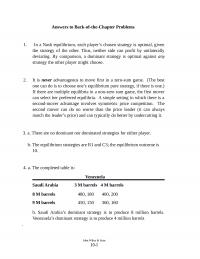
978-1118808948 Chapter 10 Solution Manual
Answers to Back-of-the-Chapter Problems 1. In a Nash equilibrium, each player’s chosen strategy is optimal, given 2. It is never advantageous to move first in a zero-sum game. (The best one can do is to choose one’s equilibrium pure strategy, […]
978-1118808948 Chapter 11 Lecture Note Part 1
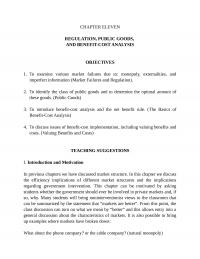
CHAPTER ELEVEN REGULATION, PUBLIC GOODS, AND BENEFIT-COST ANALYSIS OBJECTIVES 1. To examine various market failures due to: monopoly, externalities, and imperfect information (Market Failures and Regulation). 2. To identify the class of public goods and to determine the optimal amount […]
978-1118808948 Chapter 11 Lecture Note Part 2
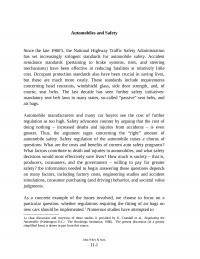
Automobiles and Safety Since the late 1960’s, the National Highway Traffic Safety Administration has set increasingly stringent standards for automobile safety. Accident avoidance standards (pertaining to brake systems, tires, and steering mechanisms) have been effective in reducing fatalities at relatively […]
978-1118808948 Chapter 11 Solution Manual
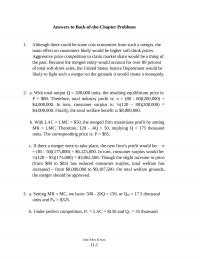
Answers to Back-of-the-Chapter Problems 1. Although there could be some cost economies from such a merger, the main effect on consumers likely would be higher soft-drink prices. 2. a. With total output Q = 200,000 units, the resulting equilibrium price […]
978-1118808948 Chapter 12 Lecture Note Part 1
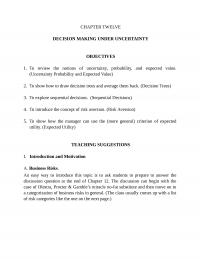
CHAPTER TWELVE DECISION MAKING UNDER UNCERTAINTY OBJECTIVES 1. To review the notions of uncertainty, probability, and expected value. (Uncertainty Probability and Expected Value) 2. To show how to draw decision trees and average them back. (Decision Trees) 3. To explore […]
978-1118808948 Chapter 12 Lecture Note Part 2
ADDITIONAL MATERIALS I. Short Readings D. Gilbert and J. Scheck, “Big Oil Companies Struggle to Justify Soaring Project Costs,” The Wall Street Journal, January 29, 2014, p. A1. “What are the Top Five Risks the World Faces in 2014?” Knowledge@Wharton, […]
978-1118808948 Chapter 12 Lecture Note Part 3
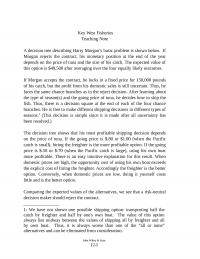
Key West Fisheries Teaching Note A decision tree describing Harry Morgan’s basic problem is shown below. If Morgan rejects the contract, his monetary position at the end of the year depends on the price of tuna and the size of […]
978-1118808948 Chapter 12 Solution Manual
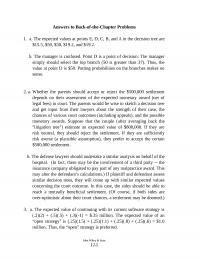
Answers to Back-of-the-Chapter Problems 1. a. The expected values at points E, D, C, B, and A in the decision tree are b. The manager is confused. Point D is a point of decision: The manager simply should select the […]
978-1118808948 Chapter 13 Lecture Note Part 1
CHAPTER THIRTEEN THE VALUE OF INFORMATION OBJECTIVES 1. To show how to incorporate new information into the manager’s decision tree. (The Value of Information) 2. To show how to revise probabilities using joint probability tables and Bayes rule. (Revising Probabilities) […]
978-1118808948 Chapter 13 Lecture Note Part 2
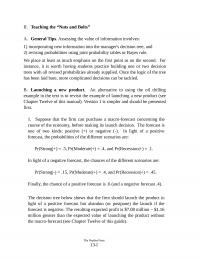
II. Teaching the “Nuts and Bolts” A. General Tips. Assessing the value of information involves: 1) incorporating new information into the manager’s decision tree, and 2) revising probabilities using joint probability tables or Bayes rule. We place at least as […]
978-1118808948 Chapter 13 Solution Manual Part 1
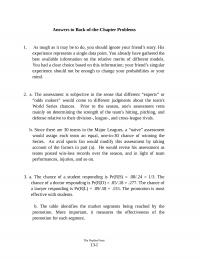
Answers to Back-of-the-Chapter Problems 1. As tough as it may be to do, you should ignore your friend’s story. His experience represents a single data point. You already have gathered the 2. a. The assessment is subjective in the sense […]
978-1118808948 Chapter 13 Solution Manual Part 2
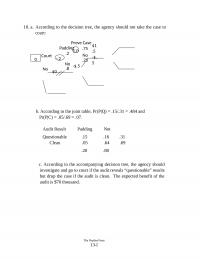
10. a. According to the decision tree, the agency should not take the case to court: b. According to the joint table, Pr(P|Q) = .15/.31 = .484 and Pr(P|C) = .05/.69 = .07. Audit Result Padding Not c. According to […]
978-1118808948 Chapter 14 Lecture Note Part 1
CHAPTER FOURTEEN ASYMMETRIC INFORMATION AND ORGANIZATIONAL DESIGN OBJECTIVES 1. To show the strategic implications posed by asymmetric information. (Asymmetric Information) 2. To understand the incentive conflicts (including moral hazard) inherent in the relationship between principal and agent. (Principals, Agents, and […]
978-1118808948 Chapter 14 Lecture Note Part 2
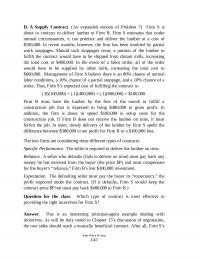
D. A Supply Contract. (An expanded version of Problem 7) Firm S is about to contract to deliver lumber to Firm B. Firm S estimates that under normal circumstances, it can produce and deliver the lumber at a cost of […]
978-1118808948 Chapter 14 Solution Manual
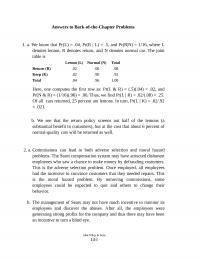
Answers to Back-of-the-Chapter Problems 1. a. We know that Pr(L) = .04, Pr(R | L) = .5, and Pr(R|N) = 1/16, where L denotes lemon, R denotes return, and N denotes normal car. The joint table is Lemon (L) Normal […]
978-1118808948 Chapter 15 Lecture Note Part 1
CHAPTER FIFTEEN BARGAINING AND NEGOTIATION OBJECTIVES 1. To identify the economic sources of mutually beneficial agreements — namely, differences in values. 2. To assess the complications posed by multiple-issue negotiations (and to stress the value-maximization principle. (Multiple-Issue Negotiations) 3. To […]
978-1118808948 Chapter 15 Lecture Note Part 2
VI. Negotiation Exercises Face-to-face negotiation is an excellent vehicle for engaging students and promoting “learning by doing.” The following exercises are good examples. To conduct the exercises, the instructor should distribute buyer and seller information sheets and pair the students. […]
978-1118808948 Chapter 15 Lecture Note Part 3
Selling a Maine House After reading these instructions, you will participate in a negotiation exercise involving two parties, a seller (you) and a potential buyer (your bargaining partner sitting next to you). The description of the bargaining setting and information […]
978-1118808948 Chapter 15 Solution Manual
Answers to Back-of-the-Chapter Problems 1. a. The plaintiff’s expected court receipt (net of legal costs) is 50,000 – 15,000 = $35,000. The defendant’s expected court payment (including legal costs) is 50,000 + 15,000 = $65,000. The zone of agreement lies […]
978-1118808948 Chapter 16 Lecture Note
CHAPTER SIXTEEN LINEAR PROGRAMMING OBJECTIVES 1. To become familiar with the types of problems that linear programming can solve. 2. To formulate LP problems. (Linear Programs) 3. To solve LP problems using graphs. (Graphing the LP Problem) 4. To relate […]
978-1118808948 Chapter 16 Solution Manual
Answers to Back-of-the-Chapter Problems 1. a. Increasing or decreasing returns to scale implies that either the objective b. The LP method can handle any number of decision variables. The earlier problem of producing a maximum level of output contained more […]
978-1118808948 Chapter 17 Lecture Note Part 1
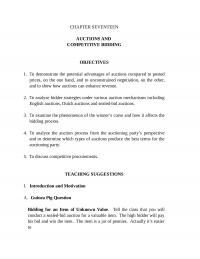
CHAPTER SEVENTEEN AUCTIONS AND COMPETITIVE BIDDING OBJECTIVES 1. To demonstrate the potential advantages of auctions compared to posted prices, on the one hand, and to unconstrained negotiation, on the other, and to show how auctions can enhance revenue. 2. To […]
978-1118808948 Chapter 17 Lecture Note Part 2
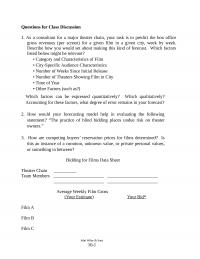
Questions for Class Discussion 1. As a consultant for a major theater chain, your task is to predict the box office gross revenues (per screen) for a given film in a given city, week by week. Describe how you would […]
978-1118808948 Chapter 17 Solution Manual
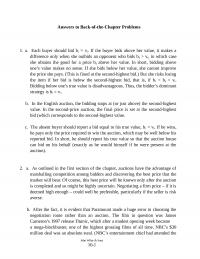
Answers to Back-of-the-Chapter Problems 1. a. Each buyer should bid bi = vi. If the buyer bids above her value, it makes a difference only when she outbids an opponent who bids bj > vi, in which case she obtains […]
978-1118808948 Chapter 2 Lecture Note
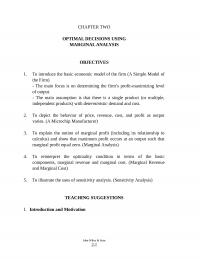
CHAPTER TWO OPTIMAL DECISIONS USING MARGINAL ANALYSIS OBJECTIVES 1. To introduce the basic economic model of the firm (A Simple Model of the Firm) – The main focus is on determining the firm’s profit-maximizing level of output. – The main […]
978-1118808948 Chapter 2 Solution Manual
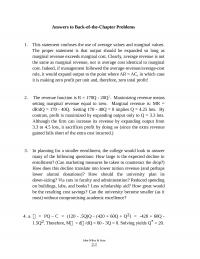
Answers to Back-of-the-Chapter Problems 1. This statement confuses the use of average values and marginal values. The proper statement is that output should be expanded so long as marginal revenue exceeds marginal cost. Clearly, average revenue is not 2. The […]
978-1118808948 Chapter 3 Lecture Note
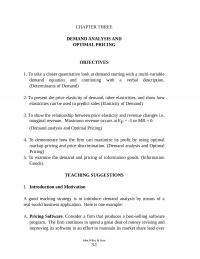
CHAPTER THREE DEMAND ANALYSIS AND OPTIMAL PRICING OBJECTIVES 1. To take a closer quantitative look at demand starting with a multi-variable demand equation and continuing with a verbal description. (Determinants of Demand) 2. To present the price elasticity of demand, […]
978-1118808948 Chapter 3 Solution Manual
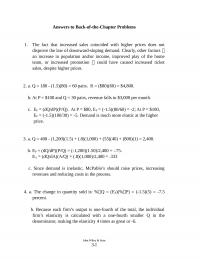
Answers to Back-of-the-Chapter Problems 1. The fact that increased sales coincided with higher prices does not disprove the law of downward-sloping demand. Clearly, other factors c. EP = (dQ/dP)(P/Q). At P = $80, EP = (-1.5)(80/60) = -2; At […]
978-1118808948 Chapter 4 Lecture Note Part 1
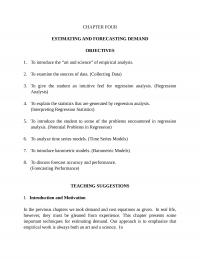
CHAPTER FOUR ESTIMATING AND FORECASTING DEMAND OBJECTIVES 1. To introduce the “art and science” of empirical analysis. 2. To examine the sources of data. (Collecting Data) 3. To give the student an intuitive feel for regression analysis. (Regression Analysis) 4. […]
978-1118808948 Chapter 4 Lecture Note Part 2
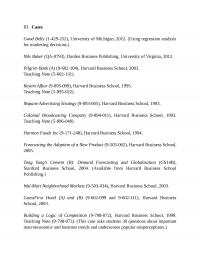
III. Cases Good Belly (1-429-252), University of Michigan, 2012. (Using regression analysis for marketing decisions.) Nils Baker (QA-0793), Darden Business Publishing, University of Virginia, 2012. Pilgrim Bank (A) (9-602-104), Harvard Business School, 2003. Teaching Note (5-602-131). Reyem Affiar (9-895-009), Harvard […]
978-1118808948 Chapter 4 Lecture Note Part 3
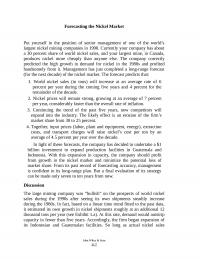
Forecasting the Nickel Market Put yourself in the position of senior management of one of the world’s largest nickel mining companies in 1990. Currently your company has about a 30 percent share of world nickel sales, and your largest mine, […]
978-1118808948 Chapter 4 Solution Manual
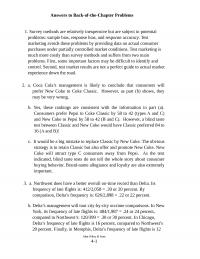
Answers to Back-of-the-Chapter Problems 1. Survey methods are relatively inexpensive but are subject to potential problems: sample bias, response bias, and response accuracy. Test marketing avoids these problems by providing data on actual consumer 2. a. Coca Cola’s management is […]
978-1118808948 Chapter 5 Lecture Note
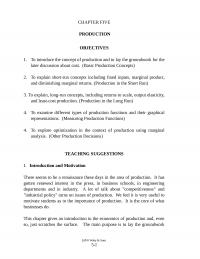
CHAPTER FIVE PRODUCTION OBJECTIVES 1. To introduce the concept of production and to lay the groundwork for the later discussion about cost. (Basic Production Concepts) 2. To explain short-run concepts including fixed inputs, marginal product, and diminishing marginal returns. (Production […]
978-1118808948 Chapter 5 Solution Manual
Answers to Back-of-the-Chapter Problems 1. Maximizing average output is typically non-optimal. First, we should emphasize that maximizing total output and maximizing average output are two different things. For instance, in Table 5.2, the firm’s maximum 2. The production function, Q […]
978-1118808948 Chapter 6 Lecture Note
CHAPTER SIX COST ANALYSIS OBJECTIVES 1. To explain relevant costs and related concepts. In particular, to contrast opportunity cost and fixed costs and to contrast accounting profits and economic profits. (Relevant Costs) 2. To explain the relationship between production and […]
978-1118808948 Chapter 6 Solution Manual
Answers to Back-of-the-Chapter Problems 1. The fact that the product development was lengthier and more expensive than initially anticipated is no reason to charge a higher price. These 2. This statement confuses average quantities and marginal quantities. Though average total […]
978-1118808948 Chapter 7 Lecture Note
CHAPTER SEVEN PERFECT COMPETITION OBJECTIVES 1. To examine supply and demand under perfect competition. (The Basics of Supply and Demand) 2. To examine equilibrium in the short run and long run and the dynamics of entry and exit. (Competitive Equilibrium) […]
978-1118808948 Chapter 7 Solution Manual
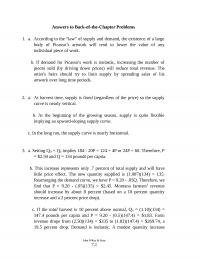
Answers to Back-of-the-Chapter Problems 1. a. According to the “law” of supply and demand, the existence of a large b. If demand for Picasso’s work is inelastic, increasing the number of pieces sold (by driving down prices) will reduce total […]
978-1118808948 Chapter 8 Lecture Note
CHAPTER EIGHT MONOPOLY OBJECTIVES 1. To examine price and output decisions under pure monopoly. (Pure Monopoly) 2. To explore how monopolies are maintained through barriers to entry. (Barriers to Entry) 3. To contrast competitive and monopolistic outcomes. (Perfect Competition versus […]
978-1118808948 Chapter 8 Solution Manual
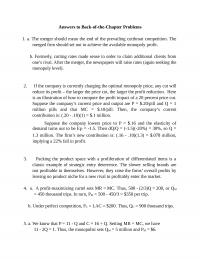
Answers to Back-of-the-Chapter Problems 1. a. The merger should mean the end of the prevailing cutthroat competition. The b. Formerly, cutting rates made sense in order to claim additional clients from one’s rival. After the merger, the newspapers will raise […]
978-1118808948 Chapter 9 Lecture Note
CHAPTER NINE OLIGOPOLY OBJECTIVES 1. To provide an overview of Porter’s Five-Forces Framework. (Oligopoly) 2. To compare market structures in terms of degree of concentration. (Industry Concentration) 3. To present the basic models of quantity competition and price competition. 4. […]
978-1118808948 Chapter 9 Solution Manual
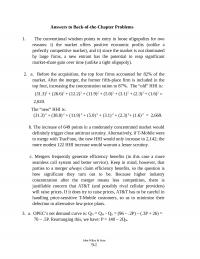
Answers to Back-of-the-Chapter Problems 1. The conventional wisdom points to entry in loose oligopolies for two reasons: i) the market offers positive economic profits (unlike a 2. a. Before the acquisition, the top four firms accounted for 82% of the […]
BUS 628
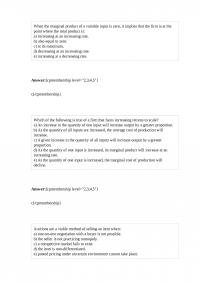
When the marginal product of a variable input is zero, it implies that the firm is at the point where the total product is: a) increasing at an increasing rate. b) also equal to zero. c) at its maximum. d) […]
BUS 805 Midterm
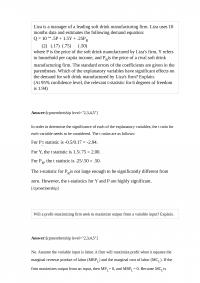
Liza is a manager of a leading soft drink manufacturing firm. Liza uses 10 months data and estimates the following demand equation: Q = 10 ‘“ .5P + 1.5Y + .25PR (2) (.17) (.75) (.50) where P is the price […]
ECB 140 Quiz 3
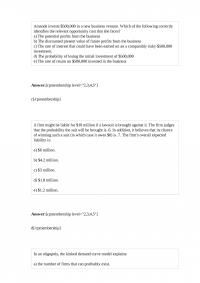
Amanda invests $500,000 in a new business venture. Which of the following correctly identifies the relevant opportunity cost that she faces? a) The potential profits from the business b) The discounted present value of future profits from the business c) […]
ECB 183 Homework
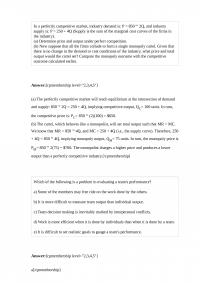
In a perfectly competitive market, industry demand is: P = 850 ‘“ 2Q, and industry supply is: P = 250 + 4Q (Supply is the sum of the marginal cost curves of the firms in the industry). (a) Determine price […]
ECB 270
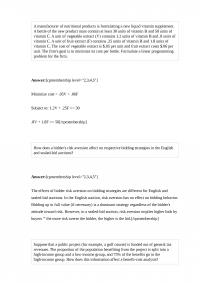
A manufacturer of nutritional products is formulating a new liquid vitamin supplement. A bottle of the new product must contain at least 30 units of vitamin B and 50 units of vitamin C. A unit of vegetable extract (V) contains […]
ECB 309
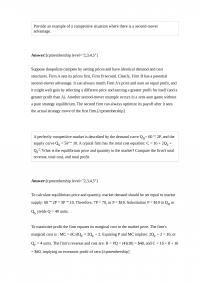
Provide an example of a competitive situation where there is a second-mover advantage. A perfectly competitive market is described by the demand curve QD= 60 ‘“ 2P, and the supply curve QS = 5P ‘“ 10. A typical firm has […]
ECB 421 Test 1
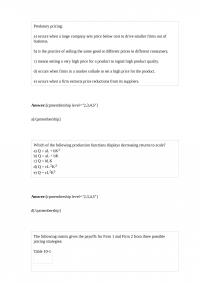
Predatory pricing: a) occurs when a large company sets price below cost to drive smaller firms out of business. b) is the practice of selling the same good at different prices to different consumers. c) means setting a very high […]
ECB 789 Midterm
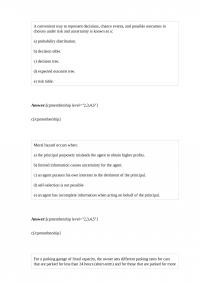
A convenient way to represent decisions, chance events, and possible outcomes in choices under risk and uncertainty is known as a: a) probability distribution. b) decision table. c) decision tree. d) expected outcome tree. e) risk table. Moral hazard occurs […]
ECON 198 Midterm 2
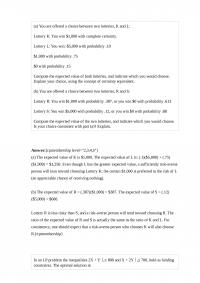
(a) You are offered a choice between two lotteries, K and L: Lottery K: You win $1,000 with complete certainty. Lottery L: You win: $5,000 with probability .10 $1,000 with probability .75 $0 with probability .15 Compute the expected value […]
ECON 360
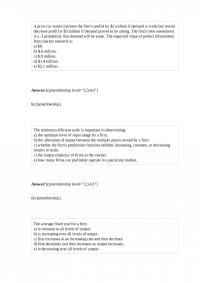
A price cut would increase the firm’s profits by $2 million if demand is weak but would decrease profit by $3 million if demand proves to be strong. The firm’s best assessment is a .3 probability that demand will be […]
ECON 381 Midterm 1
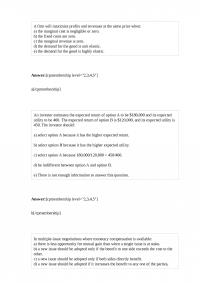
A firm will maximize profits and revenues at the same price when: a) the marginal cost is negligible or zero. b) the fixed costs are zero. c) the marginal revenue is zero. d) the demand for the good is unit […]
ECON 649
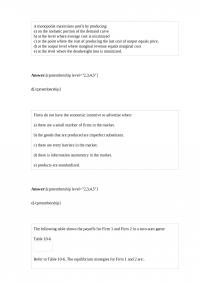
A monopolist maximizes profit by producing: a) on the inelastic portion of the demand curve b) at the level where average cost is minimized c) at the point where the cost of producing the last unit of output equals price. […]
ECON 717 Quiz 3
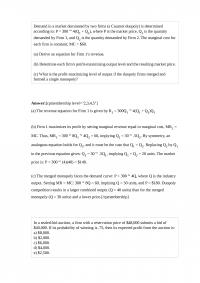
Demand in a market dominated by two firms (a Cournot duopoly) is determined according to: P = 300 ‘“ 4(Q1 + Q2), where P is the market price, Q1 is the quantity demanded by Firm 1, and Q2 is the […]
ECON 744 Quiz 2
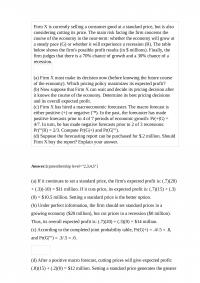
Firm X is currently selling a consumer good at a standard price, but is also considering cutting its price. The main risk facing the firm concerns the course of the economy in the near-term: whether the economy will grow at […]
ECON 888 Final
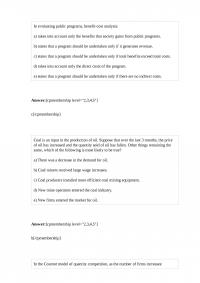
In evaluating public programs, benefit-cost analysis: a) takes into account only the benefits that society gains from public programs. b) states that a program should be undertaken only if it generates revenue. c) states that a program should be undertaken […]
ECON A 412
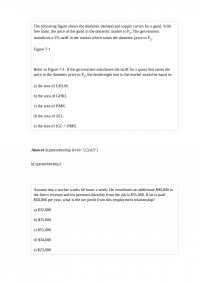
The following figure shows the domestic demand and supply curves for a good. With free trade, the price of the good in the domestic market is P3. The government introduces a 5% tariff in the market which raises the domestic […]
ECON A 476 How can the quality of a
How can the quality of a product serve as an entry barrier in a market? Explain how each of the following events will affect the average and marginal cost curves of a firm: i) An increase in labor costs ii) […]
ECON A 626 Midterm 1
Which of the following auctions are strategically equivalent for bidders holding private values? a) The English and Dutch auctions. b) The sealed-bid and second-price auctions. c) The English and Vickrey auctions. d) The Vickrey and Dutch auctions. e) The Vickrey […]
ECON A 627 Test 1 An individual
An individual is uncertain whether to bet on a football game. He believes that the probability of his team winning is 40%. If his team wins, he will receive $180. If his team loses, he’ll pay $120. If the decision […]
ECON A 807 Quiz
Carefully explain why adjusted R2is always less than R2. Specialty Steel has carefully measured production in its new plant to determine whether it is technically efficient in production. It has found that, for its two inputs K and L, it […]
ECON E 489 Test 1
Consumer surveys indicate that 40% of newspaper readers read automobile ads and 5% of those who read the ads actually purchase automobiles. On the other hand, 50% of magazine readers read automobile ads but only 3% of those who read […]
ECON E 516
What are the assumptions of the kinked demand curve model? What is its main conclusion about oligopoly behavior? How realistic is the model? Explain with an example the potential benefit of competitive bidding versus bargaining to secure a better price […]
ECON E 550
Most people believe that monopolies always have excessive profits, yet some unregulated monopolies might have very low earnings. (a) Why might a monopoly have little or no economic value? Explain. (b) If you were given a chance to enter a […]
Economics 101 Midterm 1
Use economic reasoning to comment on the following statement: ‘In a market where products appear to be similar but significant quality and performance differences exist, lack of information about product quality by some proportion of customers justifies government intervention.’ Carefully […]
Economics 355 Quiz 1
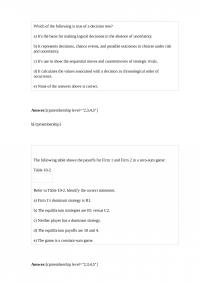
Which of the following is true of a decision tree? a) It’s the basis for making logical decisions in the absence of uncertainty. b) It represents decisions, chance events, and possible outcomes in choices under risk and uncertainty. c) It’s […]
Economics 431 Quiz
The minimum price that a seller is willing to accept for his product and the maximum price a buyer is willing to pay for the product are referred to as their: a) bid prices. b) reservation prices. c) offer prices. […]
Economics 589 Test 1
Carefully explain how short-run equilibrium and long-run equilibrium in monopolistic competition differ. Use graphs to illustrate your answer. Industry demand is given by P = 200 ‘“ .4Q. The long-run industry costs are such that: LAC = LMC = $80. […]
Economics 718
Given that digital music players are used to play music downloaded from the Internet, a fall in the price of digital music players will lead to: a) an increase in the price of a song download. b) an increase in […]
Economics 856 Quiz 1
A faulty gasket on a piece of machinery supplied by Firm Z caused a fluid leak that damaged equipment in Factory X. Determine the range of out-of-court settlements when the expected value of litigation for the two firms is $65,000 […]
Economics 872 Midterm 1
Which of the following statements is true regarding the efficiency of using pollution fees versus quantity standards to regulate pollution? a) Quantity standards are more efficient fees because they can be used even in the presence of incomplete information. b) […]
MicroEconomic 126 Test 2 George
George Stigler, a Nobel laureate in economics, suggested that one reason why oligopolies have prices higher than competitive industries is that tacit coordination concerning output and price is much easier when there are only a few competing firms. In addition, […]
MicroEconomic 266 Midterm 1
One of the major steps in decision-making is to explore the alternatives. Do most managerial decisions have a few, limited number of options? Explain. Illustrate your answer with an appropriate example. Why are computer solutions necessary to solve most linear […]
MicroEconomic 560 Quiz 3
The use of intuitive prediction in forecasting: a) puts the wrong weights on different kinds of information. b) provides approximately correct decisions most of the time. c) is objective and reliable. d) likely to produce inaccurate and biased results. e) […]
MicroEconomic 629
Suppose that demand for and supply of a commodity in a market are shown on a graph with price on the vertical axis and quantity on the horizontal axis. The y-intercept of the demand curve is equal to $30. The […]
MicroEconomic 643 Final
The following figure shows the demand curve ES, the average cost curve AC, the marginal cost curve MC, and the marginal revenue curve MR for a firm. Figure 8-1 Refer to Figure 8-1. If the firm operates as a monopoly […]
MicroEconomic 702 Quiz 1
The production of a good with positive externalities will increase when: a) the government provides a subsidy for the good. b) the marginal internal cost of the good is higher than the marginal total cost. c) there is a price […]
MicroEconomic 813
What does the law of diminishing marginal returns state? a) When all inputs to production are increased in equal proportions, output will eventually decrease. b) When one input is increased, with all other inputs unchanged, the marginal product of the […]
MicroEconomic 826 Midterm 2
The following payoff table depicts a zero-sum game: Table 10-4 Refer to Table 10-4. The equilibrium of the zero-sum game is: a) R1 versus C1. b) R1 versus C2. c) R2 versus C2. d) R3 versus C3. e) R2 versus […]
MicroEconomic 838
Refer to Figure 11-1. The external cost associated with producing the good is: a) $5. b) $7. c) $8. d) $12. e) $2. In each case below, find the profit-maximizing level of output. Verify that each output level is a […]