
(a) You are offered a choice between two lotteries, K and L:
Lottery K: You win $1,000 with complete certainty.
Lottery L: You win: $5,000 with probability .10
$1,000 with probability .75
$0 with probability .15
Compute the expected value of both lotteries, and indicate which you would choose.
Explain your choice, using the concept of certainty equivalent.
(b) You are offered a choice between two lotteries, R and S:
Lottery R: You win $1,000 with probability .387, or you win $0 with probability .613
Lottery S: You win $5,000 with probability .12, or you win $0 with probability .88
Compute the expected value of the two lotteries, and indicate which you would choose.
Is your choice consistent with part (a)? Explain.
In an LP problem the inequalities 2X + Y ‚ 800 and X + 2Y ‚ 700, hold as binding
constraints. The optimal solution is:

a) X = 300 and Y = 200.
b) X = 200 and Y = 300.
c) X = 100 and Y = 300.
d) X = 400 and Y = 0.
e) X = 200 and Y = 400.
The following table lists the payoffs for Firm 1 and Firm 2 from three possible pricing
strategies:
Table 10-3
Refer to Table 10-3. Identify Firm 1’s dominant strategy.
a) Its dominant strategy is medium prices.
b) Firm 1 does not have a dominant strategy.
c) Its dominant strategy is high prices.
d) Its dominant strategy could be low or medium prices depending on Firm 2’s
response.
e) Its dominant strategy is low prices.

An individual is said to risk averse if his/her certainty equivalent for a risky prospect is:
a) always negative.
b) equal to its expected value.
c) equal to the average probability of the outcomes.
d) always zero.
e) less than its expected value.
A firm will continue to operate in the long run only if:
a) it earns a positive rate of return.
b) it earns a nonnegative economic profit.
c) it makes a positive accounting profit.
d) average cost exceeds price.
e) the average variable cost exceeds price.
A manager recommends selling one of the firm’s divisions to a prospective buyer
through bargaining, rather than soliciting competitive bids from other firms. Does this
strategy make sense?
a) Yes, it is quicker, less expensive, and, is likely to provide a better price than a bidding
competition.
b) No, soliciting competing bids is a better option for the seller than negotiating with a
single buyer.
c) No, competitive bids will provide a better price, provided there are very few buyers.
d) Yes, there is certainly room for a mutually beneficial agreement.
e) Yes, the firm can obtain a much higher sale price by undertaking this strategy rather
than putting the division up for competitive bid.

In the long run, firms in a perfectly competitive industry are most likely to:
a) earn negative economic profits and exit the market.
b) have a positively sloped average revenue curve.
c) suppress innovative products to earn a positive economic profit.
d) continue to earn positive economic profit because of barriers to entry.
e) earn zero economic profits and produce at minimum cost.
The expected value of litigation for both firms A and B both is $300,000 in favor of
Firm A. The court costs for A and B are $50,000 and $75,000, respectively.
(a) Determine the range of out-of-court settlements for Firms A and B.
(b) What does the range calculated in part (a) mean?
(c) How would the range be affected by introducing conflicting assessments?
Specifically, suppose each side believes its own winning chance is 70%.
(d) When would an out-of-court settlement be impossible?
The following table shows the total output per hour produced in a factory at various
levels of employment of labor. The firm sells each unit of output at $2 and each worker
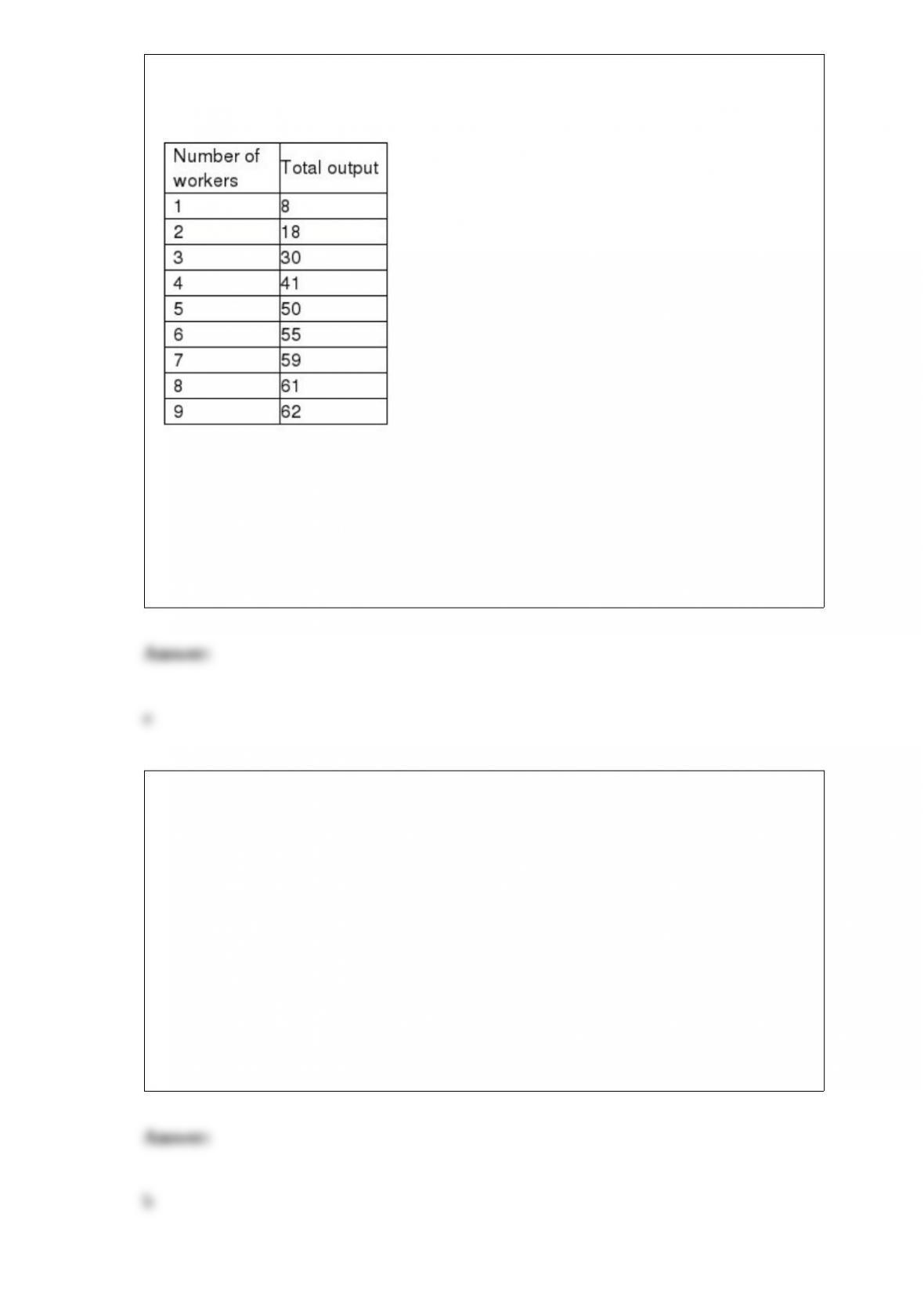
is paid a wage of $12.
Table 5-1
Refer to Table 5-1. What is the total revenue that accrues to the firm when it employs 4
workers?
a) $36
b) $112
c) $100
d) $60
e) $82
Which of the following is true of a competitive market?
a) The outcome of a competitive market is fair and equitable.
b) Competitive markets yield efficient outcomes.
c) Competitive markets allow consumers to gain at the expense of producers.
d) Competitive markets provide significant economic profits to producers in the long
run.
e) Competitive markets promote business by allowing producers to gain at the expense
of consumers.

The reservation price of the good at an auction denotes:
a) the initial bid price set by the seller in an English auction.
b) the value for the item assessed by an individual bidder.
c) the average bid price of the good quoted by the different bidders.
d) the minimum price for the good that is expected by the seller.
e) the buyer’s optimal bid in a sealed-bid auction.
Which of the following is true of the t-statistic?
a) It is the value of the coefficient estimate divided by its standard error.
b) It is the sum of the value of the coefficient estimate and its standard error.
c) It is the coefficient’s standard error normalized to lie between 0 and 1.
d) It measures the overall statistical validity of the regression equation.
e) It tells us how many standard errors the coefficient estimate is equal to zero.
When average total cost is at its minimum point:
a) marginal cost is also at its minimum point.
b) marginal cost is equal to zero.
c) marginal cost is constant.
d) average total cost is equal to marginal cost.
e) the firm is maximizing profit.
Doorway Computers manufactures PCs, and also produces the special DVD drives that
go into each PC. Demand for computers is estimated to be: P = 2,000 ‘“ .1Q, where Q
denotes units sold per month, and P is the price of the PC. The firm’s total cost is C =
40,000 + 800Q + CD, where CDdenotes the firm’s total cost of producing drives.
Currently, CD= 100QD, that is, the firm’s cost per drive is $100.
(a) If there is no external market for DVD drives, how many computers should
Doorway produce and sell in order to maximize profit? What transfer price should the
firm set for disk drives?
(b) The manager of the disk drive division informs Doorway’s CEO that she has
received offers to sell the specialty drives to outside customers for $200 each. In fact,
the division has firm offers to sell up to 8,000 disk drives, which is the firm’s current
maximum production capacity. If so, what is the optimal transfer price? How would
your answer change if Doorway’s cost for producing drives is: CD= 80QD+ .02QD
2?
Assume that Doorway can buy or sell drives at the $200 market price.
(a) Consider a sealed-bid auction where the reservation price of a firm is $7.5 million,
its bid is $7 million, and the probability of winning at this bid is .4. Calculate the firm’s
expected profit.
(b) If the firm bids $7.2 million instead of $7 million and the probability of winning
increases to .6, what is its expected profit?

Which of the following must be true for a firm to efficiently employ centralized
decision-making?
a) The decision-relevant information must be dispersed.
b) The employer and the employees must have compatible interests and objectives.
c) A very low degree of coordination is required between the various departments.
d) The organization structure must informal.
e) There must be significant principal-agent problems.
You are offered a favorable bet on a coin toss, heads or tails. If you correctly call the
result, you gain $20. If your call is incorrect, you lose $10. What is the expected value
of information if you could perfectly predict the coin toss?
a) $5
b) $10
c) $15
d) $20
e) $7.50
What is meant by rent-seeking by a monopoly firm?

What determines whether or not a company will settle out of court when sued for a
faulty product? How might the company react differently if other agents might sue it in
the future? Explain.
Frequently, bargaining impasses lead to prolonged and costly strikes. If we assume that
the negotiators are rational decision makers, how can this occur?
For a perfectly competitive firm, long-run average cost is: LAC = 300 – 20QF + .5QF2,
where QF denotes the firm’s output. Determine the firm’s long-run profit-maximizing
output and price.

Give examples of how a bookstore would practice the different forms of price
discrimination.
Compare and contrast profitability in equilibrium for symmetric firms when the firms’
actions are strategic substitutes and when the firms’ actions are strategic complements.

Determine the feasible region given the following constraints:
4x + 3y =< 120
x =< 20
y >= 10
x, y >= 0
Carefully define marginal analysis, and explain how it is useful in managerial
economics.
Derek is the co-owner of a small gift shop. His colleague, Ron wants the shop to hold a
sale and reduce most prices by 10% to 20%. His parents owned a convenience store,
and they said that they could always count on increased traffic when they cut prices. If a
10% price cut didn’t bring enough purchases, then cut by 20%, and the cash flow would
cover all their needs. Is Ron’s suggestion economically viable? Why or why not?