
Which of the following statements is true regarding the efficiency of using pollution
fees versus quantity standards to regulate pollution?
a) Quantity standards are more efficient fees because they can be used even in the
presence of incomplete information.
b) Pollution fees are more efficient because they ensure that all firms pay a uniform
penalty for continuing to pollute.
c) Quantity standards are more efficient because they allow for more flexibility and
adjustment.
d) Pollution fees are more efficient provided the fee is less than the marginal externality
cost.
e) Pollution fees are more efficient because they induce greater total pollution
reduction.
A time-series model attempts to identify:
a) patterns of changes in a single variable over time.
b) possible links between a dependent variable and a single independent variable over
time.
c) possible links between a dependent variable and one or more independent variables
over time.
d) the key factors that help predict future economic events.
e) patterns of forecast errors over time.

If the demand for a good is price-elastic, a cut in price will:
a) lead to an increase in quantity demanded and an increase in the firm’s revenue.
b) not affect the total revenue of the firm.
c) lead to a fall in the firm’s revenue but an increase in quantity demanded.
d) lead to a decrease in quantity demanded.
e) decrease the firm’s revenue by the same percentage as the cut in price.
Managerial economics can best be defined as the:
a) macroeconomics and microeconomics for managers.
b) study of economic incentives on consumer behavior and demand.
c) analysis of the labor market through the behavior of workers and managers.
d) analysis of major management decisions using economic tools.
e) study of the strategic interaction between firms in a market.
In an LP problem, the goal is to maximize the objective function 2S + 3T, subject to the
binding constraints S + T ‚ 700 and S + 2T ‚ 1,000. The optimal solution is:
a) S = 400 and T = 300.
b) S = 200 and T = 600.
c) S = 700 and T = 0.
d) S = 0 and T = 500
e) S = 500 and T = 200

Which of the following correctly explains the dominant firm model of an oligopoly?
a) The firm that sets the lowest price gains the entire market share.
b) A single firm sets a price which is lower than the current market price and gains
market share at the expense of the other firms.
c) A single firm sets the price in the market, which is taken as given by the other smaller
firms.
d) Each firm in the market sets its price based on the reaction of the other firm.
e) The firms in the market collude and set prices in order to maximize their combined
profits.
A manufacturing company produces and sells small farm tractors. Its annual fixed costs
are $15 million, and its marginal cost per tractor is $20,000. Demand for small tractors
is given by: P = 30,000 ‘“ Q, where P denotes price in dollars and Q is annual sales.
(a) Find the firm’s profit-maximizing output, price, and annual profit.
(b) Assume that agriculture prices fall and the farming sector faces a mild recession.
The demand for the small tractors drops to: P = 26,000 ‘“ Q. Suppose the recession is
only temporary, and demand will recover soon. What price and output adjustment
should the firm make during the recession?

The height of an individual demand curve at each level of output shows:
a) the marginal cost of producing the good.
b) the marginal benefit from consuming an extra unit of the good.
c) the value of consumer surplus.
d) the value of producer surplus.
e) the revenue earned by the firm from an additional unit consumed.
Which of the following is true of the Bertrand model of a duopoly?
a) Each firm matches the price increases by the other firm.
b) The firm that sets the lower price claims the entire market.
c) The total output supplied by the firms determines the market price.
d) Firms compete on multiple dimensions like quantity, price, and advertising.
e) The demand curve facing an individual firm is kinked at the market price.

Three firms are participating in a sealed-bid auction. Firm X assesses that each rival’s
bid will lie between $500 and $600, with all values equally likely. What bid should
Firm X submit if it seeks to gain a 64% probability of winning the auction?
a) $550
b) $560
c) $564
d) $575
e) $580
Which of the following does not contribute to the existence of monopoly power?
a) A continuously decreasing long-run average cost curve
b) The possession of a patent
c) The control of essential inputs in the production process
d) A pure cost or quality advantage
e) A relatively inelastic market demand curve
During the 1990s, the U. S. cigarette industry was dominated by four major firms that
charged similar prices for the cigarettes they sold under a variety of brand names. When
one firm raised its prices, the other firms generally followed. The cigarette industry is
best characterized as:
a) an oligopoly
b) a monopolistically competitive industry

c) a monopoly
d) a perfectly competitive industry
e) a duopoly
Assume that there are 9 bidders with reservation prices independently and uniformly
distributed between $100,000 and $180,000. What is the expected value of the sale
price at an English auction?
a) $140,000
b) $160,000
c) $164,000
d) $172,000
e) $175,000
Standale Plastics produces plastic dustpans, using a semi-automated system of five
machines to produce pans. The amount of labor to tend the machines, repair, adjust
input flows, and remove completed pans, is variable, and output tends to follow the
formula: Q = 300L.6, where Q = units of output produced per day and L = number of
daily workers.
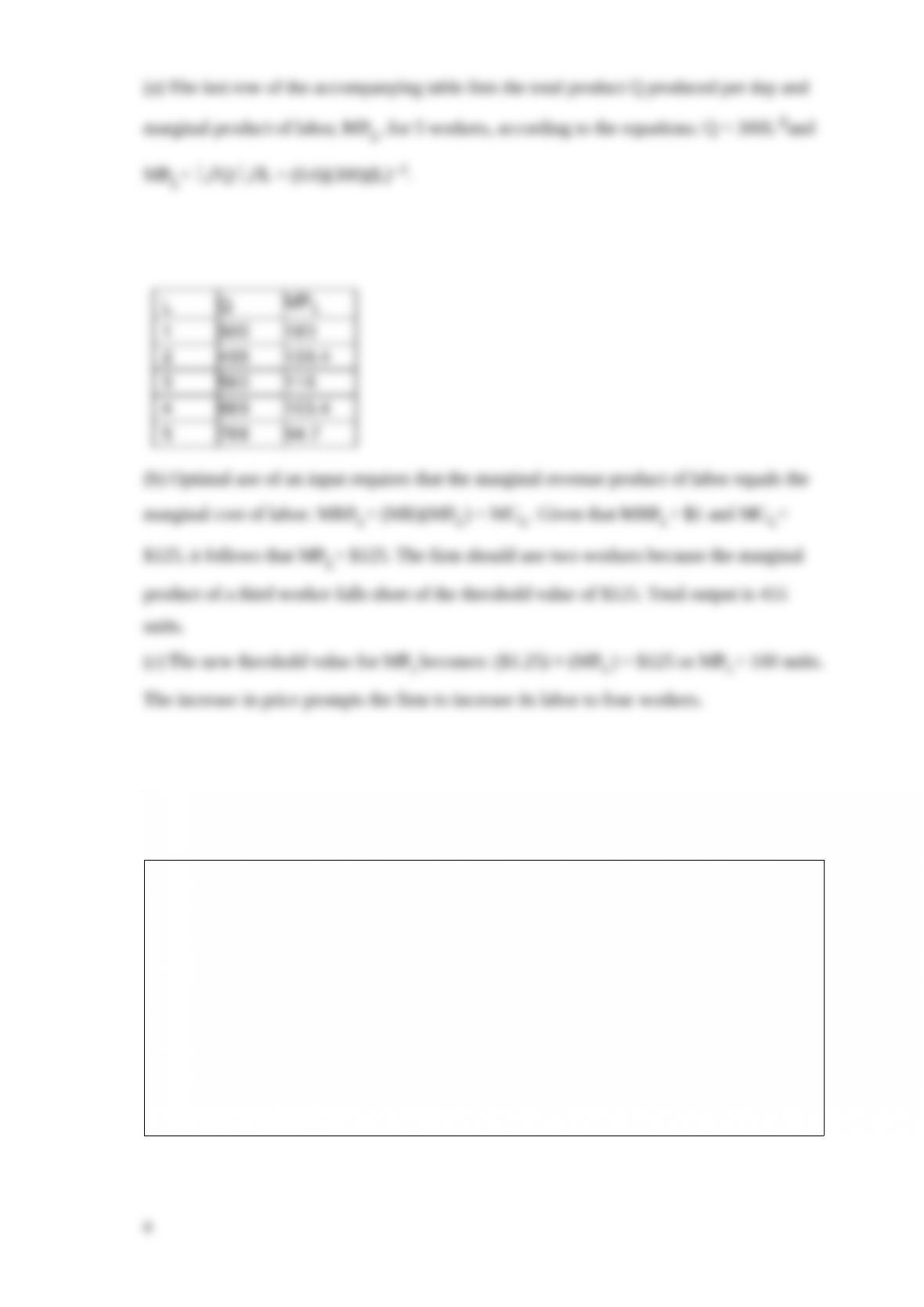
(a) Compute the total product per day and the marginal product of labor for the first five
workers.
(b) Standale sells the dustpans to retailers at a price of $1 each, and can hire labor at a
wage of $125 per day. What is the optimal amount of labor to hire? What is the optimal
output of dustpans?
(c) Suppose that the price of the dustpans increases to $1.25. What is the new optimal
amount of labor?
A manager who chooses among options by applying the expected value criterion is:
a) risk neutral.
b) risk averse.
c) risk loving.
d) willing to insure or hedge his bets.
e) a risk minimizer.

The following matrix shows the pricing strategies and resultant profits (in thousands of
dollars) for two profit-maximizing firms.
Table 9-1
Refer to Table 9-1. If both the firms act noncooperatively, which of the following is
most likely?
a) Firm B will set a high price.
b) Both Firm A and Firm B will earn profit equal to $35,000.
c) Both Firm A and Firm B will set a low price.
d) Firm A will set a high price.
e) Firm A’s profit will be equal to $37,000.
The marginal revenue product of labor is equal to the product of:
a) the marginal product of labor and the quantity of labor employed.
b) the wage rate and the marginal product of labor.
c) the wage rate and marginal revenue per unit of output
d) marginal product of labor and total revenue of the firm.
e) the marginal revenue per unit of output and the marginal product of labor

The money that a firm has already spent on research and development for a project
should be categorized as _____ when the firm is deciding whether to make an
additional investment in the project.
a) an implicit cost
b) a variable cost
c) a sunk cost
d) a marginal cost
e) an overhead cost
Which of the following is true in the long-run?
a) A firm can vary all the inputs used in production.
b) A firm can vary only one of the inputs used in production.
c) All inputs used in production are fixed in the long-run.
d) The level of output produced can be varied only over a limited range.
e) The marginal cost is at a minimum.
Based on the following utility schedule determine the decision maker’s attitude toward
risk.

You have decided to purchase a new car and are making arrangements for payment. The
salesperson suggests that you consider purchasing an extended warranty. In fact, it
seems that the salesperson is even more eager to sell the extended warranty than to sell
the new car. What economic issues should you consider before you buy the warranty?
Explain.
A small nation permits free trade in good X. At the good’s free-trade price of $8,
domestic firms supply 6 million units and imports account for 4 million units. Recently,
the small country has erected trade barriers with the result that imports have fallen to
zero, price has risen to $10, and domestic supply has increased to 8 million units.
Calculate the change in consumer surplus and producer surplus resulting from the trade
barrier. What is the deadweight loss?
Which factors typically lead a firm to produce an item in-house? What causes a firm to
outsource production?
Mike heads a new startup firm that decides to open a number of clinics that perform
laser eye surgery to correct common vision problems. He hopes that over time his
company can claim a substantial share of what is estimated to be an $18 billion per year
market.
Briefly describe the most important factors influencing his venture’s revenues and costs.
Describe the most important risks.
In the late 1990s, many local affiliates of the three TV networks (ABC, CBS, and NBC)
left their current partner to join a rival network that was seeking new stations (The
networks pay their affiliates to carry programs, which is a major source of revenue for
the stations). Why would the affiliates leave their current partner for a new network?
Estimate the expected utility of two individuals, A and B, from the investment that has
the following possible outcomes: