Archives
978-0134733821 Chapter 1 Lecture Note
Mishkin • Instructor’s Manual for The Economics of Money, Banking, and Financial Markets, Twelfth Edition 14 Chapter 1 Why Study Money, Banking, and Financial Markets? Before embarking on a study of money, banking, and financial markets, the student must be […]
978-0134733821 Chapter 1 Solution Manual
Mishkin • Instructor’s Manual for The Economics of Money, Banking, and Financial Markets, Twelfth Edition 51 Chapter 1 ANSWERS TO QUESTIONS 1. What is the typical relationship among interest rates on three-month Treasury bills, long- term Treasury bonds, and Baa […]
978-0134733821 Chapter 10 Solution Manual
Mishkin • Instructor’s Manual for The Economics of Money, Banking, and Financial Markets, Twelfth Edition 127 Chapter 10 ANSWERS TO QUESTIONS 1. Why are deposit insurance and other types of government safety nets important to the health of the economy? […]
978-0134733821 Chapter 11 Solution Manual
Mishkin • Instructor’s Manual for The Economics of Money, Banking, and Financial Markets, Twelfth Edition 136 Chapter 11 ANSWERS TO QUESTIONS 1. Do you think that before the National Bank Act of 1863 the prevailing conditions in the banking industry […]
978-0134733821 Chapter 12 Solution Manual
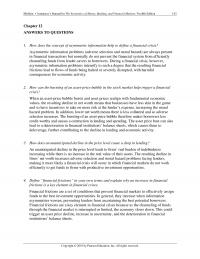
Mishkin • Instructor’s Manual for The Economics of Money, Banking, and Financial Markets, Twelfth Edition 143 Chapter 12 ANSWERS TO QUESTIONS 1. How does the concept of asymmetric information help to define a financial crisis? Asymmetric information problems (adverse selection […]
978-0134733821 Chapter 13 Solution Manual
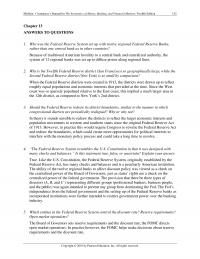
Mishkin • Instructor’s Manual for The Economics of Money, Banking, and Financial Markets, Twelfth Edition 152 Chapter 13 ANSWERS TO QUESTIONS 1. Why was the Federal Reserve System set up with twelve regional Federal Reserve Banks, rather than one central […]
978-0134733821 Chapter 14 Solution Manual Part 1
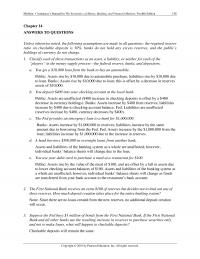
Mishkin • Instructor’s Manual for The Economics of Money, Banking, and Financial Markets, Twelfth Edition 158 Chapter 14 ANSWERS TO QUESTIONS Unless otherwise noted, the following assumptions are made in all questions: the required reserve ratio on checkable deposits is […]
978-0134733821 Chapter 14 Solution Manual Part 2
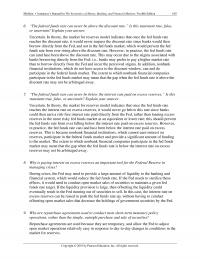
Mishkin • Instructor’s Manual for The Economics of Money, Banking, and Financial Markets, Twelfth Edition 169 Copyright © 2019 by Pearson Education, Inc. All rights reserved. 6. “The federal funds rate can never be above the discount rate.” Is this […]
978-0134733821 Chapter 16 Solution Manual
Mishkin • Instructor’s Manual for The Economics of Money, Banking, and Financial Markets, Twelfth Edition 179 Chapter 16 ANSWERS TO QUESTIONS 1. What are the benefits of using a nominal anchor for the conduct of monetary policy? A nominal anchor […]
978-0134733821 Chapter 17 Solution Manual
Mishkin • Instructor’s Manual for The Economics of Money, Banking, and Financial Markets, Twelfth Edition 193 Chapter 17 ANSWERS TO QUESTIONS 1. Suppose that you are considering going on vacation abroad and that the euro has appreciated by 15% with […]
978-0134733821 Chapter 18 Solution Manual
Mishkin • Instructor’s Manual for The Economics of Money, Banking, and Financial Markets, Twelfth Edition 201 Chapter 18 ANSWERS TO QUESTIONS 1. If the Federal Reserve sells dollars in the foreign exchange market but conducts an offsetting open market operation […]
978-0134733821 Chapter 19 Solution Manual
Mishkin • Instructor’s Manual for The Economics of Money, Banking, and Financial Markets, Twelfth Edition 210 Chapter 19 ANSWERS TO QUESTIONS 1. How would you expect velocity to typically behave over the course of the business cycle? Since nominal GDP […]
978-0134733821 Chapter 2 Lecture Note
Mishkin • Instructor’s Manual for The Economics of Money, Banking, and Financial Markets, Twelfth Edition 15 Chapter 2 An Overview of the Financial System Chapter 2 is an introductory chapter that contains the background information on the structure and operation […]
978-0134733821 Chapter 2 Solution Manual
Mishkin • Instructor’s Manual for The Economics of Money, Banking, and Financial Markets, Twelfth Edition 58 Chapter 2 ANSWERS TO QUESTIONS 1. If I can buy a car today for $5,000 and it is worth $10,000 in extra income to […]
978-0134733821 Chapter 20 Solution Manual
Mishkin • Instructor’s Manual for The Economics of Money, Banking, and Financial Markets, Twelfth Edition 219 Chapter 20 ANSWERS TO QUESTIONS 1. “When the stock market rises, investment spending is increasing.” Is this statement true, false, or uncertain? Explain your […]
978-0134733821 Chapter 21 Solution Manual
Mishkin • Instructor’s Manual for The Economics of Money, Banking, and Financial Markets, Twelfth Edition 230 Chapter 21 ANSWERS TO QUESTIONS 1. When the inflation rate increases, what happens to the federal funds rate? Operationally, how does the Fed adjust […]
978-0134733821 Chapter 23 Solution Manual Part 1
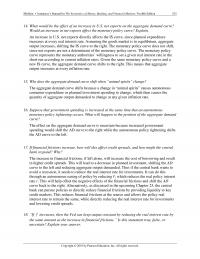
Mishkin • Instructor’s Manual for The Economics of Money, Banking, and Financial Markets, Twelfth Edition 233 Copyright © 2019 by Pearson Education, Inc. All rights reserved. 14. What would be the effect of an increase in U.S. net exports on […]
978-0134733821 Chapter 23 Solution Manual Part 2
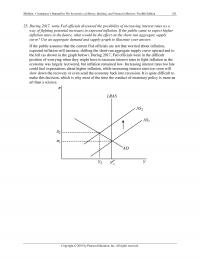
Mishkin • Instructor’s Manual for The Economics of Money, Banking, and Financial Markets, Twelfth Edition 251 Copyright © 2019 by Pearson Education, Inc. All rights reserved. 25. During 2017, some Fed officials discussed the possibility of increasing interest rates as […]
978-0134733821 Chapter 24 Solution Manual
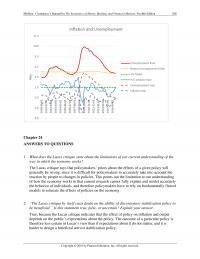
Mishkin • Instructor’s Manual for The Economics of Money, Banking, and Financial Markets, Twelfth Edition 268 Chapter 24 ANSWERS TO QUESTIONS 1. What does the Lucas critique state about the limitations of our current understanding of the way in which […]
978-0134733821 Chapter 25 Solution Manual
Mishkin • Instructor’s Manual for The Economics of Money, Banking, and Financial Markets, Twelfth Edition 280 Chapter 25 ANSWERS TO QUESTIONS 1. From 2008 to 2017, auto loan rates in the United States declined from around 8% to near historic […]
978-0134733821 Chapter 3 Lecture Note
Mishkin • Instructor’s Manual for The Economics of Money, Banking, and Financial Markets, Twelfth Edition 16 Chapter 3 What Is Money? Before becoming immersed in the study of money and banking, the student must understand how money is defined and […]
978-0134733821 Chapter 3 Solution Manual
Mishkin • Instructor’s Manual for The Economics of Money, Banking, and Financial Markets, Twelfth Edition 65 Chapter 3 ANSWERS TO QUESTIONS 1. Why is simply counting currency an inadequate measure of money? Since a lot of other assets have liquidity […]
978-0134733821 Chapter 4 Lecture Note
Mishkin • Instructor’s Manual for The Economics of Money, Banking, and Financial Markets, Twelfth Edition 17 Chapter 4 Understanding Interest Rates In my years of teaching money and banking, I have found that students have trouble with what I consider […]
978-0134733821 Chapter 4 Solution Manual
Mishkin • Instructor’s Manual for The Economics of Money, Banking, and Financial Markets, Twelfth Edition 73 Chapter 4 ANSWERS TO QUESTIONS 1. Would a dollar tomorrow be worth more to you today when the interest rate is 20% or when […]
978-0134733821 Chapter 5 Solution Manual
Mishkin • Instructor’s Manual for The Economics of Money, Banking, and Financial Markets, Twelfth Edition 80 Chapter 5 ANSWERS TO QUESTIONS 1. Explain why you would be more or less willing to buy a share of Microsoft stock in the […]
978-0134733821 Chapter 6 Solution Manual
Mishkin • Instructor’s Manual for The Economics of Money, Banking, and Financial Markets, Twelfth Edition 92 Chapter 6 ANSWERS TO QUESTIONS 1. If junk bonds are “junk,” then why do investors buy them? Junk bonds are referred to as “junk” […]
978-0134733821 Chapter 7 Solution Manual
Mishkin • Instructor’s Manual for The Economics of Money, Banking, and Financial Markets, Twelfth Edition 102 Chapter 7 ANSWERS TO QUESTIONS 1. What basic principle of finance can be applied to the valuation of any investment asset? The value of […]
978-0134733821 Chapter 8 Solution Manual
Mishkin • Instructor’s Manual for The Economics of Money, Banking, and Financial Markets, Twelfth Edition 109 Chapter 8 ANSWERS TO QUESTIONS 1. For each of the following countries, identify the single most important (largest) and least important (smallest) source of […]
978-0134733821 Chapter 9 Solution Manual
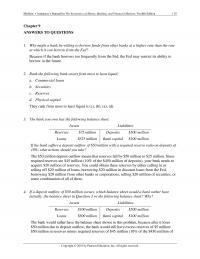
Mishkin • Instructor’s Manual for The Economics of Money, Banking, and Financial Markets, Twelfth Edition 119 Chapter 9 ANSWERS TO QUESTIONS 1. Why might a bank be willing to borrow funds from other banks at a higher rate than the […]
978-0134733821 Test Bank Chapter 1 Part 1
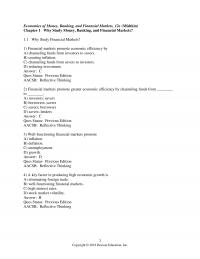
Economics of Money, Banking, and Financial Markets, 12e (Mishkin) Chapter 1 Why Study Money, Banking, and Financial Markets? 1.1 Why Study Financial Markets? 1) Financial markets promote economic efficiency by A) channeling funds from investors to savers. B) creating inflation. […]
978-0134733821 Test Bank Chapter 1 Part 2
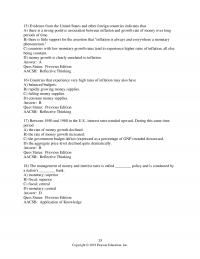
15) Evidence from the United States and other foreign countries indicates that A) there is a strong positive association between inflation and growth rate of money over long periods of time. B) there is little support for the assertion that […]
978-0134733821 Test Bank Chapter 14 Part 3
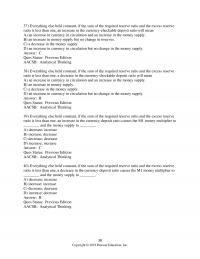
37) Everything else held constant, if the sum of the required reserve ratio and the excess reserve ratio is less than one, an increase in the currency-checkable deposit ratio will mean A) an increase in currency in circulation and an […]
978-0134733821 Test Bank Chapter 15 Part 2
17) If float is predicted to increase because of bad weather, the manager of the trading desk at the New York Fed bank will likely conduct ________ open market operations to ________ reserves. A) defensive; inject B) defensive; drain C) […]
978-0134733821 Test Bank Chapter 17 Part 2
8) ________ in the domestic interest rate causes the demand for domestic assets to shift to the left and the domestic currency to ________, everything else held constant. A) An increase; appreciate B) An increase; depreciate C) A decrease; appreciate […]
978-0134733821 Test Bank Chapter 19 Part 2
14) Keynes argued that when interest rates were low relative to some normal value, people would expect bond prices to ________ so the quantity of money demanded would ________. A) increase; increase B) increase; decrease C) decrease; increase D) decrease; […]
978-0134733821 Test Bank Chapter 2 Part 1
Economics of Money, Banking, and Financial Markets, 12e (Mishkin) Chapter 2 An Overview of the Financial System 2.1 Function of Financial Markets 1) Every financial market has the following characteristic. A) It determines the level of interest rates. B) It […]
978-0134733821 Test Bank Chapter 2 Part 2
5) If Microsoft sells a bond in London and it is denominated in dollars, the bond is a A) Eurobond. B) foreign bond. C) British bond. D) currency bond. Answer: A Ques Status: Previous Edition AACSB: Reflective Thinking 6) U.S. […]
978-0134733821 Test Bank Chapter 26
Economics of Money, Banking, and Financial Markets, 12e (Mishkin) Chapter 26 Web Chapter 1: Financial Crises in Emerging Market Economies 26.1 Dynamics of Financial Crises in Emerging Market Economies 1) Financial crises generally develop along two basic paths A) mismanagement […]
978-0134733821 Test Bank Chapter 3 Part 1
Economics of Money, Banking, and Financial Markets, 12e (Mishkin) Chapter 3 What Is Money? 3.1 Meaning of Money 1) To an economist, ________ is anything that is generally accepted in payment for goods or services or in the repayment of […]
978-0134733821 Test Bank Chapter 3 Part 2
3.3 Evolution of the Payments System 1) The payments system is A) the method of conducting transactions in the economy. B) used by union officials to set salary caps. C) an illegal method of rewarding contracts. D) used by your […]
978-0134733821 Test Bank Chapter 4 Part 1
Economics of Money, Banking, and Financial Markets, 12e (Mishkin) Chapter 4 The Meaning of Interest Rates 4.1 Measuring Interest Rates 1) The concept of ________ is based on the common-sense notion that a dollar paid to you in the future […]
978-0134733821 Test Bank Chapter 4 Part 2
57) The yield to maturity for a discount bond is ________ related to the current bond price. A) negatively B) positively C) not D) directly Answer: A Ques Status: Previous Edition AACSB: Reflective Thinking 58) A discount bond is also […]
978-0134733821 Test Bank Chapter 5 Part 1
Economics of Money, Banking, and Financial Markets, 12e (Mishkin) Chapter 5 The Behavior of Interest Rates 5.1 Determinants of Asset Demand 1) Pieces of property that serve as a store of value are called A) assets. B) units of account. […]
978-0134733821 Test Bank Chapter 5 Part 2
37) Everything else held constant, when prices in the art market become more uncertain A) the demand curve for bonds shifts to the left and the interest rate rises. B) the demand curve for bonds shifts to the left and […]
978-0134733821 Test Bank Chapter 5 Part 3
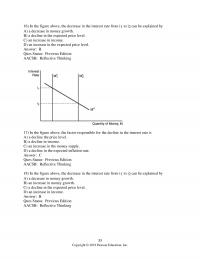
16) In the figure above, the decrease in the interest rate from i1 to i2 can be explained by A) a decrease in money growth. B) a decline in the expected price level. C) an increase in income. D) an […]
978-0134733821 Test Bank Chapter 6 Part 1
Economics of Money, Banking, and Financial Markets, 12e (Mishkin) Chapter 6 The Risk and Term Structure of Interest Rates 6.1 Risk Structure of Interest Rates 1) The risk structure of interest rates is A) the structure of how interest rates […]
978-0134733821 Test Bank Chapter 6 Part 2
6.2 Term Structure of Interest Rates 1) The term structure of interest rates is A) the relationship among interest rates of different bonds with the same maturity. B) the structure of how interest rates move over time. C) the relationship […]
978-0134733821 Test Bank Chapter 8 Part 2
13) External financing by ________ should be more important in developing countries than in industrialized countries because information about private firms is more difficult to collect in developing countries. A) financial intermediaries B) bonds C) stock D) direct lending Answer: […]