Archives
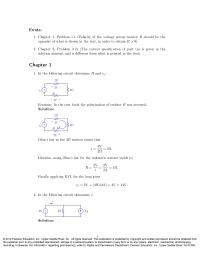
Engineering Chapter 1 Homework For Information Regarding Permissions Write To Rights
Errata: 1. Chapter 1, Problem 1.1 (Polarity of the voltage across resistor Rshould be the opposite of what is shown in the text, in order to obtain R > 0). 2. Chapter 3, Problem 3.7a (The correct specification of part […]
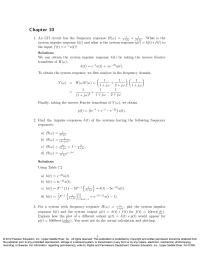
Engineering Chapter 10 Homework Determine the characteristic polynomial P
Chapter 10 1. An LTI circuit has the frequency response H(ω) = 1 1+jω +1 2+jω . What is the system impulse response h(t)and what is the system response y(t) = h(t)∗f(t)to the input f(t) = e−tu(t)? Solution: We can […]
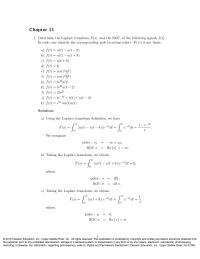
Engineering Chapter 11 Homework Applying The Coverup Method Have Thumb
Chapter 11 1. Determine the Laplace transform ˆ F(s), and the ROC, of the following signals f(t). In each case identify the corresponding pole locations where |ˆ F(s)|is not finite. a) f(t) = u(t)−u(t−8) b) f(t) = u(t)−u(t+ 8) c) […]
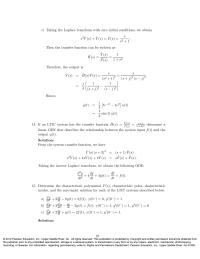
Engineering Chapter 11 Homework Clearly the characteristic polynomial of the system is
c) Taking the Laplace transform with zero initial conditions, we obtain 14. If an LTIC system has the transfer function ˆ H(s) = ˆ Y(s) ˆ F(s)=s+1 (s+2)2determine a linear ODE that describes the relationship between the system input f(t)and […]
Engineering Chapter 12 Homework Now, since from the characteristic polynomial
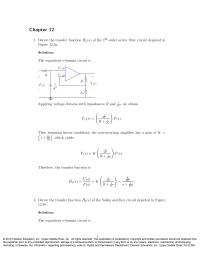
Chapter 12 1. Derive the transfer function ˆ Ha(s)of the 1st-order active filter circuit depicted in Figure 12.5a. Solution: The equivalent s-domain circuit is + ˆ V+(s) 2. Derive the transfer function ˆ Hb(s)of the Sallen and Key circuit depicted […]
Engineering Chapter 2 Homework Solving This Last Equation And The First
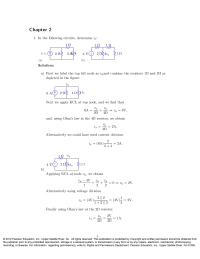
Chapter 2 1. In the following circuits, determine ix: + –ix 6A4 V 1 Ω 1 Ω 1 Ω 2 Ω 2 Ω 1 Ω 3 Ω ix (a) (b) Solution: a) First we label the top left node as […]
Engineering Chapter 2 Homework To find the equivalent resistor we suppress all
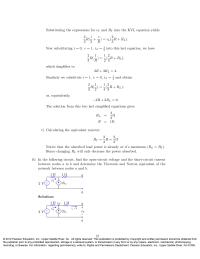
Substituting the expressions for vTand RTinto the KVL equation yields 10. In the following circuit, find the open-circuit voltage and the short-circuit current between nodes ato band determine the Thevenin and Norton equivalent of the network between nodes aand b. […]
Engineering Chapter 3 Homework Vafter The Switch Closed Have The Following
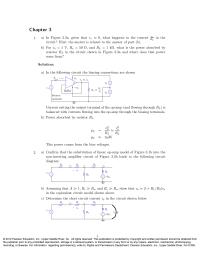
Chapter 3 1. a) In Figure 3.3a, given that i+≈0, what happens to the current vo RLin the circuit? Hint: the answer is related to the answer of part (b). b) For vs= 1 V, Rs= 50 Ω, and RL= […]
Engineering Chapter 4 Homework Calculate the series equivalent impedance of the following
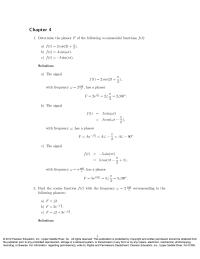
Chapter 4 1. Determine the phasor Fof the following co-sinusoidal functions f(t): a) f(t) = 2 cos(2t+π 3). b) f(t) = Asin(ωt). c) f(t) = −5 sin(πt). Solution: a) The signal b) The signal f(t) = Asin(ωt) =Acos(ωt −π 2), […]
Engineering Chapter 5 Homework This is not an LTI system, because we can not find a real
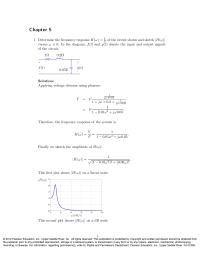
Chapter 5 1. Determine the frequency response H(ω) = Y Fof the circuit shown and sketch |H(ω)| versus ω≥0. In the diagram, f(t)and y(t)denote the input and output signals of the circuit. + – + – 0.05F f(t)y(t) 1Ω 0.2H […]
Engineering Chapter 6 Homework The case for n= 0 is analyzed in the Example
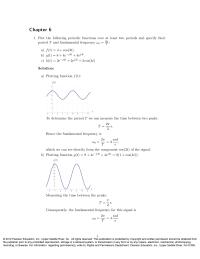
Chapter 6 1. Plot the following periodic functions over at least two periods and specify their period Tand fundamental frequency ωo=2π T: a) f(t) = 4 + cos(3t). b) g(t) = 8 + 4e−j4t+ 4ej4t. c) h(t) = 2e−j2t+ 2ej2t+ […]
Engineering Chapter 7 Homework We start with the definition of the Fourier transform
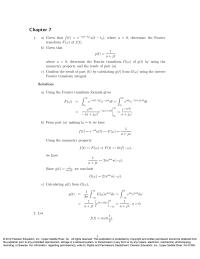
Chapter 7 1. a) Given that f(t) = e−a(t−to)u(t−to), where a > 0, determine the Fourier transform F(ω)of f(t). b) Given that g(t) = 1 a+jt, where a > 0, determine the Fourier transform G(ω)of g(t)by using the symmetry property […]
Engineering Chapter 8 Homework Then The Figure Simplifies To 2010 Pearson
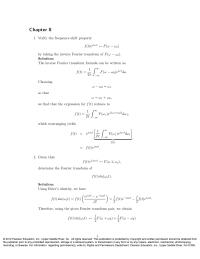
Chapter 8 1. Verify the frequency-shift property f(t)ejωot↔F(ω−ωo) by taking the inverse Fourier transform of F(ω−ωo). Solution: The inverse Fourier transform formula can be written as 2. Given that f(t)e±jωot↔F(ω∓ωo), determine the Fourier transform of f(t) sin(ωot). Solution: Using Euler’s […]
Engineering Chapter 9 Homework Therefore, the limits of the integral go from 1 to 4
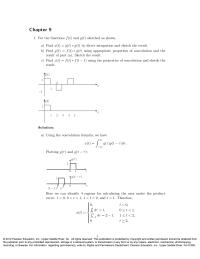
Chapter 9 1. For the functions f(t)and g(t)sketched as shown, a) Find x(t) = g(t)∗g(t)by direct integration and sketch the result. b) Find y(t) = f(t)∗g(t)using appropriate properties of convolution and the result of part (a). Sketch the result. c) […]