Chapter 10
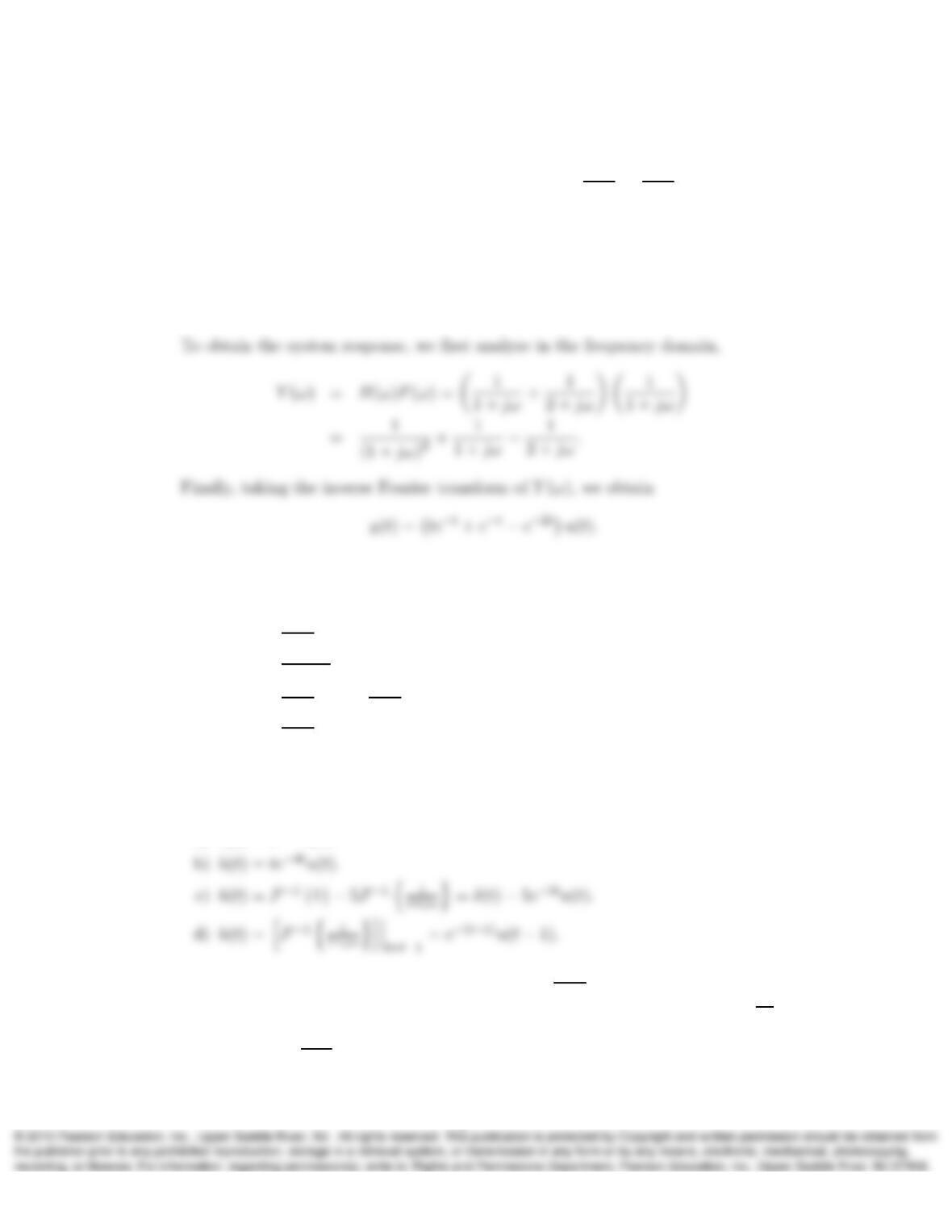
1. An LTI circuit has the frequency response H(ω) = 1
1+jω +1
2+jω . What is the
system impulse response h(t)and what is the system response y(t) = h(t)∗f(t)to
the input f(t) = e−tu(t)?
Solution:
We can obtain the system impulse response h(t)by taking the inverse Fourier
transform of H(ω),
h(t) = e−tu(t) + +e−2tu(t).
2. Find the impulse responses h(t)of the systems having the following frequency
responses:
a) H(ω) = 1
3+jω .
b) H(ω) = 1
(4+jω)2.
c) H(ω) = jω
5+jω = 1 −5
5+jω .
d) H(ω) = 1
1+jω e−jω.
Solution:
Using Table 7.2
a) h(t) = e−3tu(t).
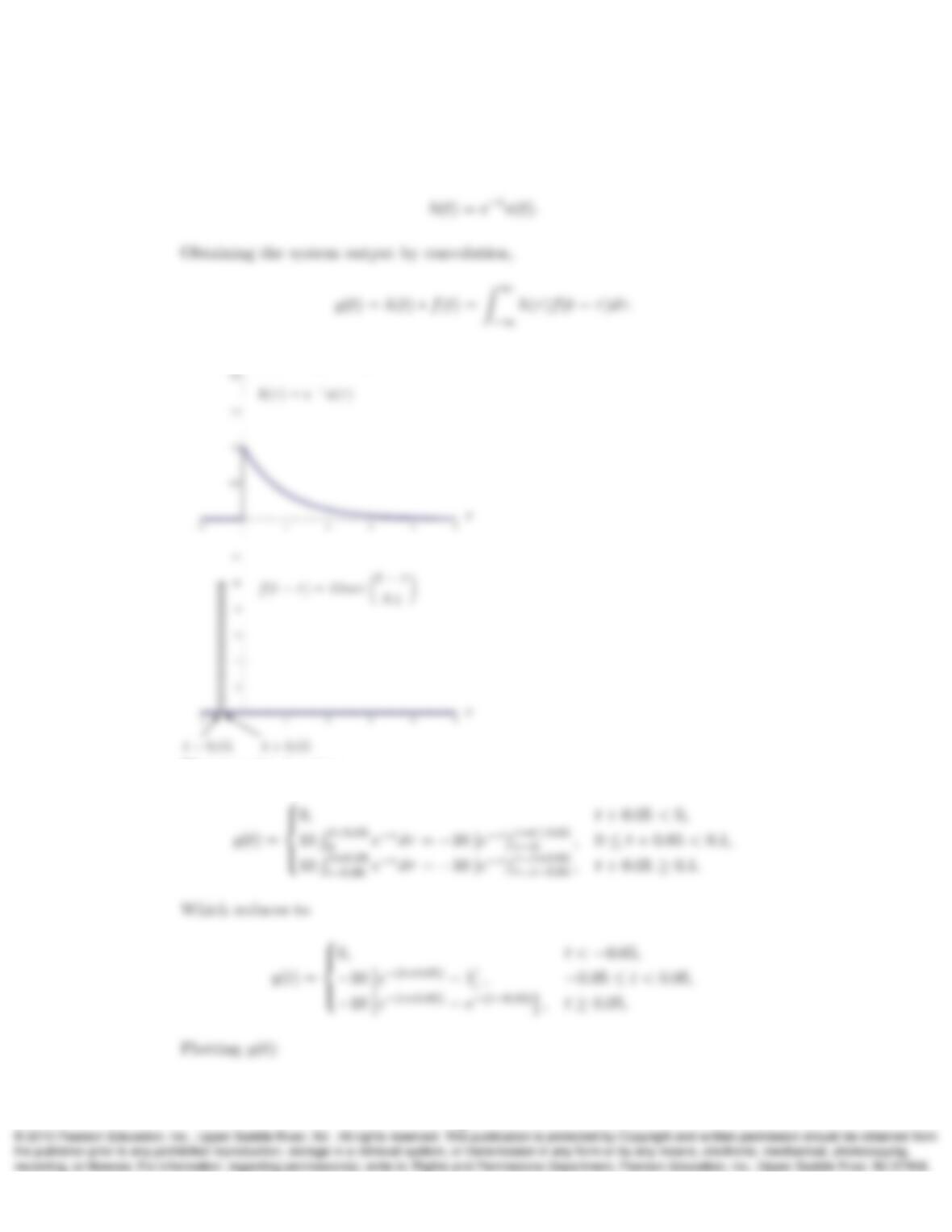
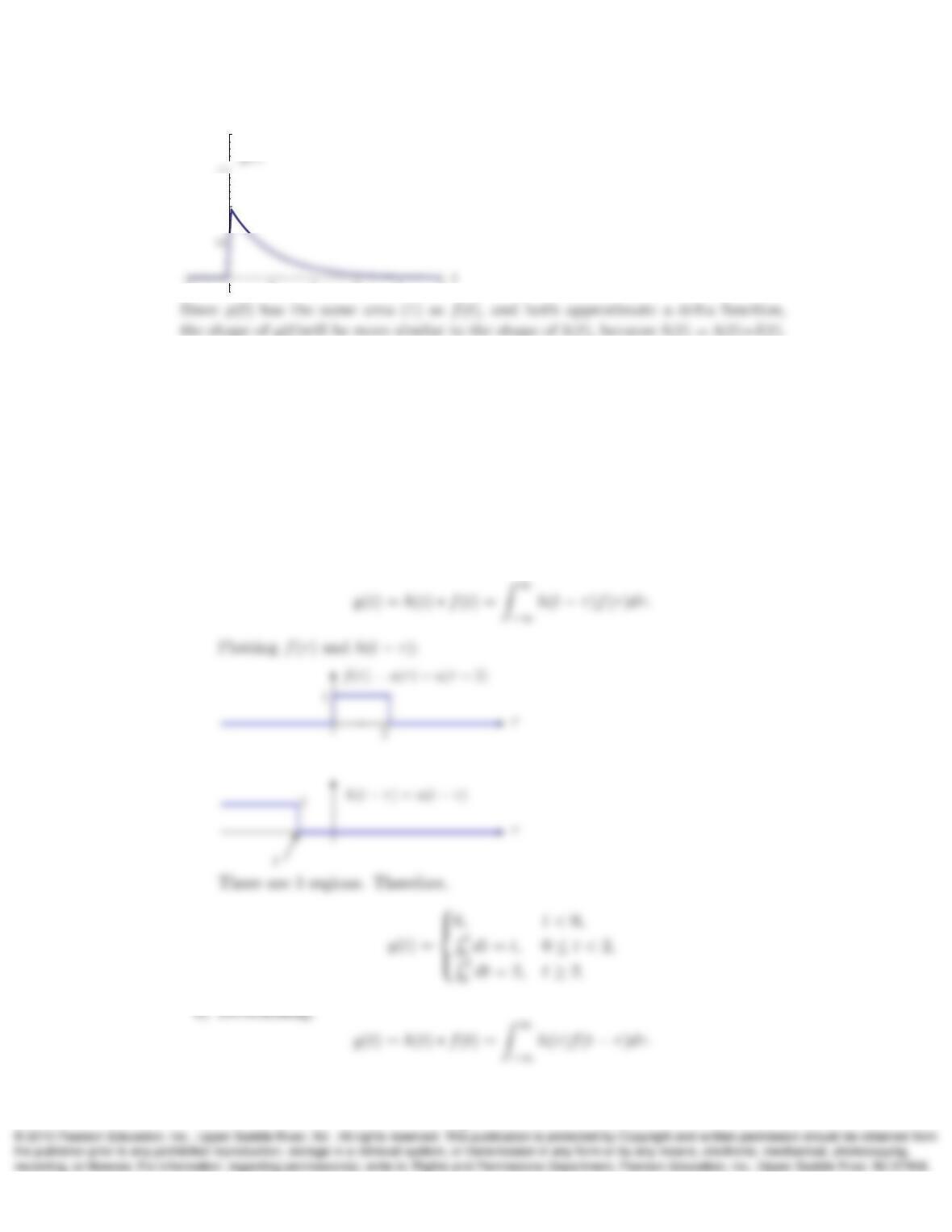
3. For a system with frequency response H(ω) = 1
1+jω , plot the system impulse
response h(t)and the system output y(t) = h(t)∗f(t)for f(t) = 10rect(t
0.1).
Explain how the plot of a different output y(t) = h(t)∗p(t)would appear for
p(t) = 1000rect(t
0.001 ). You need not do the actual calculation and plotting.
1
Solution:
Taking the inverse Fourier transform of H(ω),
Plotting h(τ)and f(t−τ)
We recognize 3 regions,
2
–1
1
2
3
4
5
1.0
2.0
4. Determine the zero-state response y(t) = h(t)∗f(t)of the following LTI systems
to the input f(t) = u(t)−u(t−2):
a) h(t) = u(t).
b) h(t) = e−2tu(t).
c) h(t) = e2tu(t).
Solution:
a) Determining h(t) = h(t)∗f(t)by solving the integral:
3
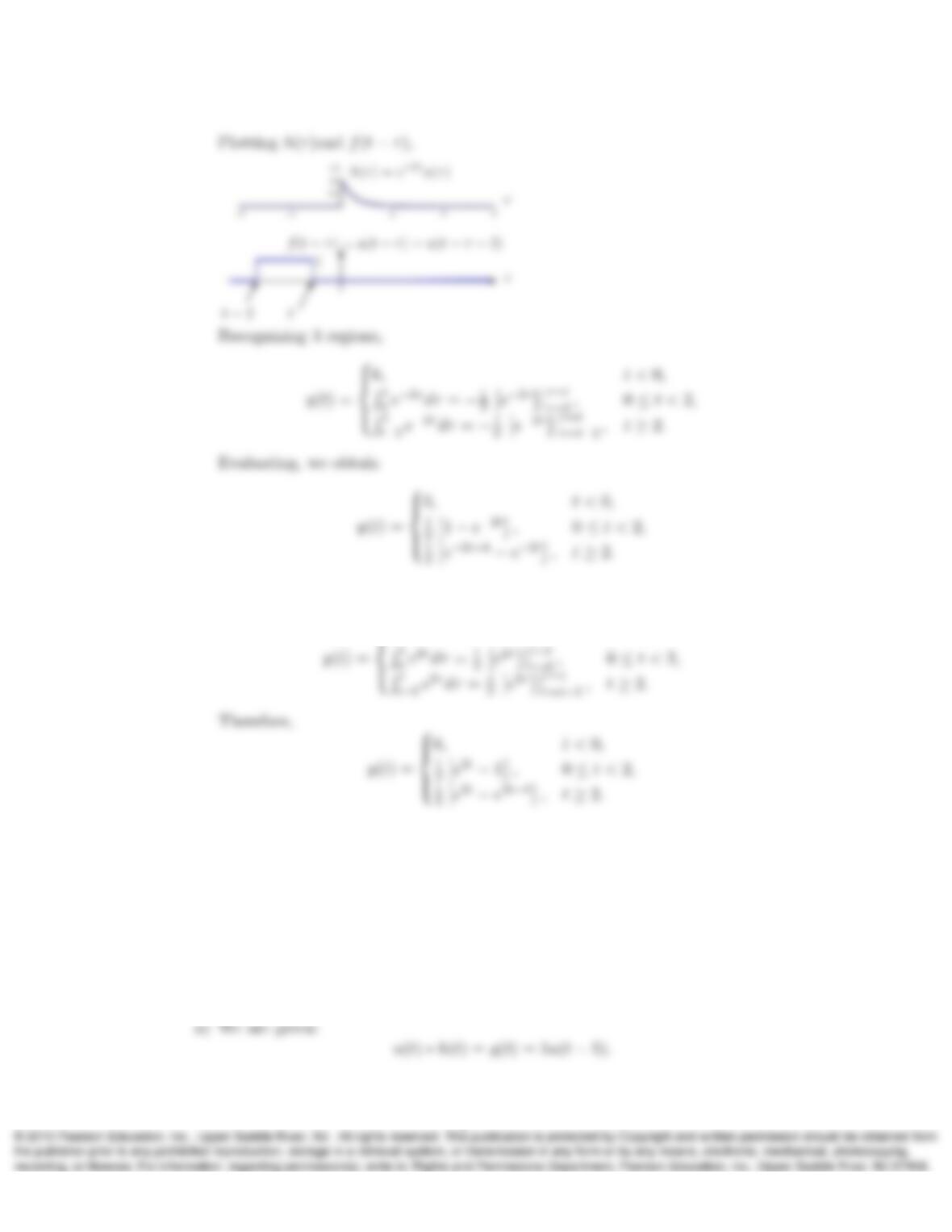
c) Similar to the part (b) we have
0, t < 0,
5. Find the impulse responses h(t)of the LTI systems having the following unit-step
responses:
a) g(t) = 5u(t−5).
b) g(t) = t2u(t).
c) g(t) = u(t)(2 −e−t).
Solution:
4
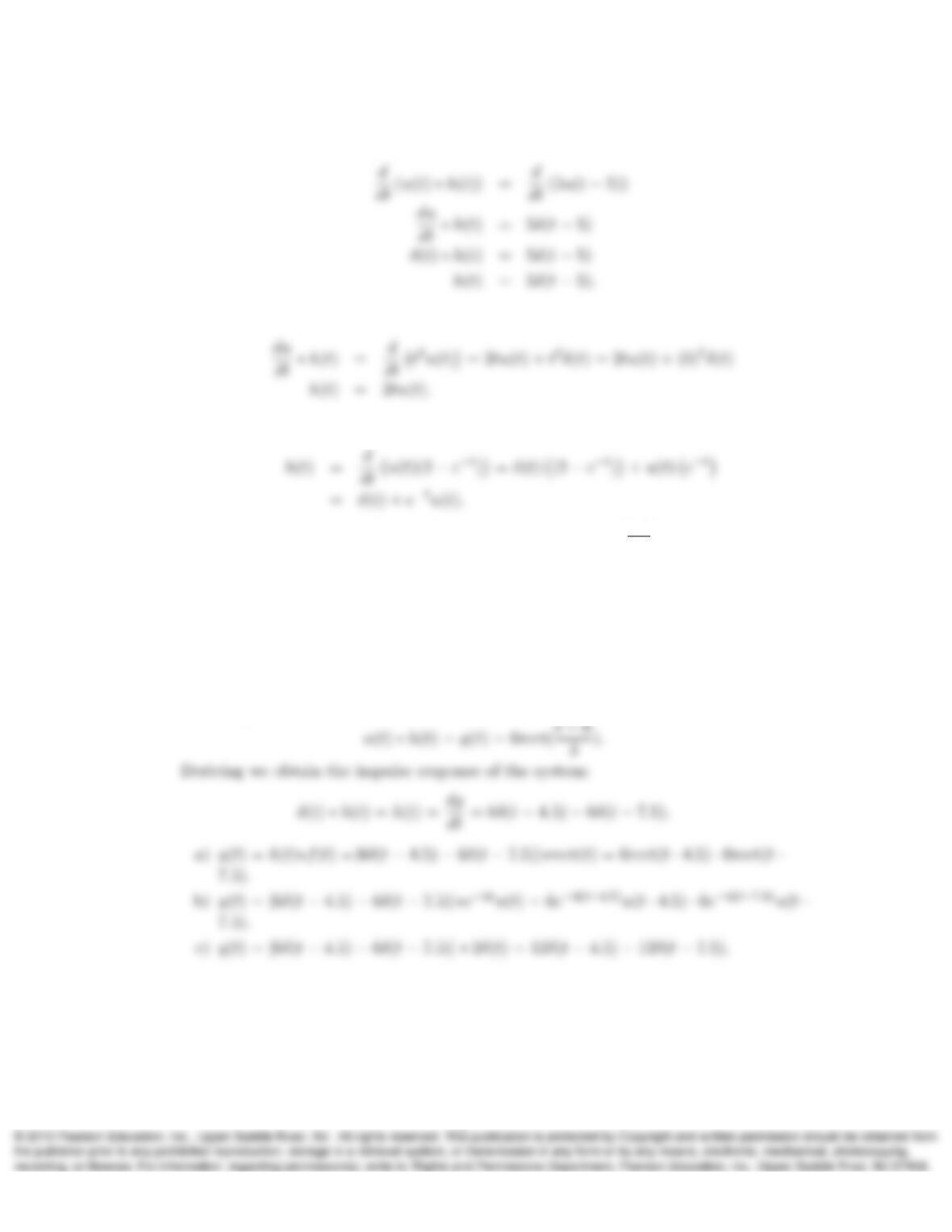
Using the derivative property of the convolution, we have
b) Similar to part (a)
c) Similarly
6. If the unit-step response of an LTI system is g(t) = 6rect(t−6
3), find the system
zero-state responses to inputs
a) f(t) = rect(t).
b) f(t) = e−4tu(t).
c) f(t) = 2δ(t).
Solution:
We are given,
7. Each of the following signals represents the impulse response of an LTI system.
Determine whether each system is causal and BIBO stable. If a system is not
BIBO stable, find an example of a bounded input f(t)that will cause an unbounded
response h(t)∗f(t).
5
a) h(t) = et
b) h(t) = rect(t−1
2)
c) h(t) = rect(t)
d) h(t) = δ(t+ 1) −δ(t−1)
e) h(t) = u(t)e−jt
Solution:
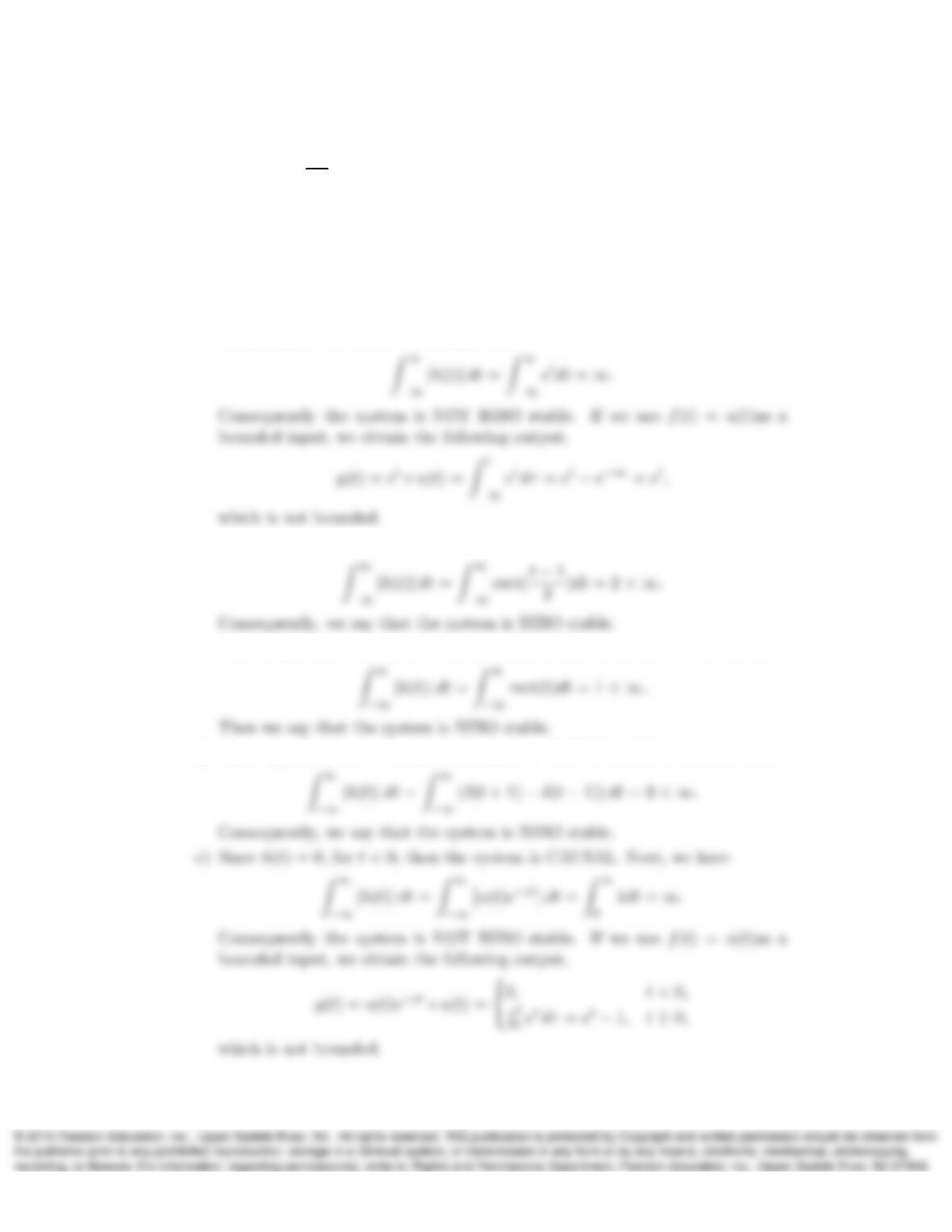
a) Since h(t)6= 0, for t < 0, then the system is NOT CAUSAL.
Analyzing if it is absolutely integrable,
b) Since h(t) = 0, for t < 0, then the system is CAUSAL. Next, we have
c) Since h(t)6= 0, for t < 0, then the system is NOT CAUSAL. Next, we have
d) Since h(t)6= 0, for t < 0, then the system is NOT CAUSAL. Next, we have
6
8. Determine whether the LTI systems with the following impulse response functions
are causal.
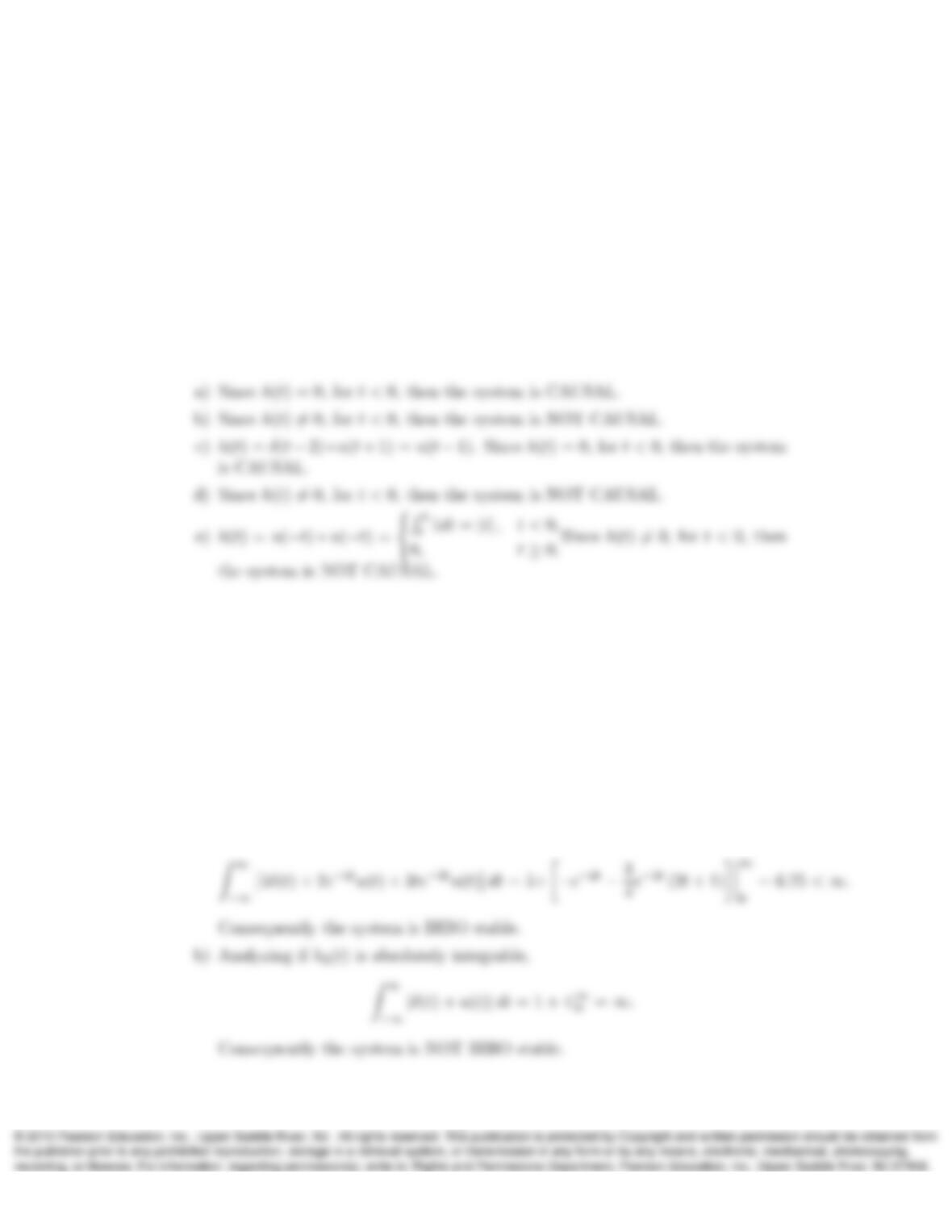
a) h(t) = u(t−1).
b) h(t) = u(t+ 1).
c) h(t) = δ(t−2) ∗u(t+ 1).
d) h(t) = u(1 −t)−u(t).
e) h(t) = u(−t)∗u(−t).
Solution:
9. Determine whether the following LTIC systems are BIBO stable and explain why
or why not.
a) h1(t) = 5δ(t) + 2e−2tu(t) + 3te−2tu(t),
b) h2(t) = δ(t) + u(t),
c) h3(t) = δ′(t) + e−tu(t),
d) h4(t) = −2δ(t−3) −te−5tu(t).
Solution:
a) Analyzing if h1(t)is absolutely integrable,
7
10. For each unstable system in Problem 10.9, provide an example of a bounded input
that will cause an unbounded output.
Solution:
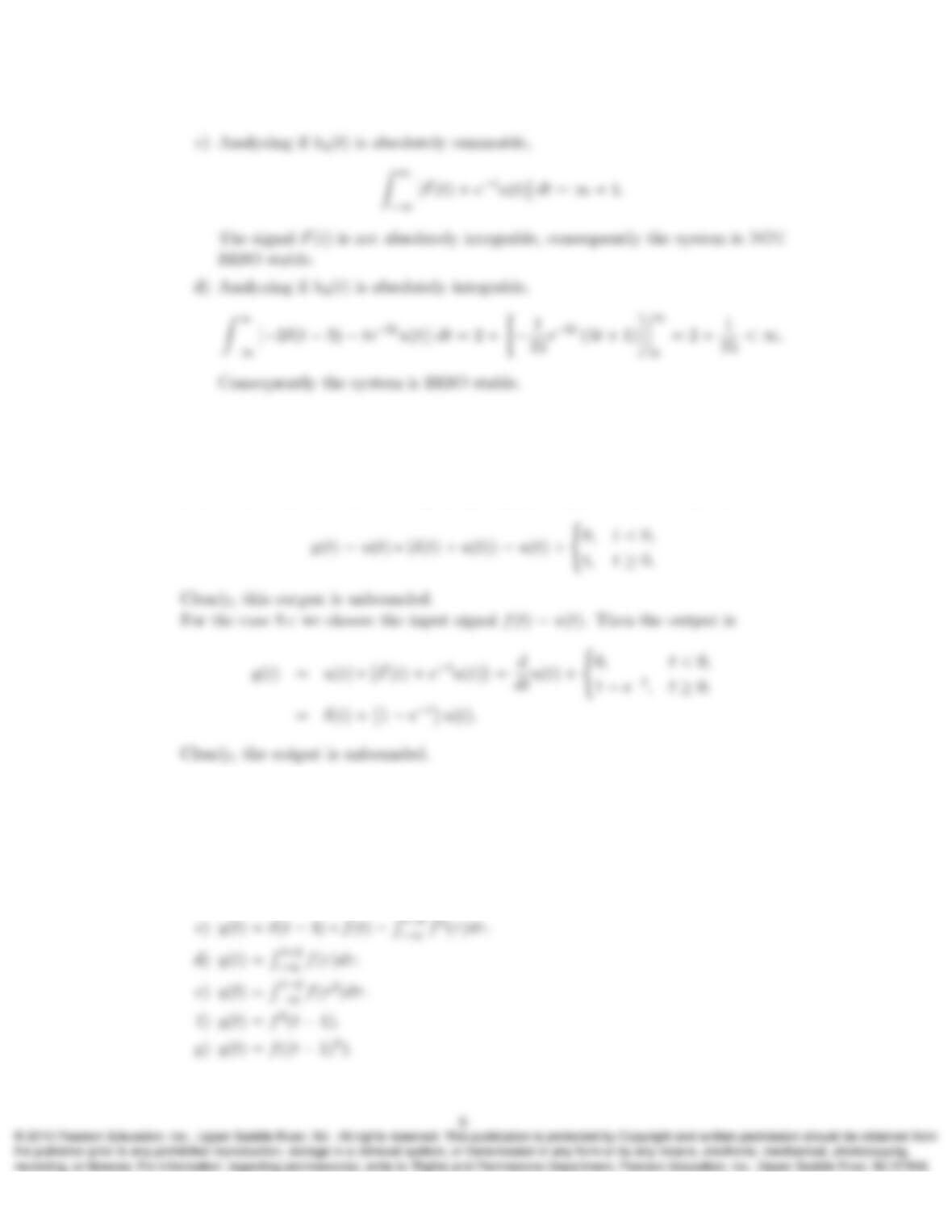
For the case 9.b we choose the input signal f(t) = u(t). Then the output is
11. Consider the following zero-state input-output relations for a variety of systems.
In each case, determine whether the system is zero-state linear, time invariant, and
causal.
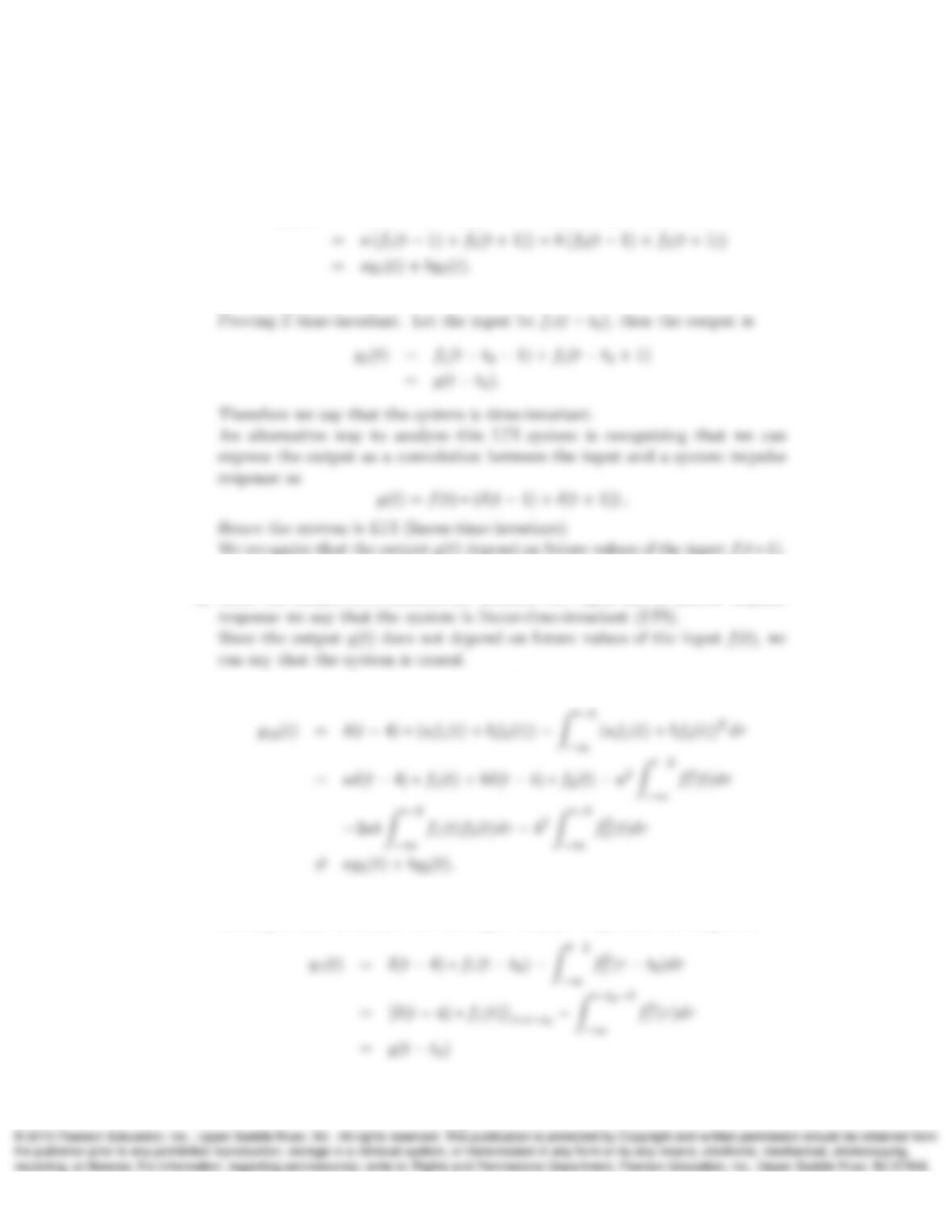
a) y(t) = f(t−1) + f(t+ 1).
b) y(t) = 5f(t)∗u(t).
Solution:
a) Proving linearity. Let the input be af1(t) + bf2(t), then the output is
y12(t) = af1(t−1) + bf2(t−1) + af1(t+ 1) + bf2(t+ 1)
Consequently the system is linear.
Hence, the system is non-causal.
b) Since the output is a convolution between the input and a system impulse
c) Proving linearity. Let the input be af1(t) + bf2(t), then the output is
Clearly the system is non-linear.
Proving if time-invariant. Let the input be f1(t−t0), then the output is
9
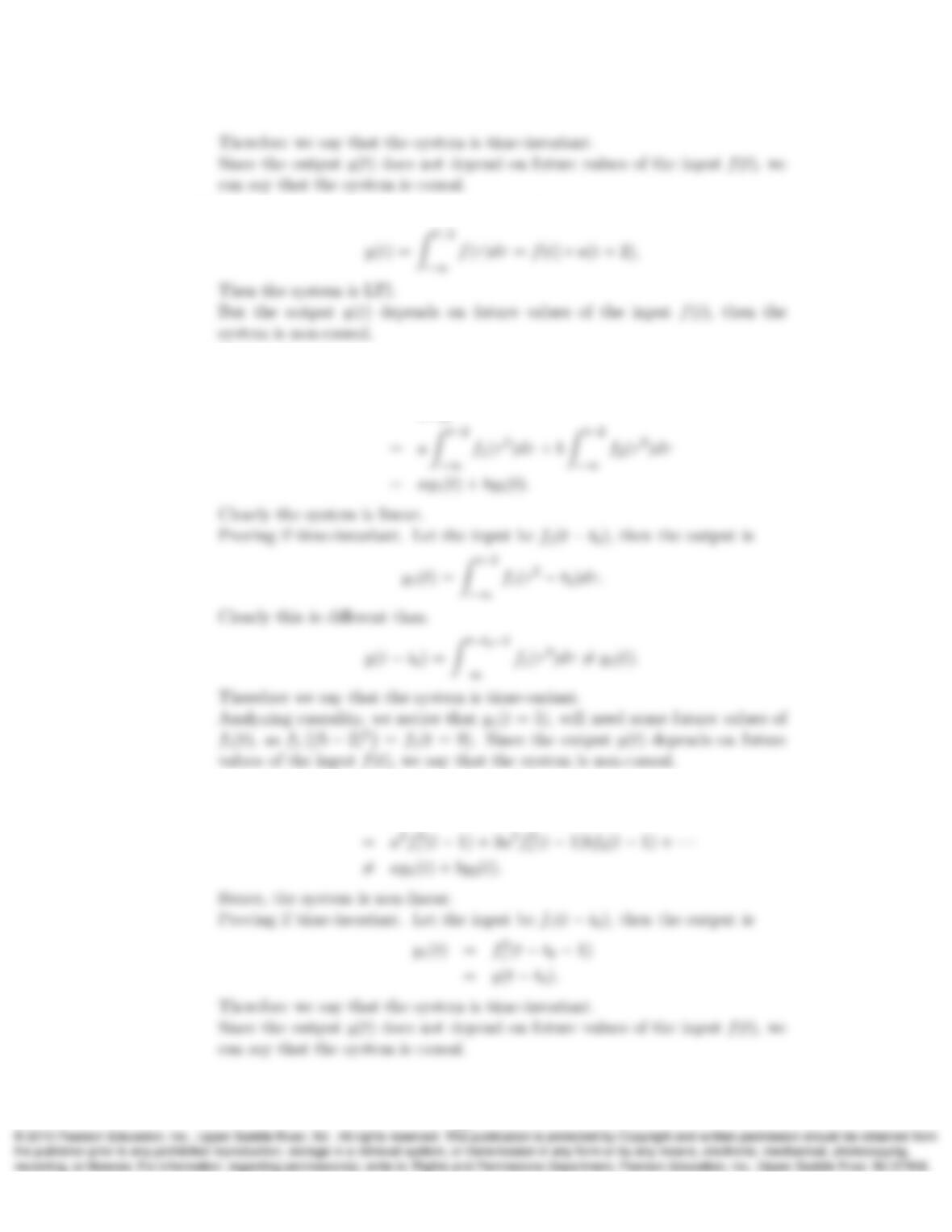
d) Since we can express the output as a convolution
e) Proving linearity. Let the input be af1(t) + bf2(t), then the output is
y12(t) = Zt−2
−∞ af1(τ2) + bf2(τ2)dτ
f) Proving linearity. Let the input be af1(t) + bf2(t), then the output is
y12(t) = (af1(t−1) + bf2(t−1))3
10
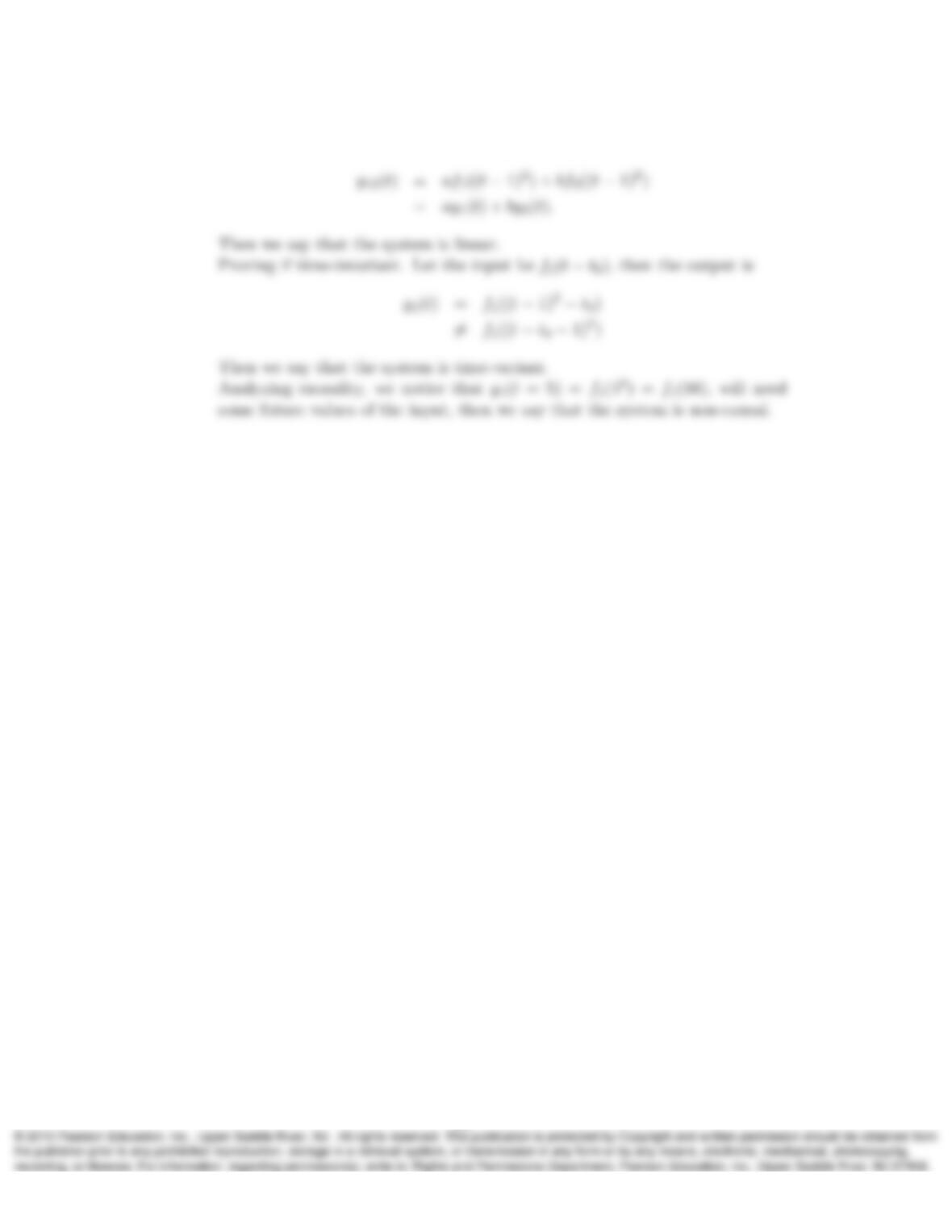
g) Proving linearity. Let the input be af1(t) + bf2(t), then the output is
11