Chapter 8
1. Verify the frequency-shift property
f(t)ejωot↔F(ω−ωo)
by taking the inverse Fourier transform of F(ω−ωo).
Solution:
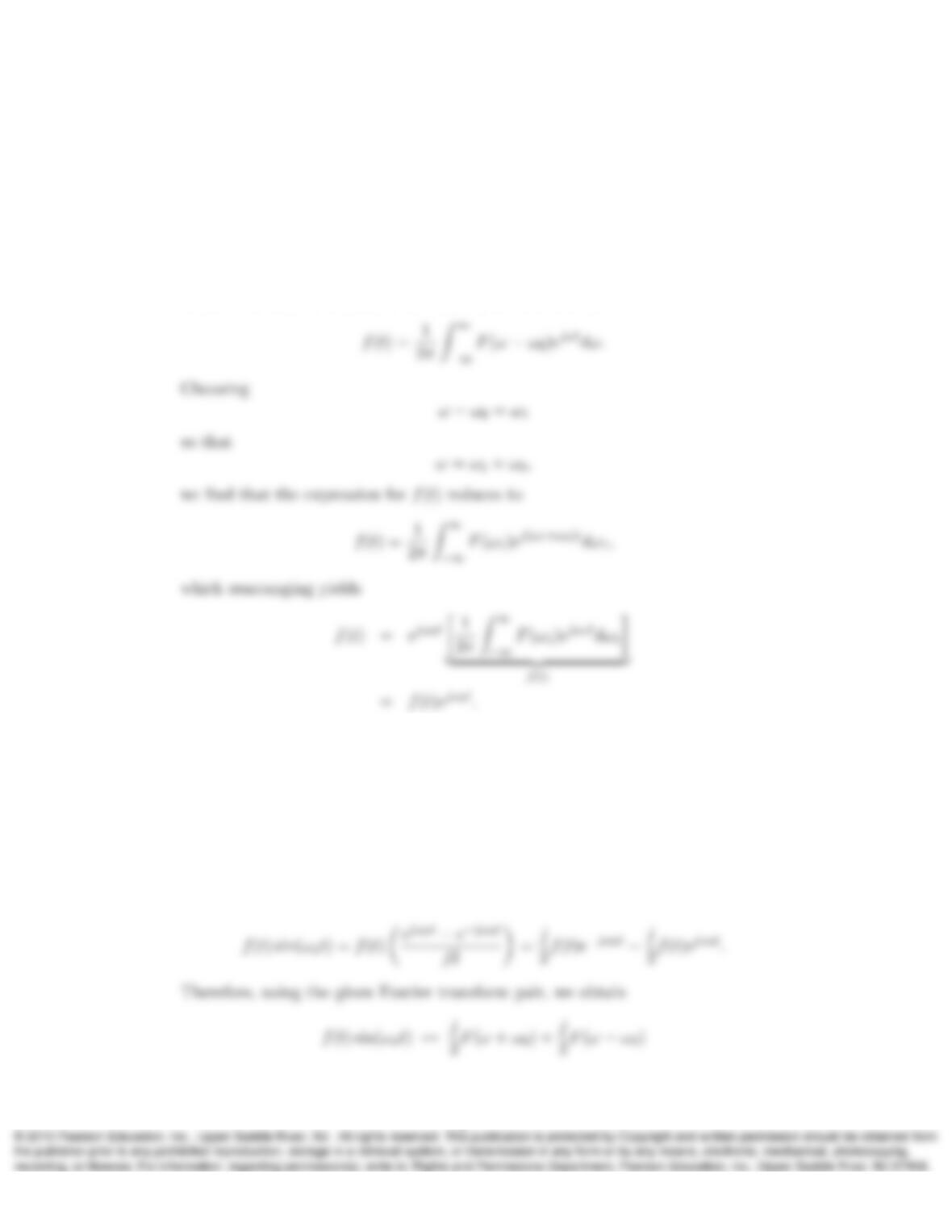
The inverse Fourier transform formula can be written as
2. Given that
f(t)e±jωot↔F(ω∓ωo),
determine the Fourier transform of
f(t) sin(ωot).
Solution:
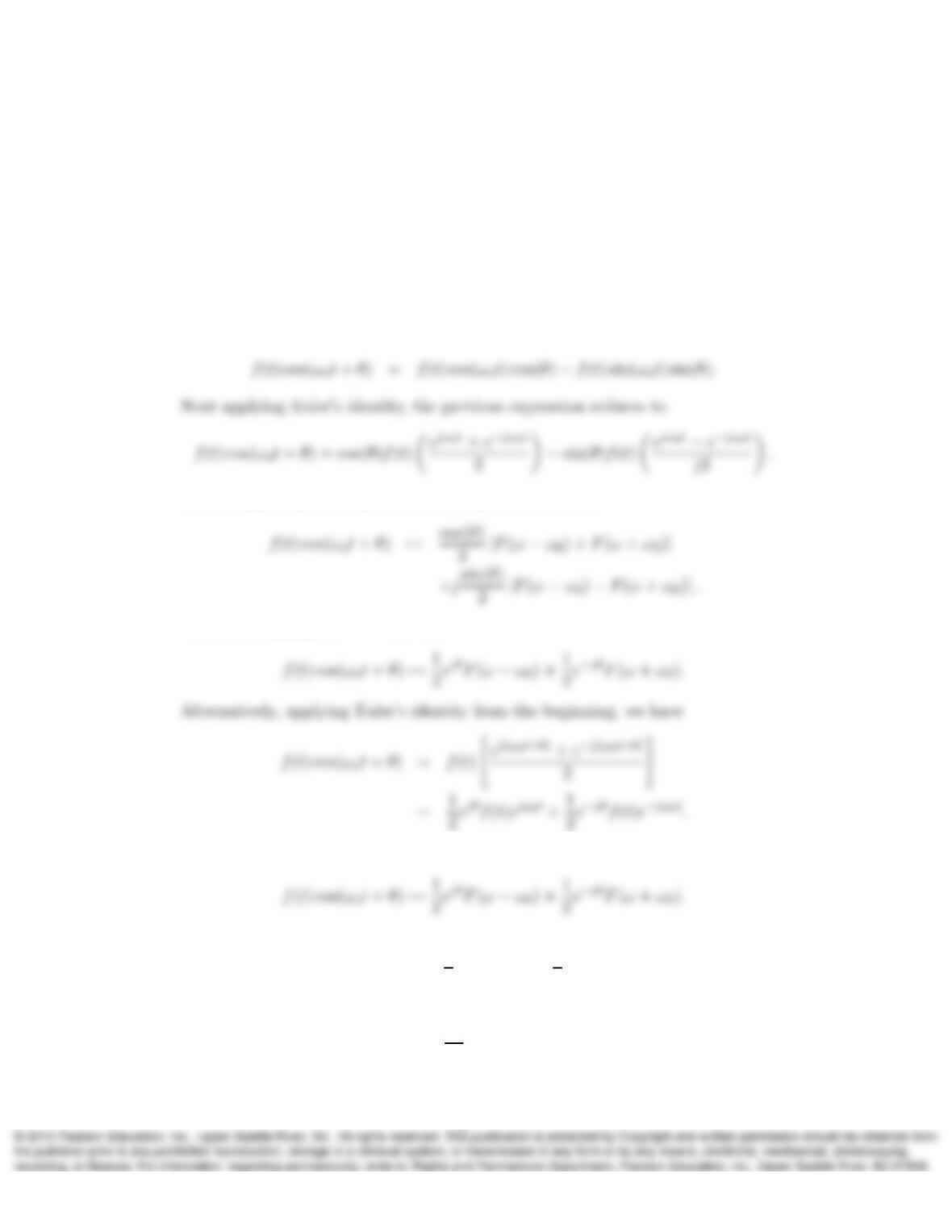
Using Euler’s identity, we have
1
3. Given that
cos(ωot+θ) = cos(ωot) cos(θ)−sin(ωot) sin(θ),
determine the Fourier transform of
f(t) cos(ωot+θ).
Hint: Use the multiplication, addition, and modulation Fourier properties, as well
as the frequency-shift property of Problem 1.
Solution:
Applying the given trigonometric identity, we have
Finally, applying the frequency-shift property, we obtain
which rearranging can be reduced to
And applying the frequency-shift property, we obtain
4. Given that
f(t) cos(ωot)↔1
2F(ω−ωo) + 1
2F(ω+ωo),
determine the Fourier transform of
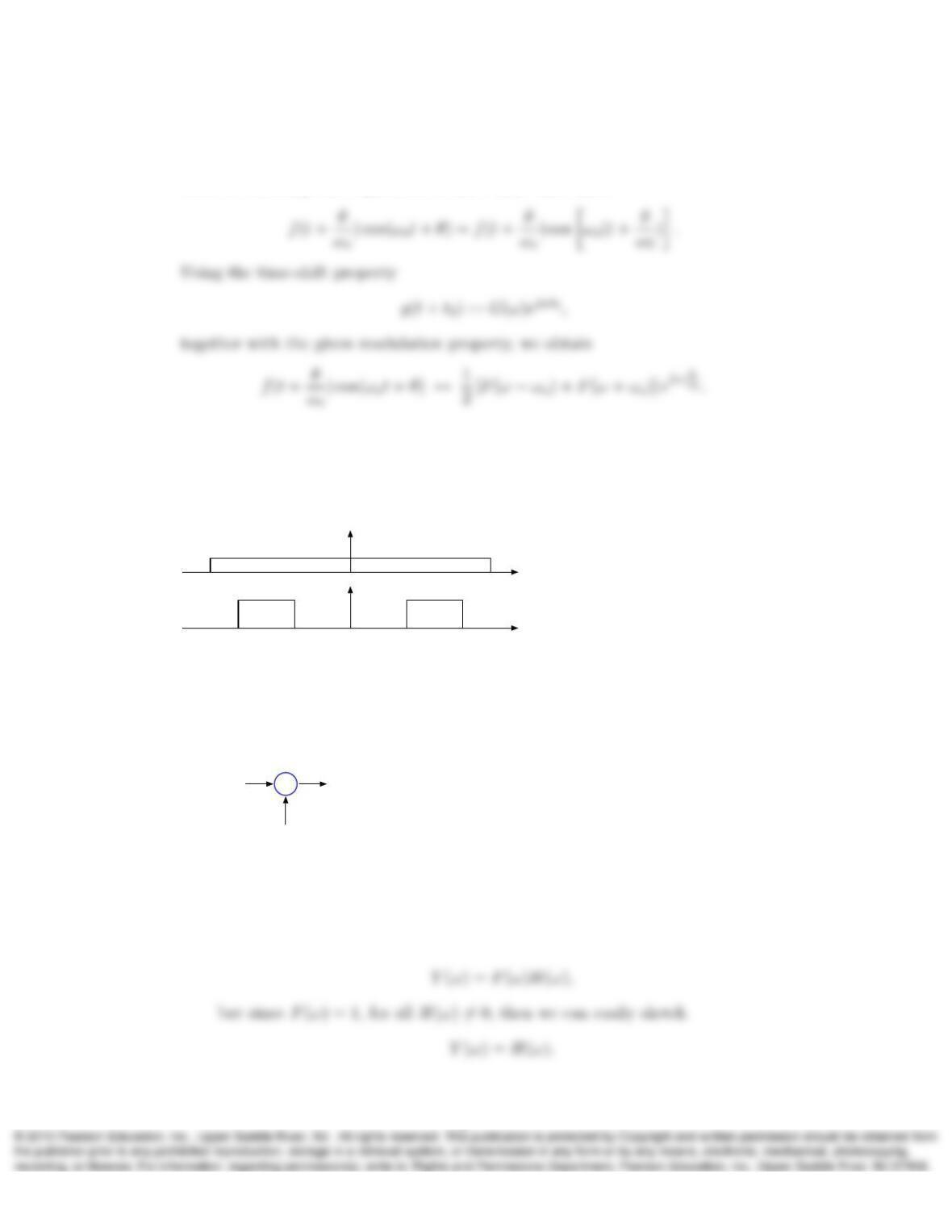
f(t+θ
ωo
) cos(ωot+θ).
2
Hint: Use the time-shift property.
Solution:
First we rearrange the expression to have same time shifts
5. A linear system with frequency response H(ω)is excited with an input
f(t)↔F(ω).
H(ω)and F(ω)are plotted below:
1
ωrad/s
ωrad/s
F(ω)
H(ω)
4π
4π
8π
8π
2
a) Sketch the Fourier transform Y(ω)of the system output y(t)and calculate
the energy Wyof y(t).
b) It is observed that output q(t)of the following system equals y(t)determined
in part (a).
×
cos(ωot)
p(t)q(t)
Sketch P(ω)and determine ωo.
Solution:
a) The output of the system is
3
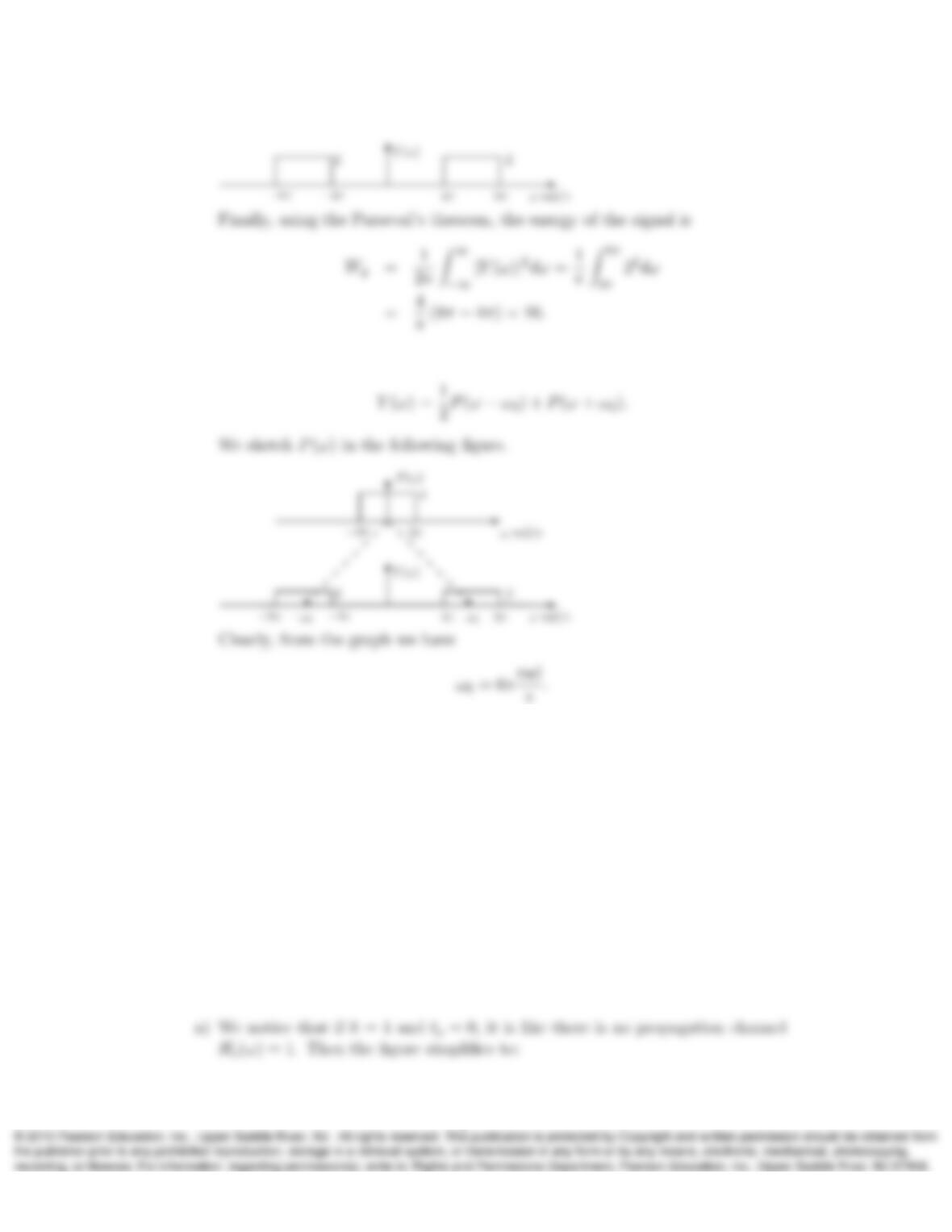
b) Using the modulation property, we have
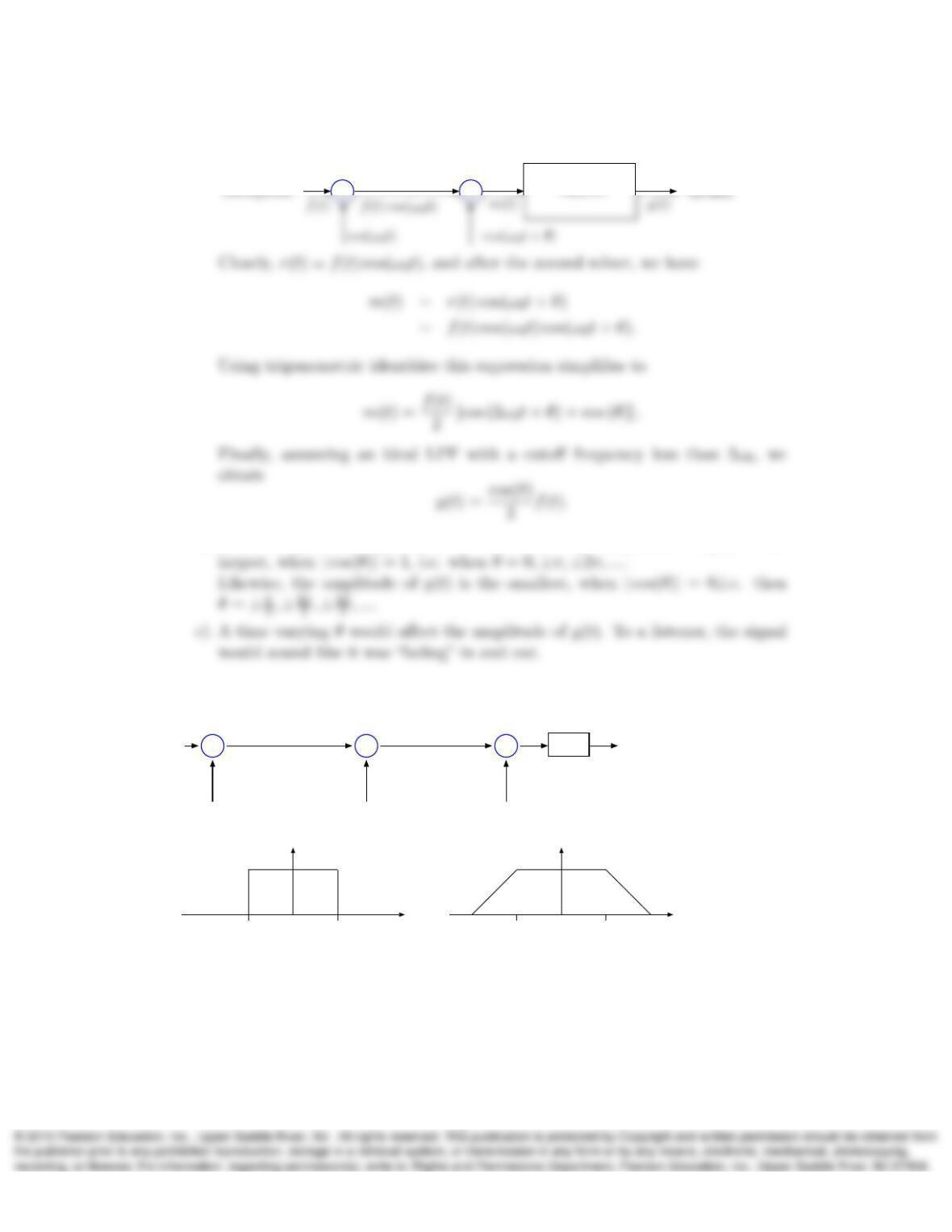
6. It was indicated that the coherent demodulation scheme depicted in Figure 8.6a
does not perform properly when the phase of the demodulating carrier signal is
mismatched to the phase of the modulating carrier. In Figure 8.6a, suppose k= 1
and to= 0, but that the demodulating carrier is cos(ωot+θ),where θis the phase
mismatch.
a) Find an expression for y(t)in terms of f(t)and θ.
b) For what values of θis the amplitude of y(t)the largest and smallest?
c) Explain how a time-varying θwould affect the sound that you hear com-
ing from the loudspeaker. This should help you understand why a coherent-
demodulation receiver requires precise tracking of the carrier phase.
Solution:
4
r(t)
Transmitter Receiver
HLPF(ω)
b) From the previous expression we notice that the amplitude of y(t)is the
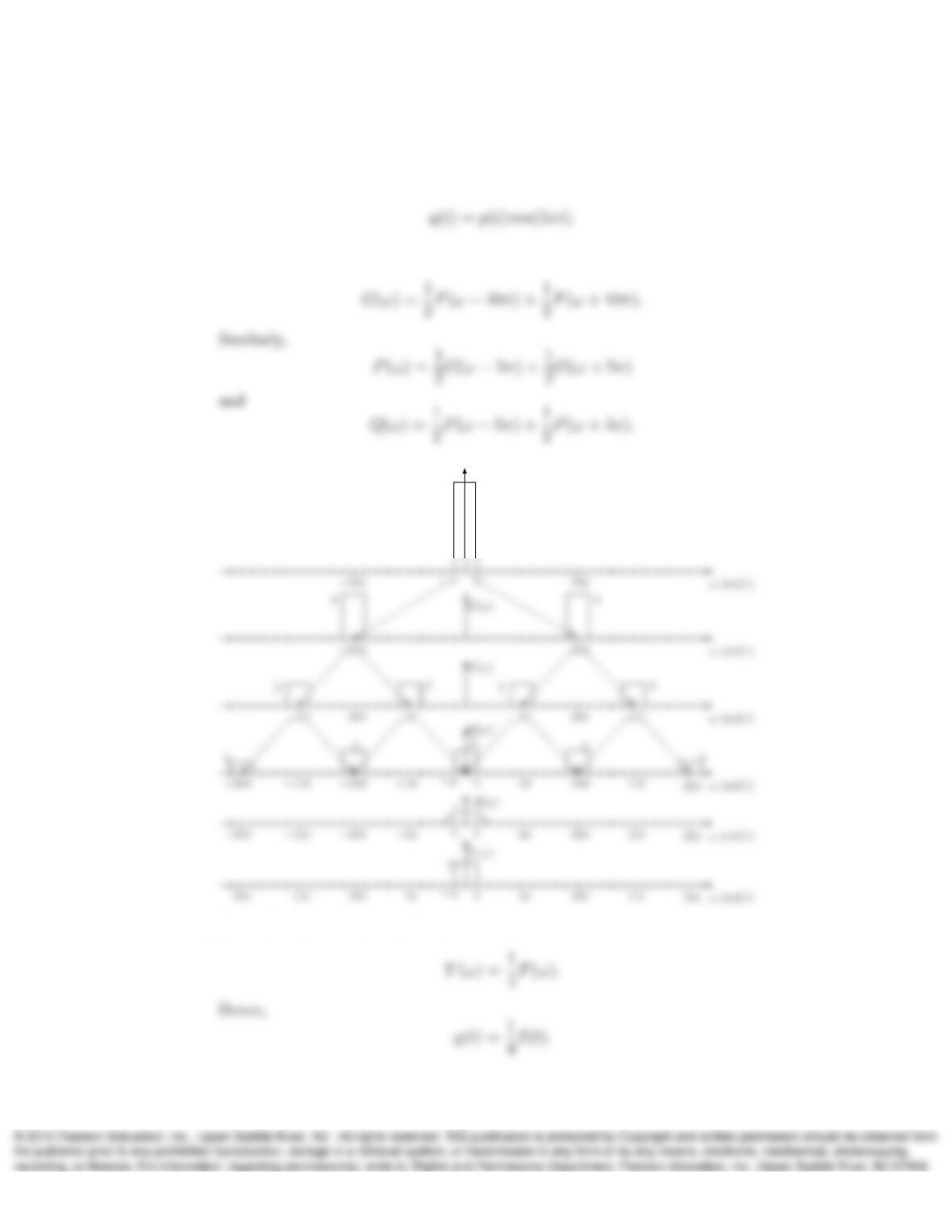
7. Consider the following system
× × × H(ω)
g(t) = f(t) cos(10πt)p(t) = g(t) cos(5πt)q(t)y(t)
f(t)
cos(10πt) cos(5πt) cos(5πt)
where F(ω)and H(ω)are as shown below:
8
πrad/s
−πrad/s
ω
F(ω)
1
2πrad/s
−2πrad/s
ω
H(ω)
π
a) Express q(t)in terms of p(t).
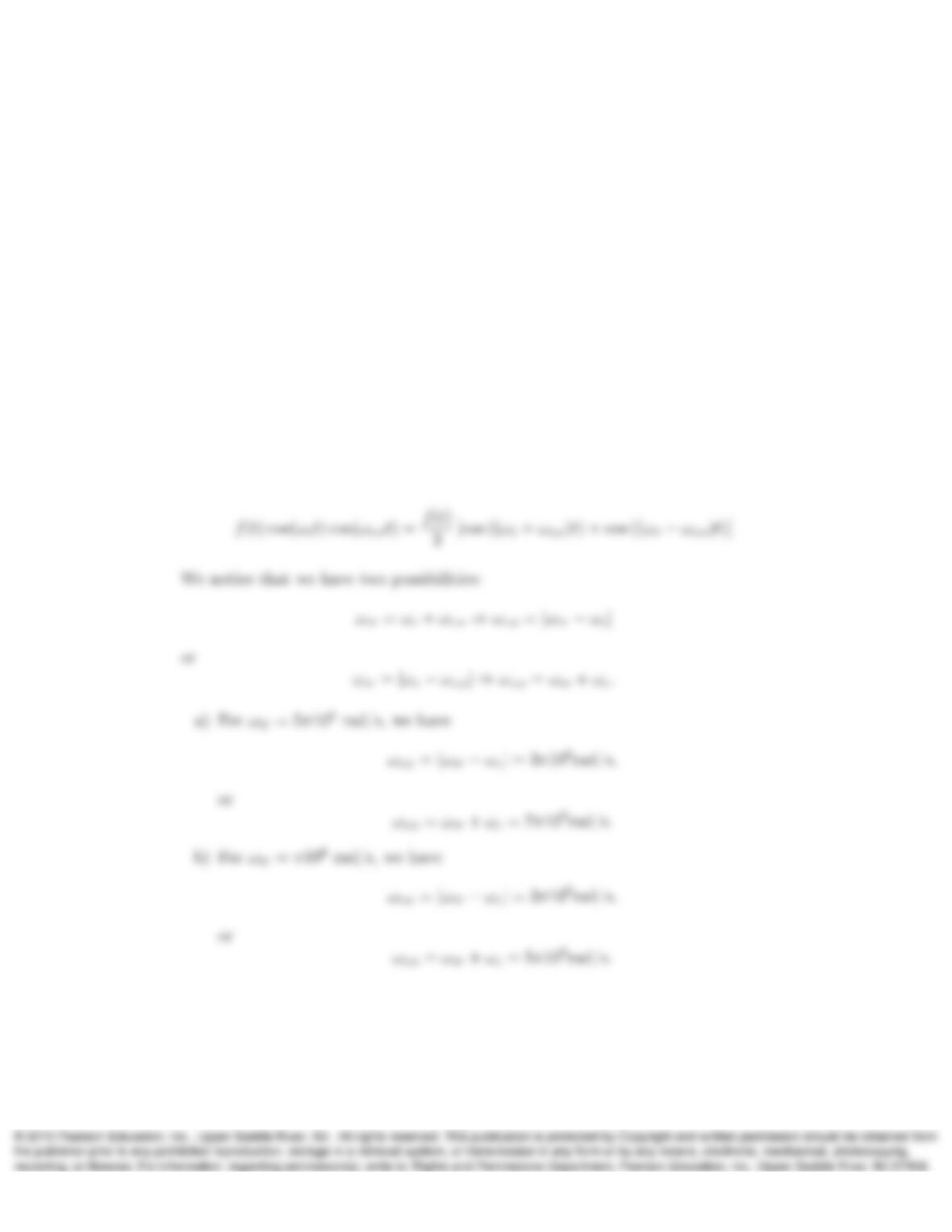
b) Sketch the Fourier transforms G(ω),P(ω),Q(ω), and Y(ω).
c) Express y(t)in terms of f(t).
5
Solution:
a) Clearly, after the third mixer, we have
b) Since, g(t) = f(t) cos(10πt), then
8
F(ω)
c) From the figure we notice that
6
8. We wish to hetero-dyne an AM signal
f(t) cos(ωct)
into an IF band, with a center frequency ωIF, by mixing it with a signal
cos(ωLOt).
Assume that an IF filter with twice the bandwidth of the low-pass signal f(t), as in
our discussion of AM receiver systems in Section 8.4. Determine all of the usable
values of ωLO if:
a) ωc= 2π106and ωIF = 5π106rad/s.
b) ωc= 4π106and ωIF =π106rad/s.
Solution:
After mixing, we have
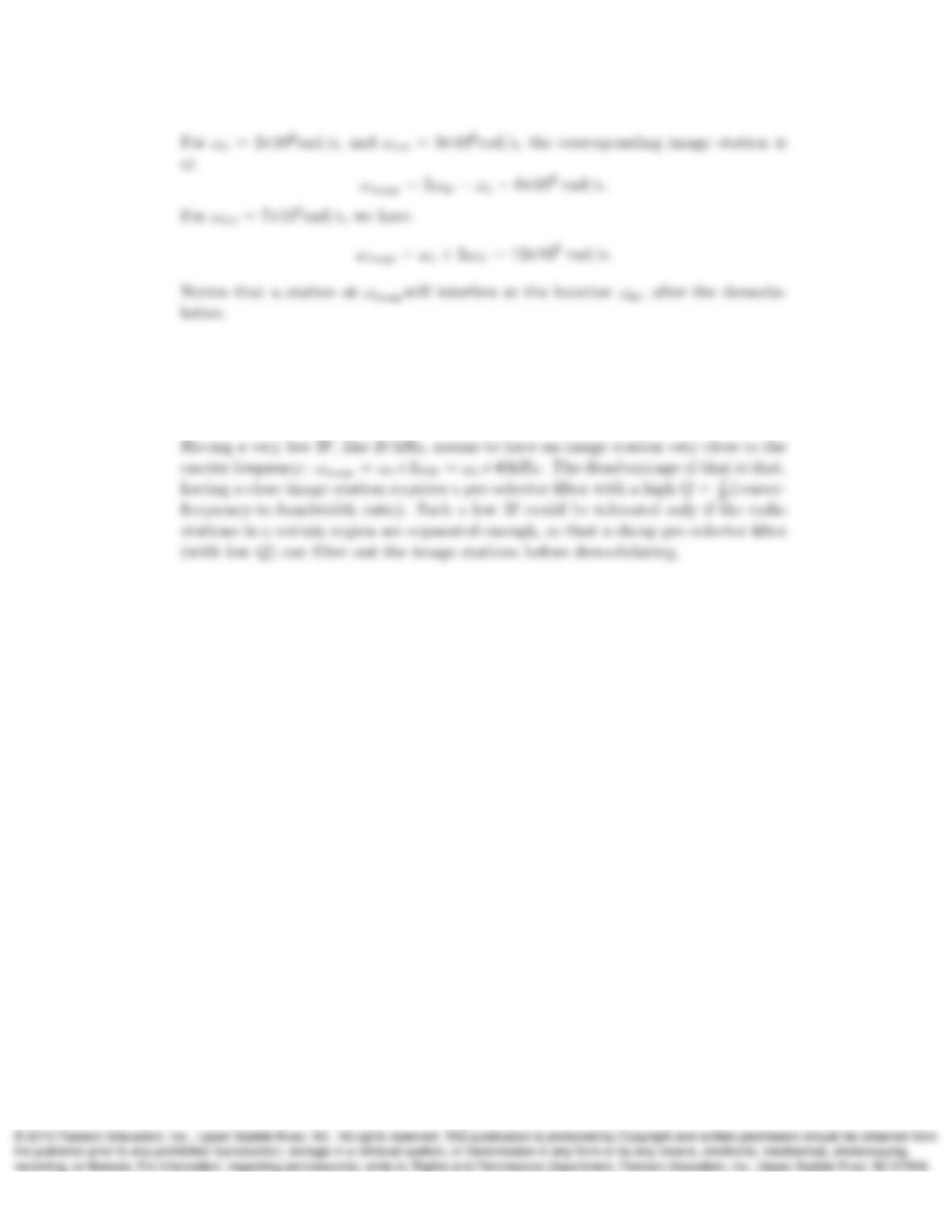
9. For each possible choice of ωLO in Problem 8(a) above, determine the carrier fre-
quency of the corresponding image station.
Solution:
7
10. What would be a disadvantage of using a very low IF, say, fIF = 20 kHz, in AM
reception? Also, under what circumstances could such a low IF be tolerated? Hint:
Think of image station interference issues.
Solution:
8