Chapter 7
1. a) Given that f(t) = e−a(t−to)u(t−to), where a > 0, determine the Fourier
transform F(ω)of f(t).
b) Given that
g(t) = 1
a+jt,
where a > 0, determine the Fourier transform G(ω)of g(t)by using the
symmetry property and the result of part (a).
c) Confirm the result of part (b) by calculating g(t)from G(ω)using the inverse
Fourier transform integral.
Solution:
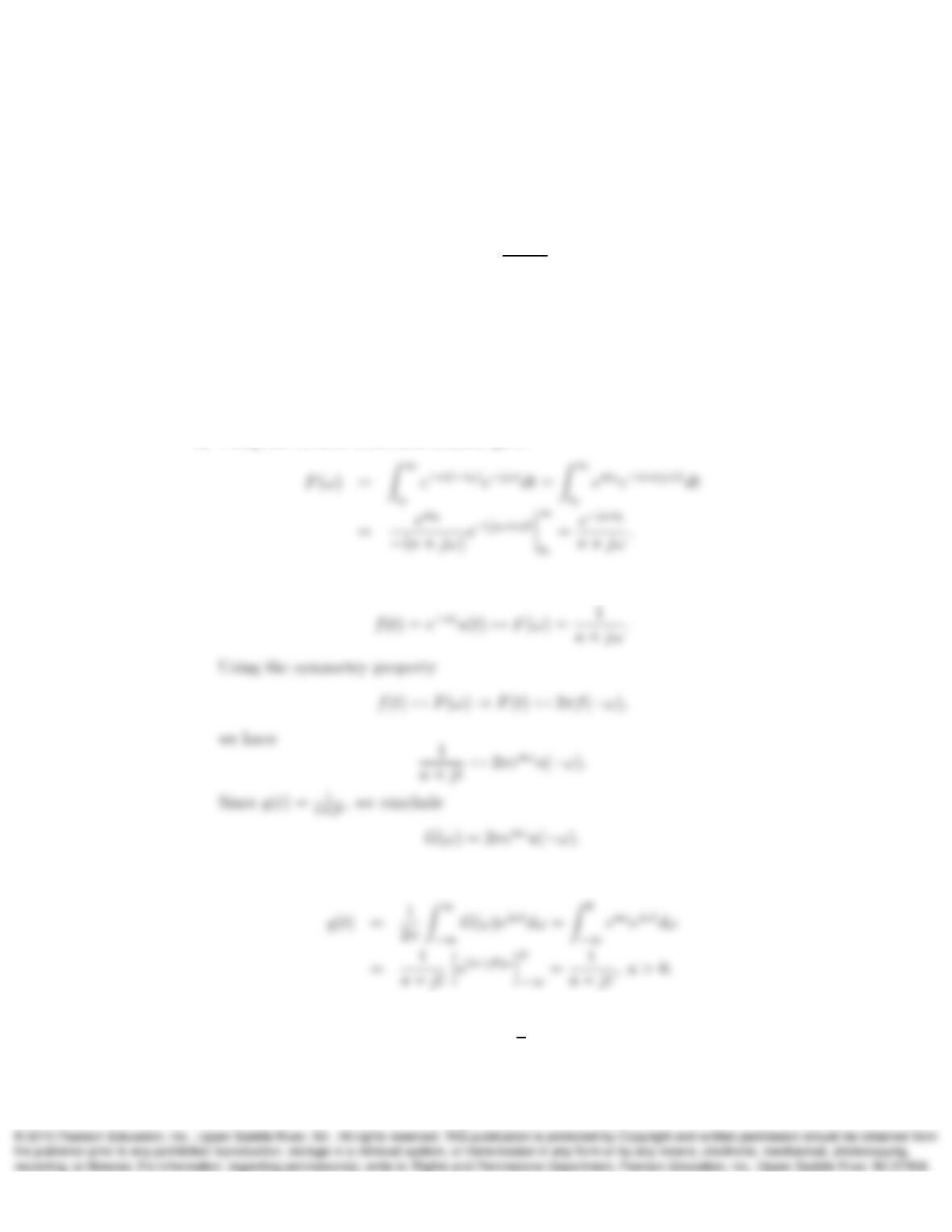
a) Using the Fourier transform formula gives
b) From part (a) making t0= 0, we have
c) Calculating g(t)from G(ω),
2. Let
f(t) = rect(t
2).
1
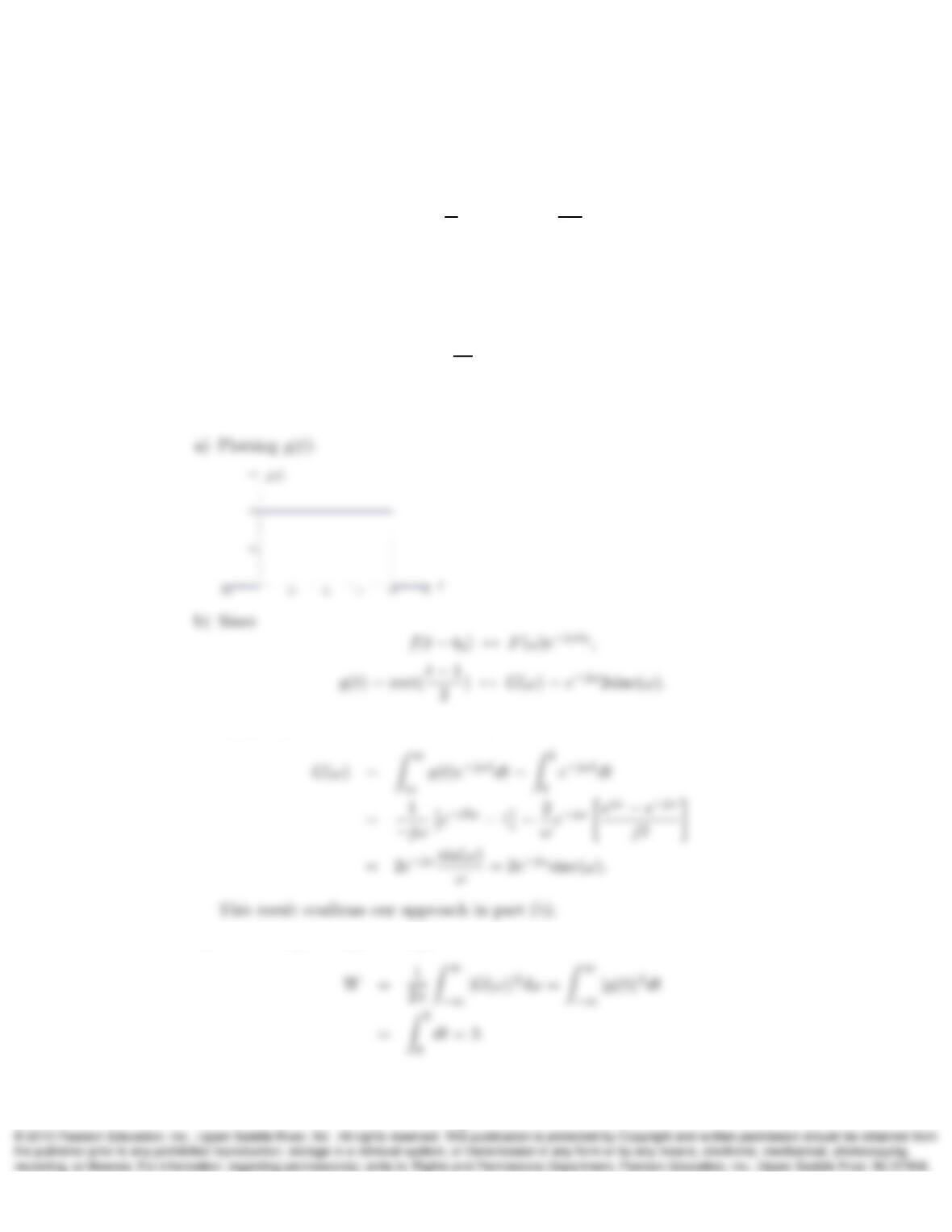
a) Plot g(t) = f(t−1).
b) Determine the Fourier transform G(ω)by using the time-shift property and
the fact that
rect(t
T)↔Tsinc(ωT
2).
c) Determine G(ω)by direct Fourier transformation (integration) of g(t)and
confirm that (b) is correct.
d) Taking advantage of Parseval’s theorem (Table 7.1, entry 16), determine the
signal energy
W=1
2πZ∞
−∞ |G(ω)|2dω.
Solution:
c) Applying the Fourier transform integral
d) Calculating the signal energy:
2
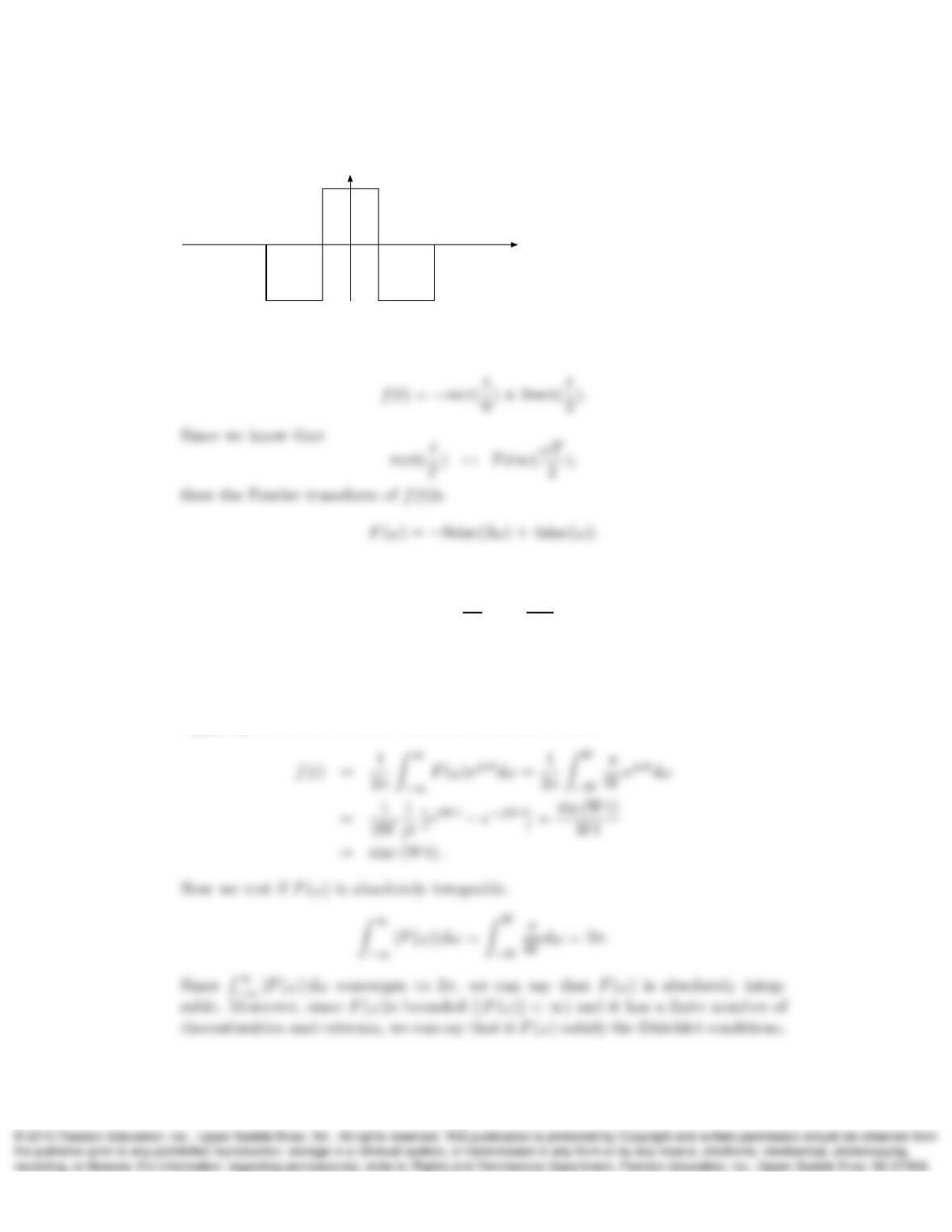
3. Determine the Fourier transform F(ω)of the following signal f(t):
f(t)
1
1
2 3−3−2
−1
−1
Solution:
Using the definition of rect function we can express f(t)as
4. Determine the inverse Fourier transform of
F(ω) = π
Wrect ω
2W
by direct integration. Is F(ω)absolutely integrable? Does it satisfy the Dirichlet
conditions?
Solution:
Applying the inverse Fourier transform formula, we have
3
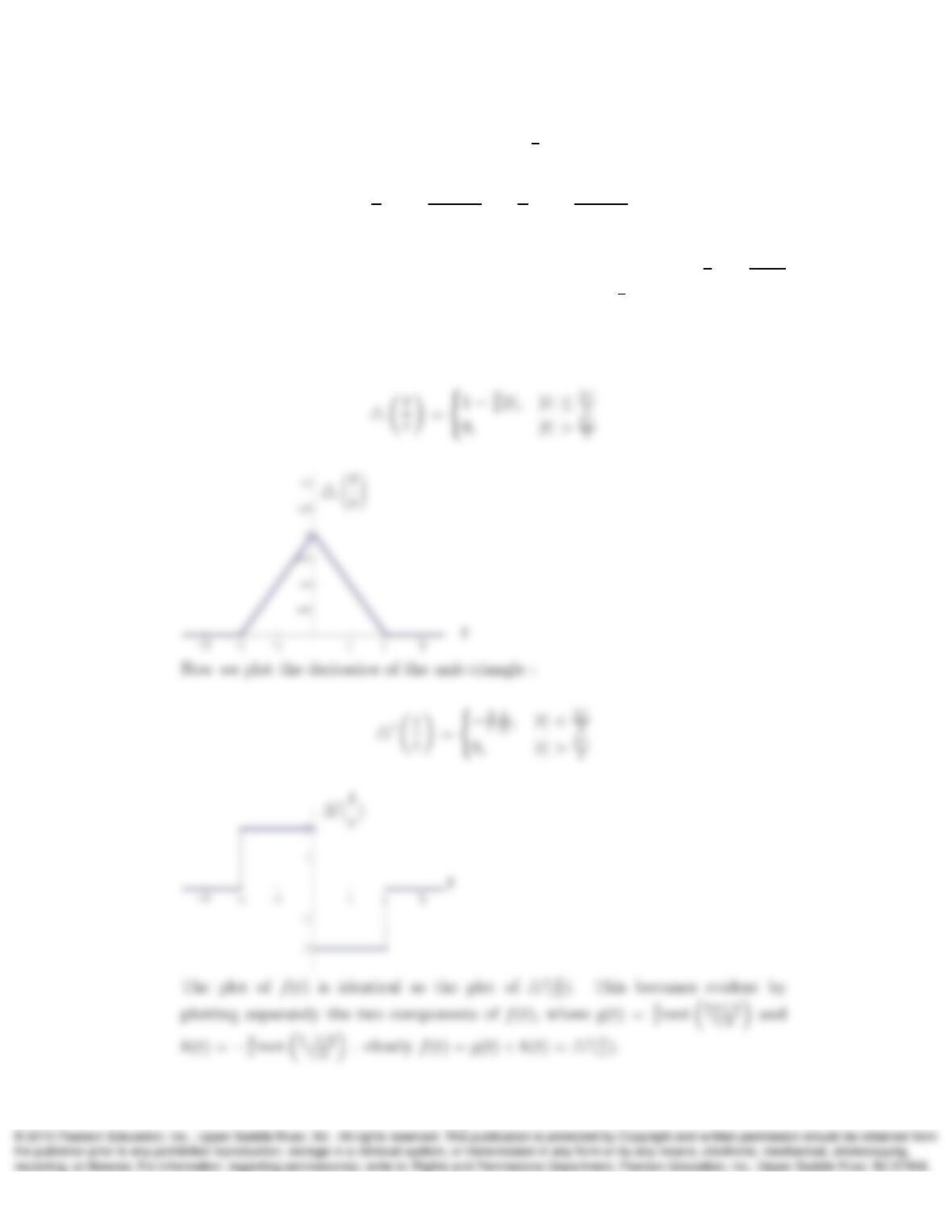
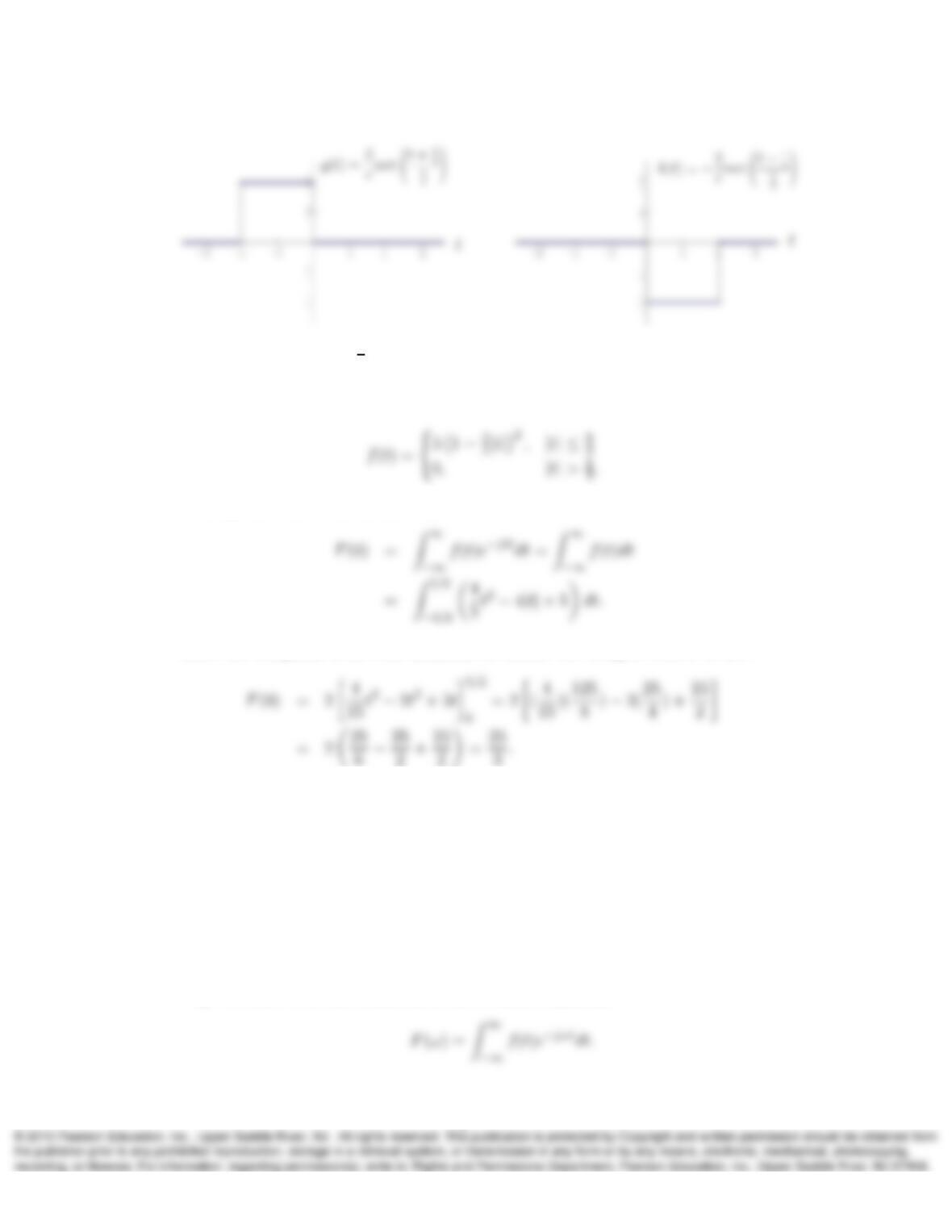
5. Plot the time derivative of the unit triangle △(t
τ), and the function
f(t) = 2
τrect t+τ/4
τ/2−2
τrect t−τ/4
τ/2,
to show that they are equivalent. In plotting f(t), superpose the plots of 2
τrect(t±τ/4
τ/2),
which you obtain by shifting and scaling the graph of rect(t
τ).
Solution:
We plot the unit-triangle as a reference:
4
6. Given that f(t) = 5△2(t
5), evaluate the Fourier transform F(ω)at ω= 0.
Solution:
We can express f(t)as
Finding the Fourier transform at ω= 0,
Since the integrand is an even function, we double the integral from 0 to 5/2 :
7. a) Show that for real-valued signals f(t), the Fourier transform F(ω)satisfies the
property
F(−ω) = F∗(ω).
b) Using this result, show that for real-valued f(t), we have |F(−ω)|=|F(ω)|
and ∠F(−ω) = −∠F(ω) (i.e. that the magnitude of the Fourier transform is
even and the phase is odd).
Solution:
a) We start with the definition of the Fourier transform
5
From that we get
b) F(ω)can be written as
8. On an exam, you are asked to calculate F(0) for some real-valued signal f(t). You
obtain the answer F(0) = 4 −j2. Explain why, for sure, you have made a mistake
in your calculation.
Solution:
As proved in the previous question, we have the Hermitian property for real f(t):
6
9. Show that, given a real-valued signal f(t), the inverse Fourier transform integral
can be expressed as
f(t) = 1
2πZ∞
0
2|F(ω)|cos(ωt +∠F(ω))dω.
Solution:
Now using the Hermitian property , we substitute F(−ω) = F∗(ω)in the previous
equation, and rearranging, we have
10. The bandwidth Ωof a low-pass signal f(t)↔F(ω)is defined by the constraint
1
2πZΩ
−Ω|F(ω)|2dω = 0.8Wf,
where Wfdenotes the energy of signal f(t).
7
a) What fraction of the signal energy Wfis contained in the frequency band
0< ω < Ω? Explain.
b) The signal f(t)is filtered using a linear system with a frequency response
H(ω)satisfying H(ω) = 0 for |ω|<Ωand |H(ω)|= 1 for |ω| ≥ Ω. What is
the total energy of the system output y(t)in terms of the energy Wfof the
input f(t)?
Solution:
a) If f(t)is real, then |F(ω)|2is an even signal. Therefore, the energy contained
in the frequency band 0< ω < Ωequals the energy contained in −Ω< ω < 0,
b) The total energy of the system output can be obtained by
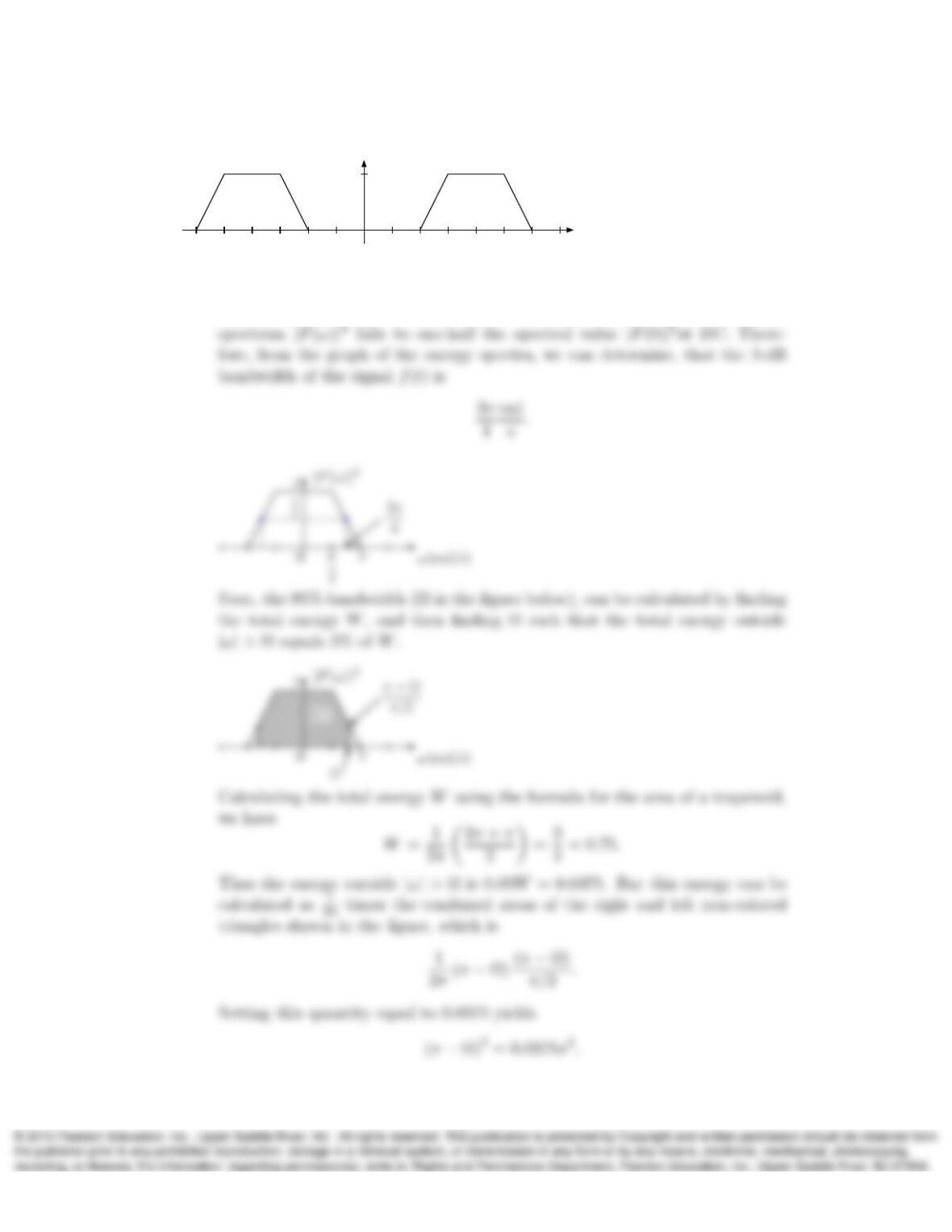
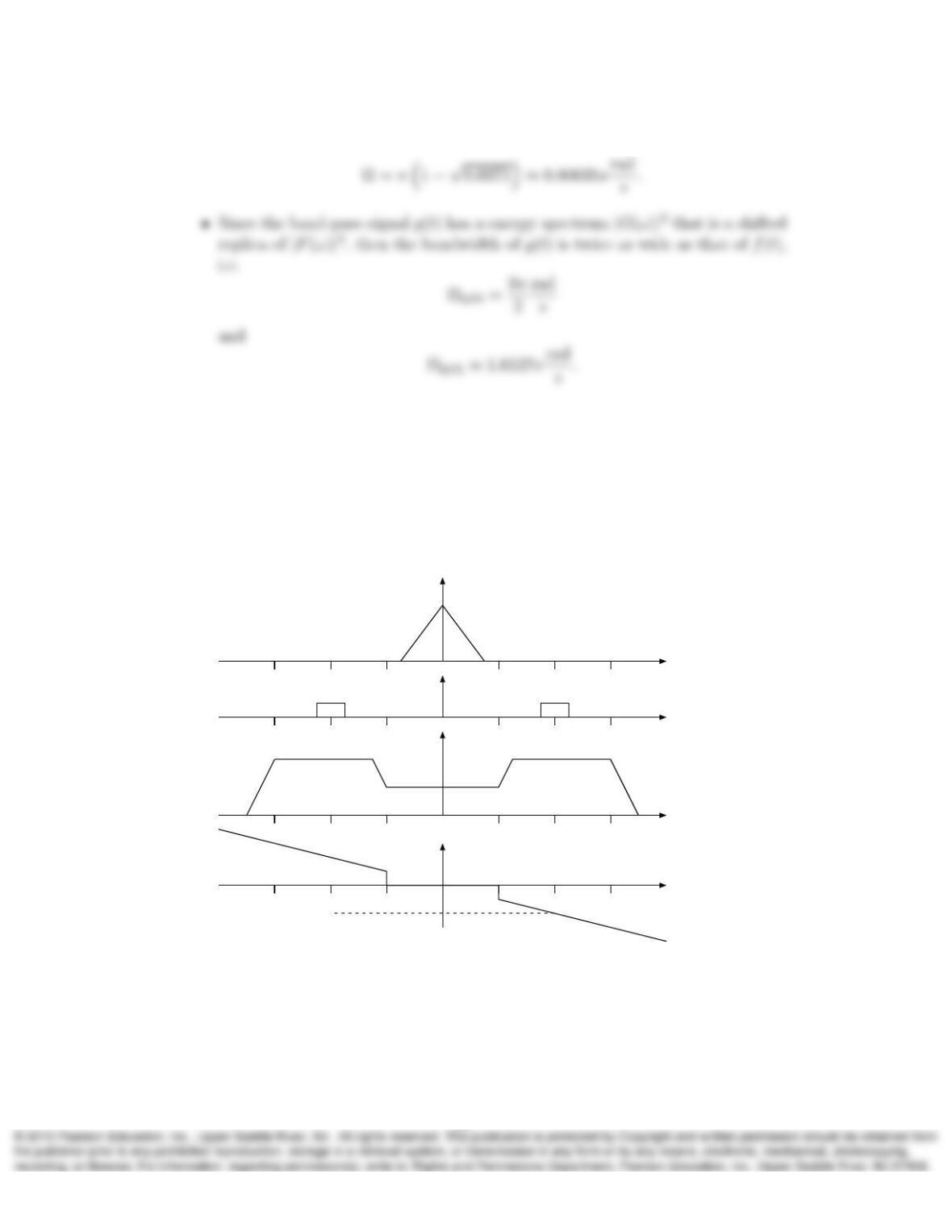
11. Determine the 3-dB bandwidth and the 95%-bandwidth of signals f(t)and g(t)
with the following energy spectra:
ω(rad/s)
|F(ω)|2
0
1
π
π
2
8
|G(ω)|2
0
1
ω(rad/s)
π2π3π−2π
Solution:
•For a low-pass signal, the 3-dB bandwidth is the frequency where the energy
9
Hence,
12. a) Let f(t) = f1(t) + f2(t)such that f1(t)↔F1(ω)and f2(t)↔F2(ω). Show
that
f(t)↔F1(ω) + F2(ω).
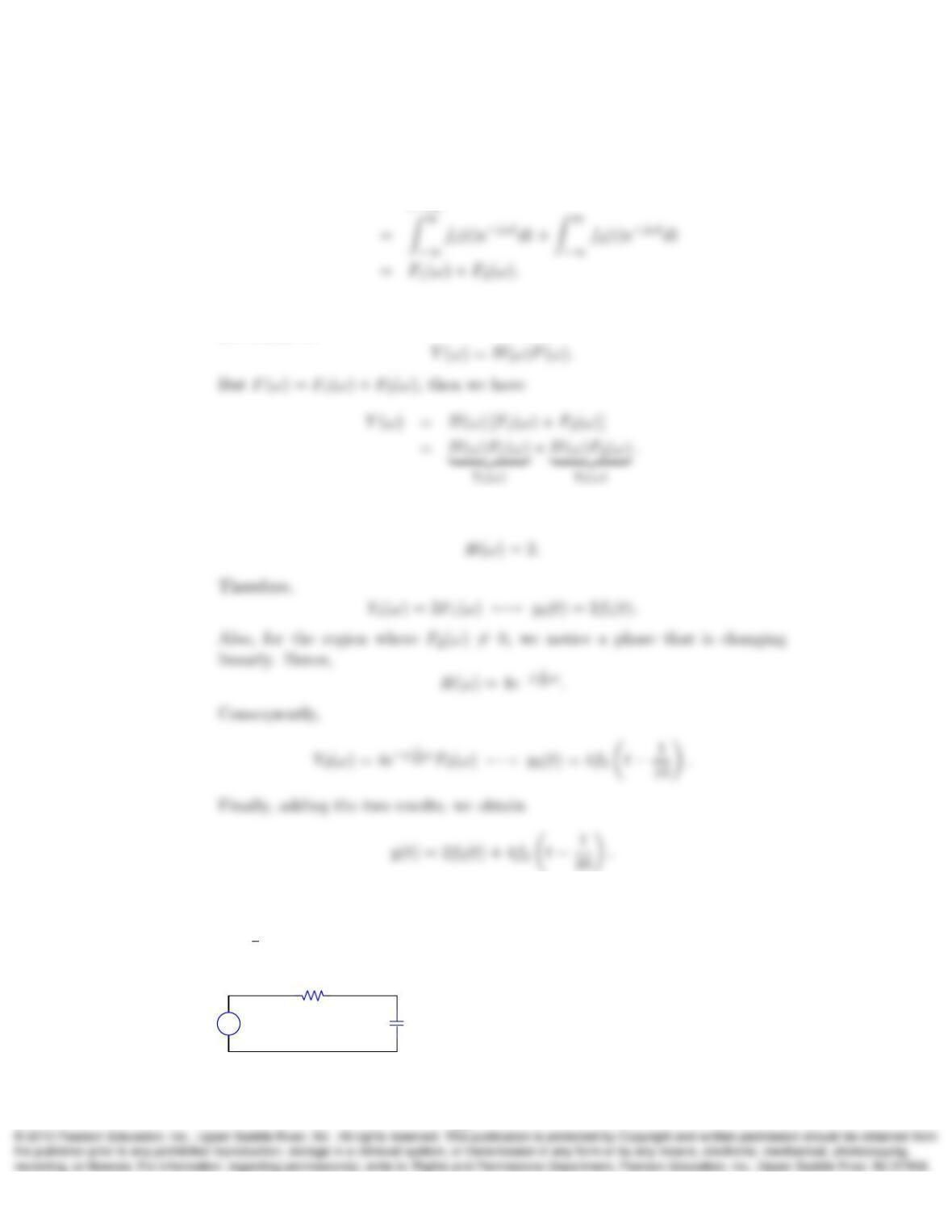
b) The input signal of an LTI system with a frequency response H(ω) = |H(ω)|ejχ(ω)
is f1(t) + f2(t). Functions F1(ω),F2(ω),H(ω)and χ(ω)are given graphically
as follows:
4
F1(ω)
F2(ω)
|H(ω)|
χ(ω)
10πrad/s
−10πrad/s
2
−πrad
−10πrad/s
−10πrad/s
−10πrad/s
10πrad/s
10πrad/s
10πrad/s
ω
ω
ω
ω
Express the output y(t)of the system as a superposition of scaled and/or
shifted versions of f1(t)and f2(t). (Hint: y(t) = y1(t) + y2(t), with Y1(ω) =
H(ω)F1(ω)and Y2(ω) = H(ω)F2(ω).)
Solution:
10
a) Proving the addition property of the Fourier transform:
F(ω) = Z∞
−∞
(f1(t) + f2(t)) e−jωtdt
b) We know that in an LTI system, the input and output in the Fourier domain
are related as
Now, for the region where F1(ω)6= 0, we have
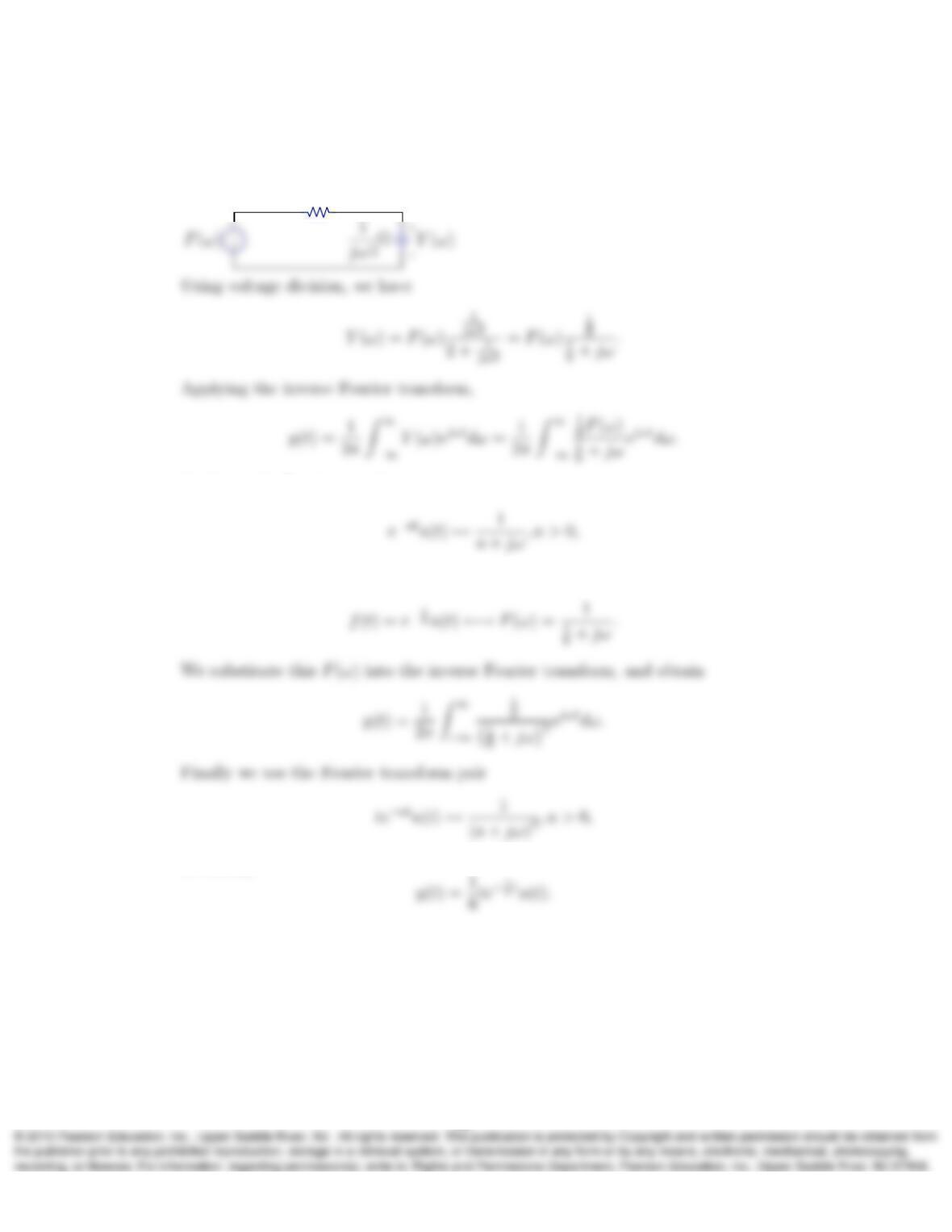
13. Determine the response y(t)of the circuit shown below with an arbitrary input
f(t)in the form of an inverse Fourier transform and then evaluate y(t)for the case
f(t) = e−t
6u(t)V.
+
–y(t)
f(t)
2Ω
+
–
3 F
11
Solution:
The equivalent circuit in the Fourier domain is
2Ω
Applying the Fourier transform pair
to the input function yields
to obtain,
12