Chapter 6
1. Plot the following periodic functions over at least two periods and specify their
period Tand fundamental frequency ωo=2π
T:
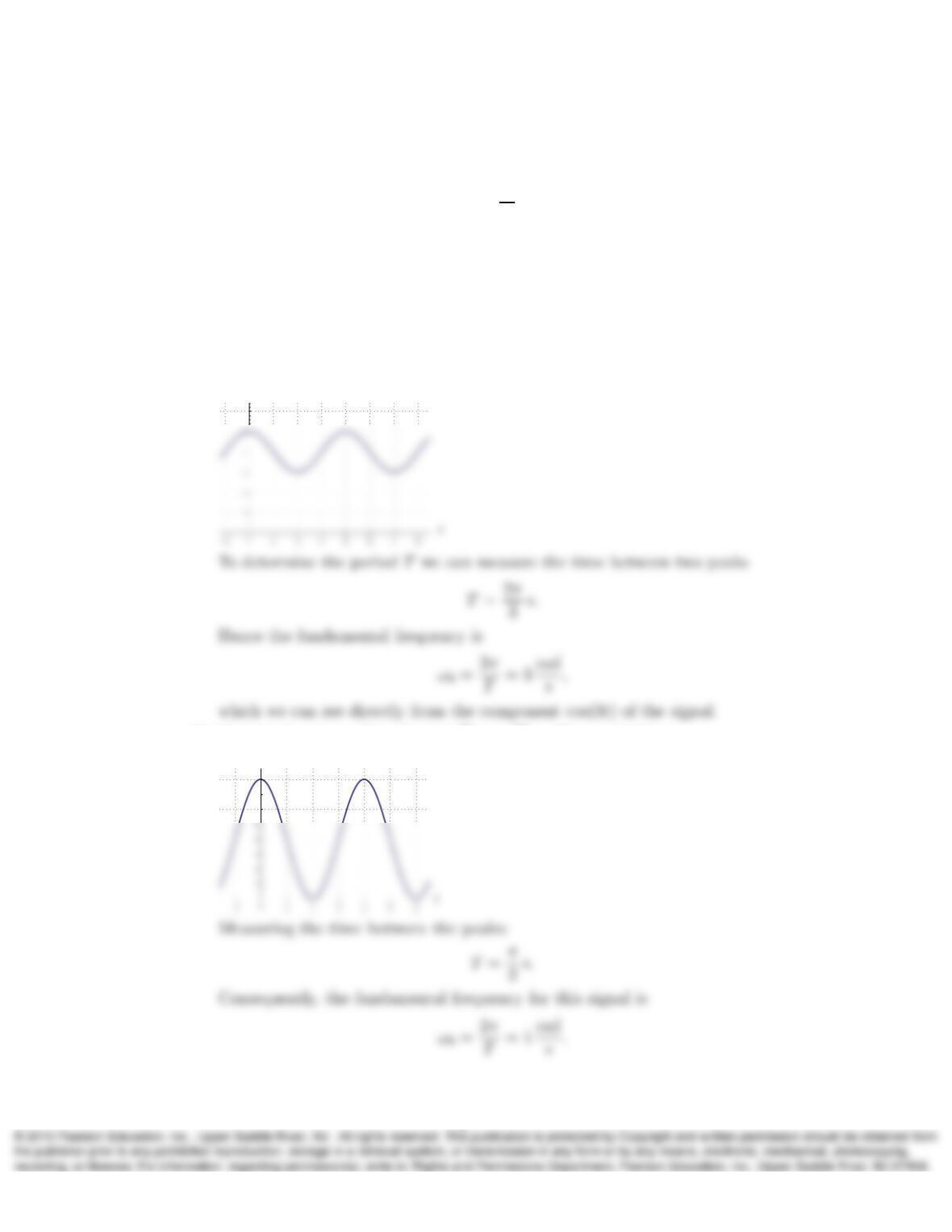
a) f(t) = 4 + cos(3t).
b) g(t) = 8 + 4e−j4t+ 4ej4t.
c) h(t) = 2e−j2t+ 2ej2t+ 2 cos(4t)
Solution:
a) Plotting function f(t):
6
f(t)
b) Plotting function g(t) = 8 + 4e−j4t+ 4ej4t= 8(1 + cos(4t)):
g(t)
12
14
16
1
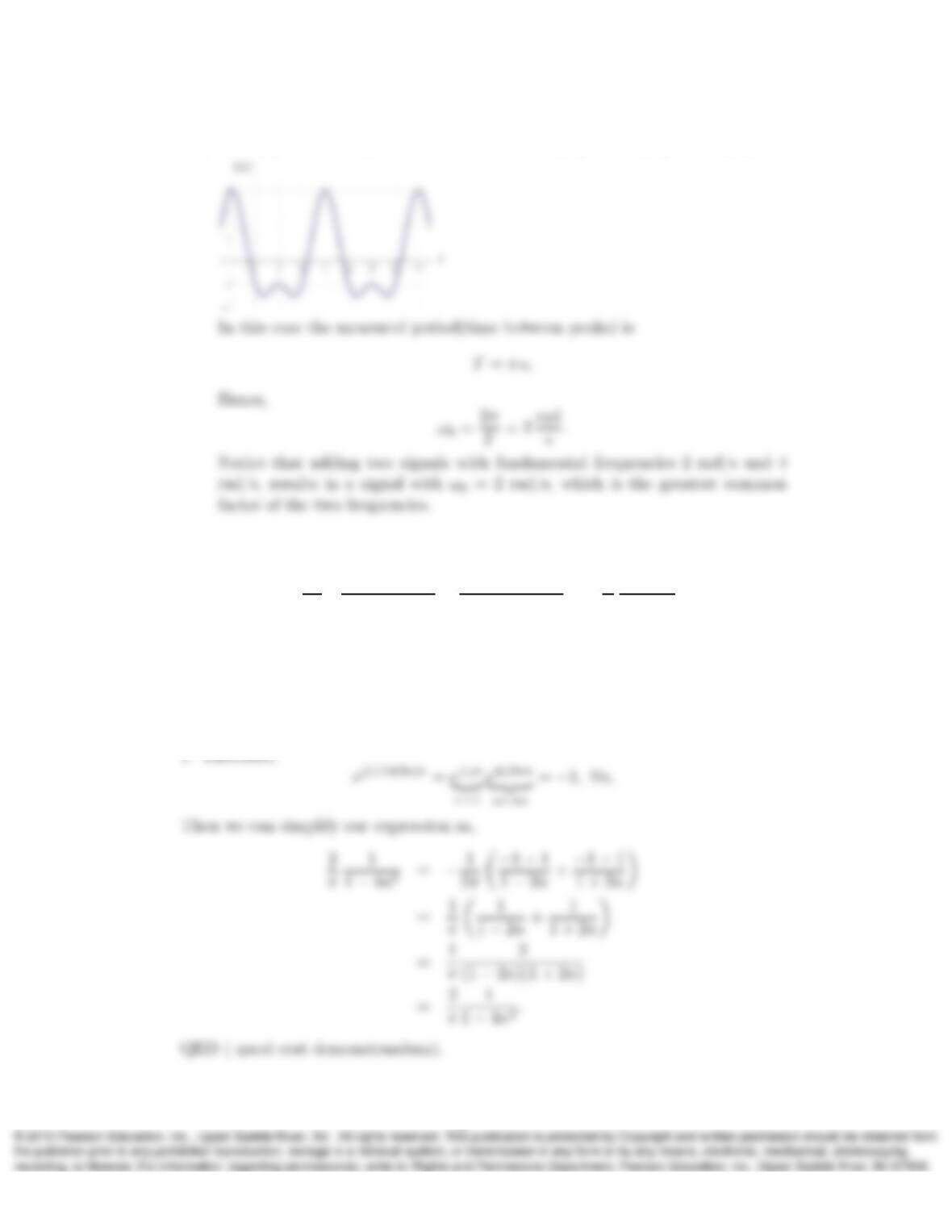
c) Plotting function h(t) = 2e−j2t+ 2ej2t+ 2 cos(4t) = 4 cos(2t) + 2 cos(4t):
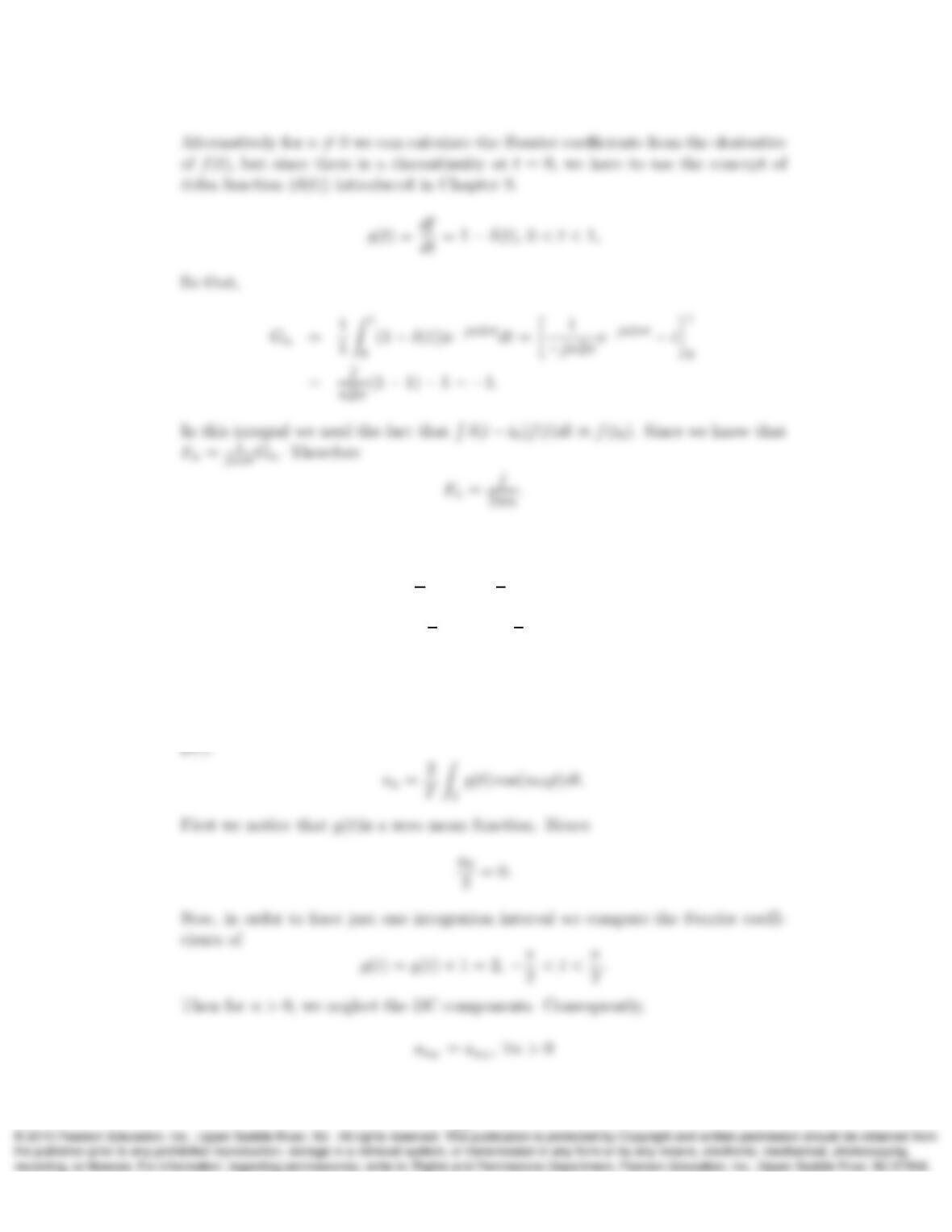
2. Show that (from Example 6.5)
−1
2π ej(1−2n)π−1
1−2n+e−j(1+2n)π−1
1 + 2n!=2
π
1
1−4n2
for all integers nand explain each step of the derivation carefully. You will be
expected to perform similar simplifications when you make Fourier coefficient cal-
culations.
Solution:
Since complex exponentials are periodic on 2π, then ej2nπwill be the same as ej0=
2
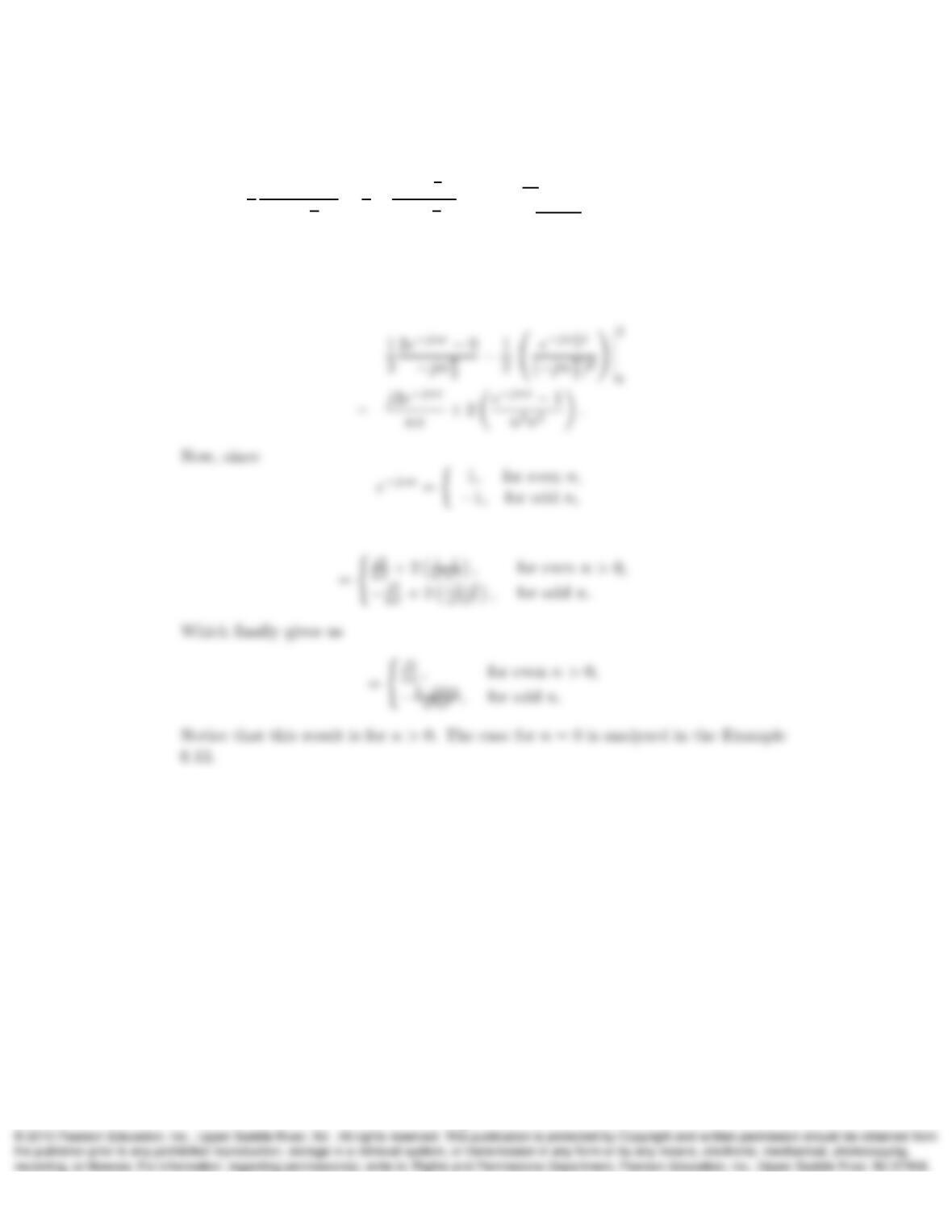
3. Show that (from Example 6.13 in Section 6.2.4)
1
2
2e−jnπ −0
−jnπ
2−1
2 e−jn π
2t
(−jn π
2)2!
2
0
=(j2
πn ,for even n > 0,
−4+j2πn
π2n2,for odd n.
Explain each step of the derivation carefully.
Solution:
First we evaluate the integral limits
the previous expression reduces to
4. The function f(t)is periodic with a period of T= 4 s. Between t= 0 and t= 4s
the function is described by
f(t) = 1,0< t < 2s
2,2< t < 4s.
a) Plot f(t)between t=−4s and t= 8 s.
b) Determine the exponential Fourier coefficients Fnof f(t)for n= 0,n= 1,
and n= 2.
c) Using the results of part (b) determine the compact-form Fourier coefficients
c0,c1, and c2.
Solution:
3
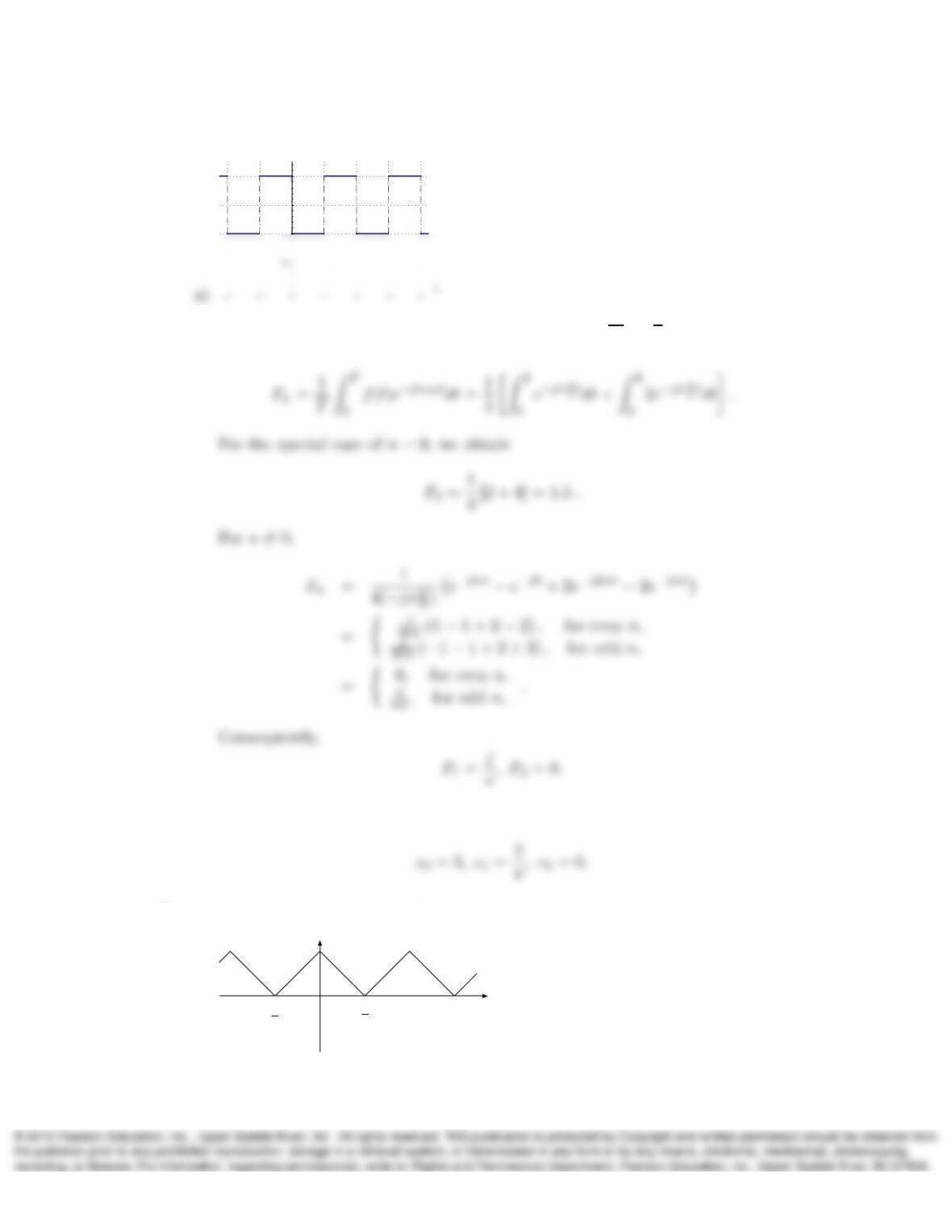
f(t)
1.5
2.0
b) Since T= 4 s, the fundamental frequency is ω0=2π
T=π
2. Therefore, the
Fourier coefficients are
c) We know that cn= 2|Fn|, then
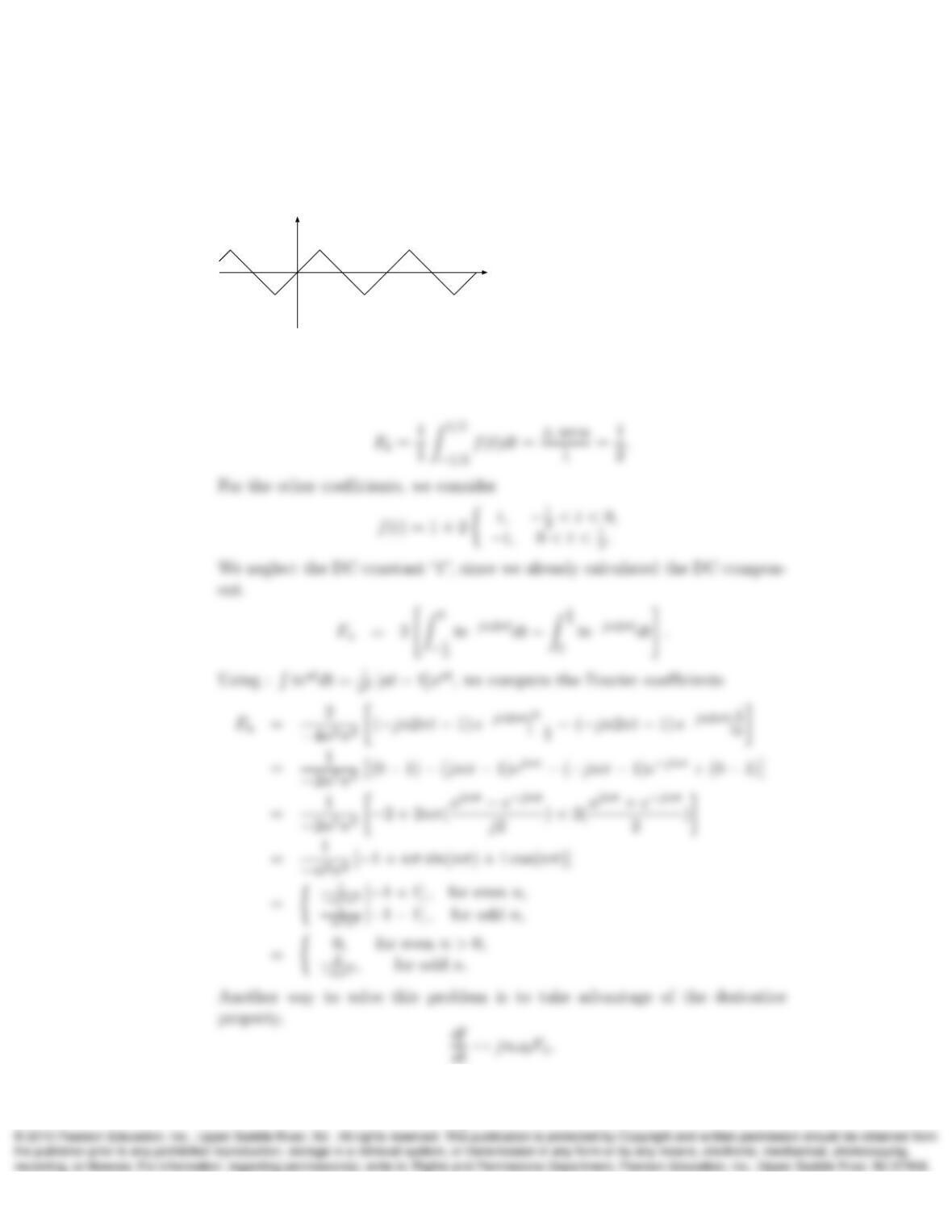
5. a) Calculate the exponential Fourier series of f(t)plotted below.
1
t
f(t)
1
2s
−1
2s
4
b) Express the function g(t), shown next, as a scaled and shifted version of the
function f(t)from part (a) and determine the Fourier series of g(t)by using
the scaling and time-shift properties of the Fourier series. Simplify your result
as much as you can.
4
t
g(t)
1 s
−4
Solution:
a) Since T= 1s, then ω0= 2πrad/s.
5
Taking the derivative to f(t), we have
Clearly we notice that to take the Fourier coefficients to h(t)is easier than to
f(t):
From the derivative property we obtain
F0=1
2is DC component that we calculate at the beginning. Having the
Fourier coefficients we can write the Fourier series of f(t)as
b) Scaling the original signal by 8 and time shifting it by 1
4we obtain g(t):
6

Hence,
6. a) Suppose a periodic signal f(t)is differentiable and g(t)≡df
dt . Express Gn, the
Fourier series coefficients of function g(t), in terms of the Fourier coefficients
Fnof f(t).
b) Determine the exponential Fourier series of the function h(t)plotted below.
Hint: If you already have solved Problem 5, then note that the derivative of
signal f(t)in that problem is related to h(t).
2
t
h(t)
1
2s
−1
2s
−2
c) Using the result of part (b), determine the exponential Fourier series of the
following signal s(t), assuming that T= 1 s:
t
s(t)
A
−A
T
d) Repeat part (c) for an arbitrary T.
Solution:
a) We know from the derivative property
7
We can prove the derivative property as follows
8
7. a) The function
z(t) = 6 + 3 cos(4t) + 2 sin(5t)
is periodic with a period T= 2πs and has fundamental frequency ωo=
1rad/s. Determine the Fourier series coefficients Z0,Z1,Z2,Z3,Z4, and Z6.
What is Z−4?
b) What is the period of the function
q(t) = 5 sin(4t) + 3 cos(6t)
and how can the function be expressed in exponential Fourier series form?
c) Determine the average power Pzand Pqof signals z(t)and q(t)and plot their
power spectra versus harmonic frequency nωoin each case.
Solution:
a) We are given the period T= 2πs. Therefore, ω0= 1rad/s, that we could have
also calculated as the greatest common factor between 4 and 5 rad/s. The
periodic signal z(t)can be written as the following Fourier series
9
c) The average Power applying Parseval’s theorem is
Plotting the power spectra for z(t):
|Zn|2
æ
40
8. For the periodic function f(t)shown here, with exponential Fourier coefficients Fn,
determine:
3t
f(t)
4
4
10
a) Period Tand fundamental frequency ωo,
b) The DC level F0=c0
2.
c) F1,c1and θ1.
d) F2,c2and θ2.
e) The average signal power Pf.
f) THD.
Solution:
c) Calculating the Fourier coefficients
d) Since Fn=4e−jn 3π
4
nπ sin(n3π
4),
11
f) The total harmonic distortion is
9. The input signal of a linear system with a frequency response H(ω)is
f(t) = 1
2+
∞
X
n=1
1
nπ cos(2πnt +π
2).
The input f(t)and frequency response H(ω)are plotted below:
ω
t
f(t)
1
1 s
H(ω)
9πrad/s
2
a) What is the system output y(t)in response to f(t)?
b) Calculate the average power of the input and output signals f(t)and y(t).
Hint: You can use either side of Parseval’s theorem to calculate the average
power of a periodic signal, but depending on the signal, one side often is easier
to evaluate than the other.
Solution:
a) Recall that for a cosine input cos(ω0t+φ)to a system H(ω), we have an
12
b) For the input average power we have
10. Show that the compact trigonometric Fourier series of f(t)shown above (in Problem
9) is
f(t) = 1
2+
∞
X
n=1
1
nπ cos(2πnt +π
2).
Solution:
Getting the Fourier coefficients, we first calculate the DC component:
Therefore the compact trigonometric coefficients are
Hence the compact trigonometric Fourier series is
13
11. Confirm the Fourier series
y(t) = 4
π[cos(t)−1
3cos(3t)
+1
5cos(5t)−1
7cos(7t) + ···]
for the square wave described and discussed in Example 6.19 of Section 6.3.3.
Solution:
Trying the trigonometric form, and taking advantage of the even characteristic of
14
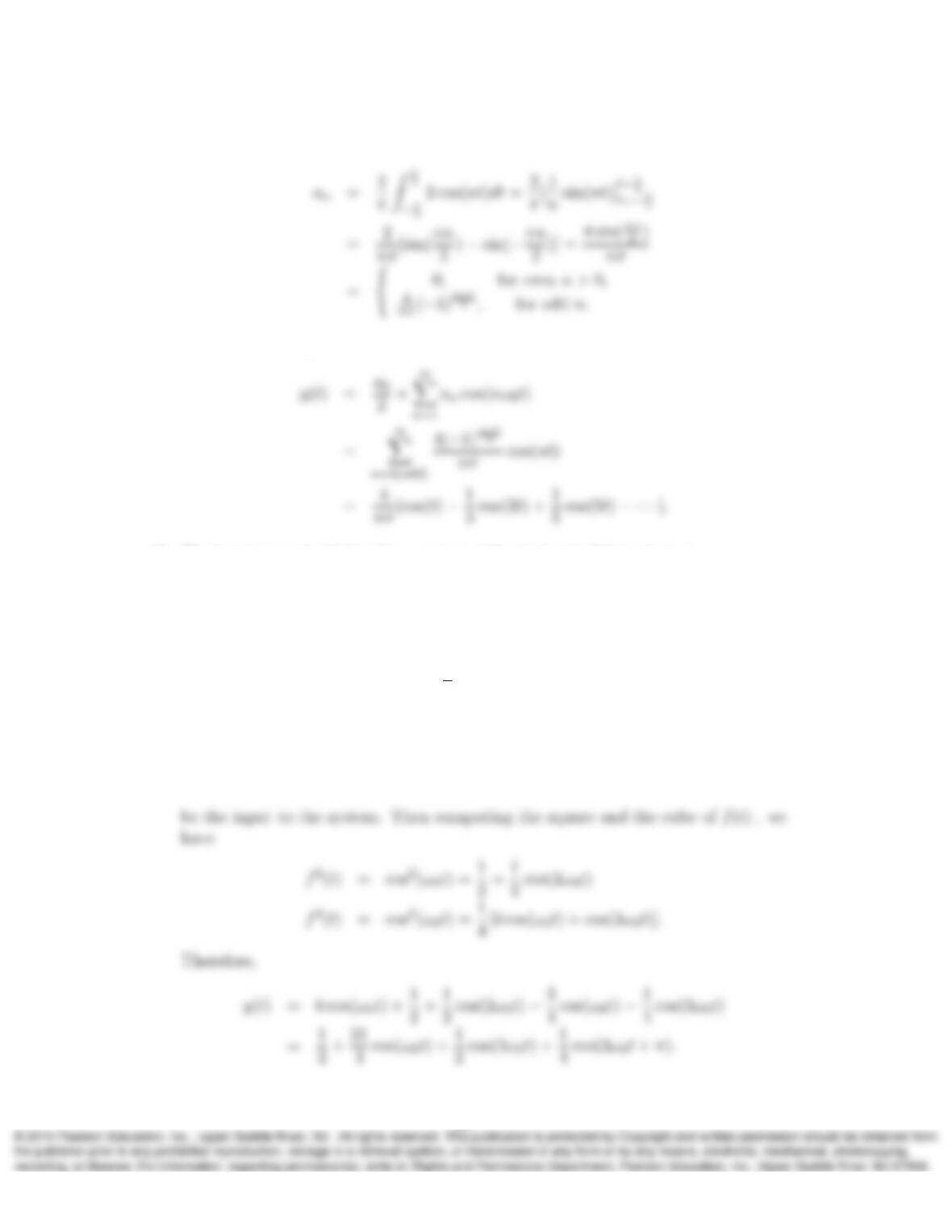
Since T= 2π, then ω0= 1rad/s we have,
Therefore the trigonometric Fourier series is
12. The input-output relation for a system with the input f(t)is given as
y(t) = 6f(t) + f2(t)−f3(t).
Determine the total harmonic distortion (THD) of the system response to a pure
cosine input. Hint:
cos3θ=1
4(3 cos θ+ cos(3θ)).
Is the system linear or nonlinear? Explain.
Solution:
Let
f(t) = cos(ω0t)
15

Computing the THD
The circuit is non linear
13. Let f(t)be a real-valued periodic signal with fundamental frequency ω0. We will
approximate f(t)with another function
fN(t) = ˆa0
2+
N
X
n=1 ˆancos(nω0t) + ˆ
bnsin(nω0t)
where (real-valued) coefficients ˆamand ˆ
bmare selected to minimize the average
power Pein the error signal
e(t)≡fN(t)−f(t).
That is, to determine the optimal ˆamand ˆ
bmwe minimize
Pe=1
TZT
e2(t)dt.
We will do so by setting ∂Pe
∂ˆamand ∂Pe
∂ˆ
bmto zero and solving for ˆamand ˆ
bm.
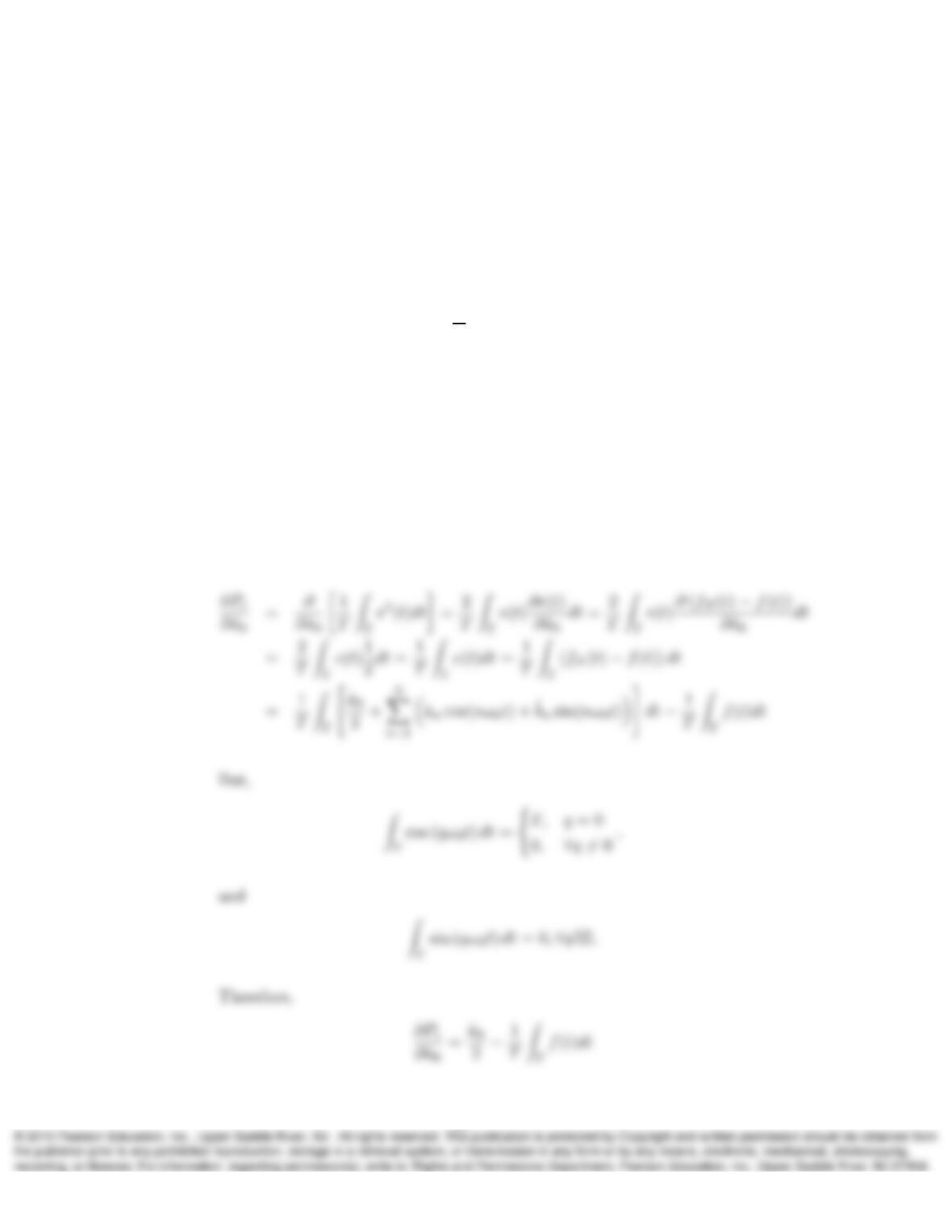
a) Confirm that
∂Pe
∂ˆa0
=1
TZT
e(t)dt =ˆa0
2−1
TZT
f(t)dt
and, for 1≤m≤N,
∂Pe
∂ˆam
=2
TZT
e(t) cos(mω0t)dt = ˆam−2
TZT
f(t) cos(mω0t)dt
and ∂Pe
∂ˆ
bm
=2
TZT
e(t) sin(mω0t)dt =ˆ
bm−2
TZT
f(t) sin(mω0t)dt.
16
b) Solve for the optimizingˆamand ˆ
bm, and show that the optimal fN(t)can be
rewritten as
fN(t) =
N
X
m=−N
Fnejnω0t
with
Fn=1
TZT
f(t)e−jnω0tdt.
c) Assuming that f(t)satisfies the Dirichlet Conditions, what is the value of Pe
in the limit as N→ ∞? Explain.
Solution:
a) Deriving Pe, using the Leibniz integral rule:
17
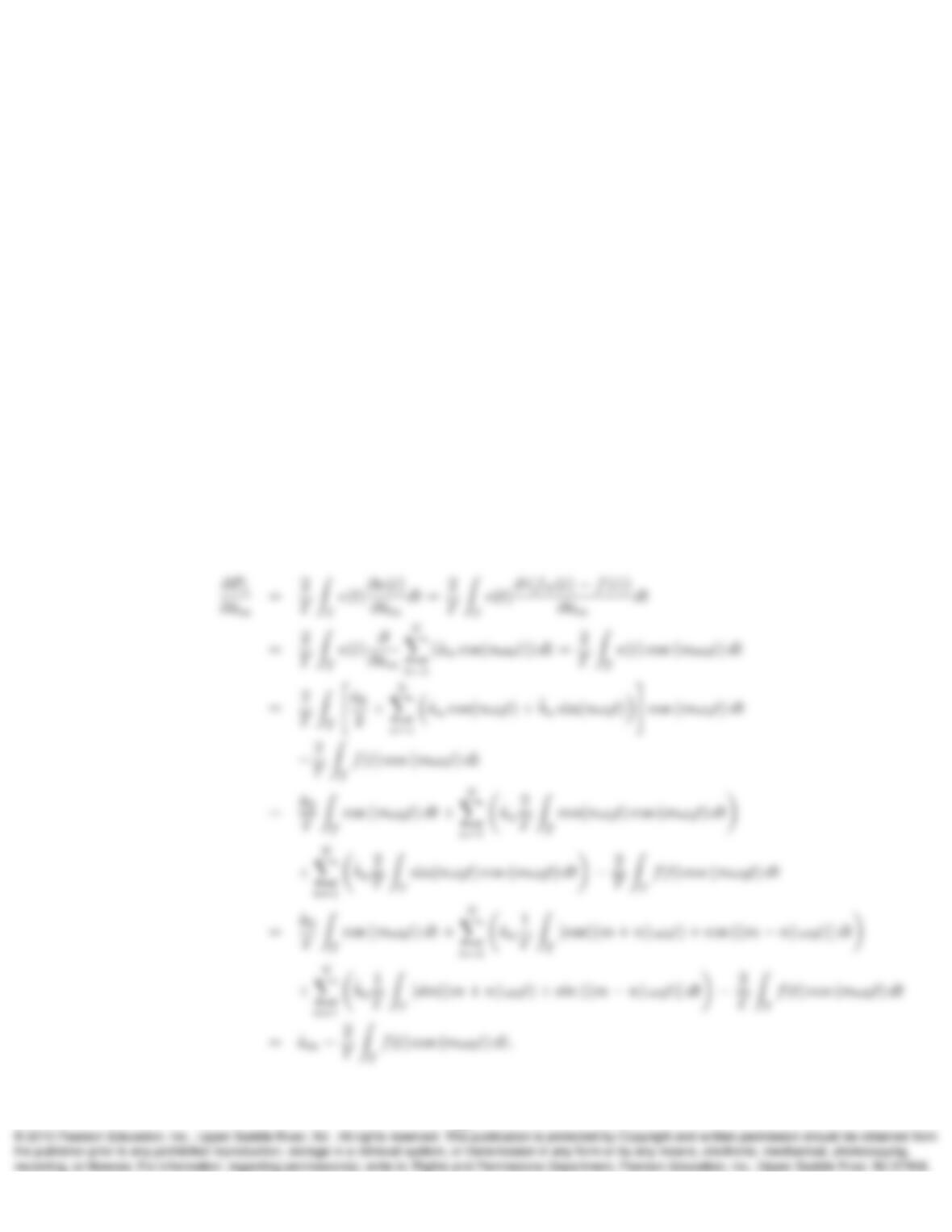
Deriving Pewith respect to ˆam,
18
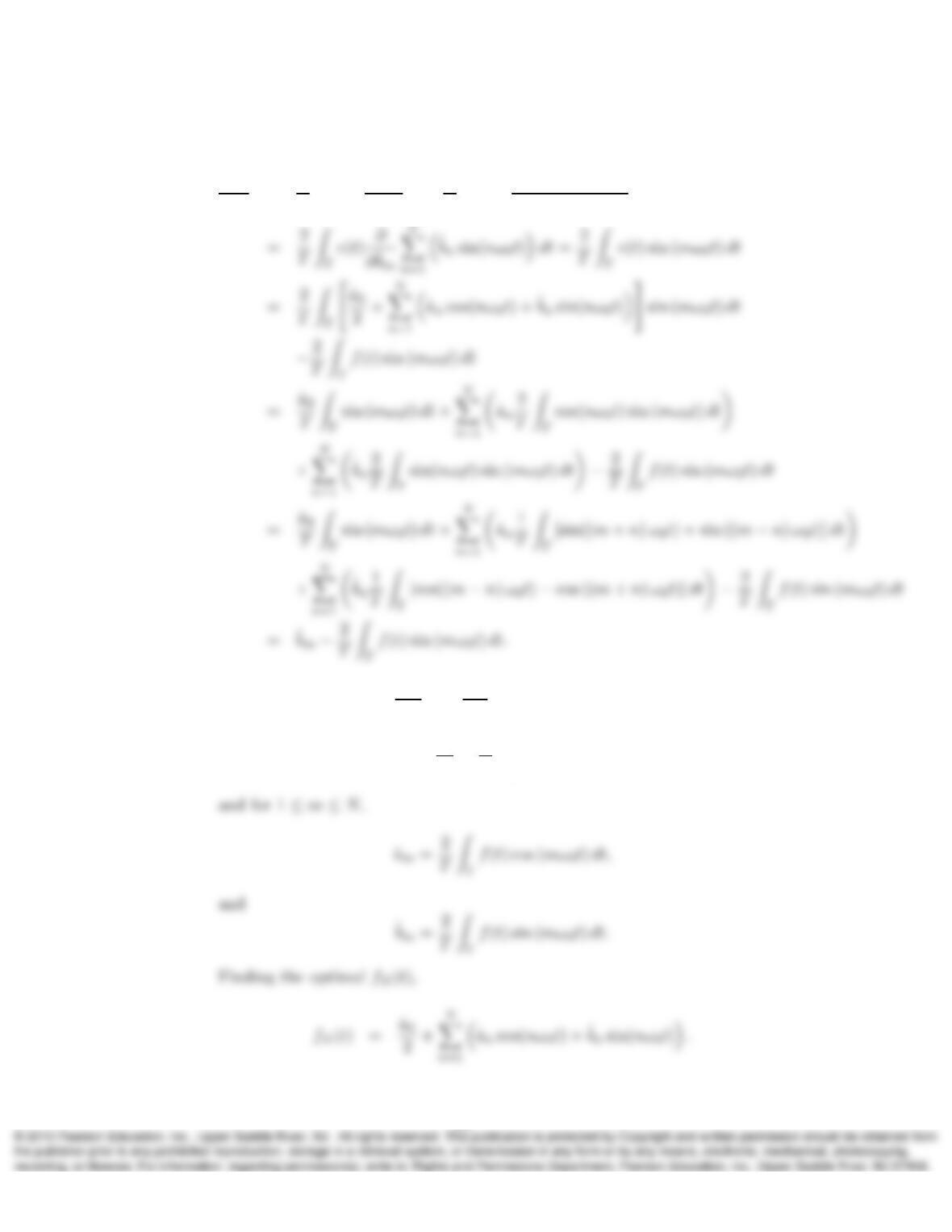
Deriving Pewith respect to ˆ
bm,
∂Pe
∂ˆ
bm
=2
TZT
e(t)∂e(t)
∂ˆ
bm
dt =2
TZT
e(t)∂(fN(t)−f(t))
∂ˆ
bm
dt
b) We optimize by setting ∂Pe
∂ˆamand ∂Pe
∂ˆ
bmto zero and solving for ˆamand ˆ
bm:
ˆa0
2=1
TZT
f(t)dt,
19
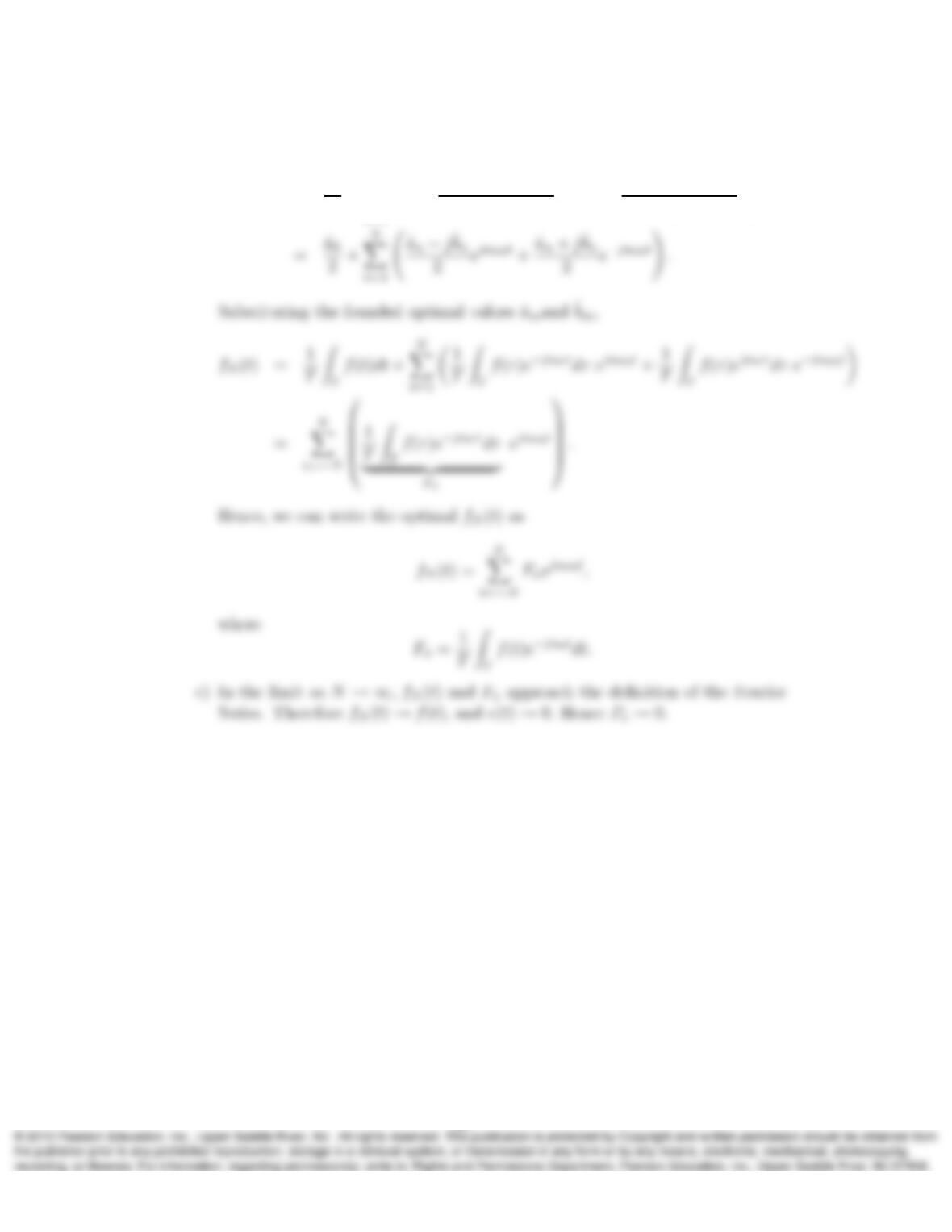
Next using Euler’s identity
fN(t) = ˆa0
2+
N
X
n=1 ˆanejnω0t+e−jnω0t
2+ˆ
bnejnω0t−e−jnω0t
j2
20