Errata:
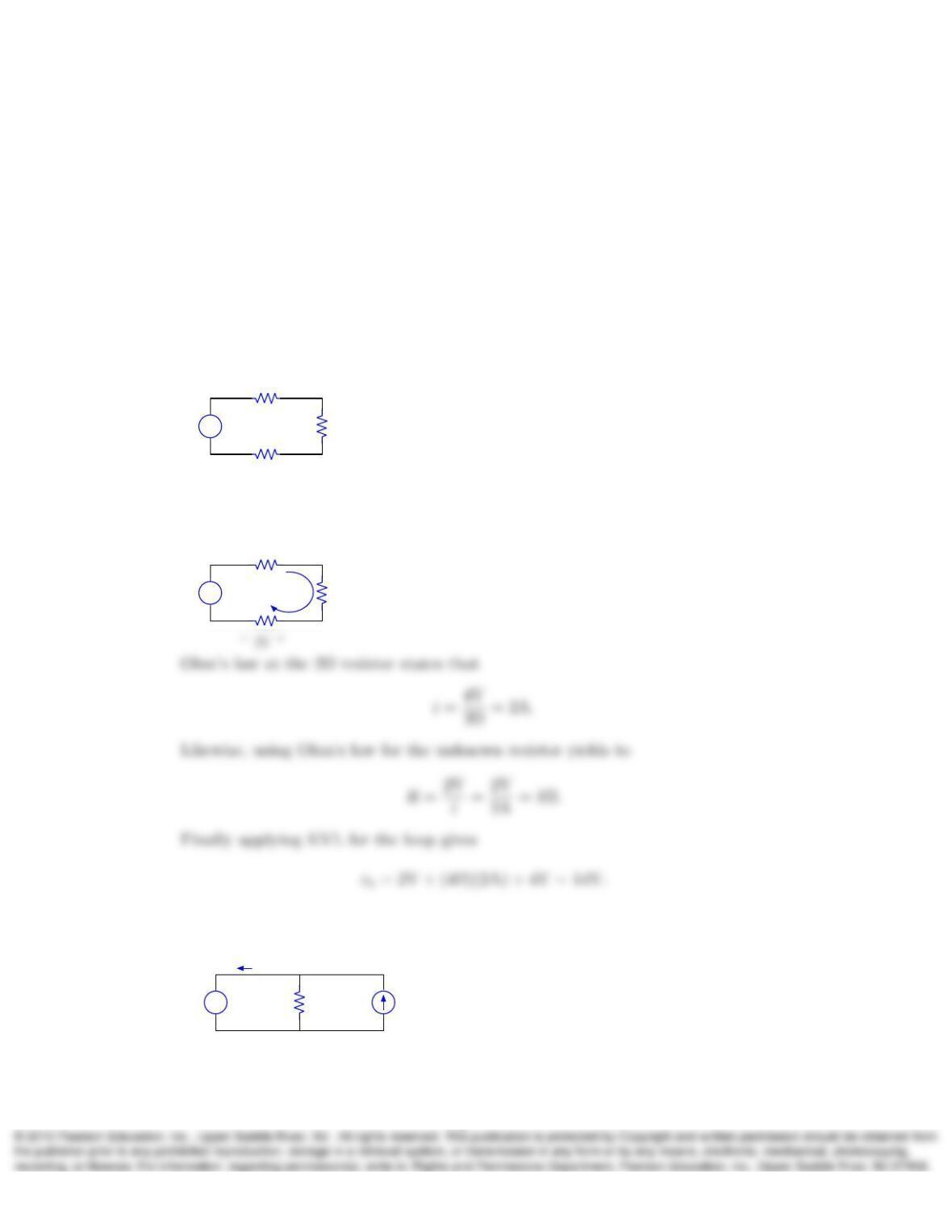
1. Chapter 1, Problem 1.1 (Polarity of the voltage across resistor Rshould be the
opposite of what is shown in the text, in order to obtain R > 0).
2. Chapter 3, Problem 3.7a (The correct specification of part (a) is given in the
solution manual, and is different from what is printed in the text).
Chapter 1
1. In the following circuit determine Rand vs:
+
–R
vs
2Ω
4Ω
4V
2V
+ –
– +
Erratum: In the text book the polarization of resistor Rwas inverted.
Solution:
+
–R
vs
2Ω
4Ω
4V
+ –
i
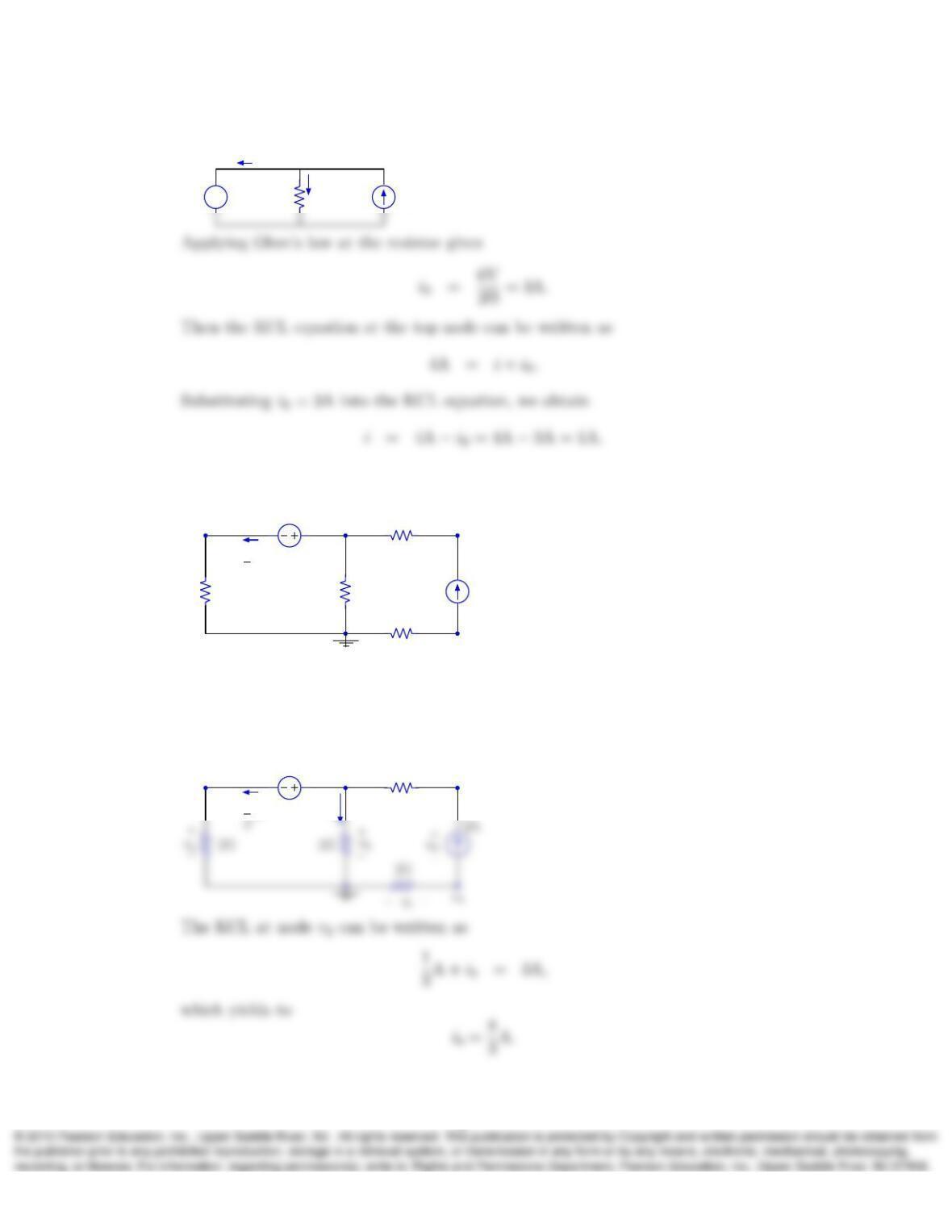
2. In the following circuit determine i:
+
–
i
6V 4A
2Ω
Solution:
1
+
–
i
6V 4A
2Ω i0
3. a) In the following circuit determine all the unknown element and node voltages.
1
3A
2Ω
2Ω
4Ω
2V
3A
v1v2v3
v4
1Ω
va
vc
vd
ve
vb
+
–
+
–
+
–
+ –
+ –
b) What is the voltage drop in the circuit above from the reference to node 4?
c) What is the voltage rise from node 2 to node 3?
d) What is the voltage drop from node 1 to the reference?
Solution:
1
4Ω
2V
v1v2v3
vc
+ –
ib
2
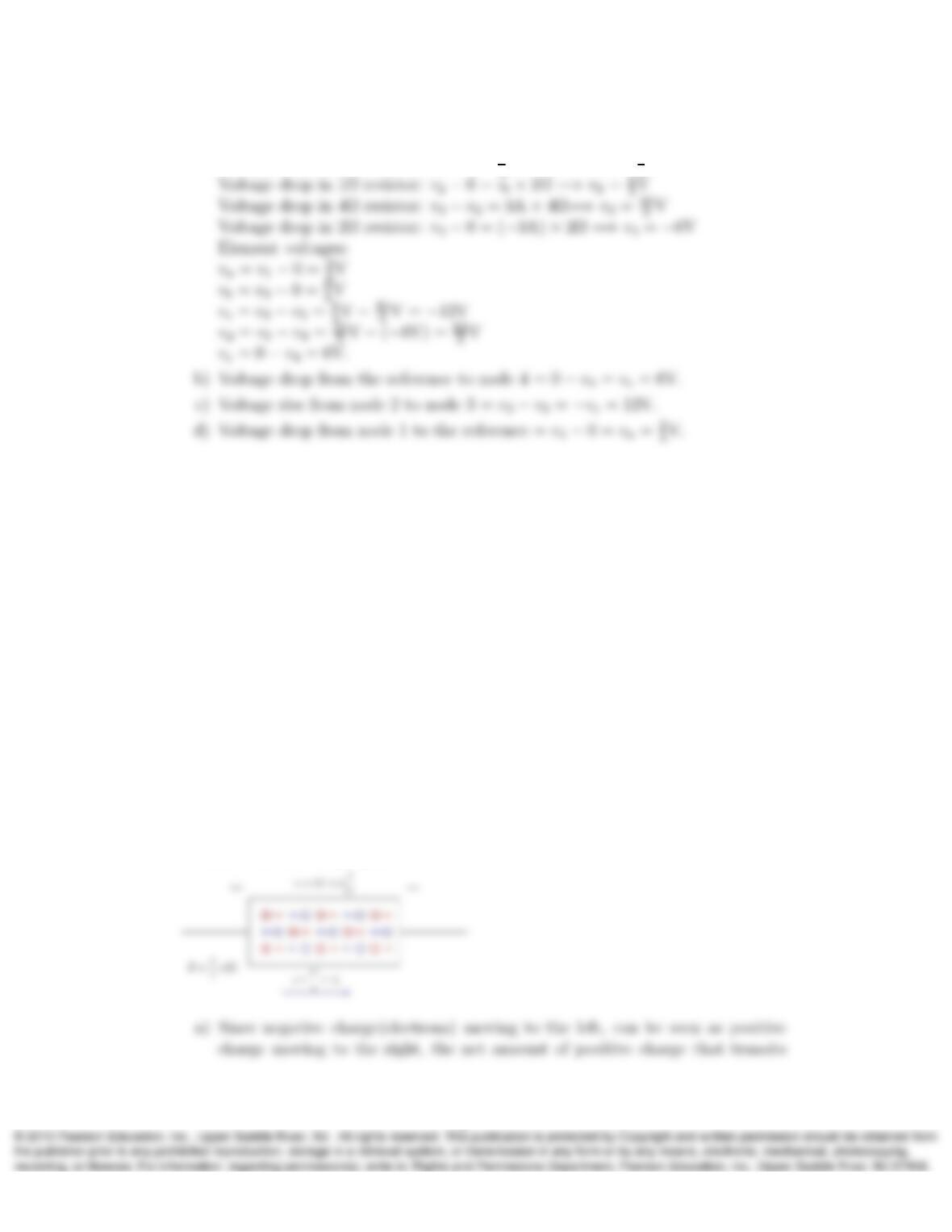
a) Node Voltages:
Voltage drop in 2Ω resistor: v1−0 = 1
3A×2Ω =⇒v1=2
3V
4. a) A volume of ionized gas filled with free electrons and protons can be modeled
as a resistor. Consider such a resistor model supporting a 6 V potential
difference between its terminals. We are told that in 1 s 6.2422 ×10¹⁸ protons
move through the resistor in the direction of the 6 V drop (say, from left to
right) and 1.24844 ×10¹⁹ electrons move in the opposite direction. What is
the net amount of electrical charge that transits the element in 1 s in the
direction of 6 V drop and what is the corresponding resistance R? Note that
electrical charge qis 1.602 ×10⁻¹⁹ C for a proton and −1.602 ×10⁻¹⁹ C for
an electron.
b) Does a proton gain or lose energy as it transits the resistor? How many joules?
Explain.
c) Does an electron gain or lose energy as it transits the resistor? How many
joules? Explain
d) A second resistor with 6 V potential difference conducts 1.87266 ×10¹⁹ elec-
trons every second but no proton is allowed to move through it. Compare the
current, resistance, and absorbed power of the two resistors.
Solution:
Consider the following figure:
3
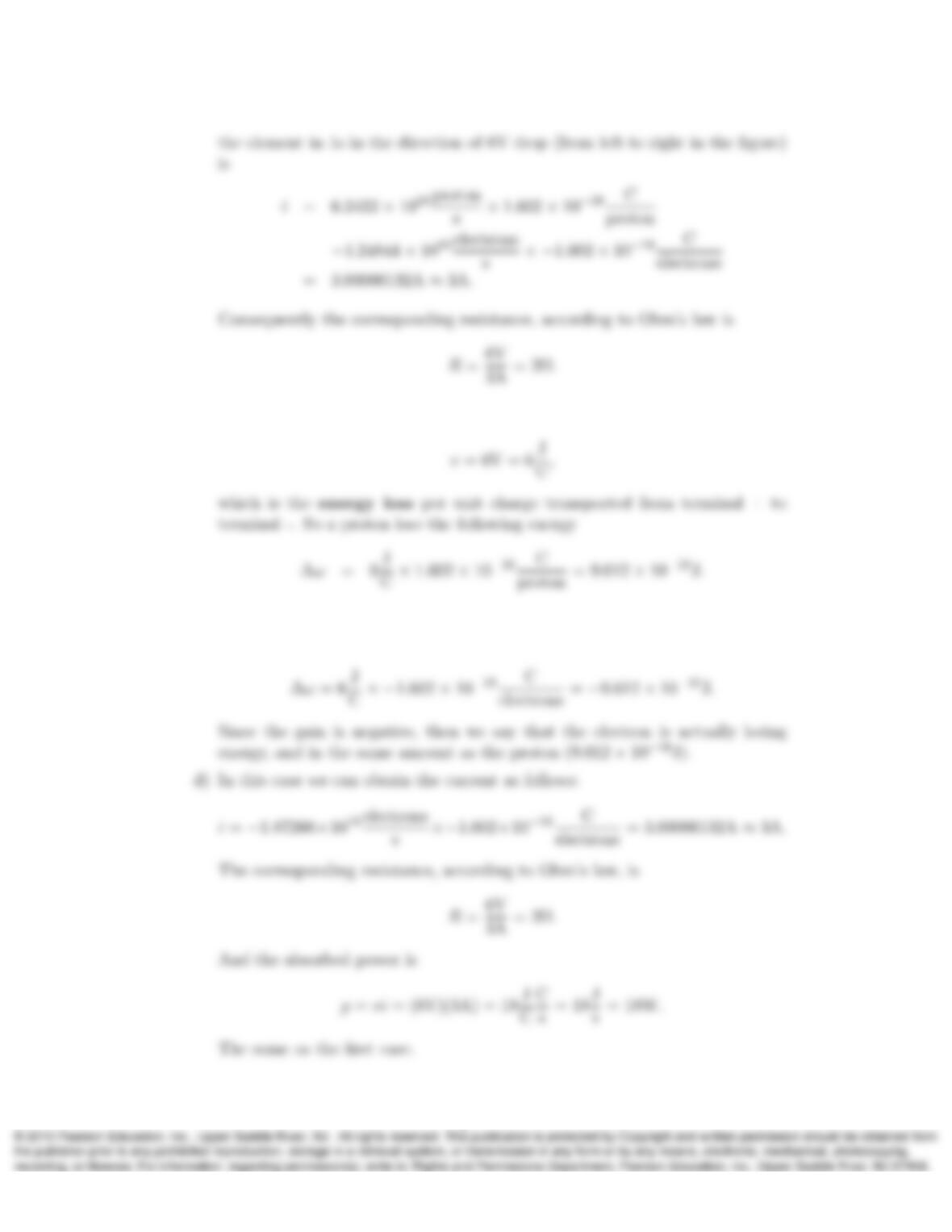
b) From definition of voltage, we have
c) Voltage can also be defined as the energy gain per unit charge transported
from terminal – to terminal +. So an electron gain the following energy
4
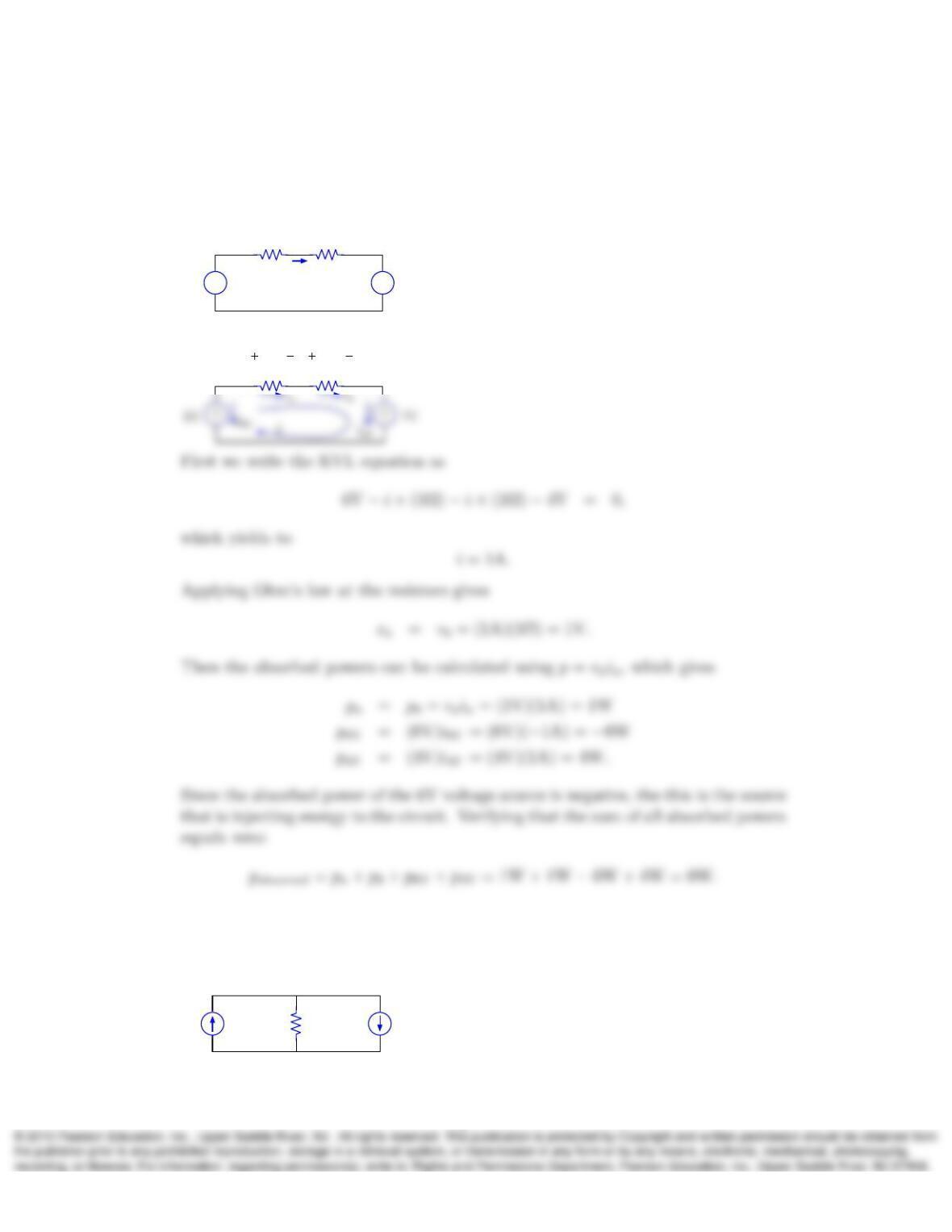
5. In the circuit pictured here, one of the independent voltage sources is injecting
energy into the circuit, while the other one is absorbing energy. Identify the source
that is injecting the energy absorbed in the circuit and confirm that the sum of all
absorbed powers equals zero.
+
–+
–
i
6V
1Ω 1Ω
4V
Solution:
1Ω 1Ω
vavb
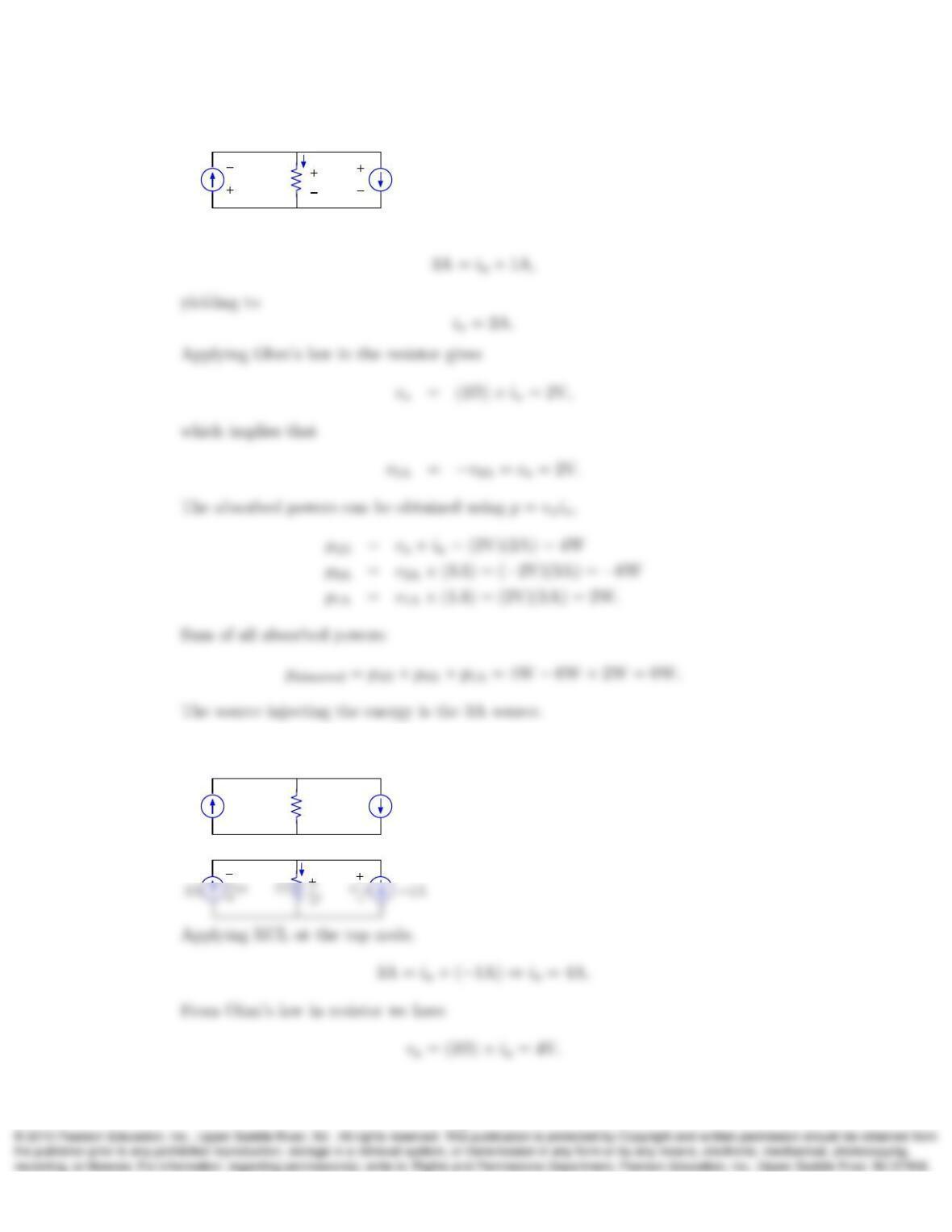
6. In the circuit pictured here, one of the independent current sources is injecting
energy into the circuit, while the other one is absorbing energy. Identify the source
that is injecting the energy absorbed in the circuit and confirm that the sum of all
absorbed powers equals zero.
1Ω
3A 1A
5
Solution:
1Ω
3A 1A
ia
v1A
v3Ava
The KCL in the top node can be written as
7. Calculate the absorbed power for each element in the following circuit and determ-
ine which elements inject energy to the circuit.
1Ω
3A −1A
Solution:
ia
6
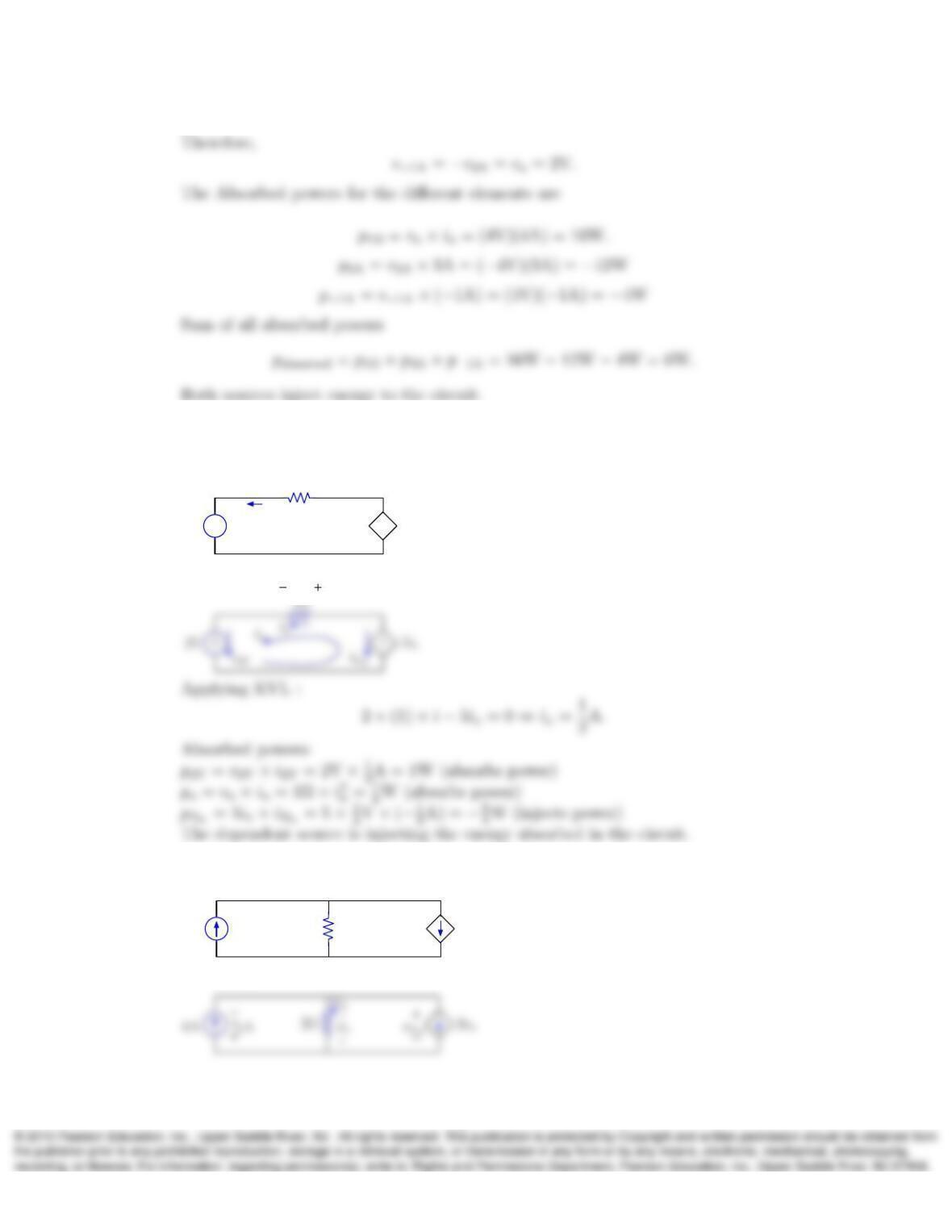
8. In the circuit given, determine ixand calculate the absorbed power for each circuit
element. Which element is injecting the energy absorbed in the circuit?
+
–+
–
ix
2V
1Ω
5ix
Solution:
va
9. In the circuit given, determine vxand calculate the absorbed power for each circuit
element. Which element is injecting the energy absorbed in the circuit?
2Ω
6A 2vx
vx
+
–
Solution:
7
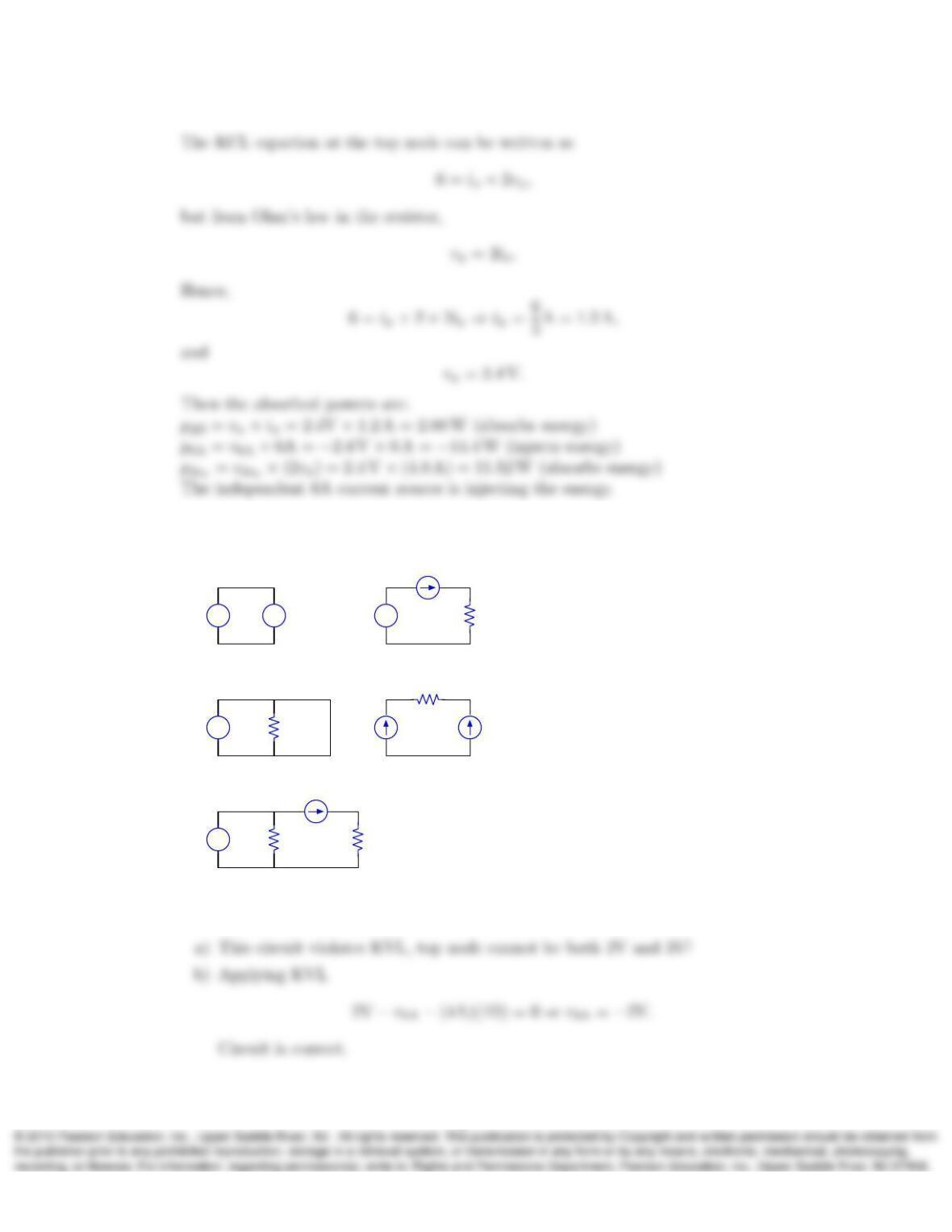
10. Some of the following circuits violate KVL/KCL and/or basic definitions of two-
terminal elements given in Section 1.3. Identify these ill-specified circuits and
explain the problem in each case.
+
–+
–+
–
+
–
+
–
(a)
2V 3V 2V
3V
6V
4A
2A 3A
2A
1Ω
1Ω
1Ω
2Ω
2Ω
(b)
(c) (d)
(e)
Solution:
8
11. a) Let A= 3 −j3. Express Ain exponential form.
b) Let B=−1−j1. Express Bin exponential form.
c) Determine the magnitudes of A+Band A−B.
d) Express AB and A/B in rectangular form.
Solution:
a) A= 3 −j3,|A|=√32+ 32= 3√2,∠A= arctan(−3
12. Do Exercise 1.11(a) through (d), but with A=−3−j3and B= 1 + j2.
Solution:
a) A=−3−j3,|A|=√32+ 32= 3√2,∠A=π+arctan(−3
−3) = 5π
4
13. a) Determine the rectangular forms of ej0,ejπ
2,e−jπ
2,ejπ ,e−jπ, and ej2π.
b) Simplify P=ejπ +e−jπ,Q=ejπ
2+e−jπ
2,R= 1 −ejπ .
c) Show that ejπ
2m= (−1)m
2.
Solution:
9
a) ej0= cos(0) + jsin(0) = 1
14. a) Determine the rectangular forms of 7ejπ
4,7e−jπ
4,5ej3π
4,and 5e−j3π
4.
b) Simplify P= 2ej5π
4−2e−j5π
4, Q = 8e−jπ
4−8ejπ
4,and R=ej3π
4
e−jπ
4.
Solution:
a) 7ejπ
4= 7(cos(π
4) + jsin(π
4)) = 7√2
2+j7√2
2
15. a) Prove that CC∗=|C|2.
b) Prove that (C1C2)∗=C∗
1C∗
2.
Solution:
a) Since C=|C|ejθ,
16.
10
a) Prove that |C1C2|=|C1||C2|.
b) Prove that |1
C|=1
|C|.
c) Prove that |C1
C2|=|C1|
|C2|.
Solution:
a)
|C1C2|=||C1|ejθ1|C2|ejθ2|
17. Show graphically on the complex plane that |C1+C2| ≤ |C1|+|C2|.
Solution:
Im
18.
11
a) The function f(t) = ejπ
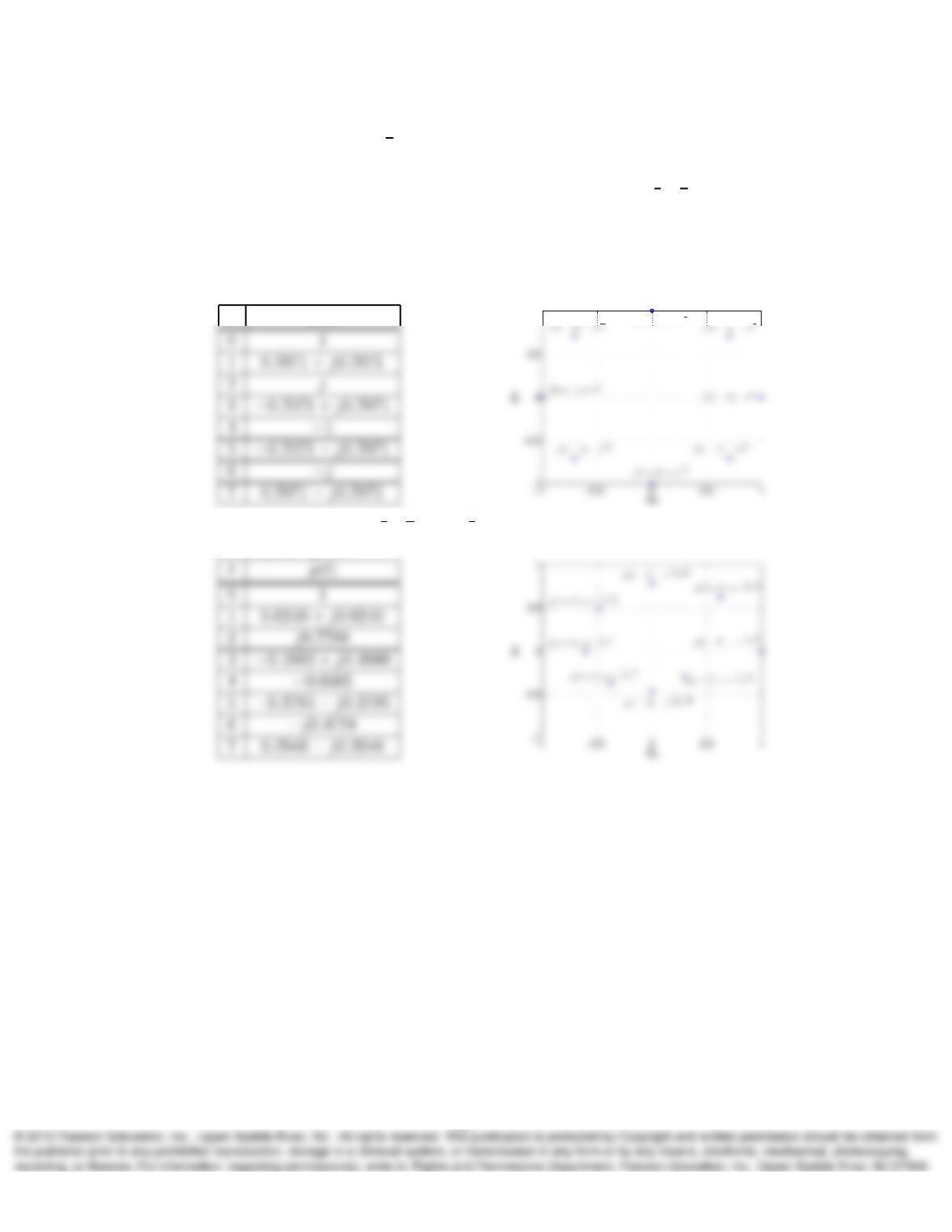
4t, for real-valued t, takes on complex values. Plot the
values of f(t)on the complex plane, for t= 0,1,2,3,4,5,6,and 7.
b) Repeat (a), but for the complex-valued function g(t) = e(−1
8+jπ
4)t.
Solution:
a) Notice that f(t)has a magnitude of |f(t)|= 1 for all t, then all the points
will have the same distance from the origin, forming a circle.
t f(t)
1
f(t= 2) = ejπ
2
b) Notice that g(t)=e(−1
8+jπ
4)t=e−1
8tf(t)decreases in magnitude as tincreases,
forming an spiral.
12