Archives: Solution Manual
978-0393123982 Chapter 26 Lecture Note
Chapter 26 61 Chapter 26 Monopoly Behavior This chapter is concerned with price discrimination, product differentiation, monopolistic competition, and the like. Price discrimination is a great topic for discussion. It is good to bring up examples of price discrimination from […]
978-0393123982 Chapter 25 Solution Manual
Chapter 25 NAME Monopoly Introduction. The profit-maximizing output of a monopolist is found by solving for the output at which marginal revenue is equal to marginal cost. Having solved for this output, you find the monopolist’s price by plugging the […]
978-0393123982 Chapter 25 Lecture Note
Chapter 25 59 Chapter 25 Monopoly This chapter discusses the theory of monopoly and compares it with that of competition. The big idea here is the inefficiency of monopoly. The first way to drive it home is to use the […]
978-0393123982 Chapter 24 Solution Manual Part 2
NAME 303 (b) In 1990 the city council of Ham Harbor created a taxicab licensing board and issued a license to each of the existing cabs. The board stated that it would continue to adjust the taxicab fares so that […]
978-0393123982 Chapter 24 Solution Manual Part 1
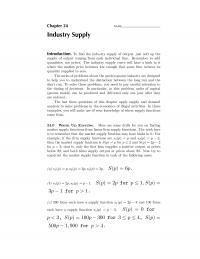
Chapter 24 NAME Industry Supply Introduction. To find the industry supply of output, just add up the supply of output coming from each individual firm. Remember to add quantities, not prices. The industry supply curve will have a kink in […]
978-0393123982 Chapter 24 Lecture Note
56 Chapter Highlights Chapter 24 Industry Supply The treatment of industry supply in the case of free entry given in this chapter is more satisfactory than that one usually sees. I simply draw the supply curves for different numbers of […]
978-0393123982 Chapter 23 Solution Manual
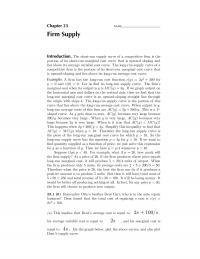
Chapter 23 NAME Firm Supply Introduction. The short-run supply curve of a competitive firm is the portion of its short-run marginal cost curve that is upward sloping and lies above its average variable cost curve. The long-run supply curve of […]
978-0393123982 Chapter 23 Lecture Note
54 Chapter Highlights Chapter 23 Firm Supply After all that material on technology and optimization problems, it is fun to get back to the behavior of “real” economic units. I devote a fair amount of time to laying out the […]
978-0393123982 Chapter 22 Solution Manual
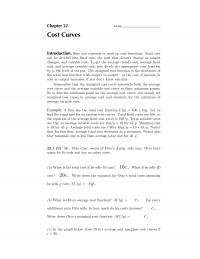
Chapter 22 NAME Cost Curves Introduction. Here you continue to work on cost functions. Total cost can be divided into fixed cost, the part that doesn’t change as output changes, and variable cost. To get the average (total) cost, average […]
978-0393123982 Chapter 22 Lecture Note
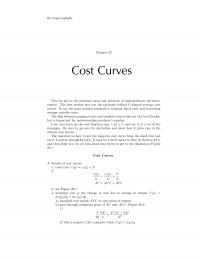
52 Chapter Highlights Chapter 22 Cost Curves Now we get to the standard meat and potatoes of undergraduate microeco- nomics. The first section lays out the rationale behind U-shaped average cost curves. To me the most natural rationale is constant […]
978-0393123982 Chapter 21 Solution Manual Part 2
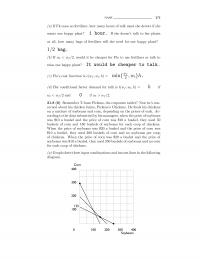
NAME 273 (a) If Flo uses no fertilizer, how many hours of talk must she devote if she wants one happy plant? 1 hour. If she doesn’t talk to her plants at all, how many bags of fertilizer will she […]
978-0393123982 Chapter 21 Solution Manual Part 1
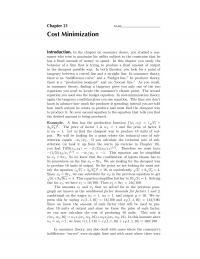
Chapter 21 NAME Cost Minimization Introduction. In the chapter on consumer choice, you studied a con- sumer who tries to maximize his utility subject to the constraint that he has a fixed amount of money to spend. In this chapter […]
978-0393123982 Chapter 21 Lecture Note
50 Chapter Highlights Chapter 21 Cost Minimization The treatment in this chapter is pretty standard, except for the material on revealed cost minimization. However, by now the students have seen this kind of material three times, so they shouldn’t have […]
978-0393123982 Chapter 20 Solution Manual Part 2
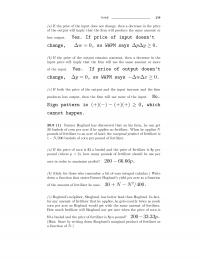
NAME 259 (a) If the price of the input does not change, then a decrease in the price of the output will imply that the firm will produce the same amount or (b) If the price of the output remains […]
978-0393123982 Chapter 20 Solution Manual Part 1
Chapter 20 NAME Profit Maximization Introduction. A firm in a competitive industry cannot charge more than the market price for its output. If it also must compete for its inputs, then it has to pay the market price for inputs […]
978-0393123982 Chapter 20 Lecture Note
48 Chapter Highlights Chapter 20 Profit Maximization I start out the chapter with a careful definition of profits: you must value each output and input at its market price, whether or not the good is actually sold on a market. […]
978-0393123982 Chapter 2 Solution Manual Part 2
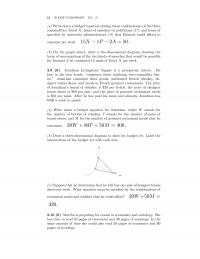
12 BUDGET CONSTRAINT (Ch. 2) (a) Write down a budget equation stating those combinations of the three commodities, Good X, hours of speeches by politicians (P), and hours of speeches by university administrators (A) that Emmett could afford to (b) […]
978-0393123982 Chapter 2 Solution Manual Part 1
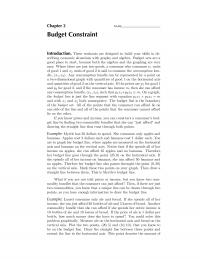
Chapter 2 NAME Budget Constraint Introduction. These workouts are designed to build your skills in de- scribing economic situations with graphs and algebra. Budget sets are a good place to start, because both the algebra and the graphing are very […]
978-0393123982 Chapter 2 Lecture Note
4Chapter Highlights Chapter 2 Budget Constraint Most of the material here is pretty straightforward. Drive home the formula for the slope of the budget line, emphasizing the derivation on page 23. Try some different notation to make sure that they […]
978-0393123982 Chapter 19 Solution Manual Part 2
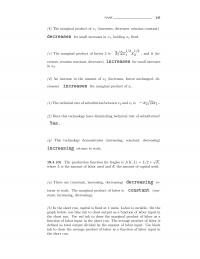
NAME 245 (b) The marginal product of x1(increases, decreases, remains constant) (c) The marginal product of factor 2 is 3/2×1/2 1×1/2 2, and it (in- creases, remains constant, decreases) increases for small increases in x2. (d) An increase in the […]
978-0393123982 Chapter 19 Solution Manual Part 1
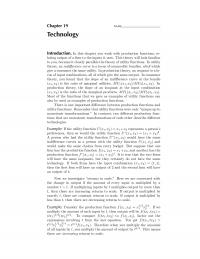
Chapter 19 NAME Technology Introduction. In this chapter you work with production functions, re- lating output of a firm to the inputs it uses. This theory will look familiar to you, because it closely parallels the theory of utility functions. […]

978-0393123982 Chapter 19 Lecture Note
46 Chapter Highlights Chapter 19 Technology Here we start our discussion of firm behavior. This chapter discusses the concepts that economists use to describe technologies. Almost all of the material here is quite straightforward, especially given all of the exposure […]
978-0393123982 Chapter 18 Solution Manual Part 2
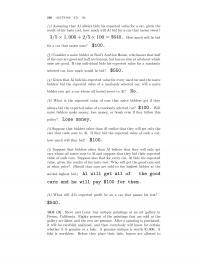
230 AUCTIONS (Ch. 18) (e) Assuming that Al always bids his expected value for a car, given the result of his taste test, how much will Al bid for a car that tastes sweet? (f) Consider a naive bidder at […]
978-0393123982 Chapter 18 Solution Manual Part 1
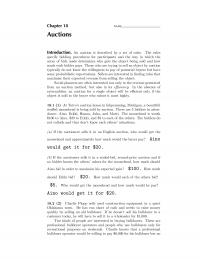
Chapter 18 NAME Auctions Introduction. An auction is described by a set of rules. The rules specify bidding procedures for participants and the way in which the array of bids made determines who gets the object being sold and how […]
978-0393123982 Chapter 18 Lecture Note
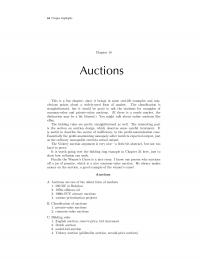
44 Chapter Highlights Chapter 18 Auctions This is a fun chapter, since it brings in some real-life examples and non- obvious points about a widely-used form of market. The classification is straightforward, but it would be good to ask the […]
978-0393123982 Chapter 17 Solution Manual
Chapter 17 NAME Measurement Introduction. There are currently no exercises for this chapter
978-0393123982 Chapter 17 Lecture Note
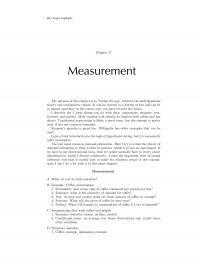
42 Chapter Highlights Chapter 17 Measurement The purpose of this chapter is to “bridge the gap” between the undergraduate theory and econometric classes. It can be covered in a lecture or two and can fit in almost anywhere in the […]
978-0393123982 Chapter 16 Solution Manual Part 2
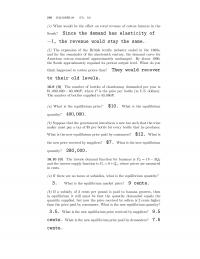
210 EQUILIBRIUM (Ch. 16) (e) What would be the effect on total revenue of cotton farmers in the (f) The expansion of the British textile industry ended in the 1860s, and for the remainder of the nineteenth century, the demand […]
978-0393123982 Chapter 16 Solution Manual Part 1
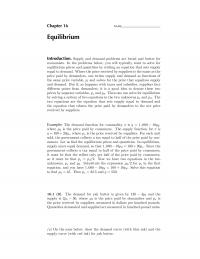
Chapter 16 NAME Equilibrium Introduction. Supply and demand problems are bread and butter for economists. In the problems below, you will typically want to solve for equilibrium prices and quantities by writing an equation that sets supply equal to demand. […]
978-0393123982 Chapter 16 Lecture Note
Chapter 16 39 Chapter 16 Equilibrium Some people have suggested that it would make more sense to save this chapter until after deriving supply curves, but I still feel that it is in a better position here. After all, the […]
978-0393123982 Chapter 15 Solution Manual
Chapter 15 NAME Market Demand Introduction. Some problems in this chapter will ask you to construct the market demand curve from individual demand curves. The market demand at any given price is simply the sum of the individual demands at […]
978-0393123982 Chapter 15 Lecture Note
Chapter 15 37 Chapter 15 Market Demand It would be logical to proceed directly to discussing the theory of the firm, but I wanted to take a break from pure optimization analysis, and discuss instead some ideas from equilibrium analysis. […]
978-0393123982 Chapter 14 Solution Manual
Chapter 14 NAME Consumer’s Surplus Introduction. In this chapter you will study ways to measure a con- sumer’s valuation of a good given the consumer’s demand curve for it. The basic logic is as follows: The height of the demand […]
978-0393123982 Chapter 14 Lecture Note
Chapter 14 35 Chapter 14 Consumer’s Surplus This chapter derives consumer’s surplus using the demand theory for discrete goods that was developed earlier in Chapters 5 and 6. I review this material in Section 14.1 just to be safe. Given […]
978-0393123982 Chapter 13 Solution Manual
Chapter 13 NAME Risky Assets Introduction. Here you will solve the problems of consumers who wish to divide their wealth optimally between a risky asset and a safe asset. The expected rate of return on a portfolio is just a […]
978-0393123982 Chapter 13 Lecture Note
Chapter 13 33 Chapter 13 Risky Assets The first part of this chapter is just notation and review of the concepts of mean and standard deviation. If your students have had some statistics, these ideas should be pretty standard. If […]
978-0393123982 Chapter 12 Solution Manual Part 2
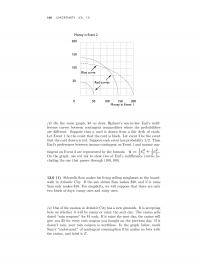
168 UNCERTAINTY (Ch. 12) 0 50 100 150 200 50 100 150 Money in Event 1 Money in Event 2 200 Blue curve Red curves (d) On the same graph, let us draw Hjalmer’s son-in-law Earl’s indif- ference curves between […]
978-0393123982 Chapter 12 Solution Manual Part 1
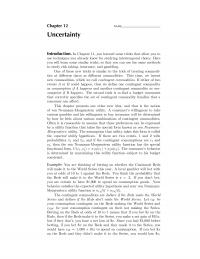
Chapter 12 NAME Uncertainty Introduction. In Chapter 11, you learned some tricks that allow you to use techniques you already know for studying intertemporal choice. Here you will learn some similar tricks, so that you can use the same methods […]

978-0393123982 Chapter 12 Lecture Note
Chapter 12 31 Chapter 12 Uncertainty This chapter begins with the idea of contingent consumption and an insurance market example. Make sure that you define “contingent” since a lot of students don’t know the term. (The definition is given in […]
978-0393123982 Chapter 11 Solution Manual Part 2
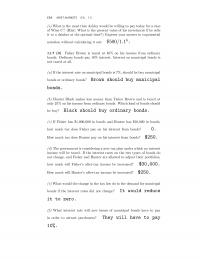
154 ASSET MARKETS (Ch. 11) (e) What is the most that Ashley would be willing to pay today for a case of Wine C? (Hint: What is the present value of his investment if he sells it to a drinker […]
978-0393123982 Chapter 11 Solution Manual Part 1
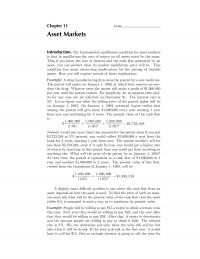
Chapter 11 NAME Asset Markets Introduction. The fundamental equilibrium condition for asset markets is that in equilibrium the rate of return on all assets must be the same. Thus if you know the rate of interest and the cash flow […]
978-0393123982 Chapter 11 Lecture Note
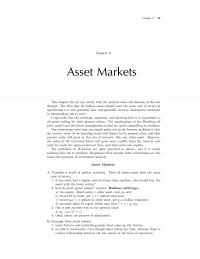
Chapter 11 29 Chapter 11 Asset Markets This chapter fits in very nicely with the present value calculations in the last chapter. The idea that all riskless assets should earn the same rate of return in equilibrium is a very […]
978-0393123982 Chapter 10 Solution Manual Part 2
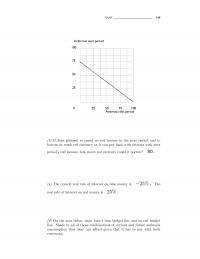
NAME 139 025 75 100 25 50 75 Ambrosia this period Ambrosia next period 100 50 (b) If Jane planned to spend no red income in the next period and to borrow as much red currency as it can pay […]
978-0393123982 Chapter 10 Solution Manual Part 1
Chapter 10 NAME Intertemporal Choice Introduction. The theory of consumer saving uses techniques that you have already learned. In order to focus attention on consumption over time, we will usually consider examples where there is only one consumer good, but […]
978-0393123982 Chapter 10 Lecture Note
26 Chapter Highlights Chapter 10 Intertemporal Choice This is one of my favorite topics, since it uses consumer theory in such fundamental ways, and yet has many important and practical consequences. The intertemporal budget constraint is pretty straightforward. I sometimes […]
978-0393123982 Chapter 1 Solution Manual
Chapter 1 NAME The Market Introduction. The problems in this chapter examine some variations on the apartment market described in the text. In most of the problems we work with the true demand curve constructed from the reservation prices of […]
978-0393123982 Chapter 1 Lecture Note
Chapter 1 1 Chapter 1 The Market This chapter was written so I would have something to talk about on the first day of class. I wanted to give students an idea of what economics was all about, and what […]
978-0324784640 Chapter 9 Solution Manual
© Cengage Learning 1 CHAPTER 9 CONSTRUCTION LENDING OBJECTIVES OF CHAPTER Upon successful completion of this chapter, students should be able to: Understand the importance of housing starts and construction lending to the entire economy. Explain which lenders […]
978-0324784640 Chapter 8 Solution Manual
© Cengage Learning 1 CHAPTER 8 GOVERNMENT LENDING OBJECTIVES OF CHAPTER Upon successful completion of this chapter, students should be able to: State the major functions of Federal Government mortgage insurance and guarantee programs Explain how the FHA […]

978-0324784640 Chapter 7 Solution Manual
© Cengage Learning 1 CHAPTER 7 PRIVATE MORTGAGE INSURANCE OBJECTIVES OF CHAPTER Upon successful completion of this chapter, the students should be able to: Identify factors contributing to the failure of mortgage guarantee companies in the 1930s. Discuss […]