Chapter 15 NAME
Market Demand
Introduction. Some problems in this chapter will ask you to construct
the market demand curve from individual demand curves. The market
demand at any given price is simply the sum of the individual demands at
that price. The key thing to remember in going from individual demands
to the market demand is to add quantities. Graphically, you sum the
individual demands horizontally to get the market demand. The market
demand curve will have a kink in it whenever the market price is high
enough that some individual demand becomes zero.
Sometimes you will need to find a consumer’s reservation price for
a good. Recall that the reservation price is the price that makes the
consumer indifferent between having the good at that price and not hav-
ing the good at all. Mathematically, the reservation price p∗satisfies
u(0,m)=u(1,m−p∗), where mis income and the quantity of the other
good is measured in dollars.
Finally, some of the problems ask you to calculate price and/or in-
come elasticities of demand. These problems are especially easy if you
know a little calculus. If the demand function is D(p), and you want to
calculate the price elasticity of demand when the price is p, you only need
to calculate dD(p)/dp and multiply it by p/q.
15.0 Warm Up Exercise. (Calculating elasticities.) Here are
some drills on price elasticities. For each demand function, find an ex-
pression for the price elasticity of demand. The answer will typically be
a function of the price, p. As an example, consider the linear demand
curve, D(p)=30−6p.ThendD(p)/dp =−6andp/q =p/(30 −6p), so
the price elasticity of demand is −6p/(30 −6p).
(a) D(p)=60−p.−p/(60 −p).
(e) D(p)=(p+3)
192 MARKET DEMAND (Ch. 15)
15.1 (0) In Gas Pump, South Dakota, there are two kinds of consumers,
Buick owners and Dodge owners. Every Buick owner has a demand func-
tion for gasoline DB(p)=20−5pfor p≤4andDB(p)=0ifp>4.
Every Dodge owner has a demand function DD(p)=15−3pfor p≤5
and DD(p)=0forp>5. (Quantities are measured in gallons per week
and price is measured in dollars.) Suppose that Gas Pump has 150 con-
sumers, 100 Buick owners, and 50 Dodge owners.
(a) If the price is $3, what is the total amount demanded by each indi-
(c) What is the total amount demanded by all consumers in Gas Pump
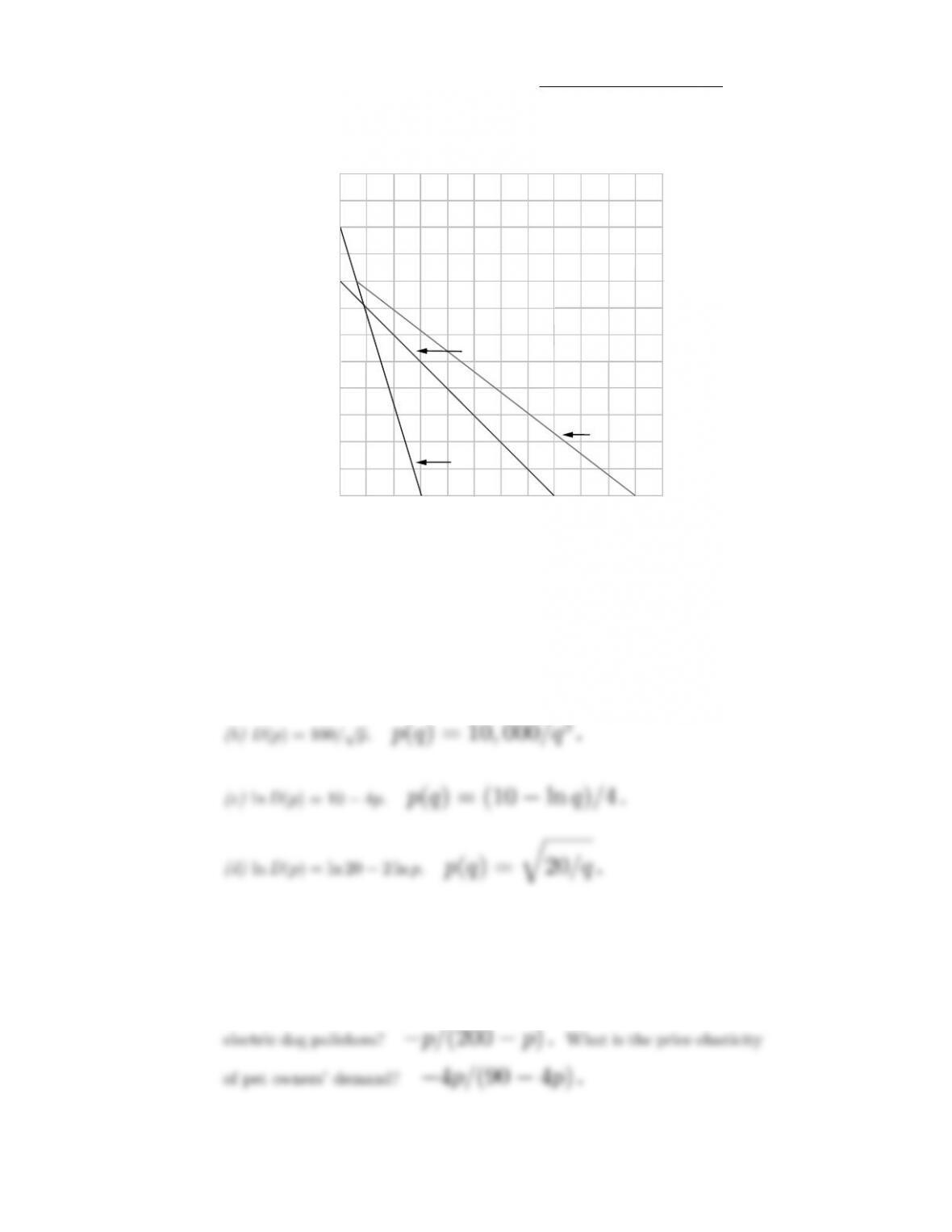
(d) On the graph below, use blue ink to draw the demand curve repre-
senting the total demand by Buick owners. Use black ink to draw the
demand curve representing total demand by Dodge owners. Use red ink
to draw the market demand curve for the whole town.
(f) When the price of gasoline is $1 per gallon, how much does weekly
(g) When the price of gasoline is $4.50 per gallon, how much does weekly
(h) When the price of gasoline is $10 per gallon, how much does weekly
NAME 193
0 1500 2000 2500 3000
1
2
3
4
5
6
500
Dollars per gallon
1000
Gallons per week
Blue line
Black
line
Red line
15.2 (0) For each of the following demand curves, compute the inverse
demand curve.
(a) D(p)=max{10 −2p, 0}.p(q)=5−q/2if q<10.
15.3 (0) The demand function of dog breeders for electric dog polishers
is qb=max{200−p, 0}, and the demand function of pet owners for electric
dog polishers is qo=max{90 −4p, 0}.
(a) At price p, what is the price elasticity of dog breeders’ demand for
194 MARKET DEMAND (Ch. 15)
(b) At what price is the dog breeders’ elasticity equal to −1? $100.
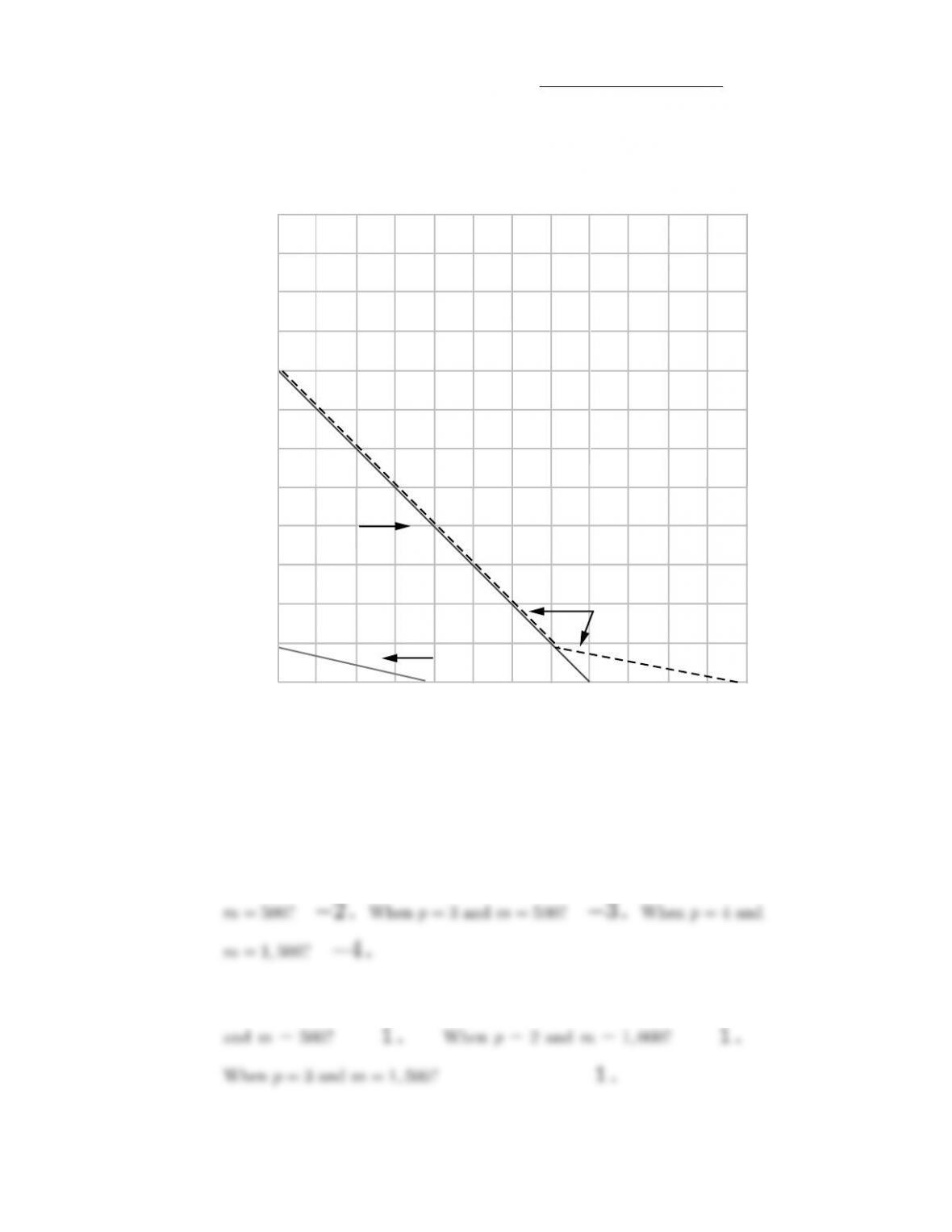
(c) On the graph below, draw the dog breeders’ demand curve in blue
ink, the pet owners’ demand curve in red ink, and the market demand
curve in pencil.
(d) Find a nonzero price at which there is positive total demand for dog
(e) Where on the market demand curve is the price elasticity equal to
NAME 195
0 150 200 250 300
50
100
150
200
250
300
50
Price
100
Quantity
Blue line
Red
line
Pencil line
22.5
90 290
Calculus 15.4 (0) The demand for kitty litter, in pounds, is ln D(p)=1,000 −
p+lnm,wherepis the price of kitty litter and mis income.
(a) What is the price elasticity of demand for kitty litter when p=2and
(b) What is the income elasticity of demand for kitty litter when p=2
196 MARKET DEMAND (Ch. 15)
(c) What is the price elasticity of demand when price is pand income is
Calculus 15.5 (0) The demand function for drangles is q(p)=(p+1)
−2.
(b) At what price is the price elasticity of demand for drangles equal to
(c) Write an expression for total revenue from the sale of drangles as
2.Use
calculus to find the revenue-maximizing price. Don’t forget to check the
(d) Suppose that the demand function for drangles takes the more general
form q(p)=(p+a)−bwhere a>0andb>1. Calculate an expression for
the price elasticity of demand at price p.−bp/(p+a).At what
price is the price elasticity of demand equal to −1? p=a/(b−1).
15.6 (0) Ken’s utility function is uK(x1,x
2)=x1+x2and Barbie’s
utility function is uB(x1,x
2)=(x1+1)(x2+ 1). A person can buy 1
unit of good 1 or 0 units of good 1. It is impossible for anybody to buy
fractional units or to buy more than 1 unit. Either person can buy any
quantity of good 2 that he or she can afford at a price of $1 per unit.
(a) Where mis Barbie’s wealth and p1is the price of good 1, write an
equation that can be solved to find Barbie’s reservation price for good 1.
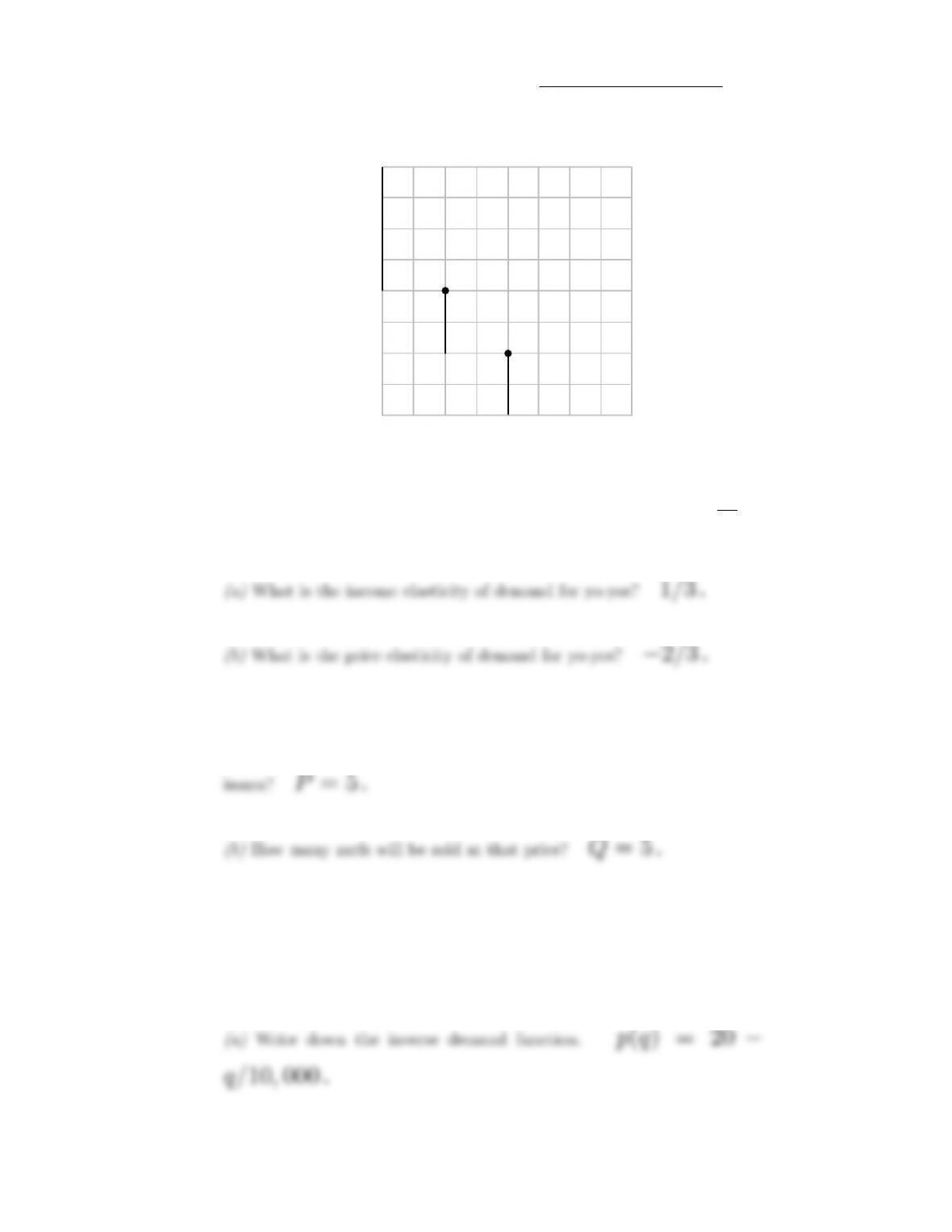
(b) If Ken and Barbie each have a wealth of 3, plot the market demand
curve for good 1.
NAME 197
0123
4
1
2
3
4
Price
Quantity
15.7 (0) The demand function for yo-yos is D(p, M)=4−2p+1
100 M,
where pis the price of yo-yos and Mis income. If Mis 100 and pis 1,
15.8 (0) If the demand function for zarfs is P=10−Q,
(a) At what price will total revenue realized from their sale be at a max-
15.9 (0) The demand function for football tickets for a typical game at a
large midwestern university is D(p) = 200,000 −10,000p. The university
has a clever and avaricious athletic director who sets his ticket prices so
as to maximize revenue. The university’s football stadium holds 100,000
spectators.
198 MARKET DEMAND (Ch. 15)
number of tickets sold.
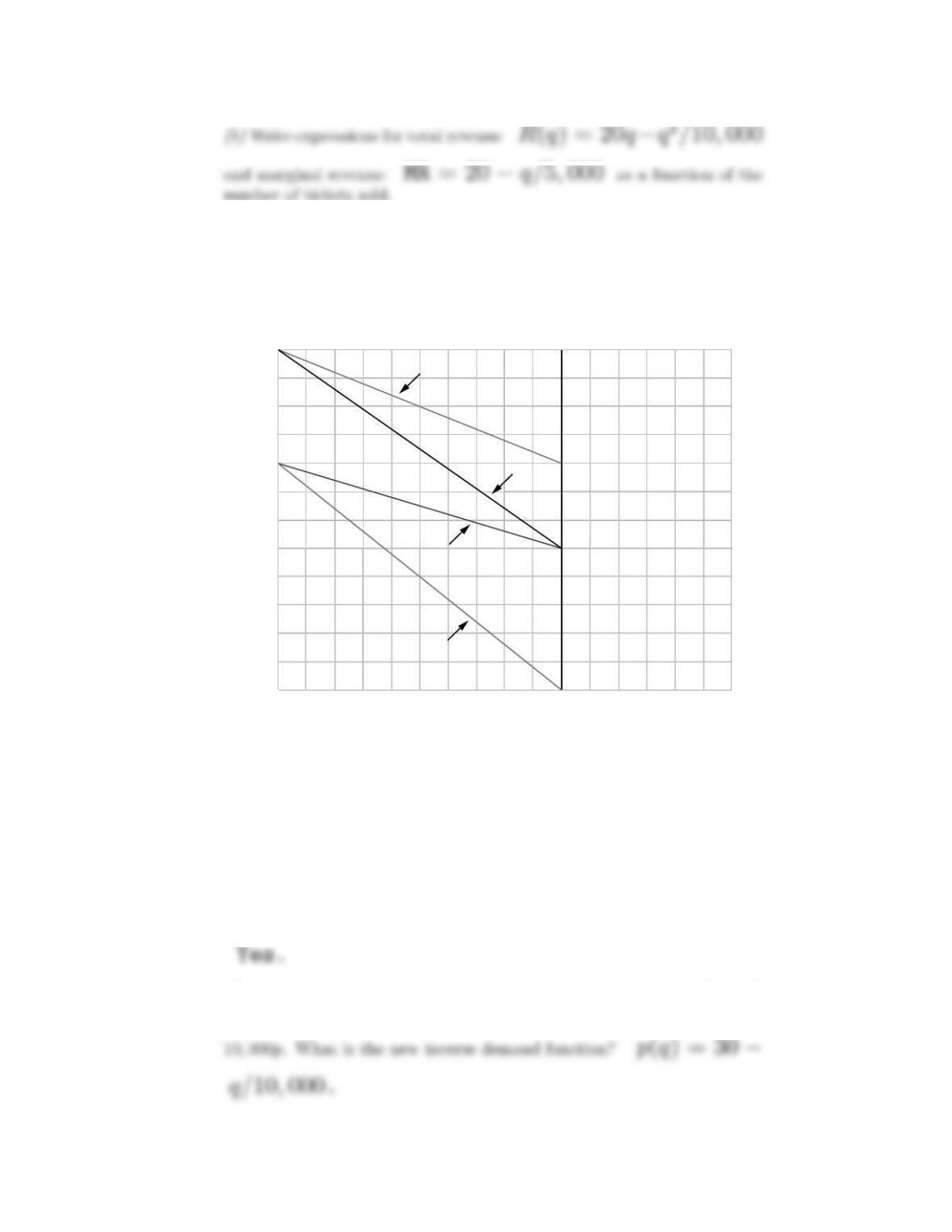
(c) On the graph below, use blue ink to draw the inverse demand function
and use red ink to draw the marginal revenue function. On your graph,
also draw a vertical blue line representing the capacity of the stadium.
0 20 40 60 80 100 120 140 160
5
10
15
20
25
30
Price
Quantity x 1000
Red line
Red line
Black line
Blue line
Stadium capacity
(d) What price will generate the maximum revenue? $10. What
quantity will be sold at this price? 100,000.
(e) At this quantity, what is marginal revenue? 0. At this quantity,
what is the price elasticity of demand? −1.Will the stadium be full?
(f) A series of winning seasons caused the demand curve for football
tickets to shift upward. The new demand function is q(p) = 300,000 −
NAME 199
(g) Write an expression for marginal revenue as a function of output.
function and use black ink to draw the new marginal revenue function.
(h) Ignoring stadium capacity, what price would generate maximum
(i) As you noticed above, the quantity that would maximize total revenue
given the new higher demand curve is greater than the capacity of the
stadium. Clever though the athletic director is, he cannot sell seats he
hasn’t got. He notices that his marginal revenue is positive for any number
of seats that he sells up to the capacity of the stadium. Therefore, in order
(j) When he does this, his marginal revenue from selling an extra seat
15.10 (0) The athletic director discussed in the last problem is consid-
ering the extra revenue he would gain from three proposals to expand the
size of the football stadium. Recall that the demand function he is now
facing is given by q(p) = 300,000 −10,000p.
(a) How much could the athletic director increase the total revenue per
game from ticket sales if he added 1,000 new seats to the stadium’s capac-
(b) How much could he increase the revenue per game by adding 50,000
(c) A zealous alumnus offers to build as large a stadium as the athletic
director would like and donate it to the university. There is only one hitch.
The athletic director must price his tickets so as to keep the stadium full.
If the athletic director wants to maximize his revenue from ticket sales,