Chapter 22 NAME
Cost Curves
Introduction. Here you continue to work on cost functions. Total cost
can be divided into fixed cost, the part that doesn’t change as output
changes, and variable cost. To get the average (total) cost, average fixed
cost, and average variable cost, just divide the appropriate cost function
by y, the level of output. The marginal cost function is the derivative of
the total cost function with respect to output—or the rate of increase in
cost as output increases, if you don’t know calculus.
Remember that the marginal cost curve intersects both the average
cost curve and the average variable cost curve at their minimum points.
So to find the minimum point on the average cost curve, you simply set
marginal cost equal to average cost and similarly for the minimum of
average variable cost.
Example: A firm has the total cost function C(y) = 100 + 10y.Letus
find the equations for its various cost curves. Total fixed costs are 100, so
the equation of the average fixed cost curve is 100/y. Total variable costs
are 10y, so average variable costs are 10y/y = 10 for all y. Marginal cost
is 10 for all y. Average total costs are (100 + 10y)/y =10+10/y. Notice
that for this firm, average total cost decreases as yincreases. Notice also
that marginal cost is less than average total cost for all y.
22.1 (0) Mr. Otto Carr, owner of Otto’s Autos, sells cars. Otto buys
autos for $ceach and has no other costs.
(a) What is his total cost if he sells 10 cars? 10c.What if he sells 20
(b) What is Otto’s average cost function? AC(y)= c.For every
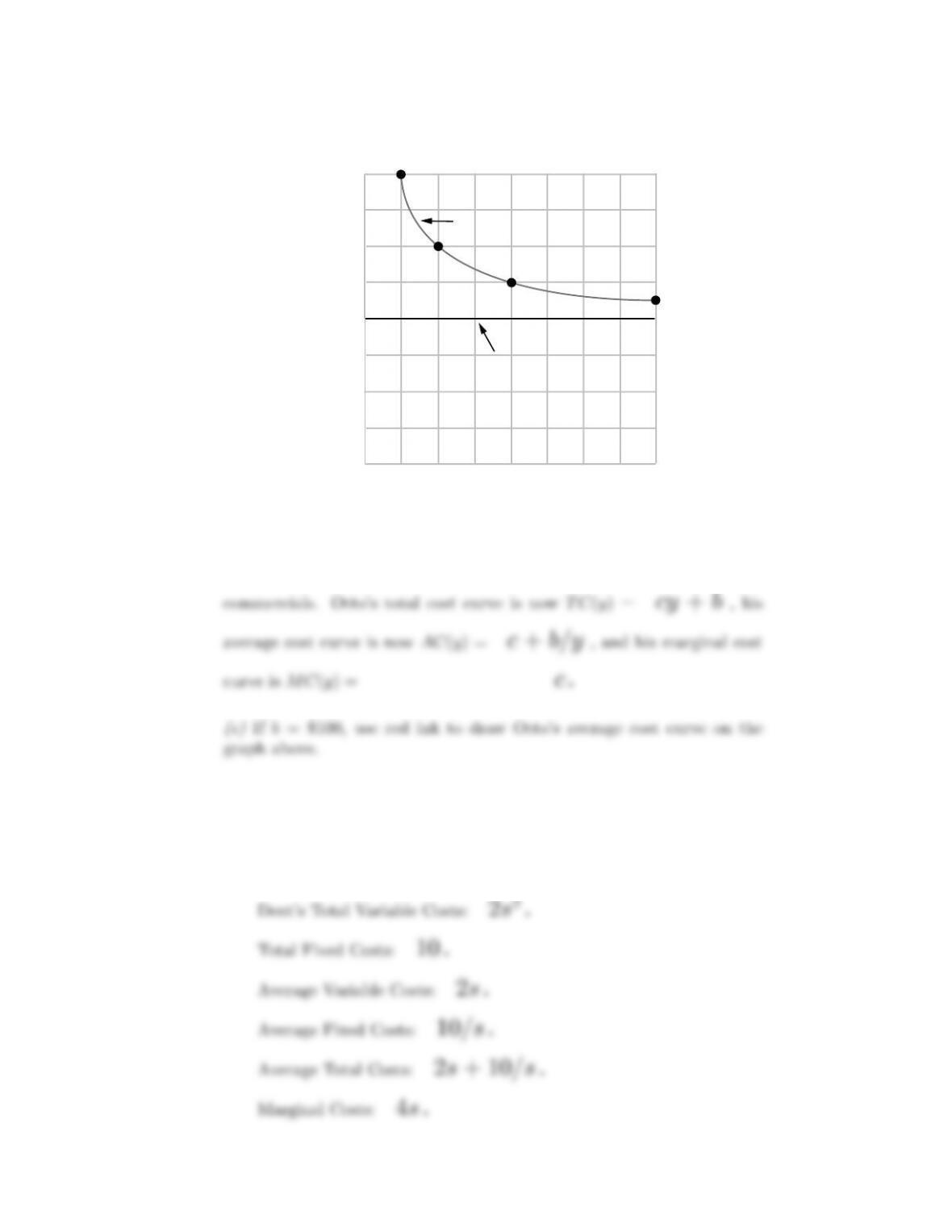
(c) In the graph below draw Otto’s average and marginal cost curves if
280 COST CURVES (Ch. 22)
0102030
40
10
20
30
40
AC, MC
Red line
AC=MC=20
Output
(d) Suppose Otto has to pay $ba year to produce obnoxious television
22.2 (0) Otto’s brother, Dent Carr, is in the auto repair business. Dent
recently had little else to do and decided to calculate his cost conditions.
He found that the total cost of repairing scars is TC(s)=2s2+ 10. But
Dent’s attention was diverted to other things … and that’s where you
come in. Please complete the following:
NAME 281
22.3 (0) A third brother, Rex Carr, owns a junk yard. Rex can use one
of two methods to destroy cars. The first involves purchasing a hydraulic
car smasher that costs $200 a year to own and then spending $1 for every
car smashed into oblivion; the second method involves purchasing a shovel
that will last one year and costs $10 and paying the last Carr brother,
Scoop, to bury the cars at a cost of $5 each.
(a) Write down the total cost functions for the two methods, where yis
(b) The first method has an average cost function 1 + 200/y and a
(c) If Rex wrecks 40 cars per year, which method should he use?
Method 2. If Rex wrecks 50 cars per year, which method should
he use? Method 1. What is the smallest number of cars per year
22.4 (0) Mary Magnolia wants to open a flower shop, the Petal Pusher,
in a new mall. She has her choice of three different floor sizes, 200 square
feet, 500 square feet, or 1,000 square feet. The monthly rent will be $1 a
square foot. Mary estimates that if she has Fsquare feet of floor space
and sells ybouquets a month, her variable costs will be cv(y)=y2/F per
month.
(a) If she has 200 square feet of floor space, write down her marginal cost
function: MC =y
100 and her average cost function: AC =
200
y+y
200.At what amount of output is average cost minimized?
(b) If she has 500 square feet, write down her marginal cost function:
MC =y/250 and her average cost function: AC =
282 COST CURVES (Ch. 22)
(c) If she has 1,000 square feet of floor space, write down her marginal
cost function: MC =y/500 and her average cost function:
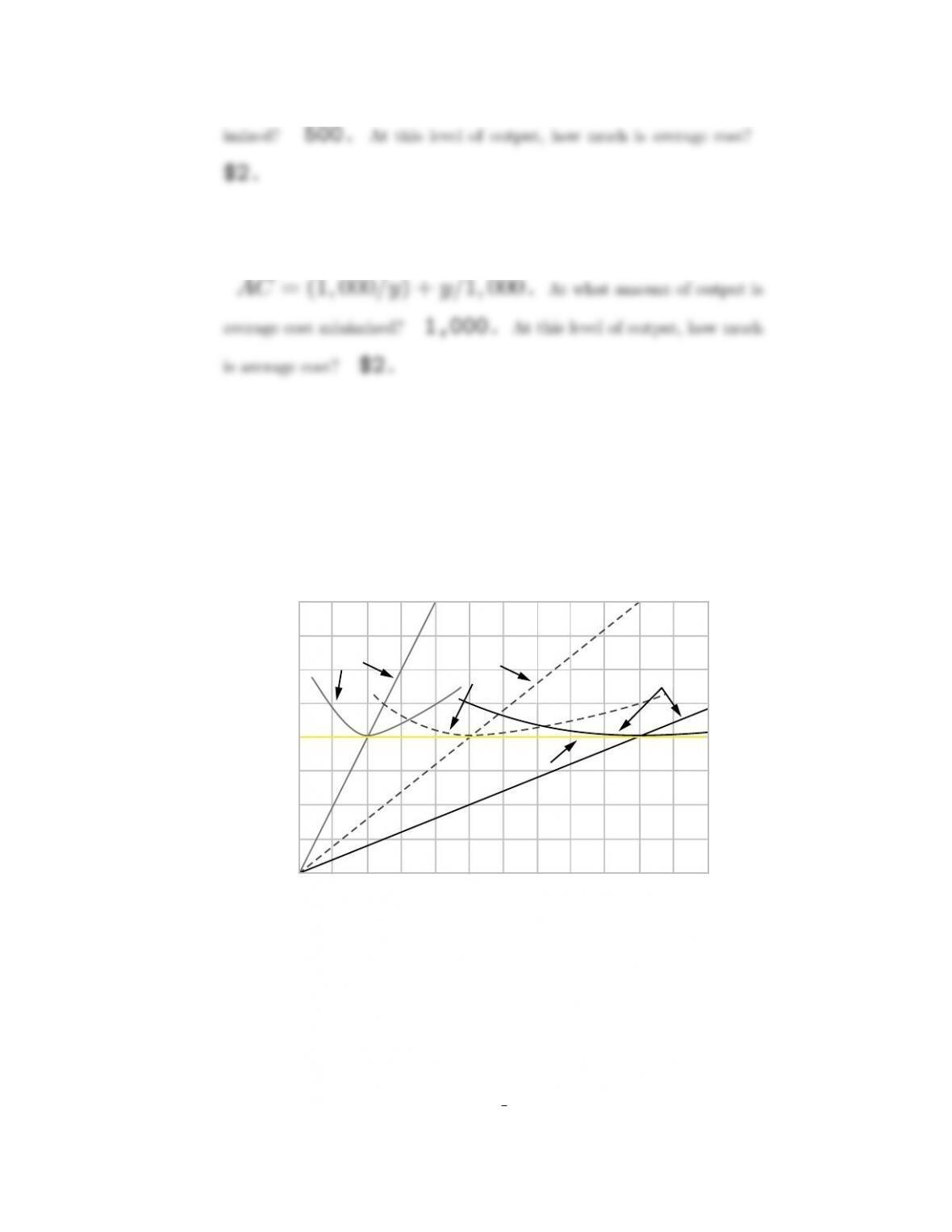
(d) Use red ink to show Mary’s average cost curve and her marginal cost
curves if she has 200 square feet. Use blue ink to show her average cost
curve and her marginal cost curve if she has 500 square feet. Use black
ink to show her average cost curve and her marginal cost curve if she has
1,000 square feet. Label the average cost curves AC and the marginal
cost curves MC.
0 400 600 800 1000
Bouquents
1
2
3
4
Dollars
200 1200
mc
ac
mc
ac
mc ac
Red
lines Blue
lines Black
lines
LRMC=LRAC (yellow line)
(e) Use yellow marker to show Mary’s long-run average cost curve and
her long-run marginal cost curve in your graph. Label them LRAC and
LRMC.
22.5 (0) Touchie MacFeelie publishes comic books. The only inputs he
needs are old jokes and cartoonists. His production function is
Q=.1J1
2L3/4,
NAME 283
where Jis the number of old jokes used, Lthe number of hours of cartoon-
ists’ labor used as inputs, and Qis the number of comic books produced.
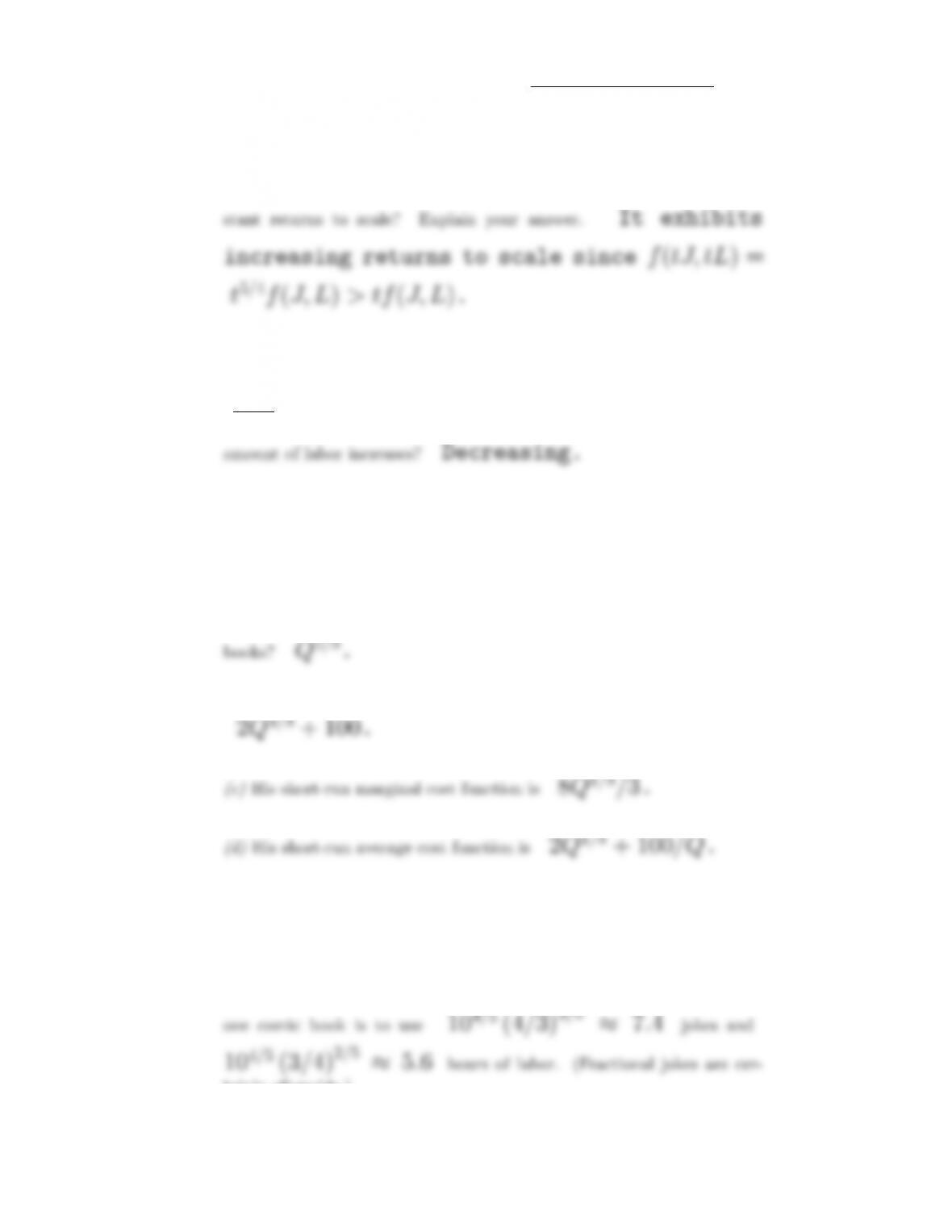
(a) Does this production process exhibit increasing, decreasing, or con-
(b) If the number of old jokes used is 100, write an expression for the
marginal product of cartoonists’ labor as a function of L.MP =
3
4L1/4Is the marginal product of labor decreasing or increasing as the
22.6 (0) Touchie MacFeelie’s irascible business manager, Gander Mac-
Grope, announces that old jokes can be purchased for $1 each and that
the wage rate of cartoonists’ labor is $2.
(a) Suppose that in the short run, Touchie is stuck with exactly 100 old
jokes (for which he paid $1 each) but is able to hire as much labor as he
wishes. How much labor would he have to hire in order produce Qcomic
(b) Write down Touchie’s short-run total cost as a function of his output
Calculus 22.7 (1) Touchie asks his brother, Sir Francis MacFeelie, to study the
long-run picture. Sir Francis, who has carefully studied the appendix to
Chapter 19 in your text, prepared the following report.
(a) If all inputs are variable, and if old jokes cost $1 each and car-
toonist labor costs $2 per hour, the cheapest way to produce exactly
tainly allowable.)
284 COST CURVES (Ch. 22)
(b) This would cost 18.7 dollars.
(c) Given our production function, the cheapest proportions in which to
use jokes and labor are the same no matter how many comic books we
print. But when we double the amount of both inputs, the number of
comic books produced is multiplied by 25/4.
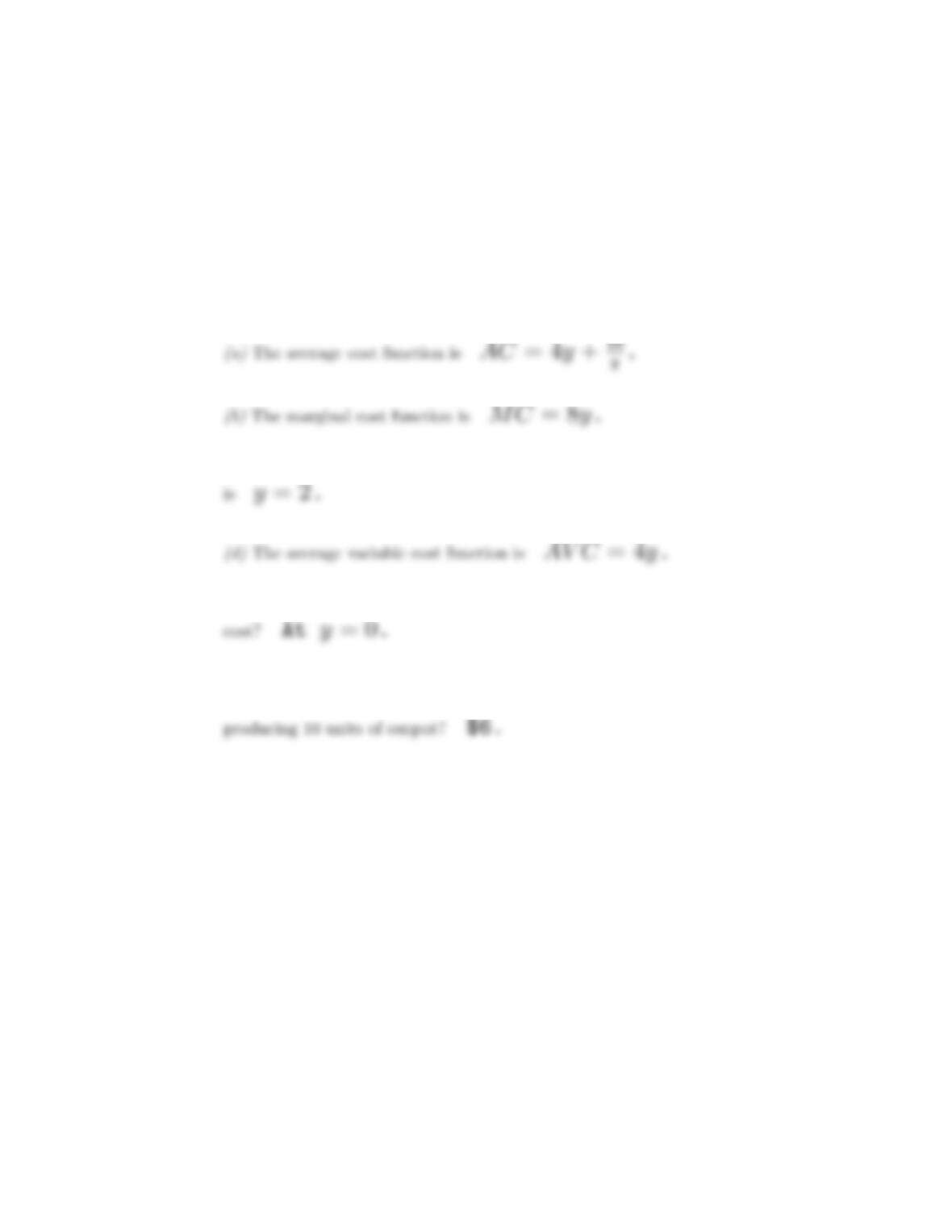
22.8 (0) Consider the cost function c(y)=4y2+ 16.
y.
(c) The level of output that yields the minimum average cost of production
(e) At what level of output does average variable cost equal marginal
22.9 (0) A competitive firm has a production function of the form
Y=2L+5K.Ifw=$2andr= $3, what will be the minimum cost of