Archives
BUS 29714
Moral hazard is not eliminated in debt financing because A) borrowers have an incentive to assume greater risk than is in the interest of the lender. B) firms with a great deal of debt often go bankrupt. C) principal-agent problems […]
BUS 29906
Which of the following statements concerning seasonal credit is true? A) It tends to have a lower interest rate than federal funds. B) It has become increasingly more important in recent years. C) Only firms receiving secondary credit are eligible […]
BUS 42996
A syndicate is A) a group of brokers illegally making use of insider information. B) a group of commercial banks that agrees to accept the checks of each other’s depositors. C) a group of investment banks underwriting a large security […]
BUS 45510
Marking to market involves A) changing the futures price to the spot price each day. B) engaging in arbitrage so as to reduce the risk involved with futures contracts. C) crediting or debiting the margin account based on the net […]
BUS 50648
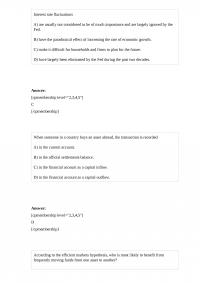
Interest rate fluctuations A) are usually not considered to be of much importance and are largely ignored by the Fed. B) have the paradoxical effect of increasing the rate of economic growth. C) make it difficult for households and firms […]
BUS 55303
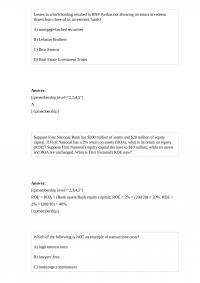
Losses in which holding resulted in BNP Paribas not allowing investors to redeem shares from three of its investment funds? A) mortgage-backed securities B) Lehman Brothers C) Bear Stearns D) Real Estate Investment Trusts Answer: Suppose First National Bank has […]
BUS 61589
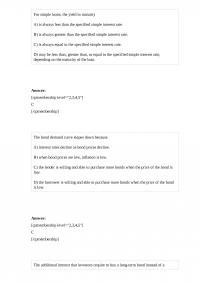
For simple loans, the yield to maturity A) is always less than the specified simple interest rate. B) is always greater than the specified simple interest rate. C) is always equal to the specified simple interest rate. D) may be […]
BUS 72174
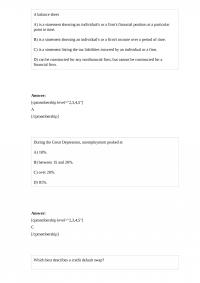
A balance sheet A) is a statement showing an individual’s or a firm’s financial position at a particular point in time. B) is a statement showing an individual’s or a firm’s income over a period of time. C) is a […]
BUS 90028
A coupon bond has an annual coupon of $75, a par value of $1000, and a market price of $900. Its current yield equals A) 50%. B) 33%. C) its yield to maturity. D) Not enough information has been provided […]
ECB 66883
Economists believe that as a saver’s wealth increases, the saver will generally A) increase his or her holdings of all assets proportionately. B) increase the fraction of wealth held as cash. C) increase the fraction of wealth held as common […]
ECB 74175
The prime interest rate is the A) interest rate on six-month U.S. Treasury bills. B) discount rate. C) Federal funds rate. D) interest rate that banks charge high-quality borrowers. Answer: Which of the following assets is the most liquid? A) […]
ECB 89606
An unsterilized intervention in which the central bank sells foreign assets to purchase domestic currency will result in A) higher domestic interest rates. B) lower domestic interest rates. C) an increase in the money supply. D) lower domestic interest rates […]
ECB 98092
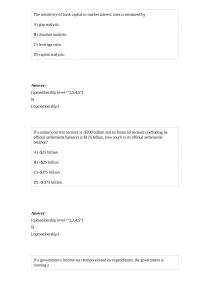
The sensitivity of bank capital to market interest rates is measured by A) gap analysis. B) duration analysis. C) leverage ratio. D) capital analysis. Answer: If a nation’s current account is -$200 billion and its financial account (excluding its official […]
ECON 11067
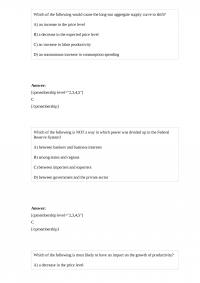
Which of the following would cause the long-run aggregate supply curve to shift? A) an increase in the price level B) a decrease in the expected price level C) an increase in labor productivity D) an autonomous increase in consumption […]
ECON 15878
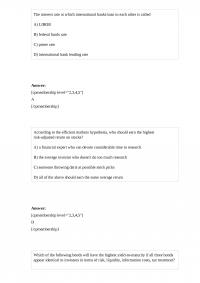
The interest rate at which international banks loan to each other is called A) LIBOR B) federal funds rate C) prime rate D) international bank lending rate Answer: According to the efficient markets hypothesis, who should earn the highest risk-adjusted […]
ECON 23824
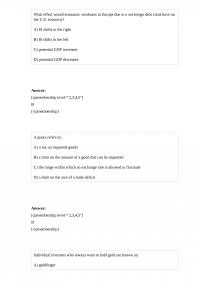
What effect would economic weakness in Europe due to a sovereign debt crisis have on the U.S. economy? A) IS shifts to the right B) IS shifts to the left C) potential GDP increases D) potential GDP decreases Answer: A […]
ECON 25587
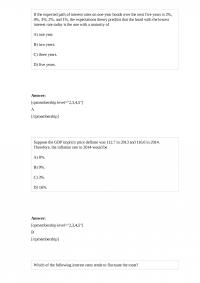
If the expected path of interest rates on one-year bonds over the next five years is 2%, 4%, 3%, 2%, and 1%, the expectations theory predicts that the bond with the lowest interest rate today is the one with a […]
ECON 27271
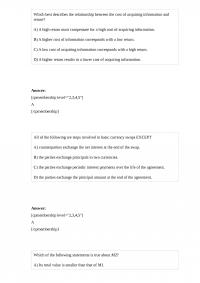
Which best describes the relationship between the cost of acquiring information and return? A) A high return must compensate for a high cost of acquiring information. B) A higher cost of information corresponds with a low return. C) A low […]
ECON 44248
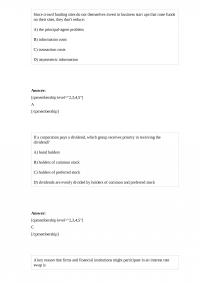
Since crowd funding sites do not themselves invest in business start ups that raise funds on their sites, they don’t reduce: A) the principal-agent problem B) information costs C) transaction costs D) asymmetric information Answer: If a corporation pays a […]
ECON 44685
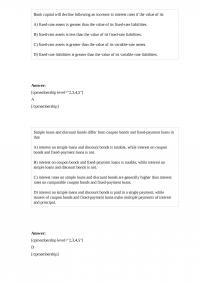
Bank capital will decline following an increase in interest rates if the value of its A) fixed-rate assets is greater than the value of its fixed-rate liabilities. B) fixed-rate assets is less than the value of its fixed-rate liabilities. C) […]
ECON 76823
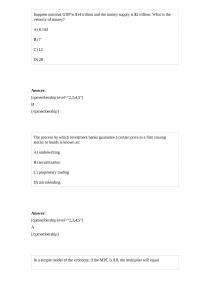
Suppose nominal GDP is $14 trillion and the money supply is $2 trillion. What is the velocity of money? A) 0.143 B) 7 C) 12 D) 28 Answer: The process by which investment banks guarantee a certain price to a […]
ECON 81157
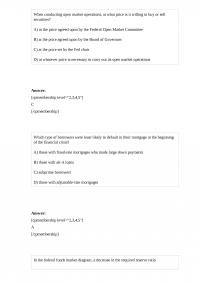
When conducting open market operations, at what price is it willing to buy or sell securities? A) at the price agreed upon by the Federal Open Market Committee B) at the price agreed upon by the Board of Governors C) […]
ECON 84357
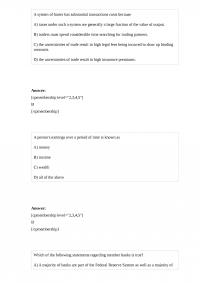
A system of barter has substantial transactions costs because A) taxes under such a system are generally a large fraction of the value of output. B) traders must spend considerable time searching for trading partners. C) the uncertainties of trade […]
ECON 95952
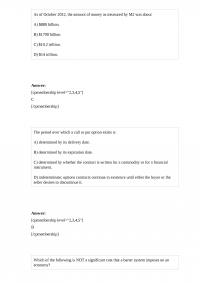
As of October 2012, the amount of money as measured by M2 was about A) $880 billion. B) $1700 billion. C) $10.2 trillion. D) $14 trillion. Answer: The period over which a call or put option exists is A) determined […]
ECON 99953
International capital mobility refers to A) the ease with which manufacturing equipment can be transported across countries. B) the ease with cash may be transferred from one country to another without having to be converted into a foreign currency. C) […]
ECON A 14821
Which of the following is the most efficient means of trade? A) barter B) money C) government rationing D) the combination of barter with some government rationing Answer: Studies by economists suggest that A) households do not increase their saving […]
ECON A 20222
An options contract A) confers the rights to buy or sell an underlying asset at a predetermined price by a predetermined time. B) is another name for a futures contract. C) may be written for debt instruments, but not equities. […]
ECON A 23050
The interest rate on interbank loans is called the A) discount rate. B) federal funds rate. C) repo rate. D) prime rate. Answer: A put option is said to be “in the money” if A) it is written on a […]
ECON A 33333
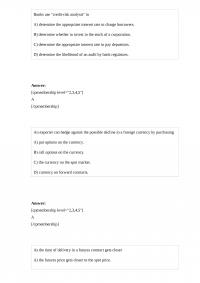
Banks use “credit-risk analysis” to A) determine the appropriate interest rate to charge borrowers. B) determine whether to invest in the stock of a corporation. C) determine the appropriate interest rate to pay depositors. D) determine the likelihood of an […]
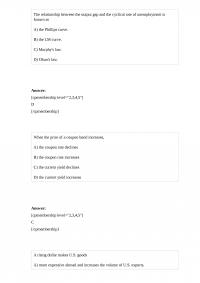
ECON A 54280 The relationship
The relationship between the output gap and the cyclical rate of unemployment is known as A) the Phillips curve. B) the LM curve. C) Murphy’s law. D) Okun’s law. Answer: When the price of a coupon bond increases, A) the […]
ECON A 55022
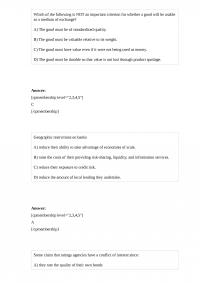
Which of the following is NOT an important criterion for whether a good will be usable as a medium of exchange? A) The good must be of standardized quality. B) The good must be valuable relative to its weight. C) […]
ECON A 84153
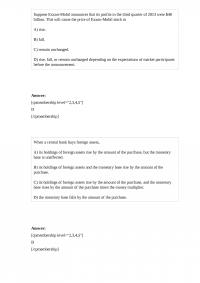
Suppose Exxon-Mobil announces that its profits in the third quarter of 2013 were $40 billion. This will cause the price of Exxon-Mobil stock to A) rise. B) fall. C) remain unchanged. D) rise, fall, or remain unchanged depending on the […]
ECON A 96300
Finance companies A) issue stock and use the proceeds to purchase bonds. B) raise funds in financial markets to lend to households and firms. C) raise funds from banks to lend to households and firms. D) issue bonds and use […]
ECON E 12397
Automatic teller machines and debit cards are examples of A) electronic funds transfer systems. B) commodity monies. C) legal tender in the United States. D) modern barter systems. Answer: Smaller firms tend to rely on financial intermediaries instead of financial […]
ECON E 16217
At an interest rate of 6%, how much will need to be invested today to have $10,000 in 5 years? A) $5,000 B) $7,473 C) $10,000 D) $13,382 Answer: How did Operation Twist affect the monetary base? A) reduced B) […]
ECON E 46357
A bank lending depositors’ money to a local business and a pension fund investing contributions in shares of a company are similar financial activities in that A) both involve the use of financial markets. B) both involve funds being channeled […]
ECON E 59485
The balance sheet channel describes ways in which interest rate changes resulting from monetary policy affect A) the portfolio decisions of households. B) the portfolio decisions of businesses. C) borrowers’ net worth. D) lenders’ net worth. Answer: Which of the […]
ECON E 72285
Everything else being constant, a lower real interest rate A) increases desired saving and net exports. B) decreases desired saving but increases net exports. C) increases desired saving and investment. D) increases desired investment but decreases net exports. Answer: Suppose […]
ECON E 74564
Which of the following can be described as when a bank buying securities owned by a business while agreeing to sell them back at a later date? A) repurchase agreement B) reverse repurchase agreement C) federal funds D) discount loans […]
ECON E 88514
The seller of a futures contract A) assumes the short position. B) assumes the long position. C) has the obligation to receive the underlying financial instrument at the specified future date. D) is expecting the price of the underlying financial […]
Economics 31386
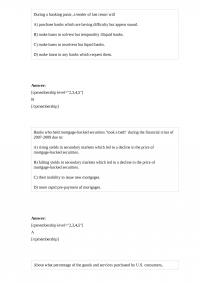
During a banking panic, a lender of last resort will A) purchase banks which are having difficulty but appear sound. B) make loans to solvent but temporality illiquid banks. C) make loans to insolvent but liquid banks. D) make loans […]
Economics 37761
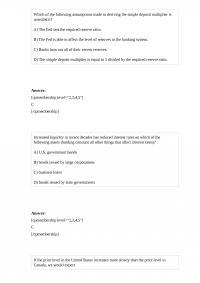
Which of the following assumptions made in deriving the simple deposit multiplier is unrealistic? A) The Fed sets the required reserve ratio. B) The Fed is able to affect the level of reserves in the banking system. C) Banks loan […]
Economics 50769
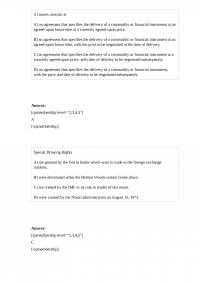
A futures contract is A) an agreement that specifies the delivery of a commodity or financial instrument at an agreed-upon future date at a currently agreed-upon price. B) an agreement that specifies the delivery of a commodity or financial instrument […]
Economics 87809
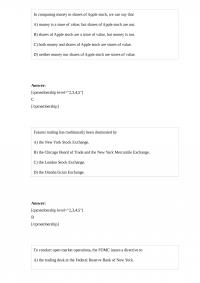
In comparing money to shares of Apple stock, we can say that A) money is a store of value, but shares of Apple stock are not. B) shares of Apple stock are a store of value, but money is not. […]
MicroEconomic 25703
The yen is considered to be stronger if: A) it takes fewer yen to acquire a foreign currency such as a dollar B) it takes more yen to acquire a foreign currency such as a dollar C) it takes fewer […]
MicroEconomic 68123
How does the Fed reach its target for the federal funds rate? A) by changing the discount rate B) by changing reserve requirements C) by adjusting the level of reserves D) by directly setting the federal funds rate Answer: All […]
MicroEconomic 84682
Which of the following is considered a default-risk-free instrument? A) a three-month commercial paper issued by GE B) a share of stock issued by Google C) a three-month Treasury bill D) a ten-year bond issued by Intel Answer: On August […]
MicroEconomic 90405
The supply curve for loanable funds would increase due to a(n) A) increase in wealth. B) increase in expected inflation. C) decrease in the liquidity of bonds relative to other assets. D) increase in the information costs of bonds relative […]
MicroEconomic 96611
A loan officer uses a credit scoring system to A) compare the interest rate on a loan to interest rates on other assets with comparable risk. B) keep track of the fraction of a bank’s assets tied up in loans […]