
Which of the following assumptions made in deriving the simple deposit multiplier is
unrealistic?
A) The Fed sets the required reserve ratio.
B) The Fed is able to affect the level of reserves in the banking system.
C) Banks loan out all of their excess reserves.
D) The simple deposit multiplier is equal to 1 divided by the required reserve ratio.
Answer:
Increased liquidity in recent decades has reduced interest rates on which of the
following assets (holding constant all other things that affect interest rates)?
A) U.S. government bonds
B) bonds issued by large corporations
C) business loans
D) bonds issued by state governments
Answer:
If the price level in the United States increases more slowly than the price level in
Canada, we would expect

A) interest rates in the United States to be higher than interest rates in Canada.
B) the U.S. dollar to depreciate against the Canadian dollar.
C) the Canadian dollar to depreciate against the U.S. dollar.
D) U.S. productivity to have increased more slowly than Canadian productivity.
Answer:
All of the following help provide the basis for the Fed controlling the real interest rate
in the IS-MP model EXCEPT
A) the Fed controls the federal funds rate through open market operations.
B) if expected future inflation remains stable, changes in nominal interest rates reflect
changes in real interest rates.
C) short-term and long-term interest rates tend to move together.
D) the Fed’s increased use of TIPS in conducting monetary policy.
Answer:
Members of the Board of Governors are
A) elected by the district bank presidents.

B) appointed by the President of the United States, subject to confirmation by the
Senate.
C) appointed by the National Monetary Commission.
D) appointed by the Securities and Exchange Commission, subject to congressional
veto.
Answer:
In Moscow in 1989, what were taxi drivers using as a medium of exchange?
A) Russian rubles
B) Marlboro cigarettes
C) gold coins
D) caviar
Answer:
The series of induced changes in consumption spending that result from an initial
change in autonomous expenditure is called the
A) induced effect.

B) autonomous effect.
C) multiplier effect.
D) consumption effect
Answer:
If the price level in Japan increases more rapidly than the price level in Britain, we
would expect
A) interest rates in Japan to lower than interest rates in Britain.
B) the Japanese yen to depreciate against the British pound.
C) the British pound to depreciate against the Japanese yen.
D) Japanese productivity to have increased more rapidly than British productivity.
Answer:
Which of the following is a hybrid of a checking and savings account?
A) CD
B) negotiable CD
C) passbook accounts

D) money market deposit account
Answer:
The result of the supply shocks of 1973-1974 was to
A) reduce aggregate output and raise the price level.
B) reduce the price level and raise aggregate output.
C) reduce both aggregate output and the price level.
D) raise both aggregate output and the price level.
Answer:
An investor who bases the decision to buy an asset solely on the expected return of an
asset is considered to be:
A) risk loving
B) risk averse
C) risk neutral
D) risk avoiding

Answer:
When all workers who want jobs have them and the demand for and supply of labor are
in equilibrium,
A) the unemployment rate will be zero.
B) unemployment is at its natural rate.
C) the economy will be experiencing high rates of inflation.
D) frictional unemployment will be zero.
Answer:
How are TIPS adjusted for inflation?
A) The interest rate is adjusted for inflation during each period.
B) The principal is adjusted once the bond reaches maturity.
C) The principal is adjusted for inflation each period.
D) The interest rate is adjusted once the bond reaches maturity.
Answer:

All of the following are problems cited by Warren Buffet as problems with derivatives
not traded on exchanges EXCEPT
A) they are thinly traded which makes it difficult to determine their value.
B) firms do not set aside reserves against potential losses.
C) they involve substantial counterparty risk.
D) they were not flexible enough due to lack of standardization.
Answer:
Which of the following will result in a decrease in the price of an existing corporate
bond?
A) lower expectations of inflation
B) new bonds issued at a lower interest rate
C) increased default risk
D) all of the above
Answer:

Which of the following is the most common goal for central banks of industrialized
countries?
A) high employment
B) high economic growth
C) low interest rates
D) low inflation
Answer:
Reserves equal
A) deposits with the Fed plus holdings of U.S. government securities.
B) currency in circulation plus vault cash.
C) deposits with the Fed plus vault cash.
D) currency outstanding plus currency in circulation.
Answer:

Blood tests administered to applicants for medical insurance are an example of an
attempt by insurance companies to deal with the problem of
A) moral hazard.
B) the drug abuse problems currently plaguing the country.
C) adverse selection.
D) failure of policyholders to keep paying their premiums.
Answer:
The use of checks in transactions
A) entails lower information costs than the use of currency.
B) entails fewer steps than settling transactions with currency.
C) avoids the cost of transporting currency back and forth.
D) entails lower information and fewer steps than settling transactions with currency.
Answer:
If currency outstanding equals $200 million, checkable deposits equal $1 billion,
reserves equal $150 million, and the required reserve ratio is 0.10, the money multiplier
equals

A) 0.86.
B) 0.14.
C) 3.43.
D) 4
Answer:
Which of the following best describes a policy of inflation targeting?
A) It’s an inflexible rule that requires the central bank to always achieve a specified
inflation rate.
B) It allows monetary policy to focus on inflation and inflation forecasts except in the
case of severe recession.
C) It allows the central bank the flexibility of setting different inflation targets each
year.
D) It requires central banks to target current inflation rather than inflation forecasts.
Answer:
Banks experience interest rate risk

A) if adverse selection problems are particularly severe.
B) if moral hazard problems are particularly severe.
C) on any investment that has high information costs.
D) if changes in interest rates cause bank profits to fluctuate.
Answer:
Dividends are
A) payments made to stock holders.
B) payments made to bond holders.
C) the total profit earned by a corporation.
D) payments to holders of common stock, not preferred stock.
Answer:
In the United States, monetary policy is carried out by
A) the Federal Reserve System.
B) Congress.

C) the President.
D) Congress and the President acting together.
Answer:
States that restrict banks to having a single branch are said to require
A) mono banking.
B) nonbank banking.
C) unit banking.
D) semi-banking.
Answer:
The theory of purchasing power parity assumes that
A) movements in nominal exchange rates are the result of movements in relative price
levels.
B) real exchange rates are volatile.
C) movements in nominal exchange rates are the result of movements in real exchange
rates.

D) inflation rates are roughly the same in most countries.
Answer:
The euro is
A) the currency of all nations in Europe.
B) the rate at which the French central bank makes discount loans.
C) a common currency of many European countries.
D) the name of the European central bank.
Answer:
If the U.S. current account balance is negative,
A) its financial account is likely to be positive.
B) its financial account is likely to be negative
C) it must use official settlements to balance its payments.
D) its balance of payments cannot be zero

Answer:
The Federal Reserve System
A) is in charge of managing the New York Stock Exchange.
B) is headed by the Secretary of the Treasury.
C) is the central bank of the United States.
D) is responsible for conducting fiscal policy for the United States.
Answer:
If the Fed purchases $1 million in securities from the nonbank public, the monetary
base will rise by $1 million
A) if the public holds the proceeds as currency.
B) if the public deposits the proceeds as checkable deposits.
C) if the public deposits the proceeds with the Treasury in a monetary base account.
D) whether the public holds the proceeds as currency or deposits them as checkable
deposits.
Answer:

In financial markets, leverage refers to:
A) the use of borrowed money in an investment
B) the power to influence the market
C) the use of political connections in attaining financial outcomes
D) the role that speculators have in impacting market outcomes
Answer:
If the federal government decreases its spending and doesn’t decrease taxes, the bond
supply shifts to the
A) left and the equilibrium interest rate rises.
B) left and the equilibrium interest rate falls.
C) right and the equilibrium interest rate rises.
D) right and the equilibrium interest rate falls.
Answer:

When the staff of the account manager at the Fed’s Open Market Trading Desk analyzes
forecasts on Treasury deposits and information on the timing of future Treasury sales of
securities, what agency does it interact with?
A) The Securities and Exchange Commission
B) The Treasury’s Office of Government Finance
C) The Treasury’s Office of Federal Reserve Relations
D) The Federal Deposit Insurance Corporation
Answer:
Money eliminates the need for
A) any government role in the economy.
B) specialization.
C) people to have a double coincidence of wants.
D) the market system.
Answer:
Make use of the quantity theory of money to solve the following problem. If the Fed
has an inflation target of 2% and the velocity of money is constant, by how much
should it increase the money supply each year if economic growth is expected to
average 3%?
Answer:
Suppose the required reserve ratio is 8% and banks do not hold excess reserves.
Illustrate on a bank’s balance sheet what happens if the Fed buys $250,000 worth of
securities from a bank.
Answer:
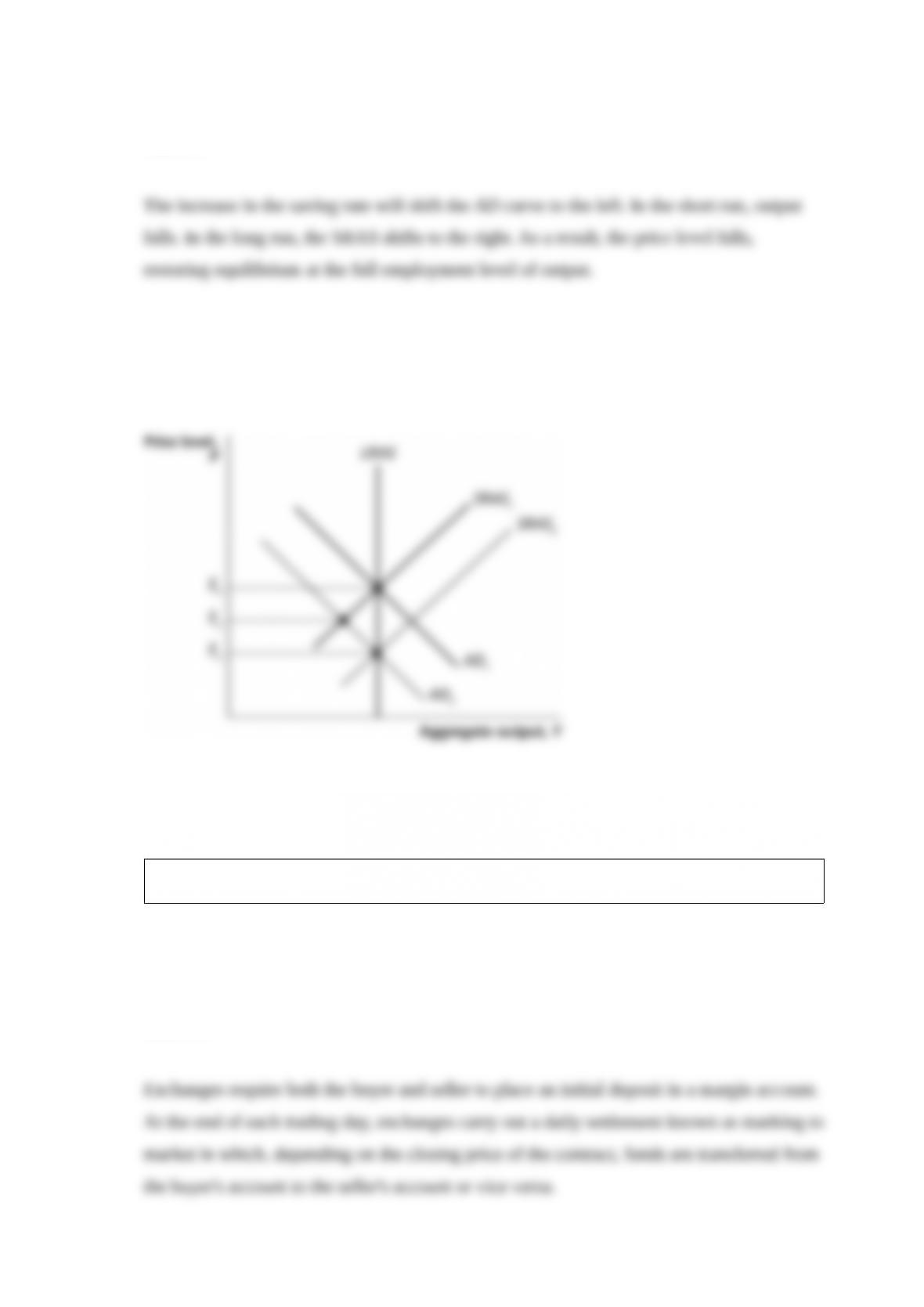
Suppose that initially U.S. households are saving only a small fraction of their incomes
because they are relying on rapid increase in stock prices to increase their wealth. If
stock prices decline and households decide to increase their saving rate, what will be
impact on output in the new Keynesian view? Be sure to distinguish the short run from
the long run.
Answer:
How do exchanges seek to reduce default risk in the futures market?
Answer:

How do defined-contribution plans differ from defined-benefit plans?
Answer:
Suppose you invest $5,000 in a one-year Japanese bond that pays 1% interest. At the
time of your purchase, 85 yen equals $1 while one year later, 80 yen equals $1. What
will be the value of your investment in one year when measured in dollars?
Answer:
How does moral hazard contribute to high bank leverage?
Answer:

How does the interest paid on reserves set a floor for the federal funds rate?
Answer:
Suppose you purchase a call option with a strike price of $85 for an options price of $10
How much profit will you earn if you exercise it when the price is $100?
Answer:
Suppose that many households look to the stock market to gauge how the economy is
likely to perform in the future. When stock prices are rising, then households will be
optimistic about the future state of the economy and will increase their spending on
houses and consumer durables, such as cars and furniture. When stock prices are
falling, then households will be pessimistic about the future and will cut back on their
spending. If this view of the link between stock prices and household spending is

correct, then what will be the effect of a decline in stock prices on output in the new
Keynesian view? Be sure to distinguish the short run from the long run.
Answer:
In 2010, fears were growing that the dollar would experience a significant decline in
value. What are the likely implications for the euro-dollar exchange rate?
Answer:
Make use of the misperceptions theory to explain why the short-run aggregate supply
curve is upward sloping.
Answer:

How does the principal-agent problem increase the possibility of moral hazard?
Answer:
What are the roles of Federal Reserve district banks?
Answer:

Suppose you are risk neutral and you are deciding between two investments. One has a
guaranteed return of 2% while the second has a 60% chance of a 10% return and a 40%
chance of a -5% return. Which investment would you choose? Why?
Answer: