
The prime interest rate is the
A) interest rate on six-month U.S. Treasury bills.
B) discount rate.
C) Federal funds rate.
D) interest rate that banks charge high-quality borrowers.
Answer:
Which of the following assets is the most liquid?
A) money market mutual fund
B) computer
C) washing machine
D) U.S. Treasury bond
Answer:
The difference between the yield on 3-month Treasury bills and 10-year Treasury notes
is largest typically during:
A) recessions

B) expansions
C) periods of high inflation
D) when the yield curve is inverted
Answer:
Futures trading practices in the United States are regulated by
A) the Chicago Board of Trade.
B) the Chicago Mercantile Exchange.
C) the Commodities Futures Trading Commission.
D) the Board of Futures Trading.
Answer:
In what way can the stock market affect the overall economy?
A) It’s an important source of funds for corporations.
B) It can affect consumer and business sentiment.
C) It is an important factor affecting consumer wealth and thus consumer spending.

D) All of the above
Answer:
In a closed economy, if the goods market is in equilibrium, national saving is $2 trillion,
national consumption is $7 trillion, and government purchases are $2.5 trillion, then
GDP equals
A) $7 trillion.
B) $9.5 trillion.
C) $11.5 trillion.
D) Not enough information has been provided to determine the answer.
Answer:
Indirect quotations in terms of foreign currency refers to:
A) expressing exchange rates as units of foreign currency in terms of domestic currency
B) expressing exchange rates as units of domestic currency in terms of foreign currency
C) expressing exchange rates of less traded currency by using a “major” currency
D) expressing exchange rates in terms of commodities such as gold

Answer:
A debt instrument represents
A) an ownership claim by the purchaser on the issuer.
B) a promise by a borrower to repay principal plus interest to a lender.
C) an attempt by a borrower in default to restore his or her credit.
D) a nontaxable asset, owned primarily by large corporations.
Answer:
Rates of inflation in the hundreds or thousands of percent per year are known as
A) super inflation.
B) megainflation.
C) hyperinflation.
D) overinflation.
Answer:

An expansionary monetary policy that successfully counteracts a recession has the side
effect of
A) lower investment spending than if no action had been taken.
B) a larger government deficit than if no action had been taken.
C) a higher price level than if no action had been taken.
D) lower output than if no action had been taken.
Answer:
What percentage of bank assets were in loans in 2012?
A) 8%
B) 20%
C) 37%
D) 60%
Answer:

Which of the following accurately describes the tax treatment of municipal bonds?
A) All income from municipal bonds is tax free.
B) Interest is tax free, but unrealized capital gains are taxable.
C) Interest is tax free, but realized capital gains are taxable.
D) Interest is taxable, but capital gains are tax free.
Answer:
If the prices of financial assets follow a random walk, then
A) they should be easy to forecast, provided market participants have rational
expectations.
B) they should be easy to forecast, provided market participants have adaptive
expectations.
C) the change in price from one trading period to the next is not predictable.
D) major traders in the market must not be making use of all available information
about the assets.
Answer:

Which criterion for suitability as a medium of exchange do Federal Reserve Notes
meet?
A) They are of standardized quality.
B) They are durable.
C) They are acceptable to most traders.
D) Federal Reserve Notes meet all of the criteria for suitability as a medium of
exchange.
Answer:
What is a primary reason for the yield on 3-month Treasury bills being low during
recessions?
A) low risk premium
B) the Fed pushing short-term interest rates down
C) rising inflation
D) the inversion of the yield curve
Answer:
Any reserves beyond what is required are called

A) required reserves.
B) excess reserves.
C) secondary reserves.
D) bank capital.
Answer:
If you deposit $500 in a savings account at an annual interest rate of 5%, how much
will you have in the account at the end of five years?
A) $625
B) $392
C) $638
D) $550
Answer:
The members of Federal Reserve district bank boards of directors who are bankers are
known as
A) Class A directors.

B) Class B directors.
C) Class C directors.
D) Class D directors.
Answer:
Small investors face
A) high transactions costs in financial markets.
B) low transactions costs in financial markets.
C) high transactions costs in financial intermediaries.
D) high information costs in financial intermediaries.
Answer:
What made the recession of 2007-2009 different than any other recession since the
Great Depression?
A) the government did not implement a fiscal stimulus
B) the Fed failed to reduce interest rates

C) it was accompanied by a financial crisis
D) the impact was primarily limited to the financial sector
Answer:
An increase in expected inflation results in
A) lower nominal interest rates and higher bond prices.
B) lower real interest rates and higher bond prices.
C) higher real interest rates and lower bond prices.
D) higher nominal interest rates and lower bond prices.
Answer:
In the IS-MP model, when the Fed increases the real interest rate
A) the MP curve shifts up resulting in a decline in the output gap.
B) the MP curve shifts up resulting in an increase in the output gap.
C) the MP curve shifts down resulting in a decline in the output gap.
D) the MP curve shifts down resulting in an increase in the output gap.

Answer:
An increase in the price level reduces net exports because
A) it leads indirectly to a higher exchange rate.
B) it leads indirectly to a lower exchange rate.
C) it leads indirectly to a lower real interest rate.
D) it leads directly to higher real money balances.
Answer:
Above-normal returns on stock investments can be expected by investors who
A) possess insider information.
B) are wealthy enough to hold the stock of many different companies in their portfolios.
C) are risk seeking.
D) concentrate their investments in one or two stocks.
Answer:

An option buyer
A) has a greater insurance benefit than the purchaser of a futures contract.
B) bears the risk of unfavorable price movements.
C) is purchasing a naked option if he or she does not also own the underlying asset.
D) generally will incur a lower cost than will the purchaser of a futures contract.
Answer:
As of 2012, mortgage-backed securities made up approximately what portion of
securities held by a bank?
A) 5%
B) 20%
C) 50%
D) 70%
Answer:

Since Germany is a large open economy, the increase in German borrowing and
investment in what was formerly East Germany in the early 1990s resulted in
A) a decline in the world real interest rate.
B) a shift to the right in the German supply of loanable funds curve.
C) an increase in the real interest rate in the United States.
D) a shift to the left in the German demand for loanable funds curve.
Answer:
If the Fed makes a discount loan of $2 million to a commercial bank, the Fed’s balance
sheet will show
A) an increase in discount loans of $2 million and an increase in bank reserves of $2
million.
B) an increase in discount loans of $2 million and a decrease in bank reserves of $2
million.
C) a decrease in discount loans of $2 million and an increase in bank reserves of $2
million.
D) a decrease in discount loans of $2 million and a decrease in bank reserves of $2
million.
Answer:

Which of the following statements is correct?
A) Open market purchases are expansionary and open market sales are contractionary.
B) Open market purchases are contractionary and open market sales are expansionary.
C) Both open market purchases and open market sales are expansionary.
D) Both open market purchases and open market sales are contractionary.
Answer:
If prices increase rapidly
A) money’s usefulness as a store of value is diminished.
B) money increases in value.
C) deflation is likely.
D) prices will decline to their normal level.
Answer:
When prices of new houses rise significantly faster than rent prices, this is evidence of
a:

A) debt-deflation process
B) bubble
C) financial crisis
D) sovereign debt crisis
Answer:
Bank borrowing from the Fed is referred to as:
A) federal funds
B) discount loans
C) repurchase agreements
D) reverse repurchase agreements
Answer:
According to the Efficient Markets Hypothesis, prices of securities
A) change infrequently.
B) change frequently to reflect news about changes in the fundamental values of the

securities.
C) change frequently as evaluations of existing information about the securities change.
D) are not allowed, under federal securities laws, to change more frequently than once a
month.
Answer:
Assuming a required reserve ratio of 5%, interest rate on reserves of 1%, and interest
rate on loans of 6%, what is the effective cost of the reserve requirement on a $10,000
deposit?
A) 0.05%
B) 0.25%
C) 0.30%
D) 1%
Answer:
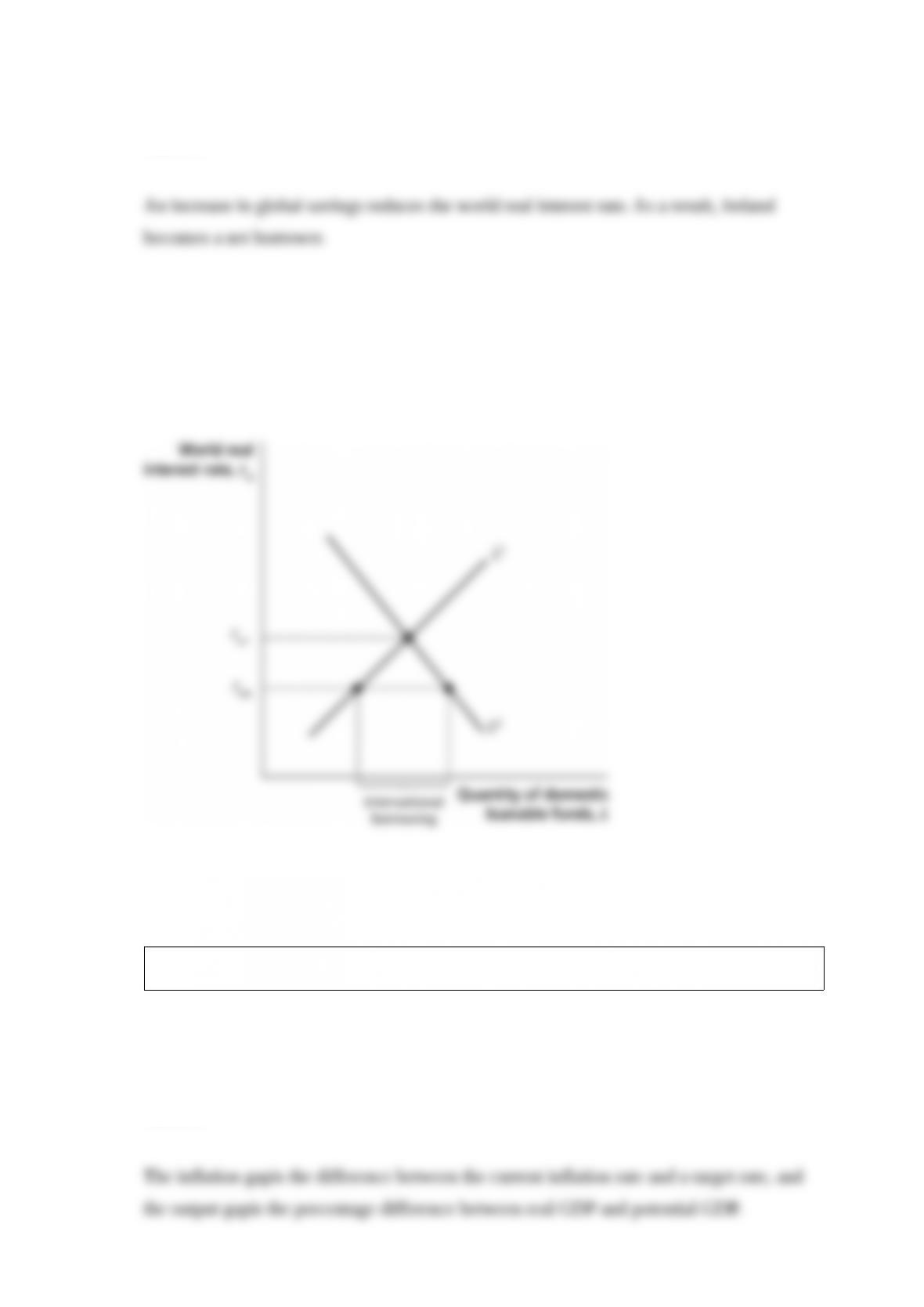
Suppose Ireland is a small open economy that is neither a net international borrower or
international lender. Many countries increase their savings resulting in a lower world
real interest rate. Make use of a graph of the loanable funds market for a small open
economy to show the impact this has on Ireland’s international financial position.
Answer:
What is the inflation gap? What is the output gap?
Answer:

If the required reserve ratio is 10% and the Fed purchases $20 million worth of
securities, what is the simple deposit multiplier and what happens to the amount of
deposits in the banking system? Assume that banks do not hold excess reserves and the
public does not change its currency holdings.
Answer:
What are two ways that governments can prevent banking panics?
Answer:
How are interest payments on mortgages distributed to investors who own
mortgage-backed securities?
Answer:

Suppose you purchase a bond with a coupon of $50 for $1010. You sell it one year later
for $900. What rate of return did you earn? Report a percentage with two decimal
places.
Answer:
Suppose you put $500 in your savings account and earn 4% interest per year. How
much will you have in your account after two years? Be sure to round off to the nearest
cent
Answer:
Use the following data to calculate equilibrium real GDP: C= .75Y, I = $2 trillion,
G=$1 trillion and NX = -$0.5 trillion.
Answer:
What is an advantage of using options instead of forward contracts when hedging
against exchange-rate risk?
Answer:
How do payments on a fixed-payment loan differ from a coupon bond?
Answer:
Suppose that businesses in Japan reduce their spending on plant and equipment. What
will be the effect on spending on plant and equipment by businesses in the United
States?
Answer:
What are the five characteristics that make an asset suitable to be used as a medium of
exchange?
Answer:
Why are forward contracts typically illiquid?
Answer:
What are the advantages of bank deposits compared to other types of assets?
Answer:
What should affect the fundamental value of a stock according to the efficient markets
hypothesis?
Answer:
What are three reasons that employees may prefer to save through pensions provided by
employers rather than through savings accounts?
Answer:
Compare the characteristics of loans and marketable securities in terms of liquidity,
risk, and information costs.
Answer: