
A balance sheet
A) is a statement showing an individual’s or a firm’s financial position at a particular
point in time.
B) is a statement showing an individual’s or a firm’s income over a period of time.
C) is a statement listing the tax liabilities incurred by an individual or a firm.
D) can be constructed for any nonfinancial firm, but cannot be constructed for a
financial firm.
Answer:
During the Great Depression, unemployment peaked at
A) 10%.
B) between 15 and 20%.
C) over 20%.
D) 81%.
Answer:
Which best describes a credit default swap?

A) It is designed to reduce interest-rate risk.
B) The issuer receives payments from the buyer in return for agreeing to make
payments to the buyer if the security goes into default.
C) Issuers are taking out insurance in case of default.
D) It represents a way for the issuer to establish its creditworthiness.
Answer:
An insurance premium is a
A) payment made by an insurance company to a policyholder after the occurrence of an
insurable event.
B) payment made by an insurance company to a policyholder following a period in
which the policyholder has filed no claims against the company.
C) fee paid by policyholders to insurance companies as payment for coverage.
D) fee paid by policyholders to insurance companies in exchange for special
considerations, such as a particularly large policy.
Answer:
Investment banks do NOT engage in which of the following?

A) proprietary trading
B) securitization
C) lending to households
D) underwriting
Answer:
A $10 million open market purchase will increase the monetary base by
A) $10 million.
B) $10 million times the money multiplier.
C) $10 million divided by the money multiplier.
D) an amount between $0 and $10 million, depending on the fraction of the purchase
the public wishes to hold as currency.
Answer:
What is the yield to maturity on a simple loan that requires payment of $500 plus $30 in
interest one year from now?
A) 6%

B) 6.38%
C) 5.3%
D) Not enough information has been provided to determine the answer.
Answer:
The main argument against Fed independence is that
A) in a democracy elected officials should make public policy.
B) monetary and fiscal policy would be easier to coordinate if the Fed were not
independent.
C) the Fed has proven irresponsible on many occasions.
D) congressional control was tried during the 1960s and it worked well.
Answer:
A key point made by the Gordon-Growth model is that the
A) value of a stock depends on investor’s expectations about the future profitability of a
firm.
B) past trends in a stock’s behavior indicate future price trends.

C) dividends have little to do with a stock’s value.
D) risk has little effect on a stock’s value.
Answer:
Which of the following is the most likely result of financial intermediaries?
A) increased funds available to borrowers
B) higher transaction costs
C) higher information costs
D) lower information cost but higher transaction costs
Answer:
How many times has the Fed has changed reserve requirements since 1993?
A) never
B) about once a year
C) only once
D) only twice

Answer:
A speculator who believes strongly that interest rates will rise would be likely to
A) buy futures contracts on Treasury bills.
B) sell futures contracts on Treasury bills.
C) buy Treasury bonds in the spot market.
D) increase now the amount of money which he lends.
Answer:
The new classical approach to the aggregate supply curve assumes that businesses are
A) better informed about the general price level than they are about prices in their own
markets.
B) better informed about prices in their own markets than they are about the general
price level.
C) equally well informed about prices in their own markets and the general price level.
D) reluctant to engage in investment spending because of a lack of information
concerning future prices.

Answer:
During most of the time in recent decades, the government sector
A) has not spent more than it collected in taxes.
B) has run large deficits.
C) has run large surpluses.
D) has balanced its budget every year.
Answer:
If the price of a Toyota Camry is Y2,000,000 and the price of a Ford Fusion is $20,000,
according to the law of one price, the exchange rate between the yen and the dollar
should be:
A) Y100 = $1
B) $100 = Y1
C) Y1,980,000=$1
D) the law of one price does not apply since the goods are differentiated
Answer:

If the real interest rate is -1.4% and the nominal interest rate is 6%, expected inflation
equals
A) -2%
B) -0.8%
C) 0.8%
D) 2%
Answer:
Employees of brokerage firms that rely on forecasting future profits of firms in order to
forecast future stock prices are called
A) rational analysts
B) adaptive analysts
C) technical analysts
D) fundamental analysts
Answer:

The fee charged by a typical hedge fund are sometimes called:
A) 12b-1 fees
B) hedging premiums
C) loads
D) carried interest
Answer:
Which of the following is an asset of the Fed?
A) reserves of banks
B) currency in circulation
C) discount loans to banks
D) checkable deposits in commercial banks
Answer:

The futures price
A) reflects traders’ expectations of the spot price on the day of delivery.
B) is always above the spot price on the day of delivery.
C) is always below the spot price on the day of delivery.
D) is always equal to the spot price at every point in time.
Answer:
Which of the following is an example of a commodity money?
A) gold coins
B) dollar bills
C) British pound notes
D) Japanese yen notes
Answer:
Under which circumstance is the Fed most likely to carry out a defensive open market
operation?
A) to prevent an increase in inflation

B) if a snowstorm results in a delay in check clearing, resulting in an increase in the
Federal Reserve float
C) to defend the value of the U.S. dollar on the foreign exchange market
D) to prevent the negative impact of a demand shock
Answer:
Suppose Matt’s New Cars issues a bond in which they’ll need to pay $10,000 in one
year, which includes 4% interest. How much will they receive for the bond?
A) $9,600
B) $9,615
C) $10,000
D) $10,400
Answer:
According to the theory of purchasing power parity, if the inflation rate in England is
greater than the inflation rate in Japan,
A) the law of one price has been violated.

B) the nominal value of the pound will appreciate against the yen.
C) the nominal value of the yen will appreciate against the pound.
D) the nominal value of the pound will appreciate against the yen, but only if the two
countries are on the gold standard.
Answer:
If U.S. inflation is 2%, Japanese inflation is 1%, and Mexican inflation is 3%, which of
the following is true according to the theory of purchasing power parity?
A) The dollar should rise by 1% versus the yen and fall by 1% versus the peso.
B) The dollar should rise by 1% versus the peso and fall by 1% versus the yen.
C) The dollar should rise by 1% versus both the peso and the yen.
D) The dollar should fall by 1% versus both the peso and the yen.
Answer:
Which of the following is a liability of the Fed?
A) U.S. government securities
B) currency in circulation

C) discount loans to banks
D) checkable deposits in commercial banks
Answer:
Federal Reserve district banks perform all of the following roles EXCEPT
A) managing checking clearing in the payments system.
B) performing regulatory functions.
C) setting the federal funds rate.
D) managing currency in circulation by issuing new Federal Reserve Notes.
Answer:
Which of the following is NOT included in aggregate demand?
A) Demand for goods and services for consumption
B) Investment in business plant and equipment
C) Net exports
D) Investment in Treasury bonds

Answer:
Which asset is sometimes referred to as a bank’s secondary reserves?
A) vault cash
B) U.S. government securities
C) repurchase agreements
D) federal funds
Answer:
A stock option is said to be “out of the money” if:
A) the strike price equals the exercise price.
B) stock price equals the strike price.
C) strike price exceeds the stock price.
D) stock price exceeds the strike price.
Answer:
Which bond would someone in a 35% tax bracket choose to buy: a municipal bond with
an interest rate of 7% or a corporate bond with an interest rate of 10%?
Answer:
Explain what happens to the short-run aggregate supply curve when output exceeds its
potential.
Answer:
What has been the approach of the European Central Bank to monetary targeting?
Answer:
How does the existence of money affect economic growth?
Answer:
What is an advantage of using options instead of forward contracts when speculating on
exchange rates?
Answer:
What are four inefficiencies of a barter system?
Answer:
Explain how does an increase in real interest rates affect the components of AE.
Answer:
What is included in the public statement released by the FOMC following the
conclusion of its meeting?
Answer:
What are the three books to which the FOMC has access and what information is
included in each?
Answer:
What are the two most common reasons for a sovereign debt crisis?
Answer:
How do car dealers help reduce adverse selection?
Answer:
Suppose the private bond rating agencies ceased to exist. What would be the impact on
the bond market?
Answer:
What is the yield to maturity of a perpetuity with a coupon of $40 and a price of $800?
Answer:
What unusual policy actions did the Fed take during the Financial Crisis of 2007-2009
that affected its balance sheet?
Answer:
How can restrictive covenants help to reduce moral hazard in bond markets?
Answer:
What is the multiplier? If MPC =0.75, what is the value of the multiplier in the simple
model of the economy?
Answer:
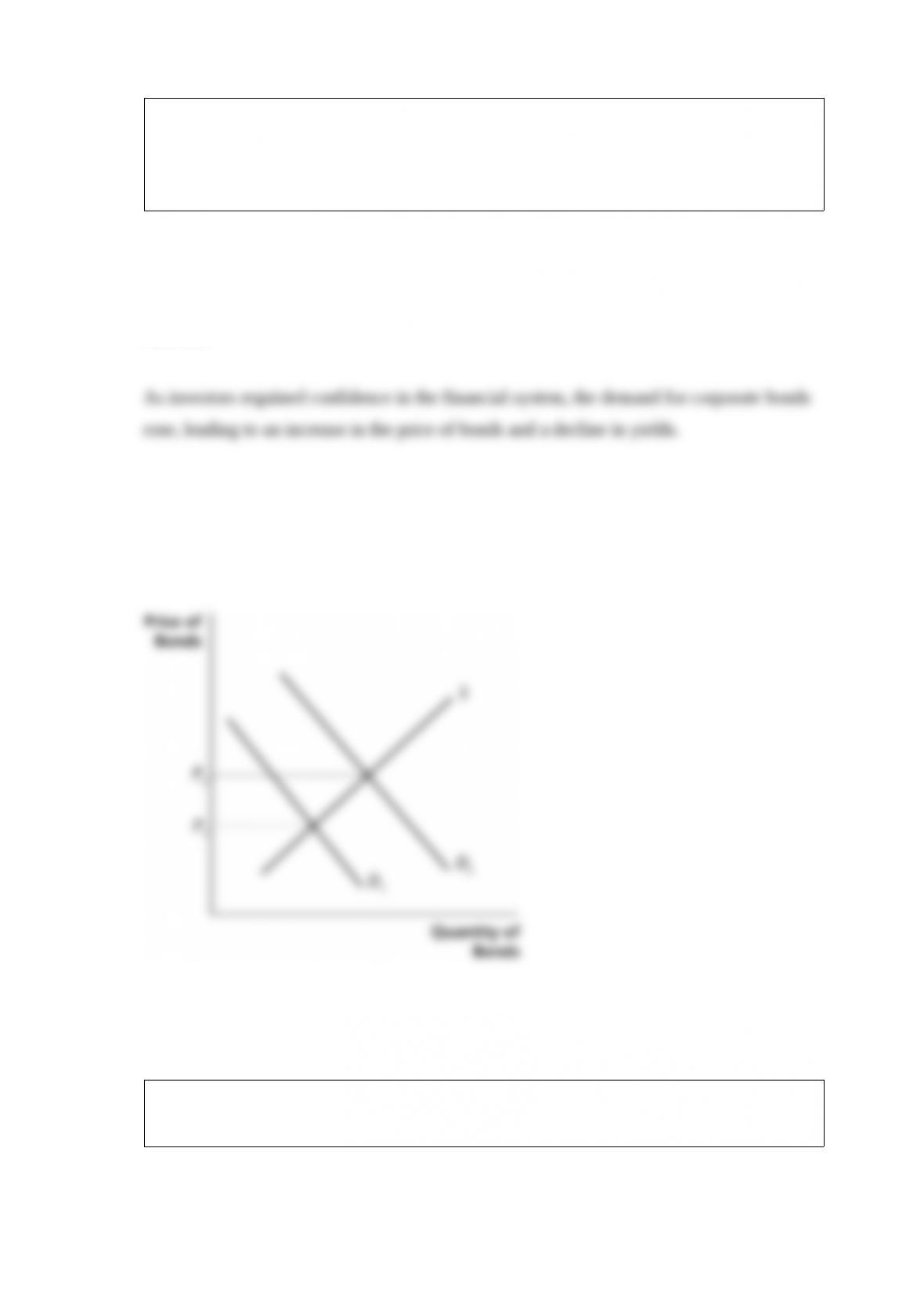
In 2009, global investors began to regain confidence in the financial system and
reversed the flight to safety that had taken place during the depths of the financial crisis.
Make use of a graph of the market for corporate bonds to show the impact on corporate
bonds prices and yields.
Answer:
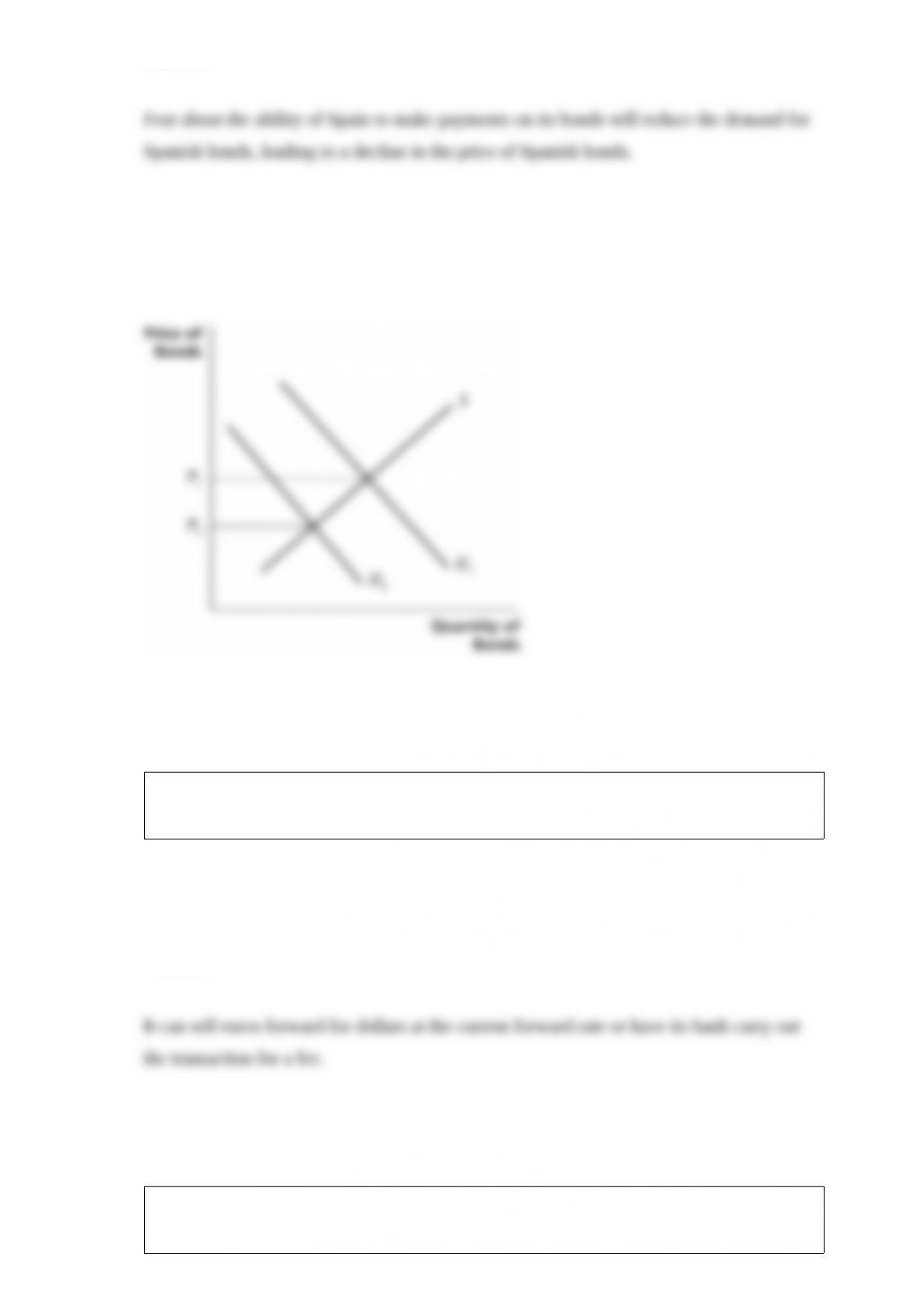
In November 2012, concern was raised about Spain’s sovereign debt. Make use of a
graph of the bond market to show how this would affect the price of Spanish bonds.
Answer:
Briefly explain how a U.S. company that exports to Europe can hedge against exchange
rate risk.
Answer:
Suppose a bank has $10 million in capital, $100 million in assets, and after-tax profit of
$2 million? what is its return on assets? What is its return on equity?
Answer: