
Bank capital will decline following an increase in interest rates if the value of its
A) fixed-rate assets is greater than the value of its fixed-rate liabilities.
B) fixed-rate assets is less than the value of its fixed-rate liabilities.
C) fixed-rate assets is greater than the value of its variable-rate assets.
D) fixed-rate liabilities is greater than the value of its variable-rate liabilities.
Answer:
Simple loans and discount bonds differ from coupon bonds and fixed-payment loans in
that
A) interest on simple loans and discount bonds is taxable, while interest on coupon
bonds and fixed-payment loans is not.
B) interest on coupon bonds and fixed-payment loans is taxable, while interest on
simple loans and discount bonds is not.
C) interest rates on simple loans and discount bonds are generally higher than interest
rates on comparable coupon bonds and fixed-payment loans.
D) interest on simple loans and discount bonds is paid in a single payment, while
issuers of coupon bonds and fixed-payment loans make multiple payments of interest
and principal.
Answer:

The Fed’s inability to instantaneously observe changes in inflation and economic
growth result in
A) information lag.
B) impact lag.
C) policy lag.
D) jet lag.
Answer:
If the annual interest rate is 9%, what would you expect to pay for a bond paying a
lump sum of $10,000 in two years?
A) $8,417
B) $8,200
C) $10,000
D) $11,881
Answer:
An open market purchase

A) increases the monetary base.
B) decreases the monetary base.
C) increases the federal funds rate.
D) is another name for a discount loan.
Answer:
If banks hold no excess reserves, checkable deposits total $1.5 billion, currency totals
$400 million, and the required reserve ratio is 10%, then the monetary base equals
A) $550 million.
B) $1.54 billion.
C) $1.9 billion
D) $15 billion.
Answer:
Which of the following assets had both the lowest average annual return and lowest risk
between 1926 and 2011?
A) small company stocks

B) large company stocks
C) long-term corporate bonds
D) U.S. Treasury bills
Answer:
Why has the Federal Reserve chairman often been called the second most important
person in terms of affecting the economy?
A) The Fed chairman has veto power over all federal spending.
B) The Fed is in control of monetary policy.
C) The Fed chairman draws the second highest salary of any official of the federal
government.
D) The Fed has regulatory power over all financial markets.
Answer:
The level of potential GDP
A) increases as the real rate of interest decreases.
B) increases as the real rate of interest increases.

C) is unaffected by the real rate of interest.
D) is represented on the IS-MP model by a horizontal line at the world real rate of
interest.
Answer:
In comparing actively managed mutual funds with those funds that simply buy and hold
a large market portfolio (index funds), we would expect that
A) the actively managed funds provide a higher return than the index funds.
B) the index funds provide a higher return after expenses than the actively managed
funds.
C) actively managed funds and index funds provide the same returns.
D) index funds provide a lower return than actively managed funds only if taxes are
taken into consideration.
Answer:
Following the downgrade of U.S. debt by Standard & Poor’s in August, 2011:
A) other rating agencies also downgraded U.S. debt
B) interest rates spiked as investor’s perception of risk increased

C) investors didn’t seem to be any more concerned about default risk than before the
downgrade
D) the U.S. implemented a plan to significantly reduce its budget deficit later that year
Answer:
Forward contracts are often illiquid because
A) any capital gains on them are heavily taxed, making investors reluctant to sell them.
B) government regulation has not provided for a secondary market in them.
C) they generally contain terms specific to the particular buyer and seller.
D) the brokerage fees involved in buying and selling them are very high.
Answer:
Negotiable certificates of deposit were developed in order to
A) compete for loan business that had been going to the commercial paper market.
B) circumvent interest rate regulations on deposits.
C) increase assets that were acceptable as collateral for discount loans.
D) circumvent reserve requirements.

Answer:
Noise traders
A) tend to lose money on stock trades, but help to stabilize the market.
B) tend to make higher returns than do “buy-and-hold” investors.
C) create additional risk in the market by increasing price fluctuations.
D) trade only when they have inside information.
Answer:
A shortcoming of swaps that has led to the domination of the swaps market by large
firms and financial institutions is
A) the lack of privacy.
B) need to assess creditworthiness.
C) desire for more flexibility.
D) limited size of the market.
Answer:

The default risk premium is measured
A) by an index published monthly by the Securities and Exchange Commission.
B) by an index published monthly by The Wall Street Journal.
C) as the difference between the yield on a non-Treasury security and the yield on a
U.S. Treasury security of the same maturity.
D) as the difference between the nominal yield on the security and the real after-tax
yield on the security.
Answer:
Which of the following is a possible impact of a global savings glut on a small open
economy?
A) interest rate would increase
B) interest rate would decrease
C) domestic savings would increase
D) domestic investment would increase
Answer:

If foreign interest rates rise
A) the demand for domestic currency rises, causing it to appreciate.
B) the demand for domestic currency falls, causing it to depreciate.
C) the demand for domestic currency rises, causing it to depreciate.
D) the demand for domestic currency falls, causing it to appreciate.
Answer:
All of the following arguments are presented in favor of inflation targeting EXCEPT
A) it would draw attention to what the central bank can achieve in practice.
B) it would provide an anchor for inflationary expectations.
C) it would promote accountability by providing a yardstick by which policy can be
measured.
D) it would reduce the lags inherent in monetary policy.
Answer:

To deal with difficulties in administering pension funds, Congress in 1974 passed the
A) Corrupt Pension Fund Reform Act.
B) Securities and Exchange Act.
C) Employee Retirement Income Security Act.
D) Social Security Act.
Answer:
If a $10 billion increase in investment leads to a $20 billion increase in GDP, the
multiplier is
A) 0.5
B) 2
C) 10
D) 30
Answer:
Former Fed chair Alan Greenspan’s use of ambiguous and vague language came to be
known as:

A) Greenspeak
B) Fedspeak
C) Alanguage
D) jibberish
Answer:
The usual response of the banking system to new government regulations is
A) evasion through whatever means are necessary.
B) strict compliance.
C) an attempt to circumvent the regulations through financial innovation.
D) bankruptcy.
Answer:
If the Fed desired to reduce the federal funds rate,
A) it would conduct an open market sale, reducing reserve supply.
B) it would conduct an open market purchase, increasing reserve supply.

C) it would conduct an open market sale, increasing reserve demand.
D) it would conduct an open market purchase, reducing reserve demand.
Answer:
If the Fed wants to increase the value of the dollar, it will
A) sell foreign securities and buy dollars in international currency markets.
B) buy foreign securities and sell dollars in international currency markets.
C) buy foreign securities and also buy dollars in international currency markets.
D) sell foreign securities and also sell dollars in international currency markets.
Answer:
Since all assets typically do not move together, how can investors typically reduce risk?
A) Purchase only the best performing assets.
B) Diversify one’s portfolio across different asset classes.
C) Avoid poor performing assets.
D) Actively manage one’s portfolio.

Answer:
Which of the following is NOT a responsibility of the Board of Governors?
A) approving bank mergers
B) determining permissible activities for bank holding companies
C) carrying out open market operations
D) setting the salaries of the presidents and officers of district banks
Answer:
Suppose you plan to hold a stock for one year. You expect that, in one year, it will sell
for $30 and pay a dividend of $3 per share. If your required return on equity is 10%,
what is the most you should be willing to pay for the share today?
A) $3.30
B) $23
C) $30
D) $33

Answer:
Using estimates of past returns, which monthly investment is most likely to result in the
largest amount of money at retirement for a person in the early 20s?
A) CDs
B) Treasury bills
C) stocks
D) all of the above will result in a similar amount of money
Answer:
The law of one price states that
A) most countries require that all entering goods have the same price.
B) most countries require that all exported goods have the same price.
C) identical goods should have the same price anywhere in the world.
D) most countries require that the price of a good not be changed once it is already in a
store and available for sale.
Answer:

If the expected price level increases at the same time that the federal government cuts
taxes, in the short run
A) aggregate output and the price level will both increase.
B) aggregate output will increase, but the price level will fall.
C) aggregate output and the price level will both fall.
D) the price level will increase, but aggregate output may either increase or decrease.
Answer:
If the German interest rate is 4% and the U.S. interest rate is 5%, what is the expected
change in the value of the dollar in terms of the euro?
A) 1%
B) -1%
C) 9%
D) -9%
Answer:

Swaps differ from futures and options in all of the following ways EXCEPT:
A) intended to reduce the risk faced by participants.
B) more flexibility.
C) more privacy.
D) less regulation.
Answer:
As a person’s wealth increases, which of the following portfolio holdings is likely to
increase the least?
A) checking account
B) stocks
C) money market fund
D) bonds
Answer:
Make use of a graph of the foreign exchange market to show how the Central Bank of
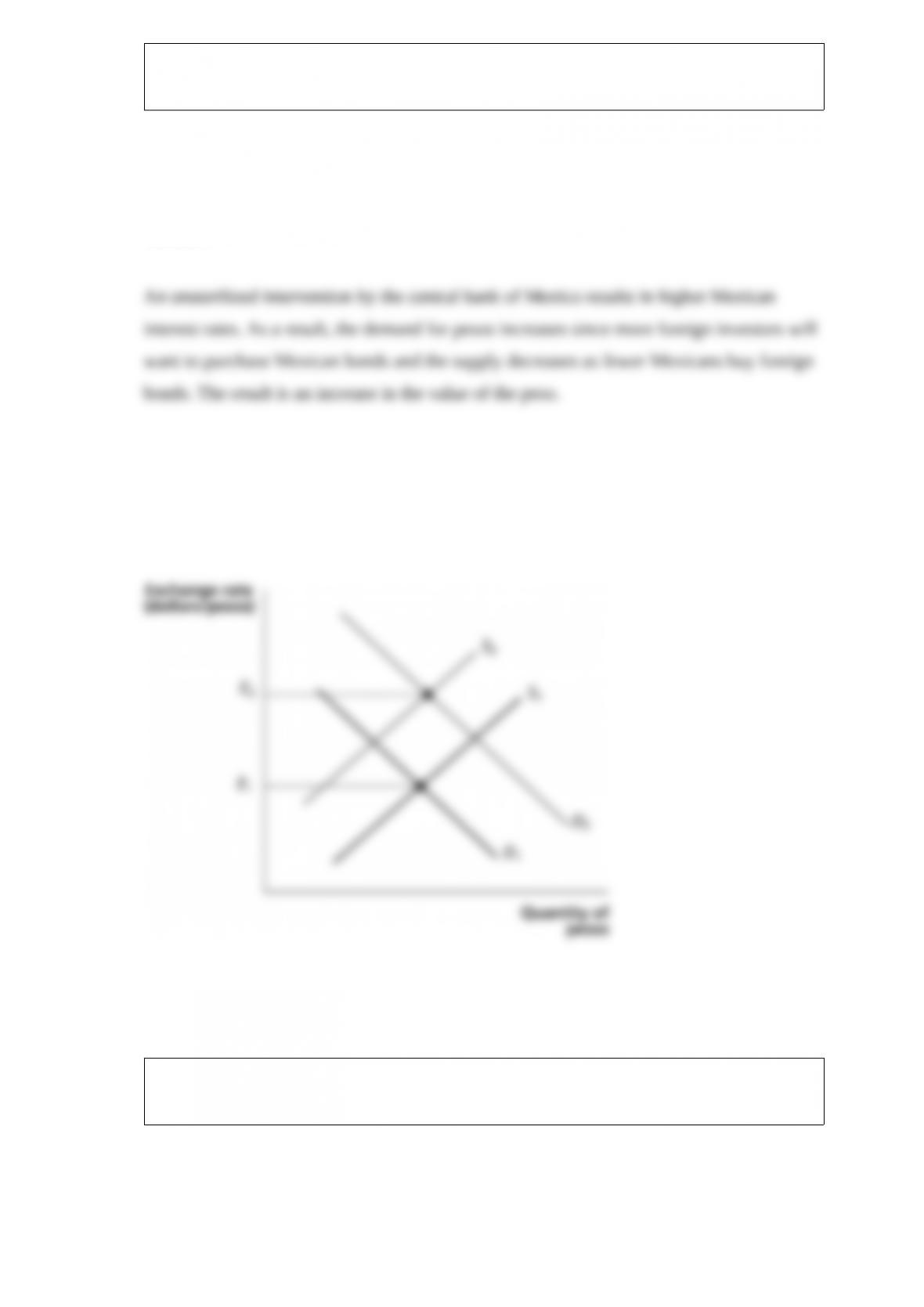
Mexico can use an unsterilized intervention to increase the value of its currency, the
peso, in terms of the dollar.
Answer:
What is quantitative easing? What was the Fed’s objective in implementing quantitative
easing?
Answer:
What are the likely effects of a sovereign debt crisis in terms of the government’s ability
to finance its debt?
Answer:
What new policy tools for controlling reserve balances did the Fed introduce during the
Financial Crisis of 2007-2009?
Answer:
Suppose you purchase a call option to buy IBM common stock at $35 per share in
September. The current price of IBM is 37 and the option premium is 4. What is the
intrinsic value of the option? As the expiration date on the option approaches, what will
happen to the size of the option premium?
Answer:
Explain what is meant by the “double taxation of dividends”?
Answer:
Why did some economists and policymakers criticize the Fed and Treasury for
arranging the sale of Bear Stearns to JP Morgan Chase in 2008?
Answer:
What type of economic research do analysts at investment banks conduct?
Answer:
Suppose that Ruritania has a fixed exchange rate versus the U.S. dollar. If foreign
investors become convinced that the Ruritanian currency is overvalued, what actions
might they take to profit from this conviction? Would these actions make it easier or
harder for Ruritania to maintain the value of its currency versus the dollar? Why?
Answer:
Explain how a bubble can develop in the market for an asset.
Answer:
If you think that there is a 75% chance of a stock increasing by 8% and a 25% change
of it falling by 20%, what is the expected return on the stock? Report using percentages
with two decimal places.
Answer:
What are three reasons that the interest-rate parity condition may not always hold?
Answer:
What are the primary reasons for and against a policy of “too big to fail.”
Answer:
What alternative to restrictions on capital inflows do some economists recommend to
minimize the possibility of increased lending booms and risk taking by domestic banks?
Answer:
During 2000, the government repurchased $30 billion in U.S. Treasury bonds
outstanding. This was the first time this had been done since the administration of
Herbert Hoover in the early 1930s. Analyze the impact of this repurchase on the bond
market.
Answer:
What is a black swan event?
Answer:
How did the federal funds rate compare to that suggested by Taylor’s rule following the
2001 recession and during the Financial Crisis of 2007-2009? How would proponents
of Taylor’s rule evaluate monetary policy in each period.
Answer: