
The seller of a futures contract
A) assumes the short position.
B) assumes the long position.
C) has the obligation to receive the underlying financial instrument at the specified
future date.
D) is expecting the price of the underlying financial instrument to rise.
Answer:
What percentage of bank assets were in security holdings in 2012?
A) 5%
B) 13%
C) 22%
D) 37%
Answer:
In 2012, the European Central Bank bought the debt of which nation?
A) the United States

B) France
C) Spain
D) Germany
Answer:
Many economists and policymakers have raised concerns about crowd funding due to
the existence of:
A) information costs facing small investors
B) information costs facing business start ups
C) transaction costs facing business start ups
D) increased competition for banks in funding business start ups
Answer:
Why was the Fed reluctant to rescue insolvent banks?
A) It thought it may lead to moral hazard.
B) It thought it may lead to adverse selection.

C) It thought they were still liquid.
D) It did not think they were insolvent.
Answer:
Which of the following is NOT a financial intermediary?
A) NASDAQ
B) Allstate Insurance Company
C) Bank of America
D) Vanguard Total Stock Market Index Fund
Answer:
The bond supply curve slopes up because
A) interest rates rise as bond prices rise.
B) when bond prices are high, inflation is high.
C) the lender is willing and able to offer more bonds when the price of the bond is low.
D) the borrower is willing and able to offer more bonds when the price of the bond is
high.

Answer:
Momentum investing can be described as
A) consistent with the efficient markets hypothesis.
B) similar to mean reversion.
C) follow the picks of investors who have been successful in the past.
D) the trend is your friend.
Answer:
Which of the following statements about ACH transactions is false?
A) They reduce the likelihood of missed payments.
B) They reduce transactions costs associated with check processing.
C) They reduce the costs that lenders incur in notifying customers of missed payments.
D) They typically involve digital cash.
Answer:

Which of the following statements is correct?
A) The discount rate is determined by market forces.
B) The Fed’s control over discount lending is more complete than its control over open
market operations.
C) Decisions by both banks and the Fed determine the volume of discount loans.
D) The discount rate is typically greater than other short-term market interest rates.
Answer:
Why has the IMF come in for widespread criticism for its handling of the Asian
financial crisis?
A) It refused to make loans to any of the countries whose currencies were under
speculative attack.
B) Its policies did not sufficiently punish speculators with losses, giving rise to moral
hazard.
C) Its policies led to unsustainably low interest rates in a number of Asian countries.
D) Its policies failed to lead to sufficient hardship for citizens in a number of Asian
countries, giving rise to moral hazard.
Answer:

Which groups were opposed to the Bank of the United States?
A) northeastern industrial interests
B) northeastern financial interests
C) southern and western agrarian and small-business interests
D) exporters
Answer:
Federal funds are
A) the tax revenues of the Federal government.
B) loans by the Federal Reserve to banks.
C) loans by banks to the Federal Reserve.
D) short-term loans between banks.
Answer:

The main reason central banks engage in foreign-exchange interventions is to
A) stabilize the domestic money supply.
B) stabilize domestic interest rates.
C) stabilize foreign interest rates.
D) stabilize the exchange rate.
Answer:
As of 2012, the bank portion of TARP:
A) earned a profit of $21 billion
B) earned a profit of $245 billion
C) cost $266 billion
D) cost $700 billion
Answer:
The FDIC was created inA) 1863B) 1913C) 1934D) 1991

Answer:
Diversification is most effective in reducing:
A) market risk
B) systemic risk
C) idiosyncratic risk
D) all forms of risk
Answer:
If you look at the financial page listings for futures contracts and find that futures prices
on Treasury bonds are falling over a particular time period, futures market investors
must expect that
A) Treasury bond prices will be higher in the future.
B) Treasury bond yields will be higher in the future.
C) Treasury bond yields will be lower in the future.
D) futures prices will rise again at the end of the period.

Answer:
If the interest rate on a U.S. one-year bond is 1%, the interest rate on a Mexican
one-year bond is 5%, and investors expect the dollar to appreciate by 1% versus the
peso, what is the currency premium for U.S. investors to hold Mexican pesos?
A) -3%
B) 3%
C) 4%
D) 7%
Answer:
Suppose that a small economy that had previously been closed becomes open. If its real
interest rate had previously been below the world real interest rate, we would expect
that
A) the country’s real interest rate would remain below the world level.
B) the country would become a net lender abroad.
C) the country would become a new borrower abroad.
D) the amount of loanable funds supplied in the country would decline.
Answer:

If a large open economy, like the United States, reduces its budget deficit, what impact
would this have on a small open economy?
A) higher savings
B) increased investment
C) increased net savings
D) no change in interest rates
Answer:
Which of the following is NOT true of restrictive covenants?
A) They sometimes require borrowers to maintain the value of collateral offered to the
lender.
B) They increase the marketability and liquidity of loans.
C) They sometimes require a borrower to maintain a certain minimum level of net
worth.
D) They sometimes limit a borrower’s risk taking.
Answer:

In 2012, the House of Representatives voted to have what type of audit of the Fed?
A) auditing of financial statements
B) auditing lending policy that took place during the financial crisis of 2007-2009
C) auditing of monetary policy decisions
D) auditing of personal finances of members of the Board of Governors
Answer:
Why didn’t the surge in the monetary base between 2008-2012 lead to a similar surge in
the money supply?
A) The currency-deposit ratio rose significantly, resulting in a much smaller money
multiplier.
B) The excess reserve-deposit ratio rose significantly, resulting in a much smaller
money multiplier.
C) The Fed increase the required reserve ratio, resulting in a much smaller money
multiplier.
D) Nonborrowed reserves declined, offsetting the increase in the monetary base.
Answer:

Productivity growth occurs when:
A) there are more inputs
B) firms can produce more output per unit of input
C) more output is produced
D) employees work extra hours
Answer:
One of the most important enforcement tools of the Consumer Finance Protection
Bureau is:
A) the threat of civil charges against those who violate the laws involving money
transfers, foreclosure and many other financial services
B) the ability to audit financial firms and institutions
C) the ability to initiate new regulations
D) the authority to impose criminal penalties
Answer:

In late 2012, President Obama proposed raising the top income tax rate. All of the
following are likely impacts of higher income tax rates on bonds EXCEPT:
A) higher interest rates on Treasury bonds
B) lower interest rates on Municipal bonds
C) increased demand for Municipal bonds
D) lower prices for Municipal bonds
Answer:
According to the efficient markets hypothesis,
A) the equilibrium price of an asset equals the optimal forecast of fundamental value
based on available information.
B) the actual and expected prices of an asset will be equal.
C) the actual price of an asset reflects only information on past returns on the asset.
D) the expected price of an asset incorporates only information on past returns on the
asset.
Answer:
Which of the following is the least likely take place if the Fed responds to a negative

demand shock by reducing the real interest rate?
A) IS shifts to the right
B) output gap returns to zero
C) inflation returns to its previous rate
D) MP shifts down
Answer:
If a central bank engages in an unsterilized foreign-exchange intervention with the
intention of raising the foreign-exchange value of its currency,
A) the central bank’s holdings of international reserves will fall.
B) the domestic money supply will rise.
C) domestic interest rates will fall.
D) it will buy foreign assets.
Answer:
A closed economy is one that
A) has no government sector.

B) neither borrows from nor lends to foreign countries.
C) produces mainly agricultural goods.
D) produces mainly manufactured goods.
Answer:
Securitization refers to
A) changing the mix in a financial portfolio away from stocks and toward bonds.
B) selling directly to investors loans or securities that were formerly held by financial
intermediaries.
C) banks insisting that collateral be supplied on previously unsecured loans.
D) reducing the exposure of a bank’s portfolio to interest rate risk.
Answer:
How do ratings agencies earn income?
Answer:
Which aspects of a bank’s operations are evaluated as part of the CAMELS rating
system?
Answer:
Suppose you are risk loving and you are deciding between two investments. One has a
guaranteed return of 5% while the second has a 50% chance of a 10% return and a 50%
chance of a 0% return. Which investment would you choose? Why?
Answer:
Discuss the problems associated with the imposition of capital controls.
Answer:
Describe the debt-deflation process.
Answer:
Suppose the required reserve ratio is 10%, excess-to-deposit ratio is 10%, and the
currency-to-deposit ratio is 20%. If the Fed buys $50 million worth of securities, what
will happen to the money supply?
Answer:
How does adverse selection affect the economic efficiency of the used car market?
Answer:
What is a matched sale-purchase transaction (also known as a reverse repo)?
Answer:
Suppose you are considering buying shares of a stock to hold for one year. The stock
has an expected annual dividend of $2 and an expected price at the end of the year of
$25. If your required rate of return is 10%, what is the most that you should be willing
to pay for the stock? Round off to the nearest cent.
Answer:
The American Civil War lasted from the spring of 1861 to the spring of 1865. During
the war the Confederate government issued substantial amounts of fiat paper currency.
What do you think happened to the price level (measured in Confederate dollars) in the
Confederate states during the final months of the war?
Answer:
What does it mean to “cover a short”?
Answer:
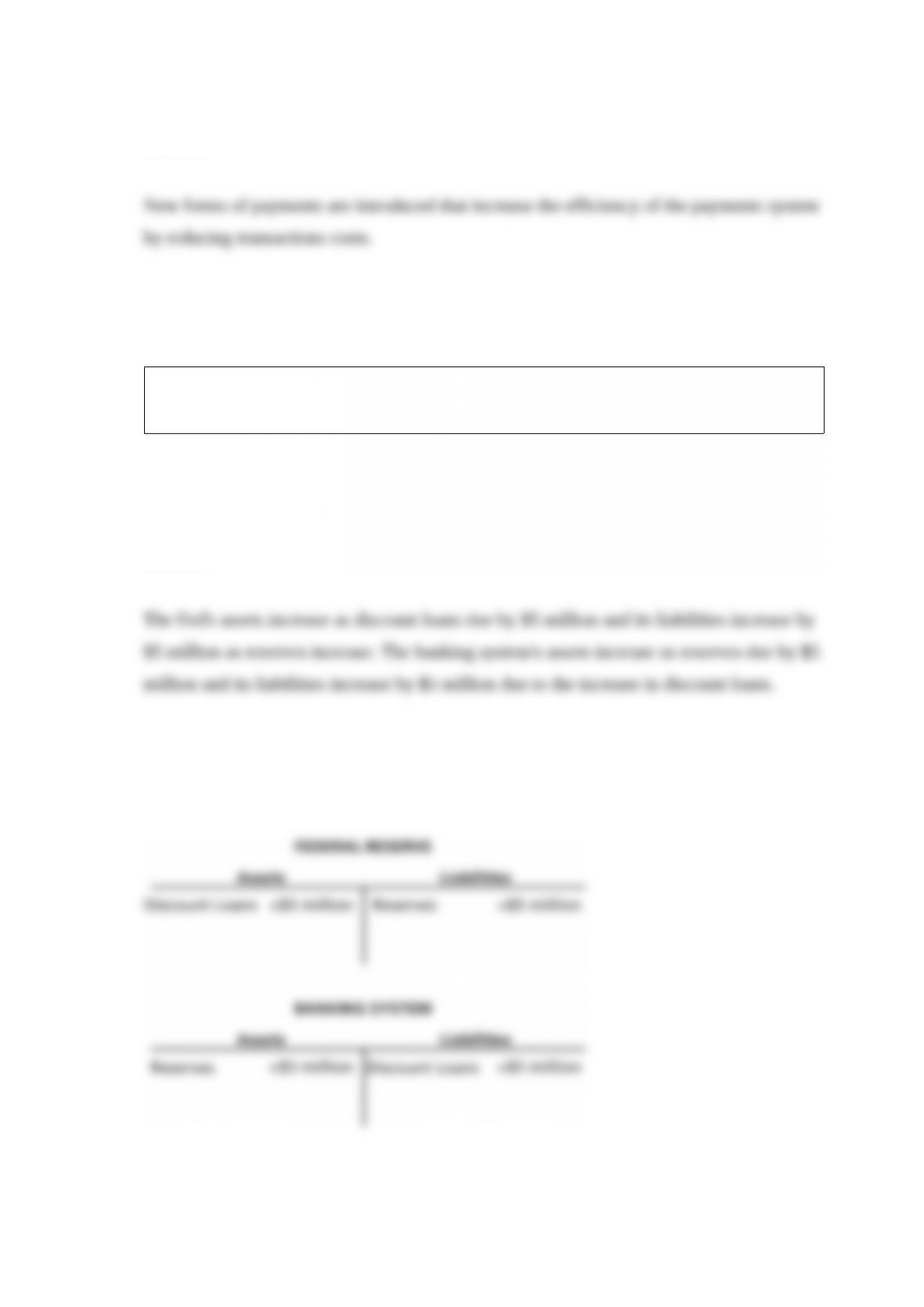
Why does the payments system continue to change over time?
Answer:
Suppose the Fed makes a $5 million discount loan to a bank. Illustrate how this affects
the balance sheets of the Fed and the banking system.
Answer:

According to New Keynesians, why can firms increase output in the short run in
response to higher prices?
Answer:
What are some reasons that hedge funds have become controversial?
Answer:
A one-year discount bond has a face value of $1000 and price of $880. What is the yield
to maturity on the bond? Report using percentages with two decimal places.
Answer:
Why do futures have lower information costs and higher liquidity than forward
contracts?
Answer: