
Since crowd funding sites do not themselves invest in business start ups that raise funds
on their sites, they don’t reduce:
A) the principal-agent problem
B) information costs
C) transaction costs
D) asymmetric information
Answer:
If a corporation pays a dividend, which group receives priority in receiving the
dividend?
A) bond holders
B) holders of common stock
C) holders of preferred stock
D) dividends are evenly divided by holders of common and preferred stock
Answer:
A key reason that firms and financial institutions might participate in an interest rate
swap is

A) to transfer interest rate risk to parties that are more willing to bear it.
B) the low information costs of swaps compared with other derivative contracts.
C) the greater liquidity of swaps compared with other derivative contracts.
D) the favorable tax implications of swaps compared with other derivative contracts.
Answer:
Who had served as a de facto lender of last resort during the 1907 panic?
A) The U.S. Treasury
B) J. P. Morgan
C) Henry Ford
D) John D. Rockefeller
Answer:
As wealth increases in the economy, savers are willing to
A) hold more cash relative to their holdings of bonds.
B) buy fewer bonds at any given price.

C) buy more bonds at any given price.
D) lend less at any given interest rate.
Answer:
When bank loan officers screen loan applicants to eliminate potentially bad risks, they
are attempting to mitigate the problem of
A) adverse selection.
B) moral hazard.
C) interest rate risk.
D) illiquidity.
Answer:
Who sets the inflation target for the Bank of England?
A) Prime Minister
B) Chancellor of the Exchequor
C) head of the monetary policy committee

D) majority vote of the monetary policy committee
Answer:
The facts show that the political business cycle theory
A) does a good job of explaining monetary policy during presidential election years.
B) is unable to explain monetary policy during presidential election years.
C) doesn’t generally support the political business cycle theory.
D) explains monetary policy best during years in which the President is running for
reelection.
Answer:
If a bank has a leverage ratio of 0.1 and a return on capital of 2%, what is its return on
equity?
A) 0.2%
B) 2.1%
C) 5%
D) 20%

Answer:
In quantity theory terms, during a hyperinflation,
A) money supply increases rapidly, but velocity does not
B) velocity increases rapidly, but money supply does not
C) both the money supply and velocity increase rapidly
D) neither the money supply nor velocity increase rapidly
Answer:
Suppose $100 buys less in the year 2013 than in 2000. Then we can say that
A) money’s store of value has decreased.
B) money’s store of value has increased.
C) the economy must have been growing rapidly between 2000 and 2013.
D) the economy must have been growing slowly between 2000 and 2013.
Answer:

Which of the following statements concerning stabilization policy is correct?
A) Increasing government spending during an economic boom would be an example of
a stabilization policy.
B) Increasing taxes during a recession would be an example of a stabilization policy.
C) New Keynesian economists are skeptical of the value of stabilization policies.
D) Increasing the money supply during a recession is an example of a stabilization
policy.
Answer:
If the government were to simultaneously cut the personal income tax and the corporate
profits tax, the equilibrium interest rate
A) would fall.
B) would rise.
C) would be unaffected.
D) might either rise or fall.
Answer:

If the Fed purchases $1 million worth of securities and the required reserve ratio is 8%,
by how much will deposits increase (assuming no change in excess reserves or the
public’s currency holdings)?
A) rise by $1 million
B) decline by $1 million
C) rise by $8 million
D) rise by $12.5 million
Answer:
Which of the following statements about the supply of dollars in the foreign exchange
market is true?
A) It is equal to the money supply.
B) It represents the demand for U.S. goods and financial assets by firms and households
outside the United States.
C) It represents the supply of U.S. goods and financial assets by firms and households
within the United States.
D) It is determined by the willingness of households and firms that own dollars to
exchange them for foreign currency.
Answer:

All of the following are examples of risky mortgages that became more common in the
2000s EXCEPT
A) alt-A mortgages.
B) adjustable-rate mortgages with low rates for a few years and then higher rates in
later years.
C) mortgages requiring down payments of at least 20%.
D) subprime mortgages.
Answer:
The problem of a double coincidence of wants refers to
A) the insatiability of wants in a free market economy.
B) poorly-managed companies producing what consumers want only by coincidence.
C) the necessity in a barter system of each trading partner wanting what the other has to
trade.
D) the likelihood that needs will not be the same as wants.
Answer:

Who benefits from rising inflation?
A) those who already have fixed-rate loans
B) those considering taking out a loan
C) lenders that already made loans
D) lenders considering whether to make new loans
Answer:
Under the liquidity premium theory, a flat yield curve indicates that investors expect
future short-term rates to
A) fall.
B) rise.
C) remain constant.
D) either fall or remain constant.
Answer:
Borrowers who stated but did not document their incomes are referred to as:

A) subprime
B) alt A
C) adjustable
D) securitized
Answer:
In the late 2000s, which source of funds for corporations grew the most?
A) net new stock issues
B) net new bond issues
C) net new loans
D) net new commercial paper
Answer:
Consider an open economy that is a net borrower (like the United States). What would
be the impact of a shift to a closed economy?
A) domestic interest rates would decline

B) domestic savings would decline
C) domestic investment would decline
D) net borrowing would increase
Answer:
Which of the following statements about junk bonds is false?
A) Given the likelihood of default, it is never profitable to purchase junk bonds.
B) They pay higher interest rates than investment grade bonds due to higher perceived
risk.
C) Prior to the 1970s, corporations were unable to issue junk bonds.
D) A popular measure of junk bond yields reached a record low in 2012.
Answer:
What was the name of the plan, enacted in 2011, in which the Fed bought $400 billion
worth of long-term securities while selling $400 billion worth of short-term securities?
A) Operation Go Long
B) Operation Twist

C) QE2
D) QE3
Answer:
Countries in which region experienced disruptive capital flows in 1997-98?
A) Eastern Europe
B) Western Europe
C) Latin America
D) East Asia
Answer:
Money is a medium of exchange in that
A) money is generally accepted for buying and selling goods and services.
B) currency may be exchanged for gold at any national bank.
C) other assets may be better or worse in facilitating exchange than money.
D) it must maintain most of its value over time.

Answer:
If a member of the Board of Governors is limited to one 14-year term, how did Alan
Greenspan serve 19 years on the Board of Governors?
A) A special exemption was approved for him.
B) The rule was not in place at the time.
C) He completed the remaining years left on someone else’s term and then served one
14-year term.
D) He didn’t serve consecutive terms.
Answer:
According to the Fisher effect, an increase in expected inflation results in:
A) lower nominal interest rates
B) higher nominal interest rates
C) lower real interest rates
D) higher real interest rates

Answer:
Which of the following has the largest impact on short-run movements in exchange
rates?
A) growth rate of exports
B) growth rate of imports
C) investment opportunities
D) changes in the trade deficit
Answer:
What is the most direct method the Fed uses to change the monetary base?
A) open market operations
B) changing the required reserve ratio
C) changing the federal funds rate
D) changing the level of discount loans
Answer:

The information lag facing the Fed is
A) the difficulty of becoming informed quickly of changes in public opinion about
which policy goal is most important.
B) the delay in receiving accurate information about the state of the economy.
C) the delay in Congress and the President communicating their policy goals for the
Fed to act on.
D) the time required for monetary policy changes to affect output, employment, and
prices.
Answer:
Reserve requirements are set by
A) the Secretary of Treasury.
B) the President.
C) Congress.
D) the Fed.
Answer:
Vesting refers to
A) the right of the holder of an insurance policy to collect for an insurable event.
B) the shielding of returns on whole life policies from taxation.
C) the length of service required of an employee before he or she is eligible for a
pension.
D) the payments made by an employee into a pension plan.
Answer:
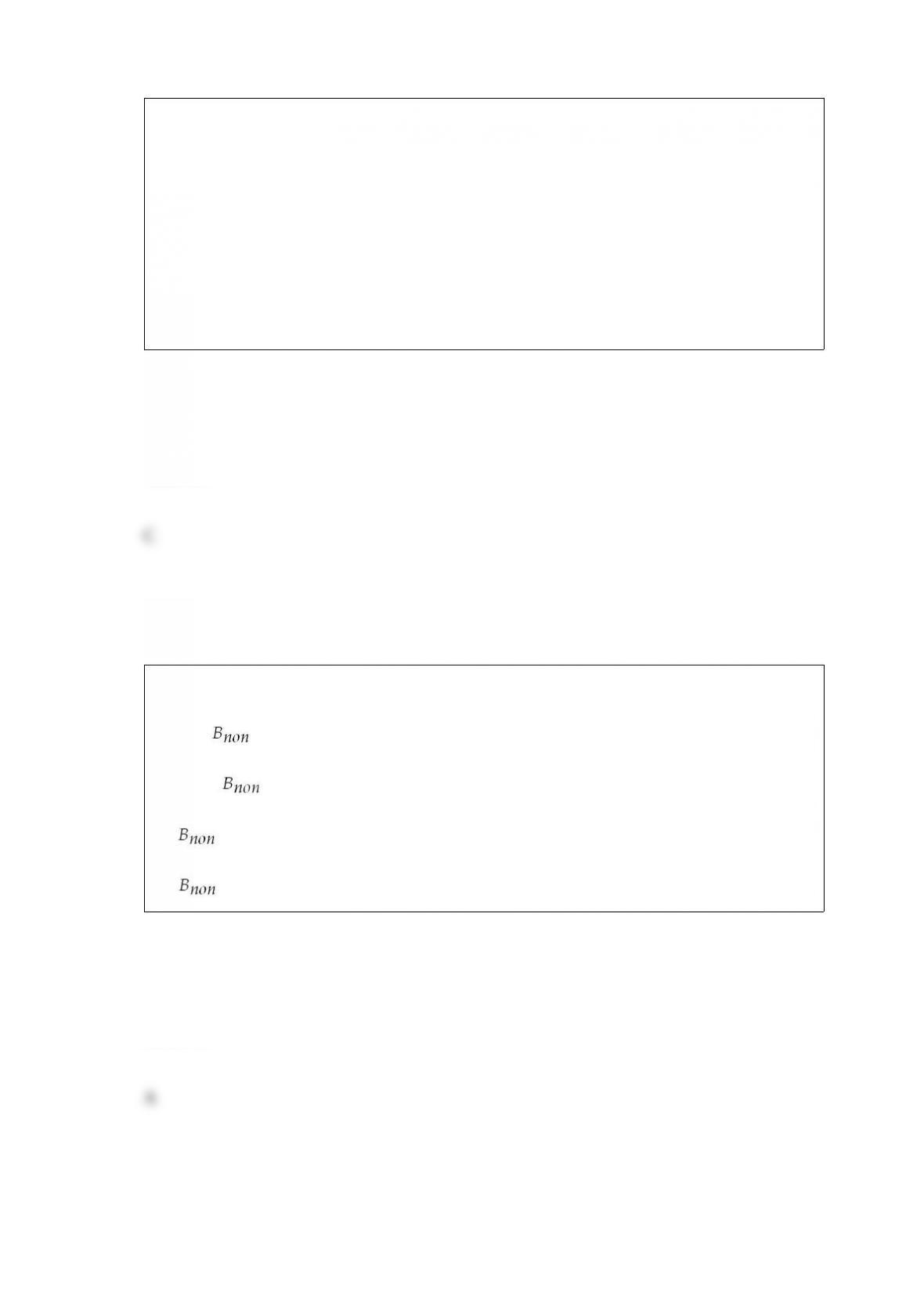
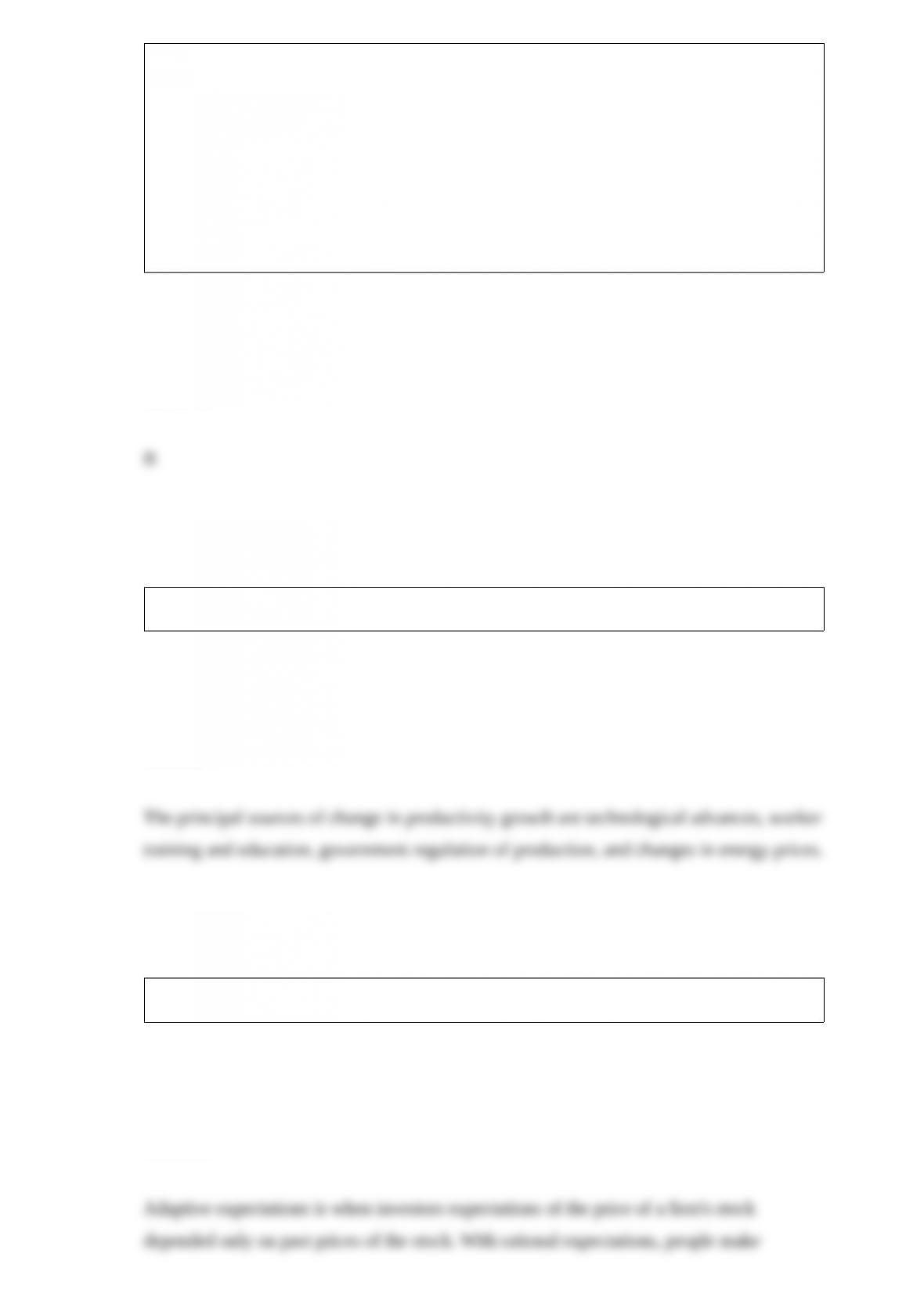
Which of the following expressions is correct?
A) B = + BR
B) BR = + B
C) = B + BR
D) = -BR – B
Answer:
An open market purchase
A) decreases the price of Treasury securities and also decreases their yield.
B) increases the price of Treasury securities and decreases their yield.
C) increases the price of Treasury securities and also increases their yield.
D) decreases the price of Treasury securities and increases their yield.
Answer:
What are the principal sources of change in productivity growth?
Answer:
What is the difference between adaptive expectations and rational expectations?
Answer:
What are the different forms of bank borrowings?
Answer:
Briefly describe how the Bretton Woods system worked. What advantages did it have
over the gold standard? What problems did the Bretton Woods system eventually
encounter?
Answer:
Suppose you had $1000 and were deciding between two investments. One pays 5% a
year for two years while the other pays 8% the first year and 2% the second year. Which
investment would provide a higher return?
Answer:
How do new Keynesians use menu costs to help explain price stickiness in the short
run?
Answer:
Describe two useful purposes served by speculators in derivatives markets.
Answer:
Suppose a bond has a coupon of $40, face value of $1000, and current price of $950.
What is the coupon rate? What is its current yield? Report a percentage with two
decimal places.
Answer:
What are the steps involved in using options for a short sale of a stock?
Answer:
How should a financial plan of an older saver differ from that of a younger saver?
Answer:
What information is typically included in a prospectus?
Answer:
A one-year bond has an interest rate of 3% and is expected to fall to 5% next year and
2% in two years. The term premium for a two-year bond is 0.3% and for a three-year
bond is 0.5%. What are the interest rates on a two-year bond and three-year bond
according to the liquidity premium theory?
Answer:
How do high interest rates increase the risk of adverse selection in the bond market?
Answer:
According to the Taylor rule, what should the federal funds rate target be if inflation is
5%, the target rate of inflation is 2%, the equilibrium real federal funds rate is 2%,
full-employment real GDP is $9 trillion, and current real GDP is $8.55 trillion?
Answer:
Suppose 3M pays a dividend of $2 per share which the investor is expected to receive
immediately. The dividend is expected to grow by 5% per year and the investor has a
required rate of return of 8%. What should be the current price of the stock according to
the Gordon-Growth model?
Answer:
What is normally the ultimate cause of hyperinflation?
Answer: