
The sensitivity of bank capital to market interest rates is measured by
A) gap analysis.
B) duration analysis.
C) leverage ratio.
D) capital analysis.
Answer:
If a nation’s current account is -$200 billion and its financial account (excluding its
official settlements balance) is $175 billion, how much is its official settlements
balance?
A) -$25 billion
B) +$25 billion
C) -$375 billion
D) +$ 375 billion
Answer:
If a government’s income tax receipts exceed its expenditures, the government is
running a

A) surplus and is a net borrower of funds.
B) surplus and is a net saver of funds.
C) deficit and is a net borrower of funds.
D) deficit and is a net saver of funds.
Answer:
In the late 2000s, the primary source of external funds for corporations was
A) commercial paper.
B) loans.
C) bonds.
D) stocks.
Answer:
If the Fed buys $2 billion of short-term securities issued by the government of Japan
and pays for them by writing a check for $2 billion,
A) its assets will rise by $2 billion and the monetary base will rise by $2 billion.

B) its assets will fall by $2 billion and the monetary base will fall by $2 billion.
C) its assets will rise by $2 billion and the monetary base will fall by $2 billion.
D) its assets will fall by $2 billion and the monetary base will rise by $2 billion.
Answer:
A cash item in the process of collection is
A) a U.S. Treasury bill that has matured, but for which the bank has not yet received
payment.
B) a car loan payment that is due but not yet received by the bank.
C) a check drawn against another bank, from whom the funds have not yet been
collected.
D) currency that has been deposited in the bank, but not yet formally counted and
entered into the bank’s balance sheet.
Answer:
Noise traders involves investors who
A) overreact to good and bad news.
B) strictly follow the efficient markets hypothesis.

C) filter out the noise involved in following their stocks.
D) ignore new information about stocks.
Answer:
How did the global savings glut in the 2000s affect the U.S. current account balance?
A) It caused it to decline by increasing the value of the dollar.
B) It caused it to decline by reducing the value of the dollar.
C) It caused it to increase by increasing the value of the dollar.
D) It caused it to increase by reducing the value of the dollar.
Answer:
Which type of investor is most likely to have a diversified portfolio?
A) risk averse
B) risk loving
C) risk neutral
D) risk tolerant

Answer:
Which of the following helps explain why depositors sometimes put their funds in
demand deposits rather than NOW accounts?
A) Demand deposits pay interest, whereas NOW accounts do not pay interest.
B) Businesses may not hold NOW accounts.
C) Checks may be written against demand deposits, but not against NOW accounts.
D) Demand deposits are more liquid than NOW accounts.
Answer:
Which of the following is NOT a primary center of foreign-exchange trading?
A) New York
B) London
C) Munich
D) Tokyo
Answer:

The daily turnover in the foreign exchange market is:
A) millions of dollars.
B) billions of dollars.
C) trillions of dollars.
D) declining in the last decade.
Answer:
Excess reserves equal
A) total reserves less required reserves.
B) required reserves less total reserves.
C) total reserves plus required reserves.
D) required reserves divided by total reserves.
Answer:

The aggregate M1 consists of
A) currency plus all deposits in financial institutions.
B) currency plus all deposits in all institutions.
C) currency plus checkable deposits in financial institutions.
D) currency plus all checkable deposits.
Answer:
The efficient markets hypothesis
A) assumes that market participants form their expectations adaptively.
B) applies rational expectations to the pricing of assets.
C) applies to the stock market, but not to the bond market.
D) indicates that the stock market is efficient, but not rational.
Answer:
Which of the following is NOT true of the foreign-exchange market?

A) It is an over-the-counter market.
B) Most foreign-exchange trading takes place in London.
C) The busiest trading time is morning east coast time, when markets in New York and
London are both open.
D) Trading volume worldwide exceeds $1 trillion per day.
Answer:
Options traded on exchanges are known as:
A) listed options
B) exchange traded options
C) call options
D) put options
Answer:
Which of the following represented the largest liability on the balance sheet of U.S.
commercial banks in 2012?
A) checkable deposits

B) loans
C) nontransaction deposits
D) borrowings
Answer:
If the price of a futures contract increases, then
A) the exchange will collect the amount of the increase from the seller of the contract
and transfer it to the account of the buyer of the contract.
B) the exchange will collect the amount of the increase from the buyer of the contract
and transfer it to the account of the seller of the contract.
C) the exchange will collect the amount of the increase from both the buyer and the
seller and place it in escrow until the delivery date.
D) the additional funds will be required from either the buyer or the seller until the
delivery date.
Answer:
Suppose that your marginal federal income tax rate is 30%, the sum of your marginal
state and local tax rates is 5%, and the yield on a thirty-year corporate bond is 10%. You
would be indifferent between buying this corporate bond and buying a thirty-year
municipal bond issued within your state (ignoring differences in liquidity, risk, and

costs of information) if the municipal bond has a yield of
A) 6.5%.
B) 7.0%.
C) 9.5%.
D) 10.0%.
Answer:
Spot transactions
A) involve immediate settlement.
B) may only take place in face-to-face trading.
C) take place on-the-spot, rather than on an organized exchange.
D) are relatively unimportant in financial markets.
Answer:
Most economists believe that the aggregate supply curve is
A) upward-sloping in the short run, but vertical in the long run.

B) upward-sloping in the long run, but vertical in the short run.
C) upward-sloping in both the short run and in the long run.
D) vertical in both the short run and in the long run.
Answer:
Businesses hold substantial balances in demand deposits for all of the following reasons
EXCEPT:
A) they cannot hold NOW accounts
B) the existence of low transaction costs
C) to maintain liquidity
D) relatively high interest rates
Answer:
Which of the following agencies has established standardized accounting principles for
reporting corporate earnings?
A) The Securities and Exchange Commission
B) The Federal Trade Commission

C) The National Accounting Board
D) The Fair Reporting Commission
Answer:
If the current price of a bond is less than its face value,
A) an investor will receive a capital gain by holding the bond until maturity.
B) the yield to maturity must be less than the current yield.
C) the coupon rate must be greater than the current yield.
D) the coupon rate must be equal to the current yield.
Answer:
When economists say consumers, firms, or investors are behaving rationally, they
mean:
A) they recognize that it is not worthwhile to invest in risky stocks
B) they are taking actions to reach their goals, given the available information
C) they have significant investment expertise
D) they are consistently able to avoid poor performing stocks

Answer:
If the central bank buys foreign assets,
A) the domestic monetary base will decline.
B) domestic short-term interest rates will decline.
C) the foreign-exchange value of the domestic currency will rise.
D) its holdings of international reserves will rise.
Answer:
When a country’s real exchange rate depreciates,
A) its nominal exchange rate must have appreciated.
B) its nominal exchange rate must also have depreciated.
C) it can trade its goods for fewer units of foreign goods.
D) it can trade its goods for more units of foreign goods.
Answer:

Symmetric information
A) is the same as perfect information.
B) holds under the assumption of rational expectations.
C) is true only in efficient markets.
D) means that savers and borrowers have the same information.
Answer:
The efficient markets hypothesis predicts that an investor
A) will not be able consistently to earn above-normal profits from buying or selling
stocks.
B) will be able consistently to earn above-normal profits from buying or selling stocks
so long as he or she makes use of rational expectations.
C) will be able consistently to earn above-normal profits from buying or selling stocks
so long as he makes use of adaptive expectations.
D) will be able consistently to earn above-normal profits so long as stock prices in
general are rising.
Answer:

A one-year discount bond with a face value of $1000 has an interest rate of 4%. What is
its price?
A) $960
B) $961.54
C) $996
D) $1,040
Answer:
Intermediate targets are
A) interim goals set on the way to fully achieving policy goals.
B) targets for policy goals that are of secondary importance.
C) targets the Fed hopes to achieve by June of each year.
D) financial variables, such as interest rates or monetary aggregates, the Fed believes
will help it to achieve policy goals.
Answer:

Who are the members of the Financial Stability Oversight Council?
Answer:
How does adverse selection affect the willingness of corporations to issue stock?
Answer:
Suppose that the one-year Treasury bill rate in the United States is 6%, the one-year
government bond rate in Canada is 4%, and investors expect the U.S. dollar to
depreciate against the Canadian dollar by 4% over the coming year. Is the nominal
interest rate parity condition violated?
Answer:

What was the original intent of the Federal Reserve Act of 1913?
Answer:
How can diversification reduce idiosyncratic risk but not systematic risk?
Answer:
Which types of unemployment still occur even when the economy is considered to be
operating at full employment?
Answer:

How are financial intermediaries able to reduce transactions costs?
Answer:
What are the economic implications of an inverted yield curve?
Answer:
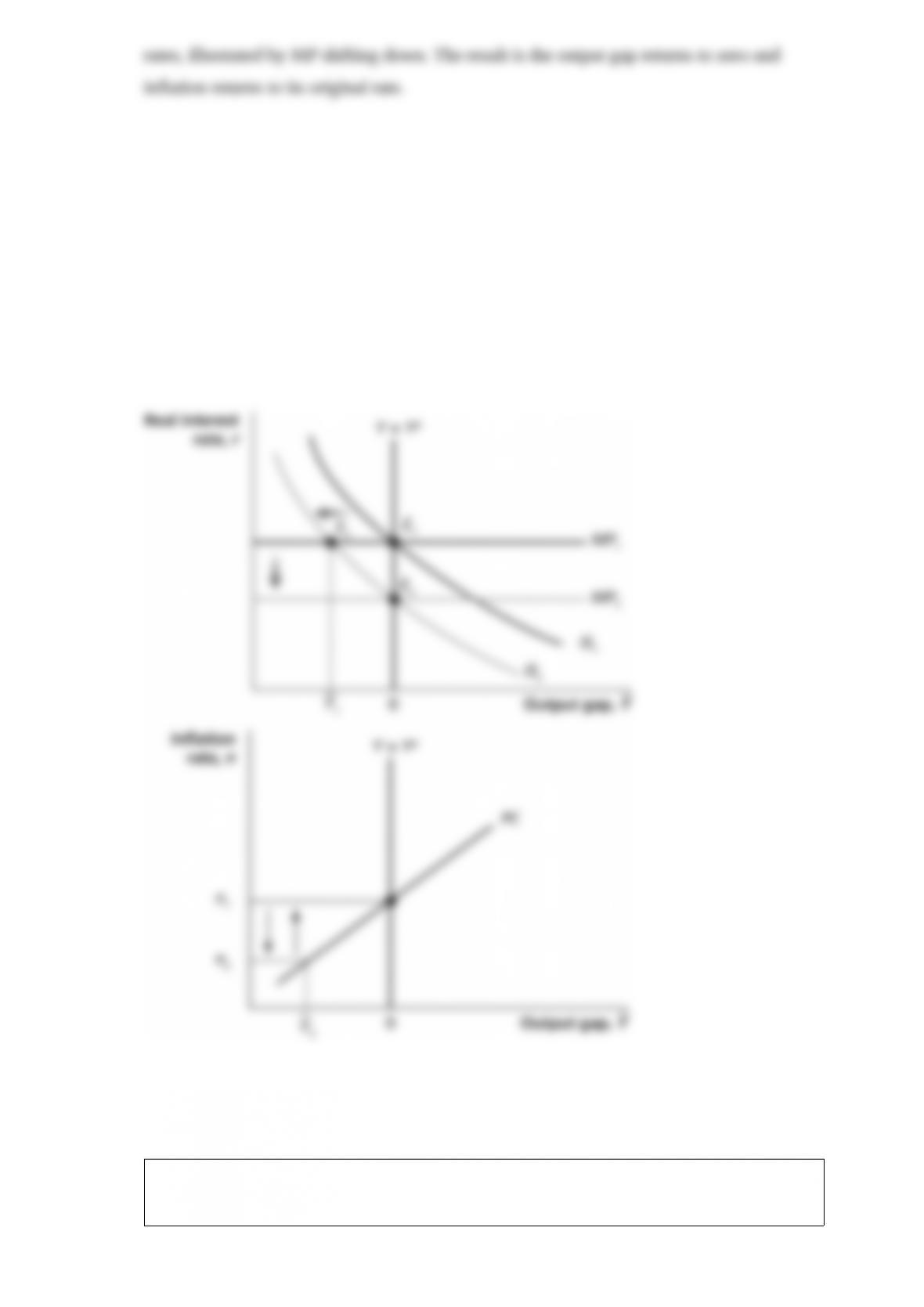
Suppose the stock market crashes resulting in a significant decline in the wealth of
consumers. Make use of the IS-MP model to illustrate the impact this has on the
economy. How is the Fed likely to respond? Show the impact of the change in monetary
policy on the graph of the IS-MP model.
Answer:
Shouldn’t better informed investors be able to profit from the deviations from pricing
efficiency caused by noise traders?
Answer:
Suppose a Nintendo Wii has a price of 24,000 yen in Japan and the yen-dollar exchange
rate changes from 80 yen to the dollar to 100 yen to the dollar? What happens to the
price of the Wii measured in dollars?
Answer:
What are the various ways that financial intermediaries can take advantage of
economies of scale?
Answer:
What are the limitations to the Fed’s independence?
Answer:
What is the multiplier effect?
Answer:
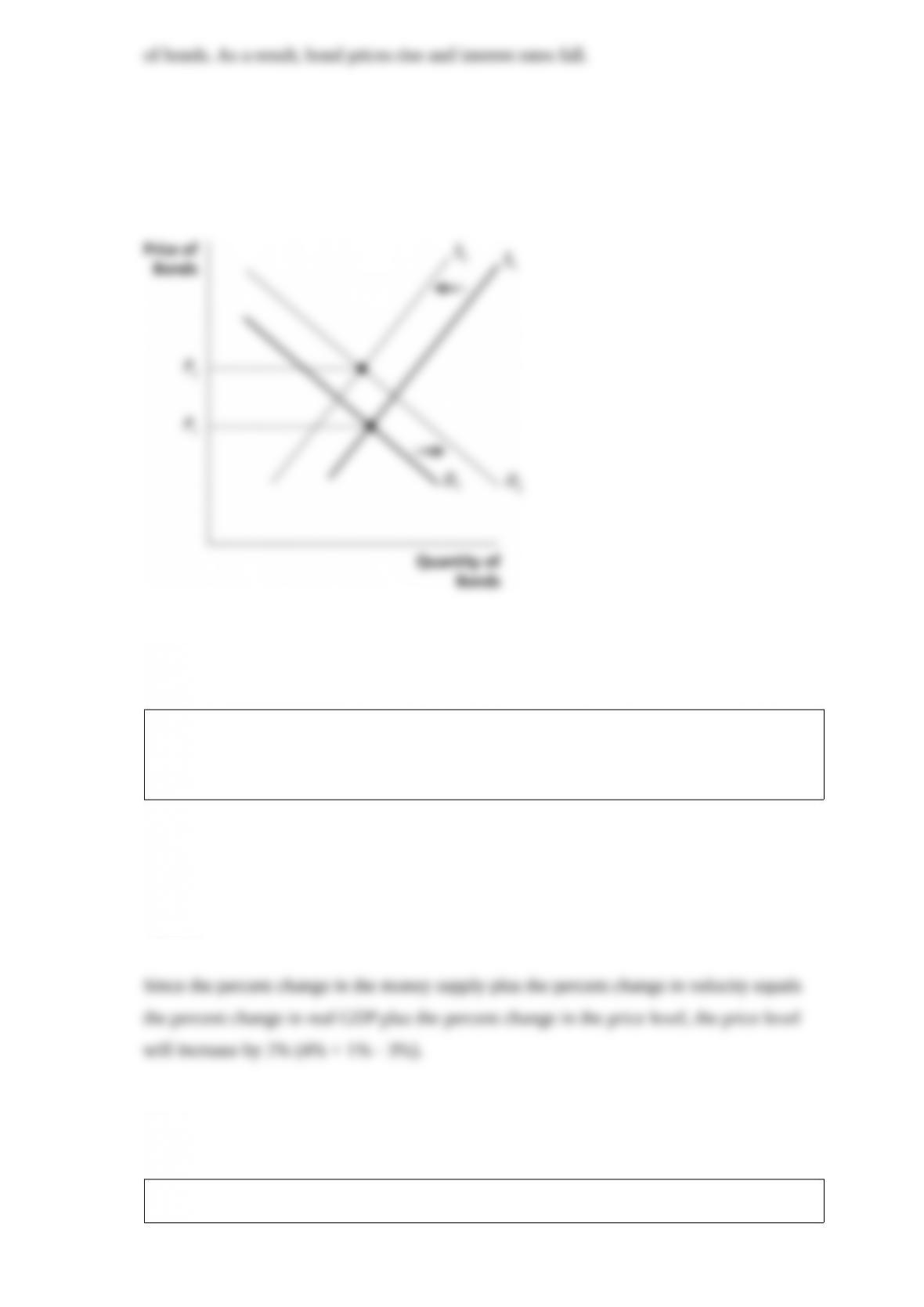
In late 2008 and early 2009, many feared that the economy may experience deflation.
Make use of a graph of the bond market to show how this affected interest rates.
Answer:
Make use of the quantity equation to answer the following problem. If the Fed increases
the money supply by 4%, velocity increases by 1%, and economic growth is 3%, by
how much will the price level increase?
Answer:
Why would people outside the United States choose to hold dollars?

Answer:
Describe the three ways that banks normally earn revenue.
Answer:
Briefly describe the process of microlending.
Answer: